I Hate My Period. I Hate Not Having It More
Living with PCOS — now PMOS — in a healthcare system that still sees women through fertility.
I Hate My Period. I Hate Not Having It More
Living with PCOS — now PMOS — in a healthcare system that still sees women through fertility.
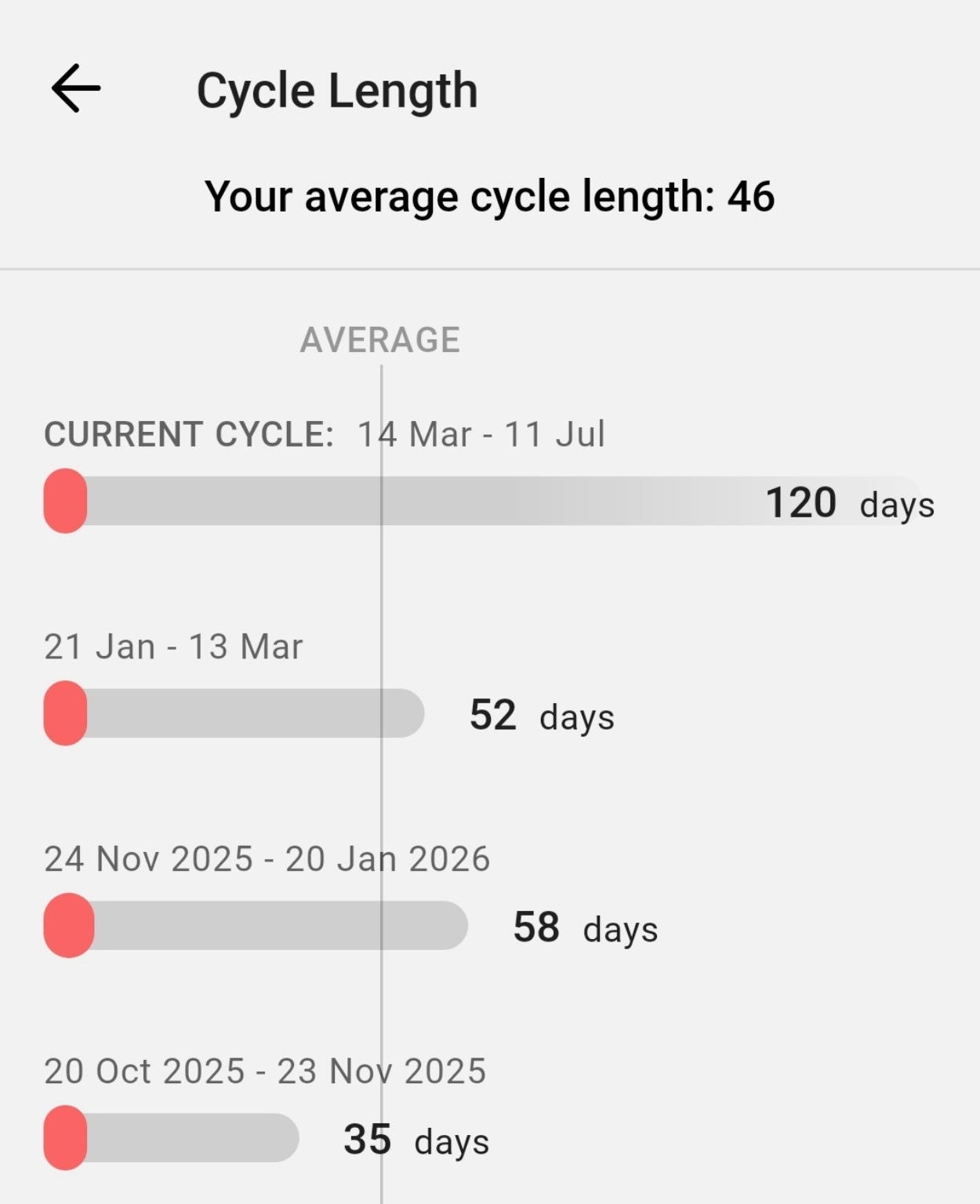
My current cycle reached 120 days, more than twice the length of my previous two. Personal cycle data shown in Flo® Period Tracker. Screenshot captured by the author; app interface © 2026 Flo Health. All rights reserved.
My period tracker says I am on day 120 of my cycle.
Above that, its tells me my average cycle length is 46 days, as though this is useful information. The grey bar representing my current cycle stretches far beyond all the others. At this point, it looks less like a menstrual cycle and more like the app has given up waiting with me.
I hate being on my period.
Mine can be long, painful and accompanied by cramps bad enough to make the rest of the day feel irrelevant. I do not enjoy bleeding. I do not look forward to it. I have never understood the idea that periods should make someone feel especially connected to their femininity or body.
And yet, I hate not having my period even more.
Because a missing period does not feel like nothing.
It feels like waiting.
No period is not the same as no symptoms
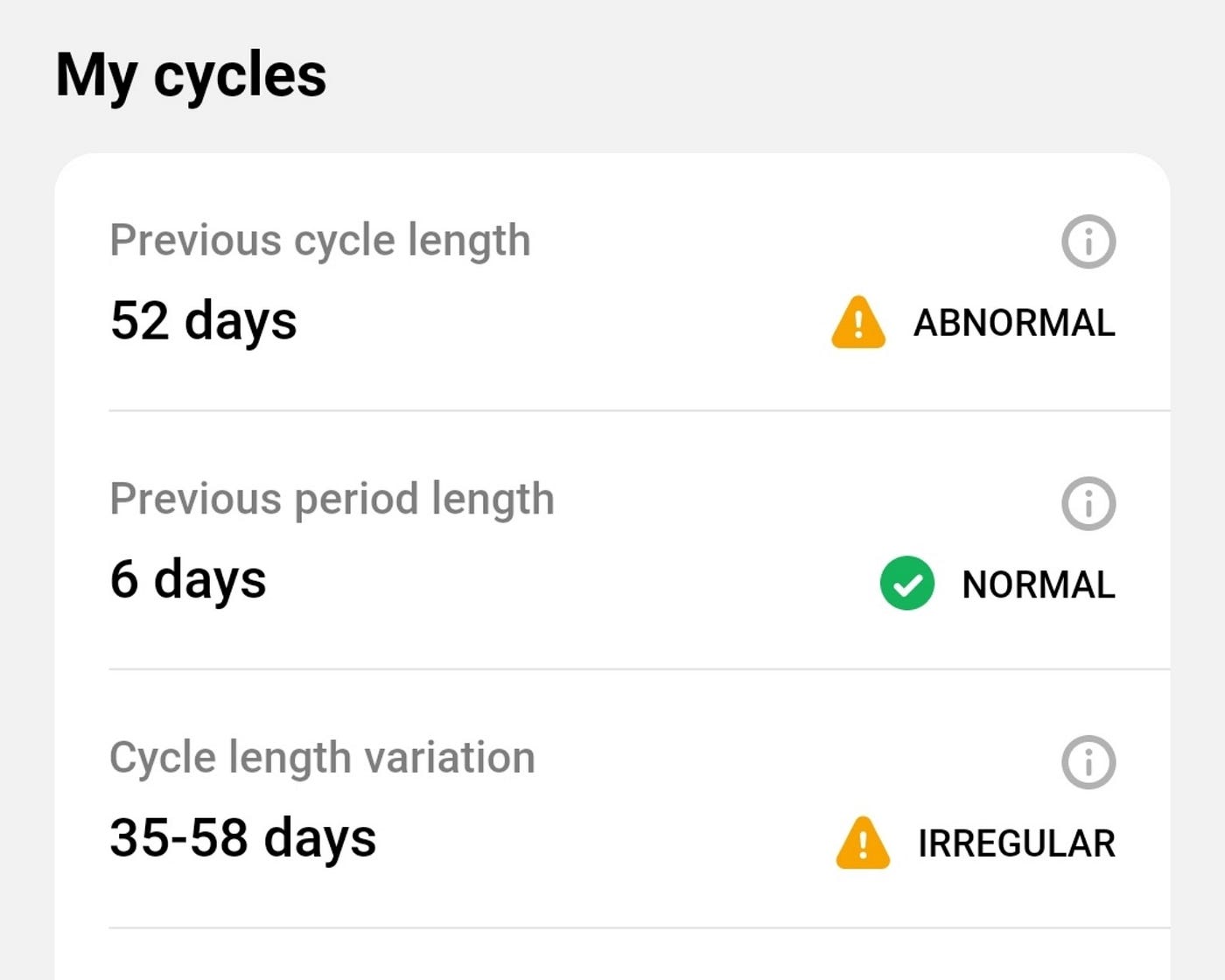
My previous cycle lasted 52 days, while my recent cycle lengths ranged from 35 to 58 days. Personal cycle data shown in Flo® Period Tracker. Screenshot captured by the author; app interface © 2026 Flo Health. All rights reserved.
There is an assumption that not having a period must be a relief.
No blood. No cramps. No inconvenience. A temporary escape from something most of us spend years complaining about.
But my body does not simply pause until my period eventually arrives.
Sometimes, I get what feels like PMS for days or weeks. I become bloated and nauseous. My breasts feel tender. I feel more anxious, emotional and physically uncomfortable. My body repeatedly announces that something is about to happen, but it refuses to tell me when.
I can spend several days convinced that my period must be coming.
Then nothing happens.
The symptoms fade and I am left wondering whether I imagined the whole thing. Or they continue, stretching what should have been a brief premenstrual phase into an unknown period of feeling as though my body is having a meltdown.
There is no countdown. No reliable pattern. I do not know whether the discomfort will last another two days or another two weeks.
Strangely, feeling no symptoms is not particularly reassuring either. At least the bloating and tenderness create the illusion that my period might be close. When I feel completely normal, I begin to wonder whether it is coming at all
I am either interpreting every sensation or worrying about the absence of one.
Pregnancy paranoia does not care about logic
Then there is pregnancy anxiety.
It can be astonishingly intense, even when I know pregnancy is not a realistic explanation.
I do not have to have had sex at a relevant point in my cycle. Sometimes I barely need to have had sex at all. The moment my period is late enough, a small part of my mind starts whispering:
What if?
I know I have PCOS. I know irregular and missed periods are part of it. I can understand the dates, the likelihood and the biology. None of that always stops the feeling.
Pregnancy paranoia does not care about logic. It sees an absent period and begins writing its own story.
Most people can eventually use their next period as reassurance. Mine is not reliable enough to offer that. Even when I know I am not pregnant, the absence itself keeps the possibility emotionally alive far longer than it deserves to be.
It becomes one more consequence of not being able to trust my body to keep time.
My cycle has never been especially good at calendars
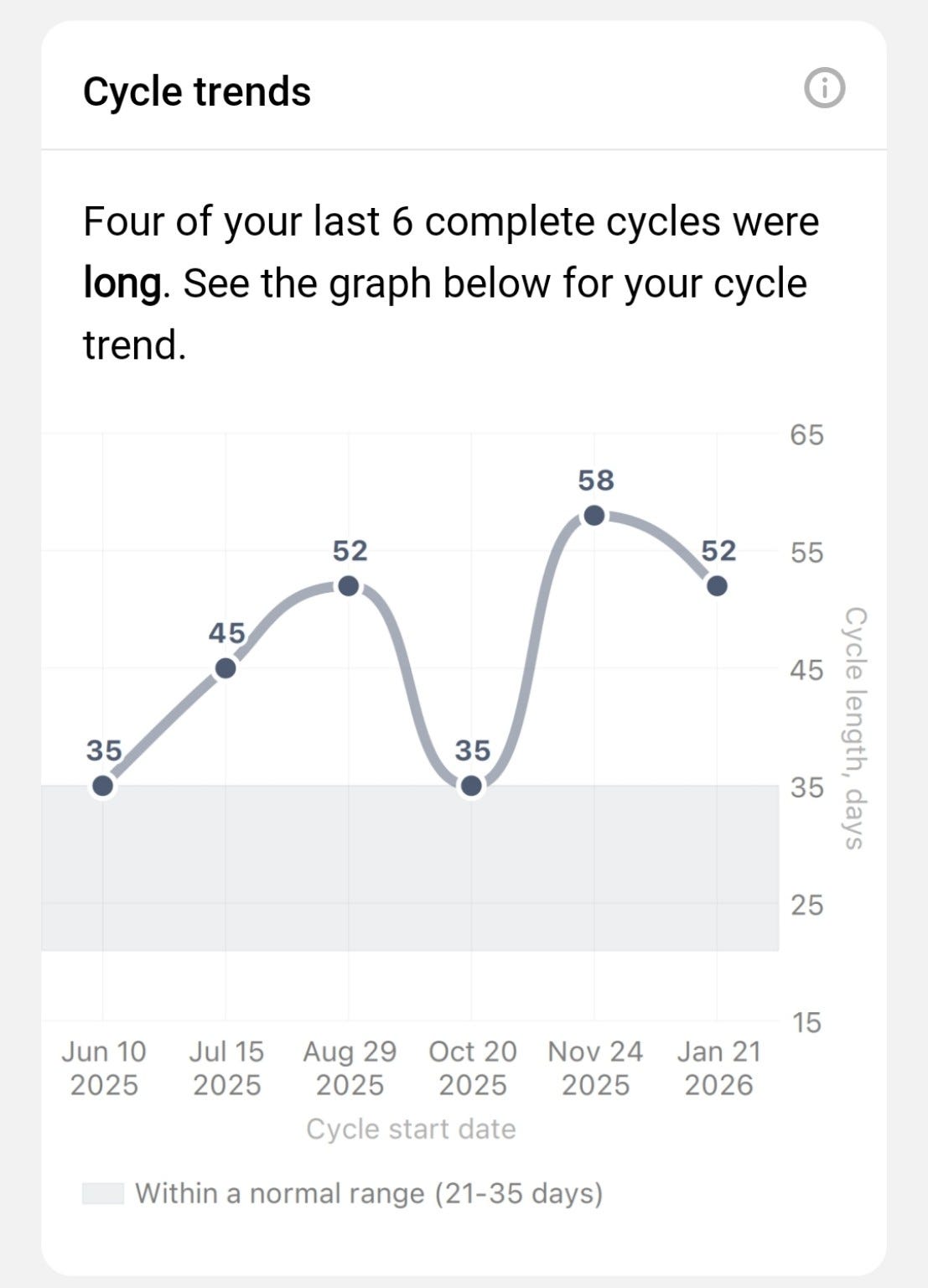
My recent cycles lasted 35, 45, 52, 35, 58 and 52 days — the closest my period tracker has come to drawing a sine curve. Personal cycle data shown in Flo® Period Tracker. Screenshot captured by the author; app interface © 2026 Flo Health. All rights reserved.
My periods have been irregular for years.
Looking through my tracker, I can see cycles lasting 22 days, 31 days, 44 days, 51 days and 58 days. At one point, the graph rose and fell so neatly that it looked like a sine curve. I wish I had taken a screenshot. There was something almost impressive about my body turning unpredictability into mathematics.
Over time, a cycle lasting around a month and a half became relatively normal for me.
Normal, in this case, did not mean predictable. It meant that I had lowered my expectations enough for 45 or 52 days to stop shocking me.
But 120 days is different.
This is no longer a slightly delayed period. It has been four months. Long enough for me to move through several rounds of expecting it, forgetting about it, worrying again and then becoming frustrated with myself for worrying.
I know this is connected to my condition.
Knowing does not make it feel as though everything is working properly.
You never entirely get over the feeling that something inside your body is failing to do what it is supposed to do.
I already knew the name was changing
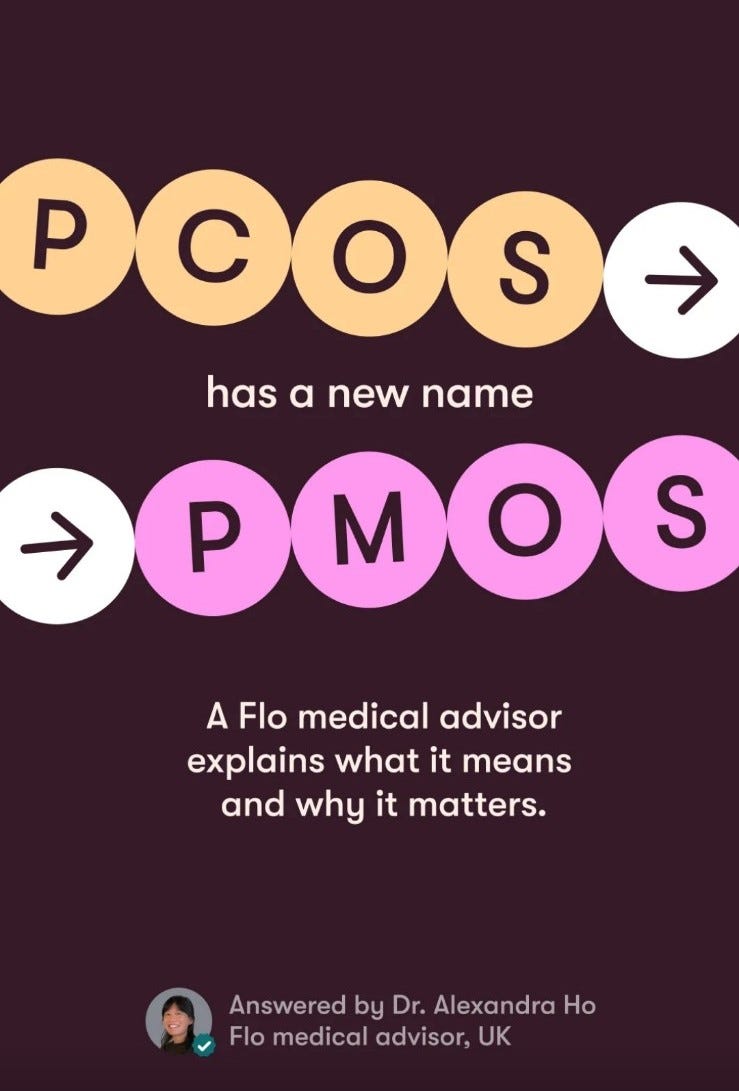
Flo announcing the change from PCOS to PMOS through an in-app story. Screenshot captured by the author. © 2026 Flo Health. All rights reserved.
I had seen discussions about the move from PCOS to PMOS before.
I had come across it in the literature and then through posts on Instagram, where people explained why polycystic ovary syndrome was such an incomplete and misleading name.
You can have the condition without having ovarian cysts. Then name focuses attention on the ovaries while flattening something far more complicated into what sounds like a reproductive issue.
The newer term-polyendocrine metabolic ovarian syndrome-attempts to reflect the wider hormonal and metabolic picture.
I already knew that.
But then I opened Flo, the period app I have used for years, and it was suddenly everywhere.
PCOS HAS A NEW NAME.
The letters appeared in brightly coloured circles across my screen. The app explained that the condition was not only about ovaries or period, but could affect things like skin, weight, mood and metabolic health.
It was not new information to me by then, but seeing it inside an app I use so often felt different.
Flo was not quietly adding PMOS to the bottom of an article. It was screaming it out.
And I felt oddly proud.
Proud that something people with this condition had been saying for years was finally being given such visible space. Proud that the name itself was beginning to catch up with the reality of living with it.
It felt like recognition.
But recognition can be frightening too.
Suddenly, my body looked less divided
I had spent years mentally sorting my health into separate folders.
My irregular period belonged to gynaecology.
My depression belonged to mental health.
My bloating, constipation and IBS-like symptoms belonged to digestion.
Needing to urinate frequently raised another set of worries.
My increased risk of diabetes was something serious but distant, filed away as a future concern rather than part of my life now.
Then I began reading more about the hormonal and metabolic dimensions of PMOS. I saw discussions of insulin resistance, diabetes risk, mood and broader metabolic dysfunction.
Those folders started to collapse into one another.
For the first time, I began wondering whether all the things I had treated as separate really were as separate as they seemed. That does not mean PMOS explains every symptom I have ever experienced. Some things may be connected, some may be coincidental and some may require completely different investigations.
But the newer name encouraged me to ask a question that had rarely been asked in appointments: Has anyone ever looked at all of this together?
That possibility felt revealing. It also felt terrifying.
There is comfort in finding a possible pattern, especially after years of feeling as though your body is a collection of unrelated problems. But there is also fear in realising how much of the body one condition may touch.
The old name made it sound like something was happening in my ovaries. The newer one makes it much harder to pretend the rest of me is separate.
A better name is not magic
The change in language matters.
Names affect what patients understand, what doctors look for and what society imagines when a condition is mentioned. Calling it polycystic ovary syndrome encourages people to think about cysts, period and fertility.
Calling it polyendocrine metabolic ovarian syndrome opens a much larger picture.
But the new name is not treatment.
It does not immediately create better appointments. easier access to specialists or more personalised care. It does not guarantee that every GP will suddenly consider metabolic health, mental health and menstrual symptoms together.
A lot of this work is either new or still new to implementation. Even where the research has existed for years, translating it into routine takes time.
So the news did not magically comfort me. In some ways, it made me more frustrated. If this condition affects so much more the ovaries, why has my experience of care so often felt limited to hormonal contraception?
Hormonal contraception cannot be the whole conversation
Whenever irregular periods come up, the conversation seems to move quickly towards the pill.
There are valid reasons hormonal contraception is offered. It can help regulate bleeding, manage some symptoms and protect the womb lining when period are very infrequent.
That matters.
But being offered contraception is not the same as having the condition properly explained.
It is not the same as checking the broader picture. It is not the same as discussing metabolic health, mental health, individual symptoms, alternative treatments or what the patient actually wants.
Too often, the options appear to be divided into two pathways. If you are not trying to become pregnant, you are offered hormonal contraception. If you are trying to become pregnant, suddenly there are conversations about ovulation, medication, fertility treatment and closer monitoring.
Pregnancy changes the urgency. But what about the years before that? Does it make sense for me to wait until I want a child before trying to understand what is happening in my body?
What if I never want to become pregnant?
What if I do want to, and later discover that I cannot without a struggle?
Why should either answer determine whether my health matters now?
My health cannot only matter in relation to a future baby
Fertility is important. For many people with PMOS, uncertainty around pregnancy can be deeply painful. But reproductive health is still health when reproduction is not the goal.
My cycle matters because living with 120 days of uncertainty is distressing.
My mood matters because I am a person living with it now.
My metabolic health matters before it reaches the point of diabetes.
My symptoms deserve investigation even if I never decide to have a child.
I should not have to become a potential mother before my body is treated as a whole body. That is perhaps what the change to PMOS has made clearest to me. The old name encouraged everyone to look at the ovaries. The usual treatment encouraged everyone to look towards fertility.
Meanwhile, I was still here, living in the rest of the body.
Still waiting
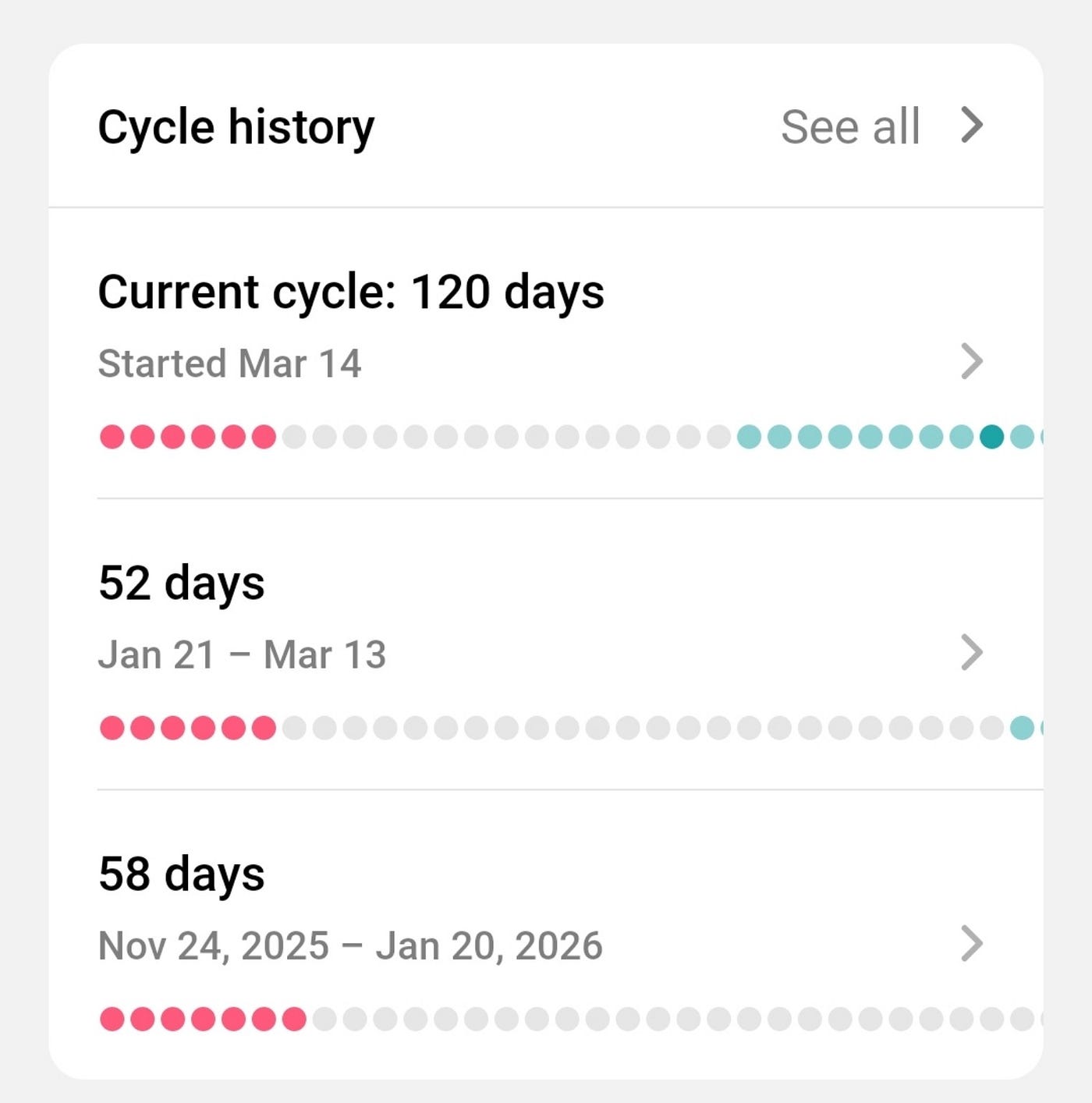
My current cycle reached 120 days, compared with previous cycles of 52, 58 and 35 days. Personal cycle data shown in Flo® Period Tracker. Screenshot captured by the author; app interface © 2026 Flo Health. All rights reserved.
I am now waiting for hormonal and thyroid blood tests and a scan.
I do not know what they will show. My period may arrive before the appointments. It may arrive tomorrow, after weeks of making me wonder. Or it may continue to stay away.
Part of me knows that when it eventually comes, I will almost certainly complain about it. I will hate the cramps. I will resent the bleeding. I will wonder why I spent so long wishing for something so unpleasant.
But what I want is not really a period.
I want some evidence that my body is moving through a process rather than remaining suspended inside one. I want predictability — or, failing that, an explanation.
PMOS does not yet give me either. A new name cannot undo years of fragmented care, and it cannot tell me which of my symptoms are connected.
But it does give me language for something I have felt for a long time.
This was never only about cysts. It was never only about periods. And it should never only become important when I want a baby. My period tracker says I am on day 120. I am still waiting for my body to keep time. But I am no longer willing to accept that the waiting means nothing.
This is an independent personal essay and has not been authorised, sponsored or endorsed by Flo Health.
Further reading
I wanted this essay to remain rooted in my own experience rather than turn into a medical explainer. For readers who would like to learn more about PMOS, the name change and the condition’s wider effects, these resources are useful starting points:
- *The Lancet: Polyendocrine metabolic ovarian syndrome, the new name for polycystic ovary syndrome*** — the original global consensus paper explaining how the new name was chosen and why the change matters.
- Monash University: Polyendocrine Metabolic Ovarian Syndrome — new name to improve diagnosis and care — an accessible explanation of the change and the hope that it will encourage broader diagnosis and care.
- **The 2023 International Evidence-based Guideline for the Assessment and Management of PCOS** — more detailed guidance covering diagnosis, metabolic health, mental health, reproductive health and treatment. This was published before the formal name change, so it still uses PCOS.
- NHS: Polyendocrine metabolic ovarian syndrome (PMOS) — a practical UK overview of symptoms, diagnosis and available treatments.
메타데이터
- post_id
- f901c2624d5b
- slug
- i-hate-my-period-i-hate-not-having-it-more-f901c2624d5b
- url
- https://medium.com/fourth-wave/i-hate-my-period-i-hate-not-having-it-more-f901c2624d5b
- canonical_url
- https://medium.com/fourth-wave/i-hate-my-period-i-hate-not-having-it-more-f901c2624d5b
- author_url
- https://medium.com/@wazoo
- status
- ok
- fetched_at
- 2026-07-15 14:44:23