Why the Y-Maze Design and Calibration Determine the Reliability of Spatial Memory Data
Spatial memory assessment in rodent models depends heavily on equipment consistency. Among the available behavioral paradigms, the Y maze…
Why the Y-Maze Design and Calibration Determine the Reliability of Spatial Memory Data
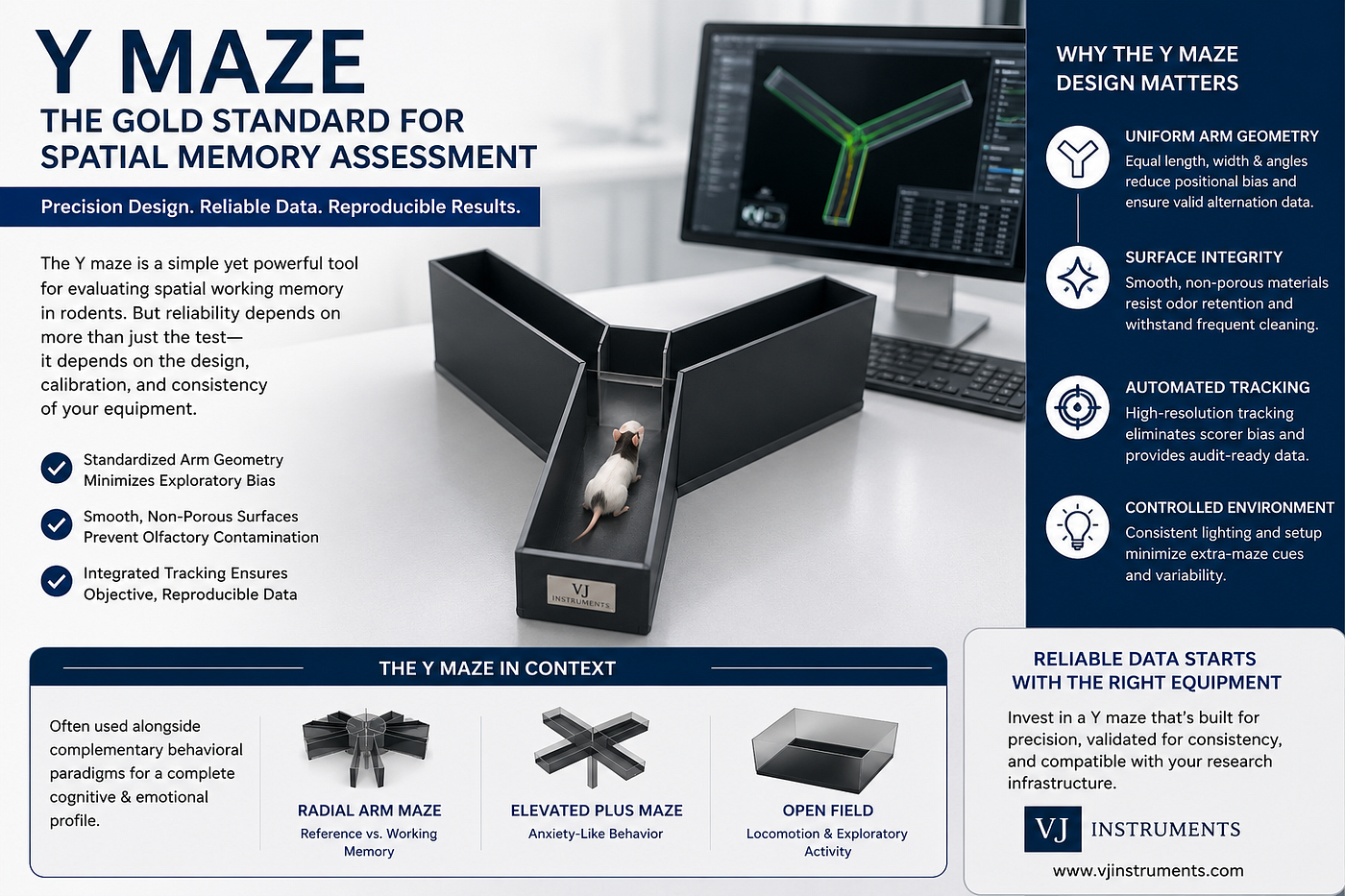
Spatial memory assessment in rodent models depends heavily on equipment consistency. Among the available behavioral paradigms, the Y maze stands out for its simplicity and speed, yet that apparent simplicity masks a set of technical variables that directly affect the validity of alternation data. Procurement teams evaluating behavioral testing equipment often underestimate how much the physical apparatus influences outcome reproducibility.
Arm Geometry and Exploratory Bias
A standard Y maze consists of three arms of equal length, typically 35–40 cm, set at 120-degree angles. When arm dimensions deviate even marginally, rodents exhibit positional bias rather than genuine alternation behavior. In one preclinical anxiety research facility, inconsistent arm widths across two units purchased from different vendors produced a 14% variance in spontaneous alternation percentages between cohorts, invalidating cross-study comparisons.
The walls must be uniform in height, generally 12–15 cm for mice and up to 20 cm for rats, to prevent visual cues from external stimuli from entering the test field. Any variation introduces uncontrolled extra-maze cues, which confound the spatial memory signal the test is designed to capture.
Material Surface and Olfactory Contamination
The interior surface material directly affects data integrity. Porous or rough surfaces absorb urine and scent markers, creating residual olfactory trails that guide subsequent animals. This leads to inflated alternation scores that reflect trail following rather than working memory. Acrylic and PVC units with smooth, chemically resistant surfaces address this risk. However, procurement teams must verify that surface treatment withstands repeated cleaning with ethanol or isopropyl alcohol without crazing or discoloration, as degraded surfaces trap odors more aggressively over time.
Facilities running back-to-back trials across multiple animals per session face higher contamination risk. Validation should include inter-trial cleaning protocols tested against the specific material specifications of the unit being purchased.
Tracking Software Integration
Manual scoring of Y maze trials introduces inter-rater variability, particularly in fast-moving rodent strains. Automated tracking through video-based rodent tracking software eliminates observer bias and creates auditable data logs. Key parameters to verify before finalizing equipment include frame rate (minimum 25 fps for accurate turn detection), arm-entry threshold calibration, and compatibility with the lab’s existing data management infrastructure.
A mismatch between tracking software and apparatus dimensions, such as incorrect zone mapping or arm boundary definitions, causes misclassification of entries. This error type is silent; it does not trigger an obvious alert but systematically distorts alternation ratios.
Complementary Apparatus Considerations
Behavioral research programs using the Y maze for hippocampal function studies often pair it with the radial arm maze for reference versus working memory discrimination or with the elevated plus maze for anxiety phenotyping within the same cohort. When multiple apparatus types are sourced from different suppliers, dimensional standardization and lighting uniformity across test environments become critical procurement requirements. Inconsistent ambient light levels between apparatus setups alter exploratory behavior independently of the cognitive variable under study.
VJ Instruments manufactures the Y maze with standardized arm dimensions and compatible tracking integration, addressing these validation requirements directly.
FAQs
What arm length is standard for mice versus rats in a Y maze?
Mice: 35 cm arms, 5 cm wide. Rats: 40–45 cm arms, 8–10 cm wide. Confirming species-specific dimensions before procurement prevents protocol mismatches.
How often should Y-maze surfaces be decontaminated during testing sessions?
Between every animal. A full ethanol wipe-down and air dry of a minimum of 90 seconds prevents olfactory carryover.
Does lighting affect Y maze alternation scores?
Yes. Overhead lux should remain between 20–60 lux across all arms. Uneven lighting creates arm-preference artifacts unrelated to spatial memory.
Can Y maze data integrate with open field locomotion metrics?
Only if tracking software supports multi-apparatus export formats. Confirm compatibility at the procurement stage, not post-installation.
메타데이터
- post_id
- f90d9b95426e
- slug
- why-the-y-maze-design-and-calibration-determine-the-reliability-of-spatial-memory-data-f90d9b95426e
- url
- https://medium.com/@maharghabarman7/why-the-y-maze-design-and-calibration-determine-the-reliability-of-spatial-memory-data-f90d9b95426e
- canonical_url
- https://medium.com/@maharghabarman7/why-the-y-maze-design-and-calibration-determine-the-reliability-of-spatial-memory-data-f90d9b95426e
- author_url
- https://medium.com/@maharghabarman7
- status
- ok
- fetched_at
- 2026-06-25 16:53:31