SWING
Why Delayed Decision-Making Makes Football Feel Like Jazz
SWING
Why Delayed Decision-Making Makes Football Feel Like Jazz
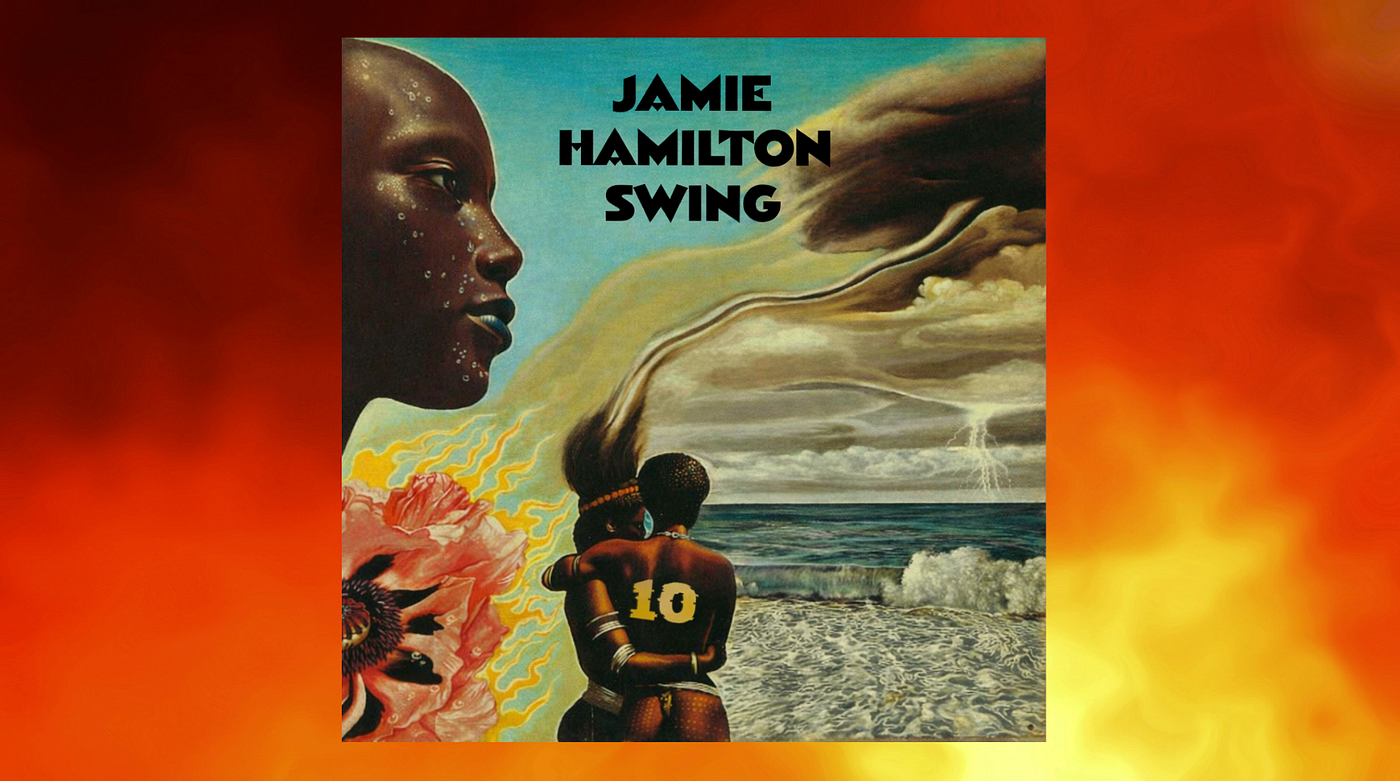
In 1949, Argentinian journalist Toni Mazzoni wrote:
“English football, well-played, is like a symphonic orchestra; Brazilian football, like an extremely hot jazz band. The English player thinks; the Brazilian improvises.”
In 2026, it is almost passé to use jazz as a metaphor for ‘fluid’ or ‘free-flowing’ football. As with most clichés, the phrase becomes hackneyed through overuse; yet the comparison endures. Motifs such as improvisation, spontaneity, and intuitive collaboration are the usual suspects to justify the description of footballing styles via the aesthetics of jazz. But these concepts are not unique to jazz. They might apply just as readily to krautrock, or to various strains of psychedelia and electronica.
What links football to jazz runs deeper than behaviour or vibe. It is concealed in the temporal structure of the play: the art of lateness and delay. The connection lies in the movement of swing.
In music, a swing beat is characterised by intentional delay. A bar in standard time is made up of four beats: 1, 2, 3, 4. Each beat contains two parts:
1-&- 2- &- 3 -&- 4- &.
In a common 4/4 time signature, the gaps between each of these eight parts are uniform in length. A swing beat, which is extremely common in jazz, is created by slightly delaying the second part of each beat. Drummers like Buddy Rich were famous for often playing the ‘&’ a little late, closer to the start of the next beat:
1 — &2 — &3 — &4 — &.
This subtle shift drastically alters the feel of the rhythm. Suddenly, the tempo seems looser, fingers begin to click, and feet can’t help but shuffle and tap.
How does this piece of musical theory relate to football? How can an aesthetic quality like swing translate into something real and actionable on the pitch? The connection emerges when we consider decision-making.
It is common to hear football coaches emphasise the importance of fast decision-making. The faster the decision, the better — provided, of course, the action itself remains effective. Speed is treated as paramount. The logic is simple: the quicker a player decides (and subsequently acts), the more likely they are to execute their action before defensive pressure disrupts the attack.
Coaches optimise for speed by reducing the variety of options available to players; too much complexity means too much time spent deciding.
This equation is predicated on familiarity. Players are conditioned to know in advance what their options will be and where they will appear. Decisions can then be made with increasing automaticity and efficiency.
As Mikel Arteta puts it:
“Football is about habit & angles. It’s much more simple for a player if you can process the image of where your team-mate will be before receiving the ball. If I am in the kitchen and I know the glasses are always in this cupboard, I get my glass of water more quickly.”
Playing football with swing doesn’t imply the slowing down of a player’s cognitive faculties. Rather, the metaphor helps us to see how the intervals between the constituent parts of a football action can be altered.
We can demonstrate this via the model popularised by coach educator Raymond Verheijen. Verheijen proposes that a ‘football action’ can be broken down into three parts: Communication, Decision, Execution (CDE). Communicate with the game-environment, Decide what to do, Execute the action.
If we apply Arteta’s logic, we can visualise this process temporally, with the Decision phase positioned very close to Communication. Players are encouraged to know where their teammates will be before receiving the ball. By reducing variance in available options — the glasses are always in the cupboard — the decision can be made almost as soon as the situation is recognised.
This mode of play is encapsulated in a concept known as an ‘up-back-through’. A first player makes a vertical pass (up), a second receives the ball and lays it off (back), a third man takes the layoff and plays forward again (through). The key point here is that the ball trajectories of the sequence are predefined. The second player is not required to perceive what is going on behind him because he already knows the third man will arrive beneath him for the layoff. This is one of the most commonly drilled patterns in modern football, and coaches embed up-back-throughs into the cognition of their specifically positioned players.
This produces a temporal structure that looks like this:
CD — — — — — E
This is the configuration desired by the vast majority of coaches; make situations familiar to afford immediate pattern recognition and choice of action. When all players are conditioned to interpret the game in this manner, quick, efficient, almost machine-like playing styles can be achieved.
The problem is that making attacking patterns of play familiar to your own players inevitably makes them familiar to the opponent. This leads to the strategic stalemate we see playing out across elite football, with margins now being gained through increasingly physical means.
An example of this predictability in attack could be easily observed during a recent Champions League match between Marseille and Liverpool. Marseille’s coach, Roberto De Zerbi, is one of the foremost practitioners of the CD — — — — — E, up-back-through method we have described. De Zerbi’s teams have often been lauded for the meticulous timings of their sequences. His players rarely miss a beat; they are like members of a classical orchestra, the sequence and tempo of their actions are decided in advance, and it is their job to execute them.
But when the Marseille players initiated an up-back-through, Liverpool players continually jumped onto the second player’s attempt to lay the ball off. The Liverpool players knew in advance where their opponent was going to play, and, as a result, were able to anticipate the action and make numerous interceptions and tackles.
A solution to the problems faced by the Marseille players is to play with swing.
Crucially, playing with swing does not necessarily mean holding the ball for longer, nor does it imply indecision. Delay must be distinguished from hesitation. Swing is not the absence of a decision-making structure; like its musical corollary, it is a temporal reconfiguration of structure itself.
By delaying the decision, the communication period — the player’s perceptual engagement with the game environment — is elongated. The player now decides what to do as close as possible to the threshold of execution. In reality, these thresholds overlap and intertwine. But by deciding later, players can select options with a higher degree of fidelity to the moment the ball is received.
When a player decides too early, they cannot account for the changes that occur between that decision-point and the moment the ball arrives. In football, the environment is in constant flux, so, from a purely functional perspective, it often makes sense to make decisions as late as possible. If one of the Marseille receivers waited a little longer to decide, they could perceive the Liverpool defender’s intention to arrive fast and intercept. The defender’s speed and trajectory can be used against them, their overcommitment allowing the attacker to roll and turn against their momentum.
Making late decisions also corresponds with the latest studies on the effectiveness of scanning. Researchers like Gier Jordet and Karl Marius Aksum have found that the later a player’s final scan occurs before receiving the ball, the more likely it is that they will be able to play forward in the next action.
When the players play with swing, our CDE temporal structure changes to this:
C — — — — — DE
The intentional delay of the decision mirrors the planned lateness of the swing beat. This is why football played in this way feels like jazz. Delayed decisions give the impression that control is being lost before, at the very last moment, the play comes together. When players are coached to decide late, they become able to hold a greater variety of options for longer. Rather than having their perception blinkered by concepts like the up-back-through, players’ eyes remain open until just before the action is made. By floating in periods of limbo, attackers can hold greater degrees of uncertainty for longer, thus reducing the predictability of the attacking patterns.
Critics will claim that such approaches are too much for players to handle; the demands of the modern game are simply too great. But is a jazz musician more talented than a classical musician? Surely this is just about how the dynamics of the game can be perceived, coached and played in different ways.
It is immediately obvious that Luciano Spalletti’s teams relate to the game in a radically different way from De Zerbi’s. Both coaches heavily emphasise 3rd-man combinations with first-time layoffs to supporting players. But there is a looseness to Spalletti’s teams’ style that just isn’t there in the tight, almost staccato pulses of De Zerbi. Spalletti’s players demonstrate a richer palette of connections; the players take the time required to achieve 360-degree perception. This enables deceptive backflicks, dummies and all manner of jarring ShadowPlay riffs.
In Brazilian football, there is a fundamental concept called ginga, roughly translated as ‘sway’. The term comes from the agile, improvised movements found in capoeira — the dance developed by African slaves to conceal their form of martial art. It’s no surprise that Mazzoni described Brazilian football as jazz. Its genius is hidden in its swing.
메타데이터
- post_id
- f9186e76db7f
- slug
- swing-f9186e76db7f
- url
- https://medium.com/@stirlingj1982/swing-f9186e76db7f
- canonical_url
- https://medium.com/@stirlingj1982/swing-f9186e76db7f
- author_url
- https://medium.com/@stirlingj1982
- status
- ok
- fetched_at
- 2026-07-10 03:02:36