Introducing Content Quality Management (CQM): The Missing Link to Make Unstructured Content…
Where ‘AI Ready Data’ Left Off — The Bold New Discipline for the LLM Era A Playbook for Making Unstructured Content LLM-Ready
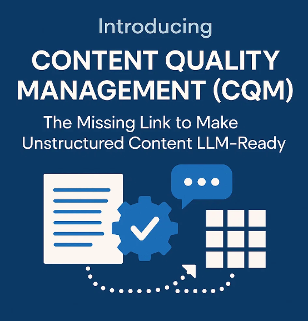
CQM
Introducing Content Quality Management (CQM): The Missing Link to Make Unstructured Content LLM-Ready
Where ‘AI Ready Data’ Left Off — The Bold New Discipline for the LLM Era
A Playbook for Making Unstructured Content LLM-Ready
Large Language Models are only as good as the content they consume. While most teams are focused on embeddings and pipelines, one layer remains dangerously under defined: content quality. If you’ve mastered structured data workflows, it’s time to expand your playbook. This article introduces Content Quality Management (CQM) — a practical, missing capability for any team trying to make messy, unstructured content useful for LLMs.
If your team has already embraced GenAI — experimenting with copilots, RAG search, or vector stores — then you’re already halfway into this territory. CQM isn’t a radical reinvention. It’s a formalization of practices you’re likely already doing — like cleaning PDFs, chunking documents, and tracing errors. What CQM brings is structure, scalability, and safety — particularly important as AI initiatives move from prototype to production.
Next Article — A blueprint
And there’s one more emerging pattern to note: the Content Mesh. While the next article focuses on the seven core CQM areas and four context types, the challenges of federated governance it uncovers make clear the critical need for a Content Mesh — a federated fabric of domain hubs sharing quality contracts and metadata. We’ll dedicate the next article entirely to defining and architecting the Content Mesh.
1. Context Recap: From AI-Ready Data to LLM-Ready Content
In our previous article, AI Ready Data, we outlined how organizations must move beyond traditional governance and quality into a layered, architecture-driven view of readiness — emphasizing flow, semantics, and policy alignment. But that lens, while essential, largely pertained to structured and semi-structured data.
As we shift into the LLM (Large Language Model) era, a new frontier emerges: making unstructured content ready for generative AI. This includes PDFs, HTML pages, scanned contracts, emails, and chat logs — content that was never designed for AI consumption.
Structured data needed data quality; unstructured content demands Content Quality Management (CQM).
2. Why Traditional Data Quality Isn’t Enough
Traditional data quality is rooted in DMBOK-style capabilities like profiling, validation, monitoring, and mastering. But LLMs require content to be:
· Chunked for context windows
· Embedded for vector similarity
· Cleaned for semantic precision
· Filtered for bias, toxicity, and hallucination risk
· Linked with metadata for lineage and traceability
In short: content quality ≠ data quality
Data quality answers: “Is the birthdate field valid?” Content quality asks: “Will this paragraph confuse the model or skew its answer?”
3. Introducing Content Quality Management (CQM)
A Missing Discipline
If this is the first time you’re seeing Content Quality Management (CQM) defined as a formal capability, that’s because it is new. Neither DMBOK nor traditional governance models currently define how to manage the quality of unstructured content for LLMs.
Definition: Content Quality Management (CQM) is a new operational discipline that ensures unstructured content is clean, coherent, semantically accurate, chunked appropriately, safe, policy-compliant, and traceable — so that it can be reliably used in LLM pipelines.
CQM fills that gap — spanning parsing, chunking, semantic safety, and hallucination control. It’s not just a feature of LLMOps; it’s a missing capability that forward-looking data and AI teams are now formalizing.
If your team has already embraced GenAI — whether through experimentation or production pilots — then you’ve already taken the leap. CQM is simply the next evolution: organizing your content practices into a strategic discipline.
4. From DMBOK to CQM: What Needs to Change
The DMBOK (Data Management Body of Knowledge) outlines a strong foundation for:
· Data profiling
· Mastering
· Quality rules
· Monitoring
But it does not yet define:
· What makes content useful for LLMs
· How to structure chunk boundaries
· When content becomes toxic or semantically misleading
· How to trace hallucinations back to raw source documents
DMBOK to CQM Shift — What Needs to Evolve
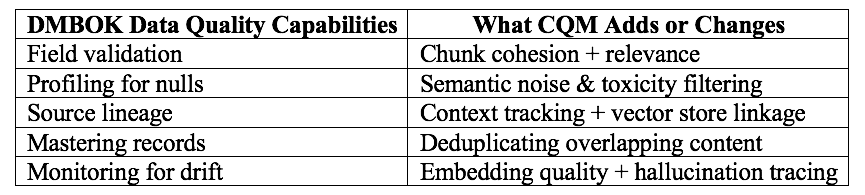
CQM is not a replacement for data quality — it’s an evolution that makes governance relevant in the LLM era.
Key DMBOK Capabilities That Must Evolve Details-
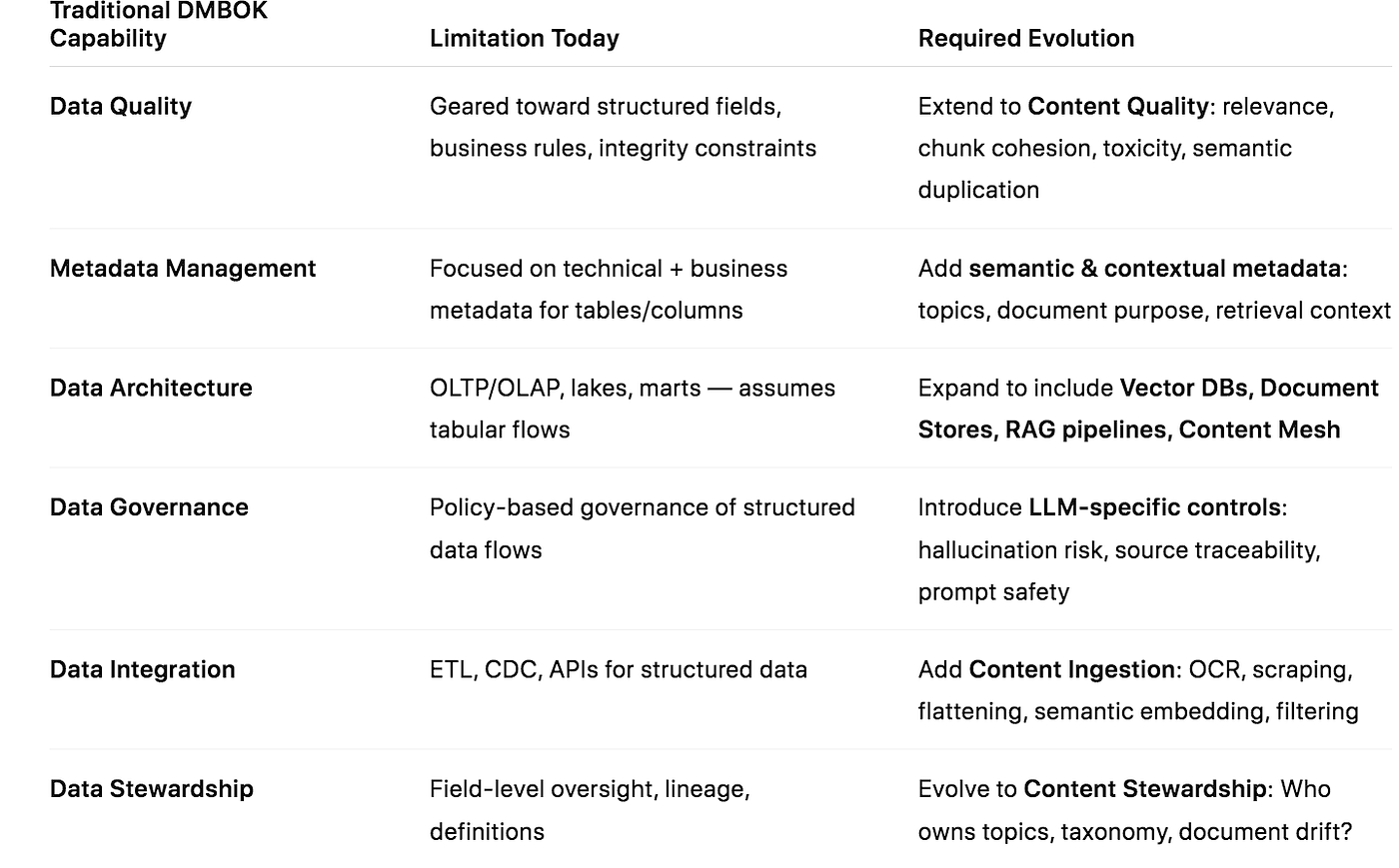
Where it fits:
- Connects Data Quality, Metadata, Data Architecture, and LLMOps
- Shared across business (L1), policy (L2), and audit (L3) teams
Changes to Capability Stack (Visualized)
Here’s how the DMBOK Pyramid or Wheel would need to change:
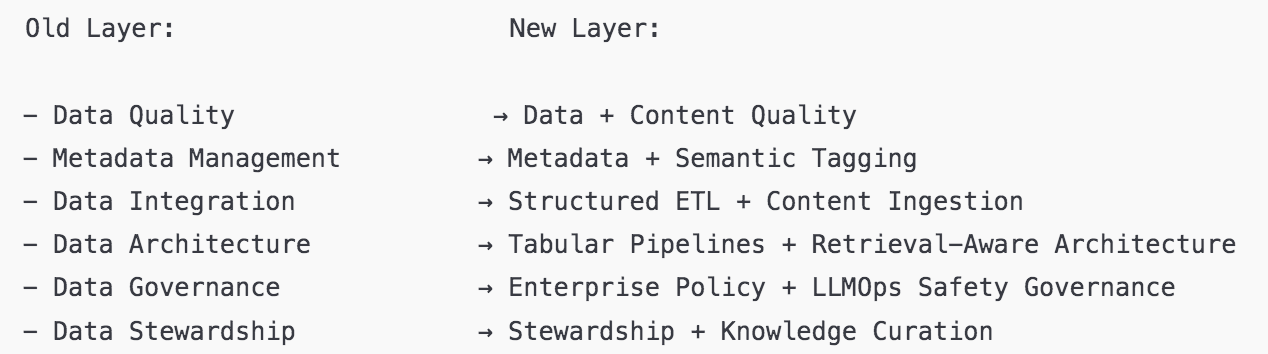
DMBOK Capability Stack: Then vs Now
Additions to DMBOK Principles
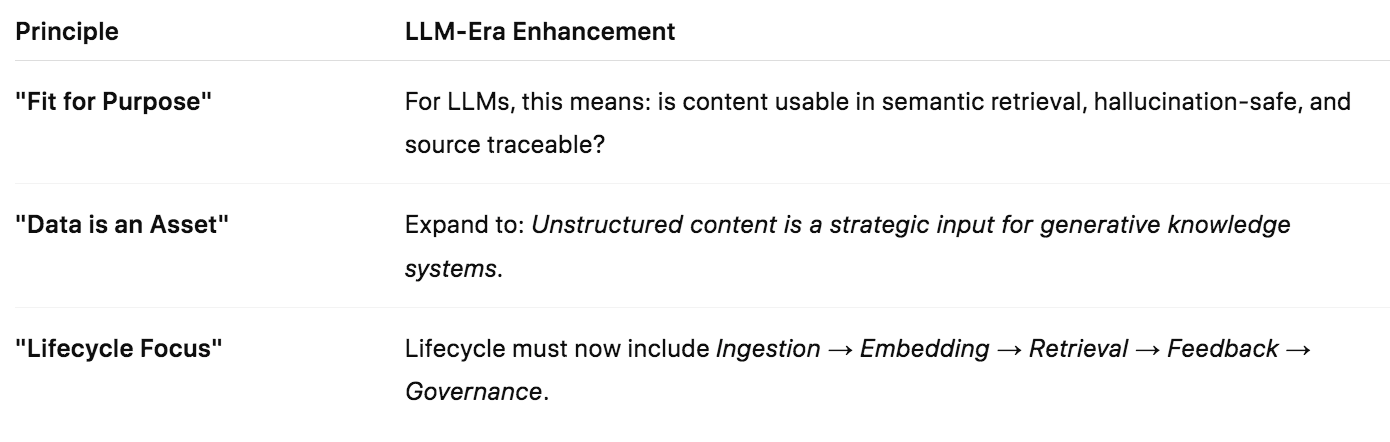
Section Summary
To support generative AI and LLMs, DMBOK must expand from data-centric to content-centric thinking.
- Introduce Content Quality Management (CQM) as a new core capability
- Evolve Metadata, Governance, Architecture, and Stewardship to span structured + unstructured flows
- Update principles to reflect LLM-usage realities: hallucination, drift, prompt safety, and retrieval integrity
5. How Unstructured Content Differs from Traditional Data
We now need to think of Content Readiness as a parallel capability to Data Readiness, with its own lifecycle and architecture stack.
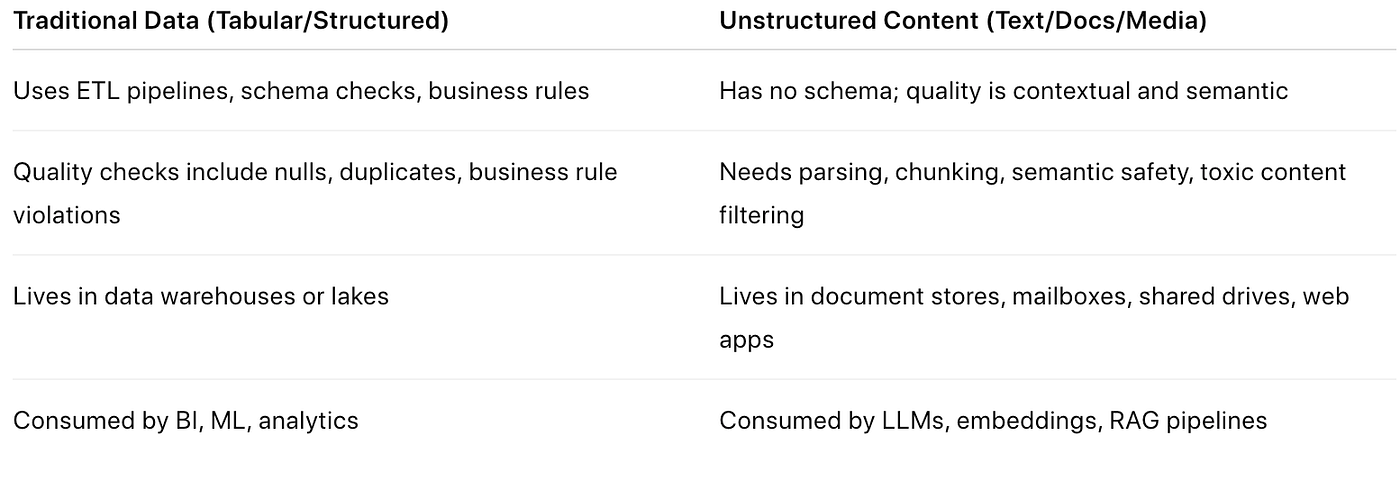
Unstructured Content for LLMs Applies to: Text, PDFs, docs, HTML, emails, etc. Goal: Make content LLM-ready — so it’s clean, chunked, relevant, contextually linked, and safe.
CQM Capabilities:
· Content parsing & extraction (OCR, HTML strip, PDF flattening)
· Chunking and segmentation (e.g., sentence/paragraph/topic level)
· Embedding preparation (semantic preservation)
· Removal of irrelevant or toxic content
· De-duplication & redundancy reduction
· Context window optimization
· Metadata tagging and linking (e.g., vector store enrichment)
These are not generic pipeline tasks — they are core responsibilities of Content Quality Management (CQM). This is part of LLMOps or LLM ingestion pipelines, not traditional data pipelines.
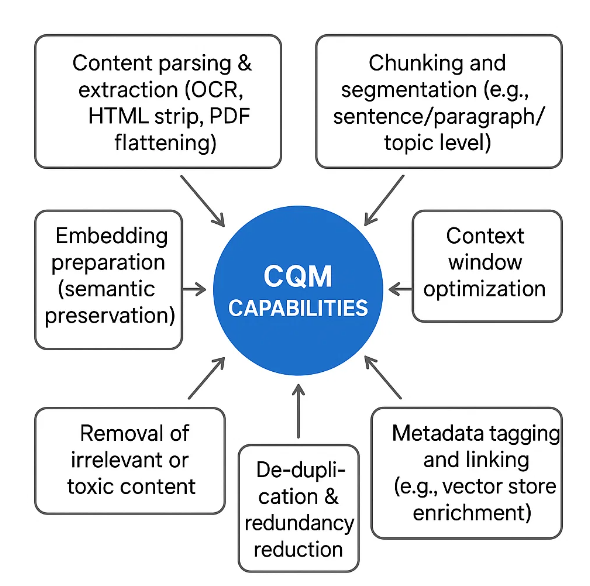
CQM Capabilities
6. Why CQM Matters for Retrieval: Vector Stores & Semantic Matching
Vector databases are only as good as the content they index. If documents are poorly chunked, semantically noisy, or overly verbose, embedding models will struggle to generate clean.
representations — leading to irrelevant or incomplete retrieval during RAG (Retrieval-Augmented Generation).
Example: Imagine a 30-page insurance policy PDF with poor structure. Without chunking and CQM steps:
· Embeddings might span unrelated clauses
· Context windows may exceed token limits
· Retrieval may pull legally risky or irrelevant passages
CQM ensures that what’s embedded is clean, scoped, and relevant — improving both retrieval accuracy and downstream model behavior.
How CQM Enhances Vector Databases
Vector databases are the backbone of Retrieval-Augmented Generation (RAG) systems — enabling semantic search across vast unstructured content. But a vector DB is only as useful as the content and chunks embedded into it.
What Goes Wrong Without CQM:
· Redundant or overlapping content leads to noisy retrieval.
· Poorly chunked documents result in irrelevant or incomplete answers.
· Toxic or sensitive data can get surfaced without proper filtering.
· Semantic drift in embeddings (due to updates or inconsistencies) undermines trust in results.
CQM ensures that what goes into your vector DB is clean, coherent, and contextually aligned — so what comes out is accurate and usable.
Example: Legal Contract Search with a Vector DB
Use Case: A legal team wants to search across thousands of scanned and OCR’d contracts using natural language queries (e.g., “Find clauses about early termination fees”).
Without CQM:
· OCR errors and formatting noise pollute embeddings.
· Entire contracts are embedded as giant chunks — leading to retrieval of irrelevant pages.
· Legal terms appear inconsistently, missing due to poor token coverage or formatting quirks.
With CQM:
· Contracts are parsed and cleaned (OCR normalized, headers flattened).
· Content is chunked by clause (e.g., one embedding per clause).
· Legal terms are standardized, and domain-specific stopwords are removed.
· Metadata (e.g., contract type, jurisdiction, client) is tagged and linked — aiding filtered retrieval.
Outcome: When a user asks, “What is our termination fee clause for UK clients?”, the vector DB returns clean, clause-level snippets — filtered by country metadata — with semantic precision
7. The Three Lines of Defense — Reimagined for LLM-Ready Content
To make LLMs usable in regulated or high-stakes domains, you need more than prompt engineers. You need governance.
Borrowing from enterprise models, we propose:
· L1: Content Ops teams who parse and prep content
· L2: Policy teams who define safety and sensitivity thresholds
· L3: Audit teams who ensure traceability and accountability
CQM acts as a foundation for this model — giving each line of defense the signals, logs, and checks it needs to operate responsibly.
8. Architecture Types That Enable CQM for LLMs
Not every data architecture works well for LLM integration. CQM must sit across multiple architectural layers to be effective. Suitable designs include:
· Content Lakes or Delta Lakehouses — store structured + unstructured
· Document Stores + Vector Databases — enable hybrid RAG workflows
· Knowledge Graphs — link context, policies, and entities
· Modular Mesh or Hub-Spoke — allow domains to handle ingestion, while central teams manage CQM and LLMOps
CQM makes these architectures usable for LLMs by ensuring the content they hold is reliable, retrievable, and relevant.
Content readiness is a cross-layer concern, not just ingestion or cleansing.
9. CQM Maturity Model: From Chaos to Clarity
This maturity model helps organizations evaluate how prepared they are to turn raw, unstructured content into semantically rich inputs for LLMs.
Dimensions:
· Ingestion & Parsing: Are we flattening, OCR-ing, cleaning systematically?
· Chunking & Embedding: Are we optimizing for semantic clarity and retrieval relevance?
· Metadata & Context: Is content enriched with policy-aware tags?
· Governance & Control: Do we apply L1–L3 roles across teams?
· Monitoring & Feedback: Do we trace source drift and detect hallucinations?
· Architecture Fit: Are we using vector stores, content lakes, graphs effectively?
A high CQM maturity enables domain-accurate answers, traceability, and scalable GenAI deployment.
10. System Integrator Blueprint: Putting CQM to Work
Example in Action: System Integrator Model with L1–L3, Architecture & Journey
Scenario: A global bank deploying a client onboarding assistant powered by LLMs.
With sensitive client contracts, compliance rules, and unstructured documents, the success of this assistant depends on:
· CQM-led parsing to extract clean input from documents
· Chunking and embedding to ensure retrievable context
· Metadata tags for policy-level filtering
· L1–L3 roles for distributed responsibility
· Vector DB integration to support efficient semantic search
CQM sits at the center of this design — converting messy content into structured LLM inputs that are explainable and safe.
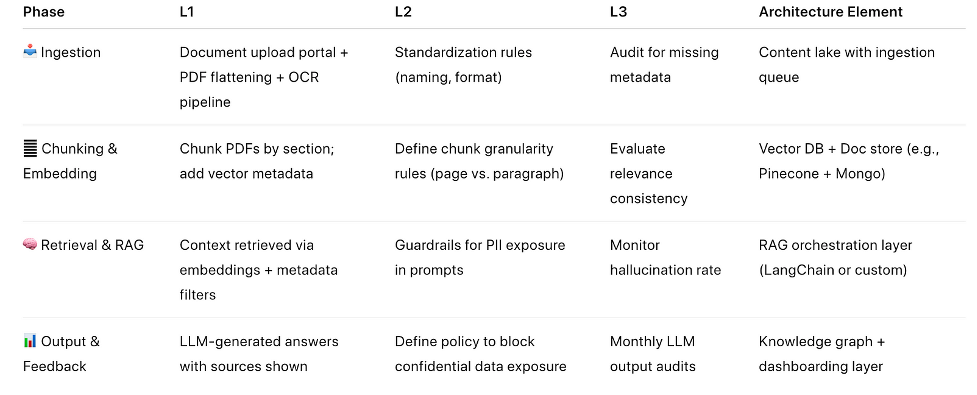
This brings us to a practical blueprint for implementation. Whether you’re an SI or an enterprise leader, the journey from raw content to LLM maturity unfolds across multiple levels.
11. Maturity Model Across the LLM Content Lifecycle
Purpose
This maturity model helps organizations evaluate how prepared they are to turn raw, unstructured content into safe, structured, semantically rich inputs for Large Language Models (LLMs). It spans the full lifecycle — from ingestion to usage — and integrates both technical and governance aspects.
At the heart of this model is a new discipline:
Content Quality Management (CQM) — the set of capabilities that make unstructured content usable, trustworthy, and governed for LLM use.
Maturity Stages
Each stage reflects how deeply CQM practices have been integrated into your LLM content lifecycle.
Dimensions Covered in Each Maturity Level
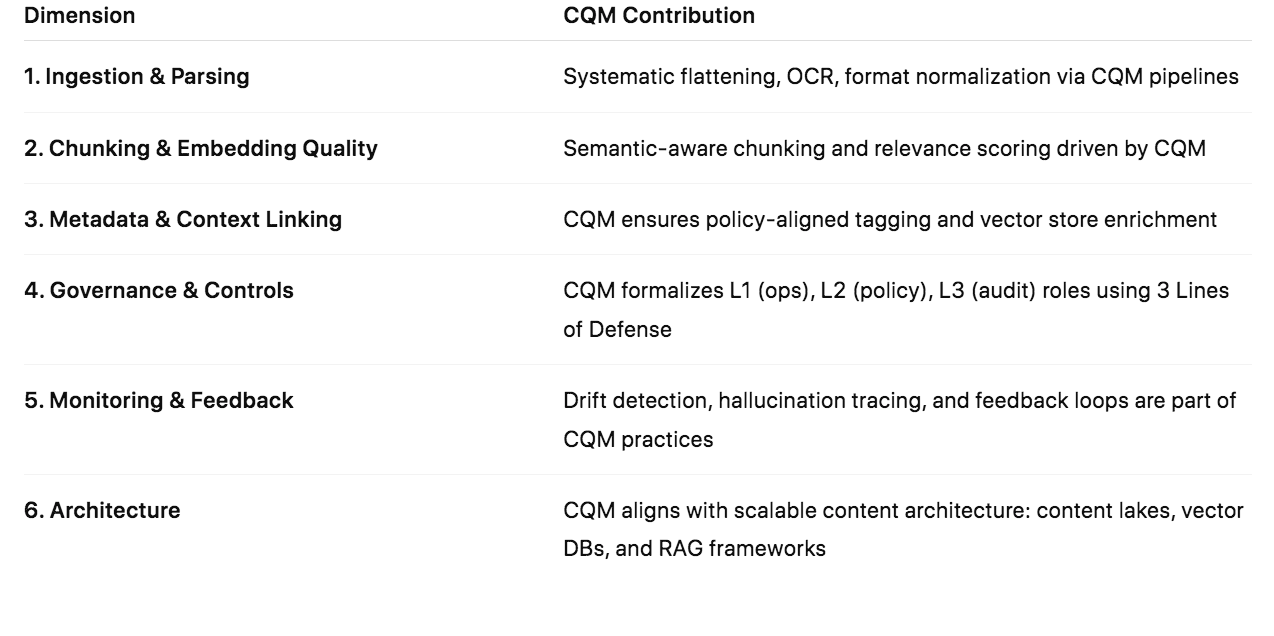
Why This Matters
LLMs are only as good as the content they retrieve from. If your content lifecycle lacks mature CQM, you face:
· Higher hallucination rates
· Governance blind spots
· Redundant or noisy embeddings
· Loss of trust in AI output
Maturity in CQM Enables:
· Domain-accurate answers
· Traceability to sources
· Regulatory compliance
· Scalability across business units
Where This Fits in the Enterprise
This model and CQM are especially relevant to:
System Integrators (SIs) creating RAG solutions for clients
Data & AI Governance teams maturing their LLM strategy
LLMOps & MLOps teams managing vector pipelines
IT Architects planning future-ready ingestion and retrieval systems
12. CQM Maturity Across the LLM Content Lifecycle
Building on the six core dimensions above, we propose the following maturity model to help teams benchmark where they are in their journey — and what capabilities they need to level up.
Purpose: This maturity model helps organizations evaluate how prepared they are to transform raw, unstructured content into safe, structured, semantically rich inputs for Large Language Models (LLMs). It spans the full lifecycle — from ingestion to usage — and integrates both technical and governance aspects.
Maturity Stages
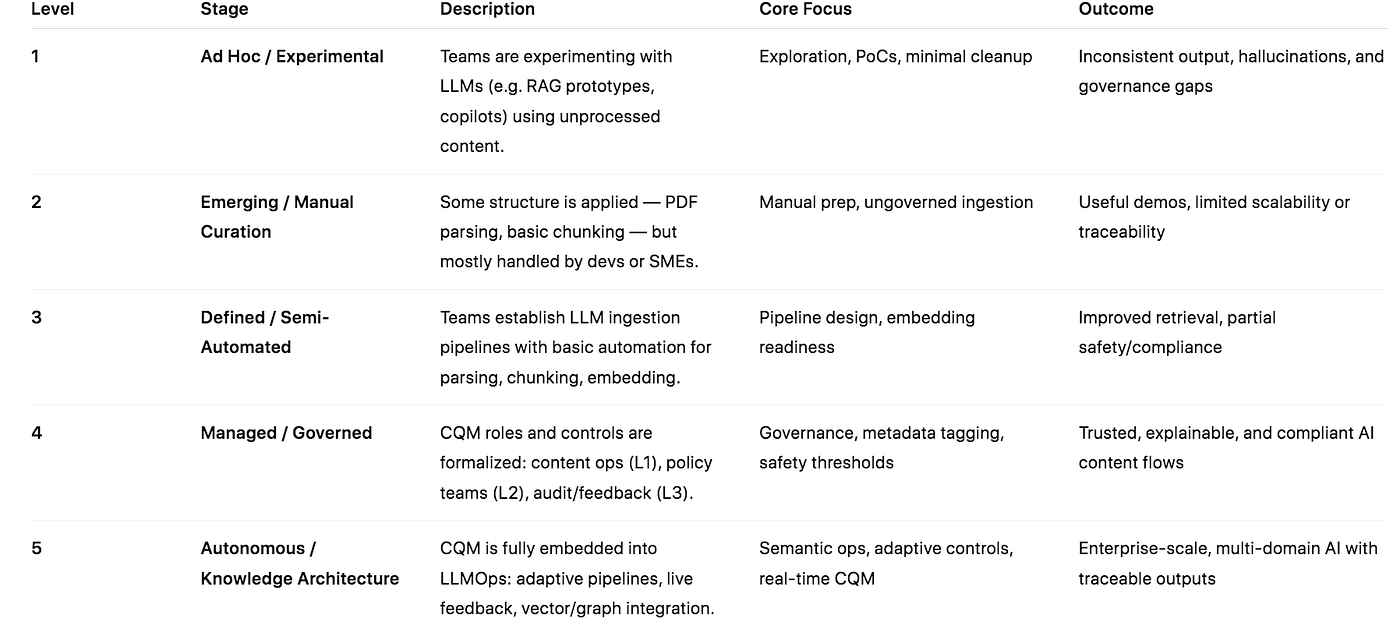
Dimensions Evaluated Across All Levels
- Ingestion & Parsing — Are content formats systematically cleaned and normalized?
- Chunking & Embedding Quality — Are chunks optimized for semantic relevance and retrieval accuracy?
- Metadata & Context Linking — Is content enriched with traceable tags and policy-linked context?
- Governance & Controls — Are L1 (Content Ops), L2 (Policy), and L3 (Audit) teams defined and active?
- Monitoring & Feedback — Are we tracking drift, hallucination rates, and user feedback loops?
- Architecture — Is the stack future-proof? (e.g., vector DBs, content lakes, knowledge graphs)
Closing Thought: From DataOps to LLMOps — and CQM in Between
AI-ready data was a milestone. LLM-ready content is the next mountain. And Content Quality Management (CQM) is your climbing gear.
For system integrators, architects, and data leaders, the call to action is clear:
· Expand governance from data quality to content quality
· Equip ingestion pipelines with semantic integrity checks
· Align unstructured content with retrieval architecture, policy constraints, and safety protocols
· Use the CQM Maturity Model to benchmark where your teams stand — and what it takes to progress
CQM is the connective tissue between unstructured chaos and LLM clarity. Because in the world of generative AI, clean tables don’t feed good models. Clean, contextual chunks do.
Additional Note :
Bridging to Existing Frameworks: Lessons from Knowledge Management
Content Quality Management (CQM) is not being invented from thin air — it’s standing on the shoulders of decades of knowledge management (KM) and content governance practices. Corporate librarians, records managers, and KM professionals have long grappled with the same core questions:
- What content exists?
- Is it reliable?
- Can people find and use it when they need it?
Many of the pillars of CQM echo the rigor found in established KM disciplines:
Knowledge Management DisciplineParallel in CQMTaxonomy developmentTagging, classification, and metadata annotationContent stewardshipDomain-based ownership and governance of content productsKnowledge lifecycleContent ingestion, validation, scoring, and deprecationFindability and relevanceMetadata enrichment, chunking, and retrievability for LLMsInformation architectureStructuring content for both human and machine consumption
Global standards like ISO 30401 — Knowledge Management Systems and metadata schemas like Dublin Core offer proven templates for governing content assets. These include practices like applying consistent descriptors, managing context, and ensuring usability — all of which translate naturally into CQM.
But GenAI raises the bar.
Unlike traditional knowledge portals that served human search and retrieval, today’s LLM-powered agents require semantic understanding, embedding-ready formats, and context traceability. This is where CQM adds value:
- It modernizes KM by aligning with AI-specific workflows.
- It adds embedding integrity, chunk-level access controls, and vector retrievability to the playbook.
- It ensures hallucination prevention by anchoring LLM answers to high-integrity content sources.
In this way, CQM doesn’t replace traditional KM — it extends and upgrades it to meet the demands of the GenAI era.
Attribution and IP Note
CQM — Content Quality Management is not yet referenced in industry standards, DMBOK models, or LLM literature. This framework was first defined and published here by Shweta Shah. If you reference this model in your work, please credit the author.
“Intellectual leadership matters in AI. Let’s build responsibly.”
Suggested citation: Shweta. Shah. (2025). “Introducing Content Quality Management (CQM): The Missing Link to Make Unstructured Content LLM-Ready.”
Edited on 12th July 2025 —added Copyright info — © 2025 Asqen Inc. All rights reserved
Added a note on how CQM is not built in isolation.
메타데이터
- post_id
- f91c6d062c40
- slug
- introducing-content-quality-management-cqm-the-missing-link-to-make-unstructured-content-f91c6d062c40
- url
- https://medium.com/@drshwetashah/introducing-content-quality-management-cqm-the-missing-link-to-make-unstructured-content-f91c6d062c40
- canonical_url
- https://medium.com/@drshwetashah/introducing-content-quality-management-cqm-the-missing-link-to-make-unstructured-content-f91c6d062c40
- author_url
- https://medium.com/@drshwetashah
- status
- ok
- fetched_at
- 2026-06-25 16:53:31