Basketball as Buddhism: It’s not the amount of breaths you take, but the strangers you hug!
There was a young, attractive, Latin couple standing behind me in the midtown bar on Saturday night, watching the NBA Finals Game 5. I’d…
Basketball as Buddhism: It’s not the amount of breaths you take, but the strangers you hug!
There was a young, attractive, Latin couple standing behind me in the midtown bar on Saturday night, watching the NBA Finals Game 5. I’d quarantined myself near the back of the room for most of the fourth quarter. I’m 6’2” and perpetually self-conscious about obstructing other peoples’ views — also a nervous wreck who needs to be able to pace during such games.
Fans were packed like sardines, probably about 200 in total, most glazed in perspiration due in part to the warm temperature of the room, potentiated by body heat, plus the stakes of the game.
I was accompanied by exactly who I’d wished, my younger brother and close friends from high school, those with whom I suffered through the many heartbreaks of the nineties and decades of pathetic irrelevance that followed.
We stood close to one another, but in a context of such density and intensity it’s easy to get separated by one or two strangers, which like living one or two neighborhoods away from a friend in Manhattan, equates to great distance. As the game neared its end, a victory appeared as realistic as the possibility that my friends would not be the closest to me in physical proximity when the final buzzer would sound. Knowing I couldn’t control myself should the Knicks win the first title of my life, I turned to the young Latin couple, with whom I’d already exchanged intermittent daps and comments, and asked for all the obvious reasons, “Is it okay if I hug you if we win?” To which they both shrugged matter-of-factly and replied: “No doubt.” Everyone was sweaty, everyone was gross, and everyone was together, physically, mentally, emotionally.
As a Buddhist, this is one of the things I love about sports. Its ability to dissolve the illusion of the individual, to fabricate, even if only momentarily and admittedly under the umbrella of egotistical attachment, one collective consciousness — not to mention one of unbridled joy and love should we receive our desired outcome.
It happened, and for the first time in my life as a fan I felt overwhelmed and outdone by the response, probably because I was nearly twice the age of most patrons in attendance. Immediately I found my brother’s shoulders to use as a manual pogo-stick. I reached for my oldest friend, who I’ve known since second grade but rarely get to see these days. We hugged as tightly as we could, felt our respective body sweats meld together, and said how much we loved each other, no doubt reflecting on the forty years (half a lifetime!) for which we’ve shared this dream. We released our loving embrace and returned to the chaos.
Drinks flew in the air, the noise level was temporarily alarming, everyone was bouncing up and down like the meaningless electrons we exist as in the galactic context. I could feel myself losing steam, losing stamina, my aging physical structure unable to match the joy I felt. I pressed pause on bouncing and raging to hug my brother again. I turned around to catch my breath and was face to face with the Latin couple I’d temporarily lost track of. The girl and I hugged, squeezing each other tightly, like a brother and sister reunited after 53 years, then we let go and I did the same with her guy. “I told you,” he reminded me. I hugged him again, laughing, and we went our separate ways, probably for the rest of our lives.
There were more hugs around the bar. Random joinings of other cyphers of strangers welcoming us with open arms, hugging me with open, sweat-filled arms, no one caring for anything except that we were finally champs.
One of the most boring, condescending platitudes offered by non-fans in response to such utterances is the obvious (hence boring): “You’re the champs? You achieved this?” Clearly not. But another example of how Buddhist philosophy is applicable to the love of sports. The disillusion of self, the equitable identification of someone else’s achievement, or their suffering, as our own. For those who can find flaws or criticism in such a sentiment I feel even greater pity than I do even for fans of teams that never win.
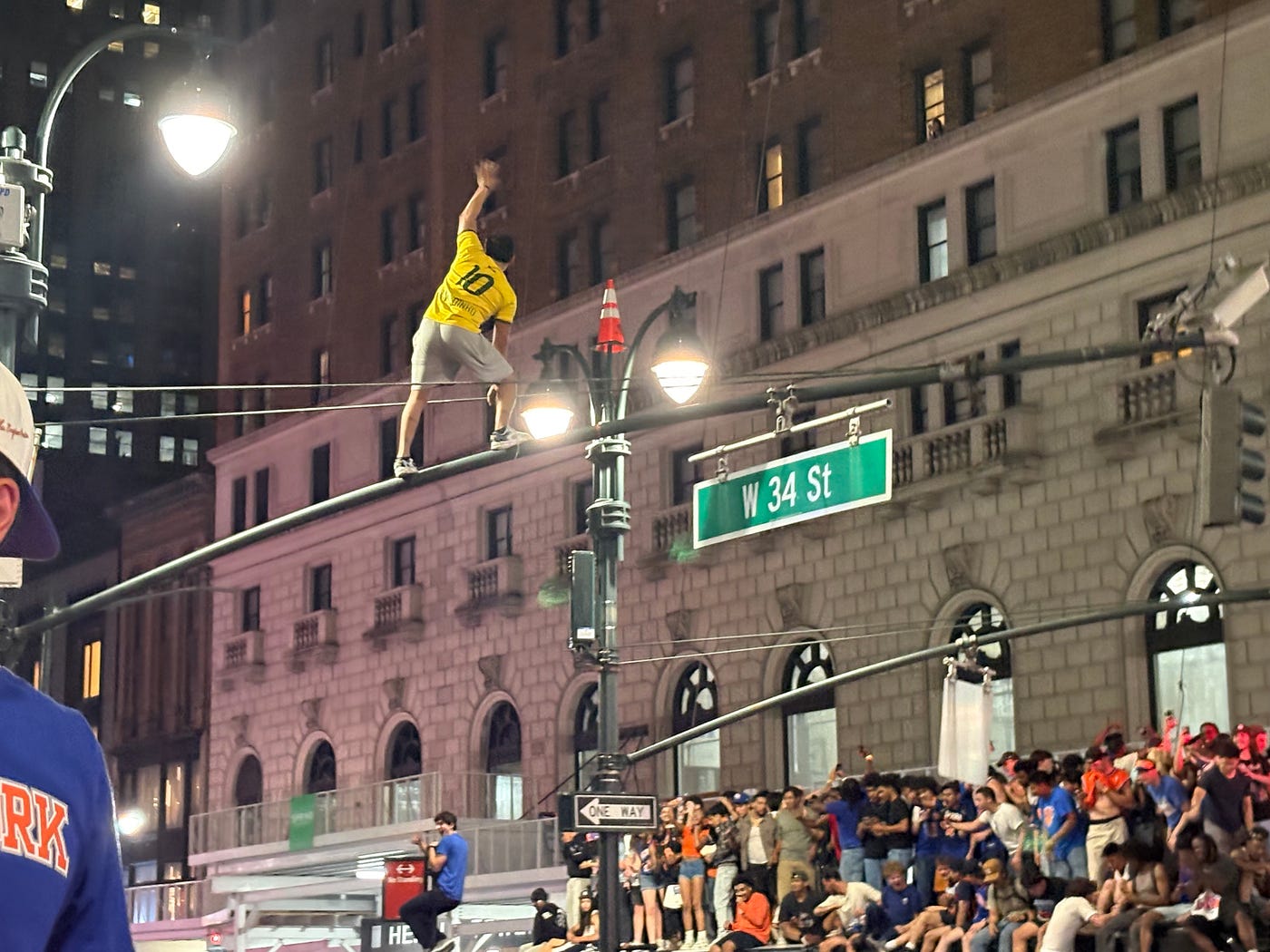
The bar piled out onto the street into a parade of nirvana — sure, the occasional “Fuck Wemby!” or “Fuck the Spurs!” but most of the focal point was the positive. High fives and impromptu dance routines, innocent flirtations between New Yorkers of every demographic, a city-wide ego-less celebration where it didn’t matter if you sounded tough, funny, or cool.
Only sports can do this. Literally, only sports can do this. People find authentic joy from countless other sources. Most of us have been lucky enough to fall in love and/or been the perfect amount of intoxicated at the perfect musical concert whereby we felt some degree of unification with the present whole. But while such experiences are fantastic and I recommend them, they lack sports’ element of unpredictability that gives birth to this explosive release. The unpromised, in fact perpetually unlikely reward of winning the lottery in the form of a championship. Just ask Buffalo Bills fans. You can live your whole life and it may never happen.
The opportunity to follow and observe a group of people who by way of God-given talent and immense dedication, are the absolute best in the world at what they do, and what they do, even on a surface level, happens to be exciting and suspenseful to spectate. Our group represents our home, which to varying degrees defines personal identities. Our teams become this unique force in their capacity to simultaneously distinguish us from others but also unite us as one. In most cases it transcends geographic identification into domestic ones, building and characterizing the bonds between loved ones, especially and most commonly fathers and sons.
My mom and dad had just begun to fall in love the last time the Knicks won. We followed the Knicks of the 90s together, and I’d hear the lore of the team my parents associated with their romance and respective heydays. My dad has been gone for about a decade and Mom has Alzheimer’s, but thanks to Alexa technology she was able to watch last week.
Sports, in my opinion are the perfect metaphor for life. Art is its perfect manmade expression, but sports are more telling inadvertently, rife with struggle, disappointment, and imperfection, until once in a while we reach the mountaintop. We get in the zone, experience that documented “flow state,” or “God state,” maybe with a temporary dash of God complex, and we find ourselves on top. If we can bring others with us — even one other, as in a business or marital partner, then look at us! We’ve made the world a better place.
If you’ve never hugged a mutually ecstatic stranger, my opinion is you’re missing out. It is so fun, so pure, and childlike. It reminds me of watching my four-year old daughter with her best friends at pre-school. Human embrace is intrinsic to us, and isn’t it cool that groups of jock Neanderthals playing with balls can incite such loving kindness? If there are 22 million people in the tri-state area and even 10% loved these Knicks (we know it was more) that means over two million people in a shared physical space shared one identical hope and dream for all their lives, then all realized it at the exact same time. Only sports can do this. That’s why we hug sweaty strangers. Jalen Brunson and the 2026 Knicks have reminded me to continue to strive and persevere no matter how bleak things look — more importantly of the Buddhist principle that we are all one, all united with the shared goals of love, joy, and self-actualization.
메타데이터
- post_id
- f93c8264c1cc
- slug
- basketball-as-buddhism-its-not-the-amount-of-breaths-you-take-but-the-amount-of-strangers-you-f93c8264c1cc
- url
- https://medium.com/@davidfosteracupuncture/basketball-as-buddhism-its-not-the-amount-of-breaths-you-take-but-the-amount-of-strangers-you-f93c8264c1cc
- canonical_url
- https://medium.com/@davidfosteracupuncture/basketball-as-buddhism-its-not-the-amount-of-breaths-you-take-but-the-amount-of-strangers-you-f93c8264c1cc
- author_url
- https://medium.com/@davidfosteracupuncture
- status
- ok
- fetched_at
- 2026-06-20 20:29:01