I Learned About Quantum Entanglement 7 Years Ago. I’m Still Not Over It.
The universe doesn’t break the speed of light. It does something weirder.
I Learned About Quantum Entanglement 7 Years Ago. I’m Still Not Over It.
The universe doesn’t break the speed of light. It does something weirder.
I remember the exact moment this broke me.
I was sitting in a coffee shop, half-listening to a podcast, when the host said something offhand, almost casual, about how two particles can be separated by billions of light-years and still affect each other instantly. Like, the moment you look at one, the other one knows.
I stopped walking mid-sip. (Yes, walking and sipping. It was a bad system.)
I rewound it. Listened again. Googled it. Fell down a rabbit hole that lasted until the barista asked me to leave because they were closing.
That thing the host mentioned? It’s called quantum entanglement. And I genuinely don’t know why it isn’t the thing everyone is talking about all the time, because it quietly suggests that everything we think we understand about space, distance, and reality might be (and I don’t use this word lightly) wrong.
Let me explain. And I promise I’ll keep it weird.
Einstein Set a Speed Limit. The Universe Seems to be Ignoring It.
Okay, first: the rule.
For over a century, physics has had one golden, non-negotiable law sitting at its center: nothing travels faster than the speed of light. Light moves at 299,792 kilometers per second. That’s fast enough to circle the entire Earth seven times in one second.
And Einstein didn’t just say this is the fastest thing we’ve built. He said it’s the fastest thing that can exist. Period. To exceed it would require infinite energy. More importantly, and this is the part people gloss over, breaking this rule doesn’t just mean going really fast. It means breaking causality itself. Effects could happen before causes. You could, theoretically, receive a message before it was sent. The entire architecture of “before” and “after” collapses.
So the speed of light isn’t a number. It’s the thing holding the plot of reality together.
Which makes what I’m about to tell you so deeply unsettling.
Two Particles Walk Into a Lab…
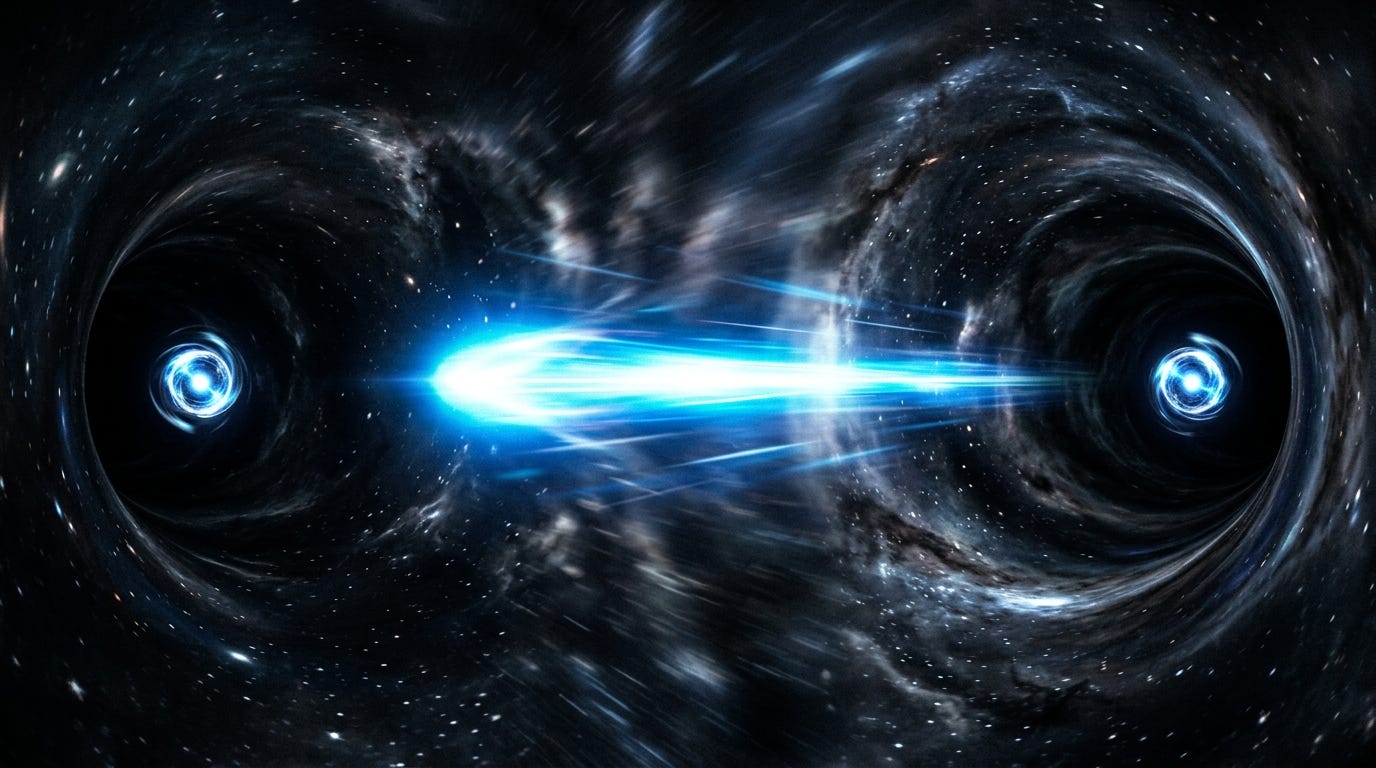
When certain particles interact under the right conditions (say, two photons born from the same source) something strange happens to them. They become entangled. Their quantum states get bound up together in a way that makes them, mathematically, a single system.
Then you separate them. Send one to New York, one to Tokyo. Or one to Earth and one to the other side of the galaxy. Doesn’t matter.
Now measure one of them. Force it to commit to a definite state: spin up or spin down, polarized this way or that.
The other one, wherever it is, instantly takes on the complementary state.
Not after a radio delay. Not after a light-speed lag. Instantly. Experiments have confirmed this happens at a minimum of 10,000 times faster than light. Some physicists think the actual answer is that “speed” doesn’t even apply here. That the correlation is simply outside the category of things that travel.
I want to pause here because I think it’s worth sitting in the strangeness for a second before we rush to explain it away.
Two particles. Separated by any distance in the universe. One gets poked. The other one knows.
Right. Okay. Moving on.
So Did We Just Find a Cheat Code?
This is where everyone’s brain goes. Mine did.
If they communicate instantly, can we use this? Can we send messages faster than light? Can we warn people about things before they happen? Can we just…
No. And the reason why is the most beautifully infuriating thing in physics.
Here’s the problem. Before you measure your particle, its state isn’t just unknown to you. It’s genuinely undecided. It doesn’t have a value. It exists in superposition, which is the quantum way of saying it’s simultaneously everything it could be, all at once, until you look.
The moment you look, it picks something. Randomly.
And that’s the catch. You didn’t choose what it picked. The universe did. So when your partner’s particle instantly snaps to its complementary state on the other side of the planet, from their perspective it just looks like their particle randomly decided something. They have no way to know if that was a signal from you or just… quantum noise.
To tell the difference, they’d need a reference from you. Context. A “key.” And that key has to travel the old-fashioned way: radio waves, fiber optic cables, carrier pigeon, whatever. All of which are capped at the speed of light.
The entanglement is instant. The meaning of the entanglement still crawls.
Einstein’s law survives. Barely. And with what feels like a very smug smirk.
But Here’s Why It Still Matters (A Lot)
I know what you’re thinking. “Cool loophole, universe. So it’s useless?”
Not even close.
Because even if we can’t send messages with entanglement, we can do something arguably more powerful: we can use it to build things that would’ve seemed like magic twenty years ago.
Quantum cryptography uses entangled particles to generate encryption keys. The security isn’t based on math that’s hard to crack. It’s based on physics that’s impossible to crack. If anyone tries to intercept the key, they have to observe the particles. Observing them disturbs the quantum state. The entanglement breaks. The system knows it’s been tampered with and the data self-destructs. You can’t eavesdrop on entanglement without leaving fingerprints at the subatomic level.
And then there’s quantum computing, which is where things get genuinely science-fiction. Classical computers (your phone, your laptop, the servers running every bank and government on earth) think in bits. 0 or 1. Off or on. Quantum computers use qubits, which thanks to superposition and entanglement can hold and process exponentially more states at once. Calculations that would take today’s best supercomputers longer than the age of the universe, quantum computers could potentially crack in an afternoon.
Drug discovery. Climate modeling. AI. Materials science. All of it gets turbocharged.
The “useless” phenomenon turns out to be the foundation of the next technological era.
Okay But What Is Actually Happening?
Here’s where I have to be honest with you: nobody fully knows.
And I find that more exciting than any of the applications.
One interpretation, and this is a real, serious, peer-reviewed one and not just poetic hand-waving, is that space itself might be an illusion.
Not metaphorically. Literally.
What we experience as distance, as “over here” versus “way over there,” might be a property that emerges from something deeper. And at that deeper level, the two entangled particles were never actually separated at all. They’re the same thing, wearing different costumes in the theatre of three-dimensional space.
Einstein spent the last decades of his life refusing to believe any of this. He was convinced quantum mechanics was incomplete. That there had to be hidden variables underneath the randomness, some clockwork we weren’t seeing that would restore sanity to the universe. He called entanglement “spooky action at a distance” and he didn’t mean it as a compliment.
But Einstein was wrong. Experiments stretching across decades, particularly those based on a devastatingly clever set of mathematical tests proposed by the Irish physicist John Bell, have closed every loophole. There are no hidden variables. The universe really is this strange, at this fundamental level, with no deeper layer of sensibleness waiting underneath.
The spookiness isn’t a bug.
It’s a feature.
The Thing I Can’t Stop Thinking About
I’ve read a lot about this now. Talked to people who study it. And there’s one image I keep coming back to that I can’t quite shake.
Somewhere in the universe, right now, there are two particles that interacted billions of years ago, before Earth existed, before our sun switched on, and they’re still entangled. Still correlated. Still, in some sense, the same thing pretending to be two things in two places.
And the distance between them, the vast and terrifying emptiness of space that seems so real and so absolute… maybe that distance isn’t the truth of the situation. Maybe it’s just the projection. The shadow. The surface.
Maybe the two particles know something about reality that we don’t.
I don’t know what to do with that. I’m not sure anyone does.
But I think about it every time I’m in a coffee shop, half-listening to something, about to have my brain rearranged.
It happens more than you’d expect.
메타데이터
- post_id
- f9473372d2c2
- slug
- i-learned-about-quantum-entanglement-7-years-ago-im-still-not-over-it-f9473372d2c2
- url
- https://medium.com/@ppp.mishra124/i-learned-about-quantum-entanglement-7-years-ago-im-still-not-over-it-f9473372d2c2
- canonical_url
- https://medium.com/@ppp.mishra124/i-learned-about-quantum-entanglement-7-years-ago-im-still-not-over-it-f9473372d2c2
- author_url
- https://medium.com/@ppp.mishra124
- status
- ok
- fetched_at
- 2026-06-16 19:09:56