Claude Code Is a Mess, Until You Install This Official Plugin
How One Plugin Helps Claude Understand Your Project, Recommend Tailored Automations, and Build Real Systems.Starting With a Resume Parser…
Claude Code Is a Mess, Until You Install This Official Plugin
How One Plugin Helps Claude Understand Your Project, Recommend Tailored Automations, and Build Real Systems.Starting With a Resume Parser Example.

There’s an official Anthropic plugin that goes far beyond suggesting generic improvements, it understands your entire codebase and helps you unlock the right AI capabilities for it.
To make this concrete, we’ll walk through a real Python project:
The Resume Parser Revolution.
We’ll start from a broad engineering workflow perspective.How AI can transform a simple script into a smart system and then gradually narrow down to how this plugin analyzes the project, understands its structure, and recommends exactly which automations, tools, and agents can upgrade it.
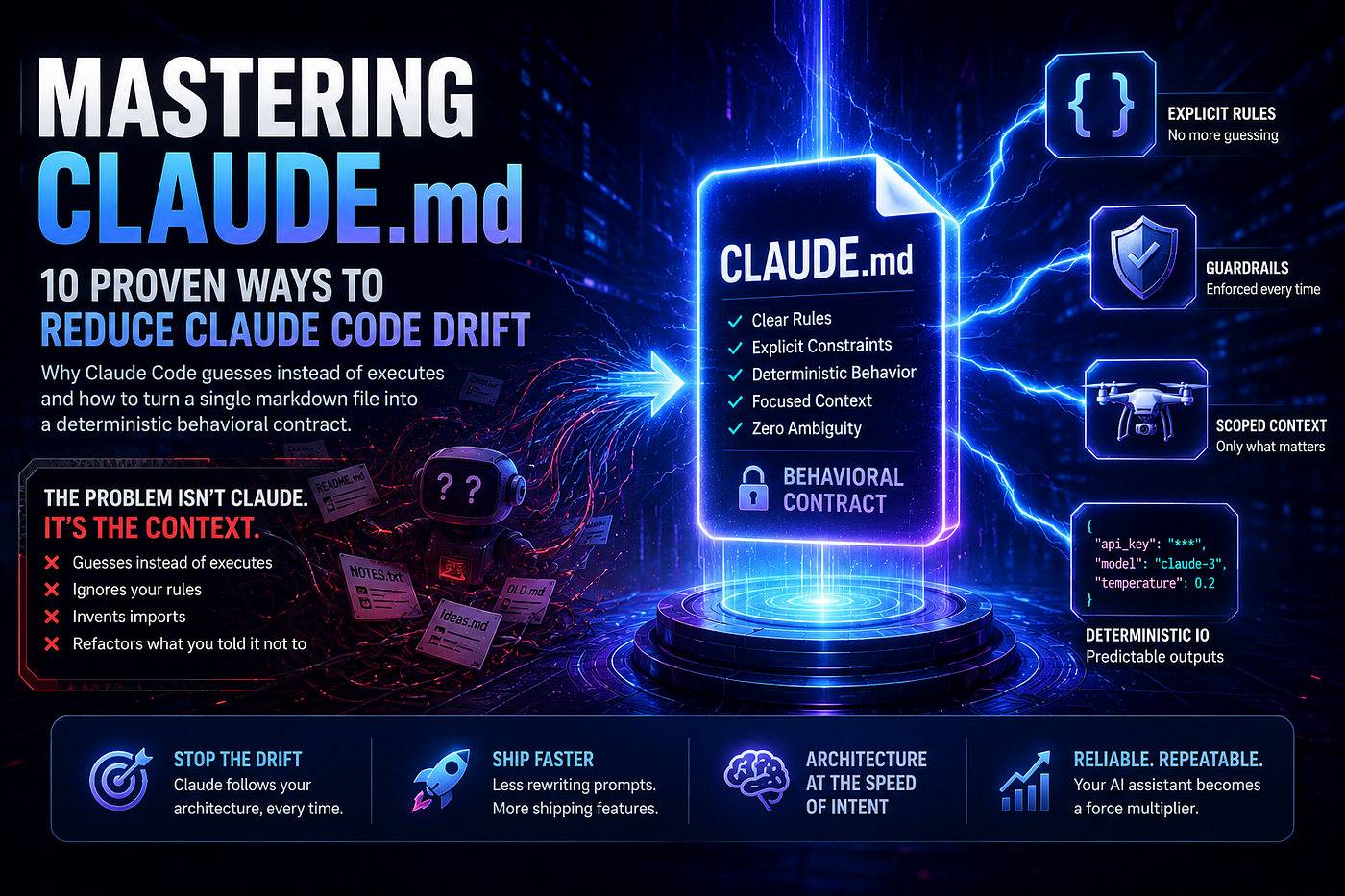
Most developers install Claude Code, try asking it to “help with a Python script,” and leave disappointed. Not because the model lacks power, but because it doesn’t see the bigger picture of the project.
*That’s exactly where
***claude-code-setup** changes the game: it turns Claude into a context-aware engineering co-pilot that understands your project first, then tells you what to build next.
What You’ll Discover in This Blog
We’re using a real Python resume parser as our working example, but the pattern applies to any project you bring into Claude Code.
Here’s how Claude Plugins + claude-code-setup transform your workflow:
- Claude Code detects your stack automatically.
- Claude Plugins recommend native MCP servers, skills, and agents.
- Hooks generated by the plugin auto-lint, auto-test, and protect sensitive files.
- Subagents deployed through the plugin system specialize in domain-specific tasks.
- Slash commands created by Claude Plugins turn complex workflows into one-liners.
The result? Claude Code stops being a chatbot that talks about your code and becomes an AI co-engineer that understands, extends, and safeguards it.
Let’s unlock it.
Before We Begin: Recommended blogs
To get the most out of this article, these two blogs will help you understand the bigger Claude Code ecosystem and why plugins matter so much.
Learn the command syntax, context handling, slash commands, and prompting patterns that actually make Claude Code productive in real engineering workflows.
Why it matters here: Plugins become dramatically more useful once you understand how Claude Code manages context, instructions, and execution flows.
Explore advanced features like memory, project awareness, hooks, session management, and team-oriented workflow patterns.
Why it matters here:
The claude-code-setup plugin plugs directly into this operating-system-like architecture, which is what enables tailored automations and project-aware behavior.
The Python Project: Before the Magic
resume-parser/
├── pyproject.toml          ← Poetry config, Python 3.11+, dependencies
├── src/
│   ├── parser/
│   │   ├── extractor.py    ← PDF/text parsing logic
│   │   ├── normalizer.py   ← Data cleaning & standardization
│   │   └── validator.py    ← Schema validation with Pydantic
│   ├── ml/
│   │   ├── classifier.py   ← Skills extraction with scikit-learn
│   │   └── embeddings.py   ← Vector embeddings for semantic search
│   └── api/
│       └── routes.py       ← FastAPI endpoints
├── tests/
│   ├── unit/
│   └── integration/
├── data/
│   ├── samples/            ← Example resumes (PDF, DOCX, TXT)
│   └── schemas/            ← JSON Schema definitions
└── .claude/                ← 🗝️ Currently empty…
    └── settings.json
This is where most teams stop. Claude can see your files but without context, it's like handing a brilliant intern a codebase with no onboarding docs.
The Fix: One Command, Infinite Context
# Inside Claude Code:
/plugin install claude-code-setup@claude-plugins-official
Then ask:
> recommend automations for this resume-parser projectWhat happens next?
claude-code-setup doesn't guess. It analyzes:
🔍 Scanning resume-parser/
├─ ✅ Detected: Poetry, FastAPI, Pydantic, scikit-learn
├─ ✅ Found: PDF parsing (pypdf), NLP (spacy), vector DB (chromadb)
├─ ✅ Identified: auth/ middleware, async workers, test fixtures
├─ ✅ Noted: .env.example, Dockerfile, GitHub Actions CI
│
💡 Generating tailored recommendations...
What It Recommends: 5 Python-Powered Categories
1️⃣ MCP Servers : Give Claude Real-Time Access to Your Stack
MCP (Model Context Protocol) servers let Claude interact with your tools, not just talk about them.
// .claude/settings.json — after setup
{
  "mcpServers": {
    "python-repl": {
      "command": "uvx",
      "args": ["mcp-server-python", "--project", "."],
      "description": "Execute Python code in your project's virtualenv"
    },
    "filesystem": {
      "command": "uvx",
      "args": ["@modelcontextprotocol/server-filesystem", "/resume-parser"],
      "description": "Safe, scoped file operations"
    },
    "chromadb": {
      "command": "uvx",
      "args": ["mcp-server-chroma", "--path", "./data/vectors"],
      "description": "Query resume embeddings for semantic search"
    }
  }
}
Now you can say:
> Parse this new resume PDF, extract skills, and check if the candidate matches our 'senior-engineer' embedding profileClaude will:
- Use
pypdfvia the Python REPL MCP to extract text. - Run your
normalizer.pylogic to clean the data. - Query ChromaDB for semantic similarity.
- Return a structured match score, all in one conversation.
*Without MCP? Claude would just describe how to do it. With MCP? It does it.*
2️⃣ Skills : Teach Claude Your Python Conventions
Skills are plain-language playbooks that encode your team’s patterns.
<!-- .claude/skills/resume-parsing.md -->

## Parsing Resumes in This Project
When extracting data from resumes:
1. Always use `src/parser/extractor.py::ResumeExtractor` as the entry point
2. Normalize dates with `dateutil.parser` + our `src/utils/dates.py` helpers
3. Validate output against `data/schemas/resume_v2.json` using Pydantic
4. Log parsing confidence scores to `logger.debug()` with context: `{"resume_id": ...}`
5. Never hardcode field mappings—use `src/config/field_aliases.py`

## ML Integration Rules
- New features must go through `src/ml/feature_engineering.py`
- Embeddings must use our `text-embedding-3-small` wrapper in `src/ml/embeddings.py`
- Always cache vector results in `data/cache/embeddings/` to avoid re-computation
Now when you ask:
> Add support for extracting GitHub profiles from resume headersClaude will:
- Edit
extractor.pyusing your class structure. - Add validation to the Pydantic schema.
- Update field aliases in config.
- Write a test in
tests/unit/test_extractor.py. - All following your actual conventions.
3️⃣ Hooks : Automate Guardrails at Key Moments
Hooks are Python/bash scripts that run automatically during Claude’s workflow.
# .claude/hooks/pre-edit.py
# Blocks unsafe edits before Claude modifies files

import sys, json, re
from pathlib import Path

data = json.load(sys.stdin)
file_path = Path(data.get("file_path", ""))

# Protect generated & sensitive files
PROTECTED_PATTERNS = [
    r"src/parser/_generated/.*",      # Auto-generated parsers
    r"data/samples/.*\.pdf",          # Raw resume files
    r"\.env.*",                        # Secrets
]

if any(re.match(p, str(file_path)) for p in PROTECTED_PATTERNS):
    print(json.dumps({
        "block": True,
        "reason": f"⚠️ {file_path} is protected. Use the CLI tool instead: `python -m resume_parser.cli extract`"
    }))
    sys.exit(0)

# Auto-format Python files after edit
if file_path.suffix == ".py":
    print(json.dumps({
        "post_action": {
            "command": ["ruff", "check", "--fix", str(file_path)],
            "description": "Auto-fix linting issues"
        }
    }))

print(json.dumps({"block": False}))
# .claude/hooks/post-test.sh
# Runs after Claude executes tests
pytest $@ --tb=short -q
if [ $? -ne 0 ]; then
echo "🔍 Running failure analysis with Claude..."
echo "Analyze these test failures and suggest fixes:" $(cat pytest-failures.log)
fiReal-world impact: When Claude touches src/auth/, a hook can auto-trigger a security subagent (see below) so no manual prompting needed.
4️⃣ Subagents : Specialists for Python-Specific Jobs
Instead of asking general-purpose Claude to do everything, spin up purpose-built agents.
# .claude/agents/resume-validator.yaml

name: resume-validator
description: >
  Specialized agent for validating resume parsing output.
  Checks schema compliance, data quality, and edge cases
  like missing fields, inconsistent date formats, or
  suspicious skill inflation.
skills:
  - skills/pydantic-validation.md
  - skills/data-quality-checks.md
  - skills/resume-fraud-patterns.md
trigger:
  - files_matching: ["src/parser/**", "tests/**/test_extractor*"]
  - on_command: "/validate-parse"
Now run:
> /validate-parse src/parser/extractor.pyThe resume-validator agent:
- Checks that all Pydantic models have
model_config = ConfigDict(validate_assignment=True) - Verifies error handling for malformed PDFs.
- Ensures test coverage for edge cases (scanned images, non-Latin scripts).
- Reports back with actionable suggestions.
5️⃣ Slash Commands : One-Liners for Complex Workflows
Custom commands that bundle multi-step Python workflows.
<!-- .claude/commands/benchmark-parser.md -->

Run end-to-end parsing benchmark:
1. Load 10 sample resumes from `data/samples/benchmark/`
2. Parse each with `ResumeExtractor` + timing instrumentation
3. Calculate: avg latency, memory peak, field completeness %
4. Compare against baseline in `data/baselines/v1.2.json`
5. Generate markdown report in `reports/benchmark-$(date).md`
6. If regression >5%, alert via `src/monitoring/alerts.py`

Usage: /benchmark-parser --samples=20 --compare=v1.2
Output:
/benchmark-parser
✅ Loaded 20 samples (PDF:12, DOCX:5, TXT:3)
⏱️  Avg parse time: 1.24s (±0.3s) — ✅ within baseline
🧠  Field completeness: 98.7% (↑1.2% vs v1.2)
⚠️  Regression detected: memory peak +7.1% in PDF parsing
🔍  Suggestion: Profile `pypdf` image extraction in extractor.py:142
📄  Report saved: reports/benchmark-20260507.md
What Happens When You Run recommend automations
claude-code-setup analyzes resume-parser/
        │
        ├── reads pyproject.toml
        │     → detects: Python 3.11, FastAPI, Pydantic v2, scikit-learn
        │
        ├── scans src/ structure
        │     → finds: parser/, ml/, api/, async workers
        │
        ├── checks data/ and tests/
        │     → notes: sample resumes, embedding cache, pytest fixtures
        │
        └── generates Python-tailored recommendations:

🔌 MCP Servers to add:
  → python-repl MCP        (detected Poetry virtualenv)
  → chromadb MCP           (detected vector search usage)
  → postgres MCP           (detected SQLAlchemy models)

📚 Skills to create:
  → resume-parsing.md      (standardize extraction logic)
  → ml-feature-engineering.md (ensure reproducible pipelines)

🪝 Hooks to configure:
  → pre-edit schema-guard  (protect Pydantic models)
  → post-test coverage-check (enforce 90%+ on parser/)

🤖 Subagents to install:
  → resume-validator       (quality assurance for parsed data)
  → security-auditor       (scan for PII leakage in logs)

⚡ Slash commands to create:
  → /benchmark-parser      (performance regression tracking)
→ /deploy-check (pre-production validation)Crucially: It doesn’t auto-apply anything. It explains why each recommendation matters for your resume parser — and lets you opt in, one by one.
The Plugin Ecosystem: Python-First, Community-Powered
claude-code-setup is just the entry point. The official Anthropic plugin marketplace (claude-plugins-official) now includes Python-specialized packs:
# Browse Python-focused plugins
/plugin discover --tag=python

# Install a resume-processing toolkit
/plugin install resume-tools@python-community

# See what's active
/plugin list

# Update all Python-related plugins
/plugin update --tag=python
Plugins bundle MCPs, skills, hooks, and agents into one install — no more hunting GitHub for compatible integrations.
📊 Before vs. After: The Resume Parser Transformation
BEFORE claude-code-setup
.claude/
└── settings.json  ← empty

Workflow:
> "Add LinkedIn URL extraction to the parser"

Claude:
- Guesses at your class structure
- Uses generic regex (breaks on international formats)
- Forgets to update the Pydantic schema
- Doesn't add a test case
- Skips logging the new field
AFTER claude-code-setup
.claude/
├── settings.json        ← MCPs: python-repl, chromadb, postgres
├── skills/
│   ├── resume-parsing.md
│   └── ml-feature-engineering.md
├── hooks/
│   ├── pre-edit-schema-guard.py
│   └── post-test-coverage-check.sh
├── agents/
│   ├── resume-validator.yaml
│   └── security-auditor.yaml
└── commands/
    ├── benchmark-parser.md
    └── deploy-check.md

Workflow:
> "Add LinkedIn URL extraction to the parser"

Claude:
✅ Edits `extractor.py` using your `FieldExtractor` base class
✅ Adds regex + fallback to `src/utils/urls.py` (your shared lib)
✅ Updates `ResumeSchema` in `schemas/resume_v2.json`
✅ Adds pytest case in `tests/unit/test_extractor.py`
✅ Logs extraction confidence with `logger.debug(context={...})`
✅ Runs `ruff` + `mypy` automatically post-edit
✅ Suggests: "Add this to the benchmark suite? (/benchmark-parser)"
Get Started in 5 Minutes
# 1. Ensure Claude Code is installed
pip install anthropic[claude-code]  # or use uv/pipx

# 2. Navigate to your Python project
cd resume-parser

# 3. Launch Claude
claude

# 4. Install the setup plugin
/plugin install claude-code-setup@claude-plugins-official

# 5. Trigger analysis
> recommend automations for this project

# 6. Activate recommendations incrementally
# Start with: python-repl MCP + resume-parsing skill
# Then add: pre-edit hook + resume-validator agent
Time invested: ~12 minutes Time saved: Hours per PR, forever.
Trust, Transparency, and Python Safety
Every plugin on claude-plugins-official passes Anthropic's security review. But because plugins can:
- Execute Python code via MCP
- Access your filesystem
- Install additional dependencies
Always:
- Click the plugin’s source link to review code before installing
- Start with read-only recommendations (
--dry-runmode available) - Use virtual environments (
uv venv,poetry shell) for isolation
claude-code-setupis built and maintained by Anthropic. For community plugins, treat them like any PyPI package: review, test, then trust.
Final Thought: Stop Prompting. Start Engineering.
Claude Code isn’t just a chatbot. It’s a programmable engineering partner but only if you give it context.
claude-code-setup closes the gap between AI that talks about code and AI that understands your codebase.
For your resume parser? That means:
Fewer parsing bugs in production
Faster onboarding for new team members
Automated guardrails for data quality
One-command benchmarks instead of manual profiling
The future of Python development isn’t just AI-assisted. It’s AI-integrated.
And it starts with one command.
/plugin install claude-code-setup@claude-plugins-official💬 Keep the Claude Code Conversation Going 🚀
If this shifted how you think about Claude Code + Claude Plugins, pass it along. Share it with the teammate still prompting blindly when the real fix was claude-code-setup, a tailored skill, or just the right MCP server.
💡 Got questions about:
- Designing effective Claude Plugin skills for your stack?
- Getting consistent outputs from Claude Code subagents?
- Configuring hooks that actually protect production code?
- Or just want to talk about what it actually takes to build reliable, AI-augmented workflows?
Let’s connect. Find me on LinkedIn: Mouez Yazidi 👋
References
메타데이터
- post_id
- f94e7cac723f
- slug
- claude-code-is-a-mess-until-you-install-this-official-plugin-f94e7cac723f
- url
- https://pub.towardsai.net/claude-code-is-a-mess-until-you-install-this-official-plugin-f94e7cac723f
- canonical_url
- https://pub.towardsai.net/claude-code-is-a-mess-until-you-install-this-official-plugin-f94e7cac723f
- author_url
- https://medium.com/@mouez.yazidi2016
- status
- ok
- fetched_at
- 2026-06-09 15:37:30