Can Consciousness Make You Immortal?
The pitch sounds irresistible. Your body is dying, your neurons are fading, but everything that makes you you, your memories, your…
Can Consciousness Make You Immortal?
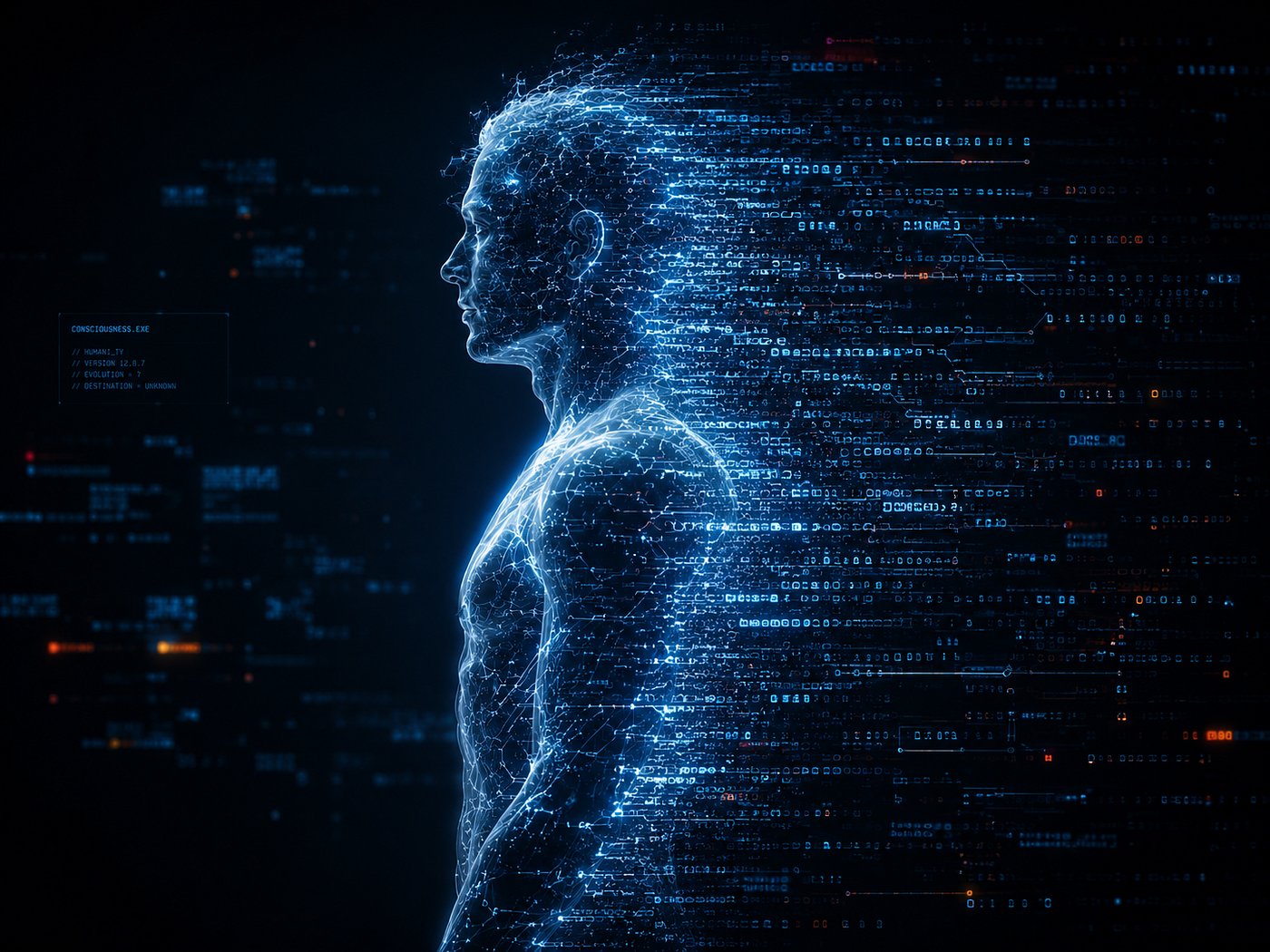
The body ends. But does the mind?
The pitch sounds irresistible. Your body is dying, your neurons are fading, but everything that makes you you, your memories, your personality, the way you laugh at bad jokes, could be extracted, digitized, and uploaded into a machine that will never age and never decay. You would live forever. Not your children, not your legacy. You.
This is the promise of mind uploading, also called whole brain emulation or consciousness transfer. And in 2026, it sits at an interesting crossroads: taken seriously enough by neuroscientists to attract real funding and real research, but still far enough from reality that anyone who promises it within the next decade is, to put it plainly, not being honest with you.
Before we get swept away by the vision, there is a more fundamental question that needs answering first. One that science, philosophy, and even the most advanced neurotechnology cannot yet resolve.
If we successfully copy every single neuron in your brain into a digital substrate, would the thing that wakes up on the other side be you? Or would it be an extremely convincing copy of you, while the original you simply ceased to exist?
What We Actually Know About Consciousness
Consciousness is one of the most studied and least understood phenomena in science. We know it exists because you are experiencing it right now. We know it is correlated with brain activity. We know that damage to certain brain regions changes it in specific, predictable ways.
What we do not know is why any of this produces subjective experience at all. Why does electrochemical activity between neurons feel like something? Why is there an “inside” to being you? This is what philosopher David Chalmers called the Hard Problem of Consciousness, and as of 2026, it remains unsolved.
This matters enormously for mind uploading, because the entire project assumes that consciousness is fundamentally computational, that it is, at its core, information processing. If you replicate the pattern of information processing in your brain, you replicate the consciousness.
But this assumption is not settled science. It is a philosophical position, and a contested one. There are at least three major competing theories about what consciousness actually is, and each gives a radically different answer to whether mind uploading is even theoretically possible.
Three Theories, Three Verdicts
The first is functionalism, the view most friendly to mind uploading. Consciousness, in this view, is entirely about what a system does, not what it is made of. A silicon circuit that processes information identically to a neuron would produce identical consciousness. If you replicate the function, you replicate the mind. Upload successful, the theory says.
The second is biological naturalism, associated with philosopher John Searle. Consciousness, in this view, is not just about computation. It is a biological phenomenon produced by specific physical processes in organic brain tissue. Neurons do not just process information; they do something chemically and biologically that silicon cannot replicate. In this view, a perfect digital copy of your brain would be a very sophisticated simulation of consciousness, but not consciousness itself. The lights would appear to be on. But nobody would be home.
The third, and most radical, is integrated information theory developed by neuroscientist Giulio Tononi. Consciousness is a specific kind of integrated information structure, measurable by a value he calls phi. A digital simulation of the brain might have very low phi, even if it behaviorally appears identical to the original. In this view, the upload would pass every behavioral test for consciousness, answer all your questions correctly, recall all your memories, claim to feel everything you feel, but may not actually be conscious in any meaningful sense.
The uncomfortable truth is that we do not yet know which of these theories is correct. And the answer changes everything.
The Copy Problem Nobody Talks About
Even if we set aside the question of what consciousness is, there is a deeper problem with mind uploading that rarely gets discussed in the breathless coverage of transhumanism.
Suppose the upload works perfectly. A digital version of you wakes up, remembers your entire life, feels continuous with who you were, and is by every measure indistinguishable from you. Meanwhile, you, the biological original, are still lying on the table.
What happens next?
If you survive the uploading process, there are now two of you. Which one is the real you? If the digital copy is genuinely you, then the biological you is a duplicate that needs to be eliminated for the question to even make sense. If the biological you is eliminated first, then the digital awakening is not a continuation but a beginning. A new entity that inherits your past but never actually experienced the transition.
This is called the teleportation problem in philosophy of mind, and it reveals something deeply uncomfortable: what we intuitively mean by “I will survive” may be fundamentally incompatible with what mind uploading actually does. Uploading may preserve your information while ending your existence, which is a very different thing from immortality.
Where the Science Actually Stands in 2026
The research landscape is real but humbling. As of early 2026, no human neurons have been perfectly replicated in silico. No consciousness has been uploaded. Connectomics, the mapping of neural connections, has made genuine progress with tools like SmartEM allowing researchers to map increasingly detailed sections of neural tissue. Brain-computer interfaces are becoming more sophisticated, with companies pushing the boundaries of reading and writing neural signals.
But the gap between mapping a brain and emulating a brain is enormous. The human brain contains roughly 86 billion neurons with an estimated 100 trillion synaptic connections, each connection dynamic and constantly changing, influenced by chemistry, temperature, and physical state in ways we are only beginning to understand. Even if we solved the hardware problem, we would still face the fundamental question of whether the map is the territory.
Brain researcher Dobromir Rahnev has argued that mind uploading will one day become reality, and he is not alone. But the realistic scientific consensus is that whole brain emulation capable of genuine consciousness transfer is likely 30 to 40 years away at minimum, if it is possible at all. Anyone promising this within the next decade should be asked to show their work.
What This Means for How We Think About Identity
The mind uploading debate is ultimately not just a technical question. It is a question about what you are.
If you are your information, your patterns of thought and memory and personality, then uploading preserves you. If you are the continuous stream of experience that has been running since you were born, the unbroken thread of awareness that moves through time, then uploading does not preserve you. It makes a very good photograph of you and calls it you.
There is a thought experiment worth sitting with. Imagine that the upload process takes one second. During that one second, the original you ceases to exist, and the digital you begins. From the outside, nothing changes. The digital you wakes up, remembers going to sleep, and continues living. From the outside, it is a perfect continuation.
But what happened to the awareness that was running during that one second? Did it simply continue into the digital substrate? Or did it end, with a new awareness beginning that merely remembers having been you?
This question cannot be answered by neuroscience alone. It cannot be answered by philosophy alone. It sits at the intersection of both, and of something else: our deepest intuitions about what it means to be a self at all.
The Thing We Keep Avoiding
The pursuit of mind uploading is, at its root, a flight from death. And there is something worth examining in that flight. Not to dismiss it, death is genuinely terrifying, and the desire to continue existing is one of the most fundamental drives in human life. But the promise of mind uploading often papers over a question that its proponents rarely ask directly.
If what continues is a copy, even a perfect copy, what exactly has been saved?
Your loved ones would still lose you. The experience of being you, that particular stream of awareness that has been navigating the world from inside your skull, would still end. What remains would be an extraordinarily detailed memorial, one that could speak and respond and claim to be you. But whether it would actually be you depends on answers to questions we do not yet have.
This is not an argument against the research. Mapping the brain in detail has enormous value for medicine, for understanding neurological disease, for building better AI. These are worth pursuing on their own terms.
But we should be careful about what we are actually being sold when someone promises to let you live forever in a machine. The science is real and genuinely interesting. The immortality part is still, for now, philosophy.
And philosophy, unlike neurons, does not yet have a substrate to upload into.
메타데이터
- post_id
- f950a85eed90
- slug
- can-consciousness-make-you-immortal-f950a85eed90
- url
- https://medium.com/@densidik858/can-consciousness-make-you-immortal-f950a85eed90
- canonical_url
- https://medium.com/@densidik858/can-consciousness-make-you-immortal-f950a85eed90
- author_url
- https://medium.com/@densidik858
- status
- ok
- fetched_at
- 2026-07-21 12:40:50




