When SWIFT Met ESG: Building the Interoperability Stack to Save the Planet (and Your Balance Sheet)
Legacy financial plumbing wasn’t built for carbon accounting. Here’s how the quietest revolution in banking is making old systems speak a…
When SWIFT Met ESG: Building the Interoperability Stack to Save the Planet (and Your Balance Sheet)
Legacy financial plumbing wasn’t built for carbon accounting. Here’s how the quietest revolution in banking is making old systems speak a new language.
The Open Working Group — O)W(G
It’s 7:42 a.m. in Frankfurt, and inside the operations floor of a 150-year-old global bank, a senior compliance officer named Katja stares at two screens. On the left, a SWIFT terminal displays a blizzard of MT messages – MT103, MT202, and MT940 – each a tiny, cryptic poem of international payments, decades old and indestructible. On the right, a sleek ESG data platform hums with charts of Scope 3 emissions, supplier biodiversity scores, and near-real-time deforestation alerts pulled from satellites.
The systems are separated by three meters of desk and about thirty years of technological philosophy. And today, Katja needs them to talk. A regulator in Brussels has just asked the bank to prove that a $400 million trade finance facility extended to a commodity trader in Singapore does not finance illegal palm oil plantations. The evidence is scattered: the payment history is in SWIFT’s walled garden of BICs and field tags, while proof of sustainable origin is in an ESG platform that uses JSON, AI-assisted assurance outputs, and blockchain-anchored certificates.
This is not a software integration problem. It’s a Rosetta Stone moment. And the only thing that can save Katja from a weekend of copy-pasting transaction references into spreadsheets is something the industry is just beginning to assemble: the interoperability stack.
The Two Worlds That Must Collide
To understand why this stack matters, you have to appreciate the chasm it bridges.
On one side stands SWIFT — the Society for Worldwide Interbank Financial Telecommunication. Born in 1973, it remains the backbone of cross-border finance, carrying on the order of 40–45 million messages a day depending on the metric and period measured. Its language is structured, rigid, and brilliantly resilient. An MT760 guarantee message still looks largely like it did when David Bowie was topping the charts. SWIFT is the reason a bank in Japan can trust a payment instruction from a bank in Chile without ever having met. It’s a masterpiece of trust infrastructure, but it was designed in a world where “green” was just a colour on a banknote.
On the other side, a sprawling ecosystem of ESG platforms has erupted: CDP, Sustainalytics, EcoVadis, along with proprietary platforms like Goldman Sachs’s “Green Storm” or HSBC’s “ESG Explorer". These systems consume unstructured data — news articles, satellite imagery, IoT sensor streams, and corporate disclosures — and spit out scores, risk ratings, and compliance flags. They are dynamic, cloud-native, and obsessed with narrative context. But they know little or nothing about the correspondent banking relationships, currency settlement chains, or trade instrument lifecycles that move the actual money.
The result is a massive semantic and technical gap. Banks are pouring billions into sustainability pledges while their core transactional nervous system remains blissfully unaware of the ecological consequences of the flows it enables. We have, in effect, built a state-of-the-art conscience for finance — but it’s not plugged into the brain stem.
The Tower of Babel
I spent the last six months talking to architects at several global transaction banks and a fintech that builds middleware for ESG integration. What I heard was a mix of excitement and exhaustion. One engineer described his current job as “translating mediaeval Latin into Python".
The problem isn’t just that SWIFT messages lack a field for “carbon intensity” or “deforestation risk flag". It’s deeper. Even the modern incarnation, ISO 20022, replaces MT messages across many payment flows and was designed for richer payment data, not for sustainability attributes. Yes, you can stuff an XML tag with almost anything, but that doesn’t make it interoperable. Without a common taxonomy, one bank’s <EnviroRisk>low</EnviroRisk> is another’s <ESG_Score>73</ESG_Score>. The machines don’t understand meaning; they just move structured noise.
And the ESG world is its own Tower of Babel. One platform’s “transition risk score” is another’s “Paris alignment metric". There are hundreds of ESG rating methodologies and frameworks globally. If you simply map SWIFT fields to an ESG platform’s API, you’ve created a point-to-point fragile connection that breaks every time a methodology is updated or a new regulation drops. What we need isn’t a one-off bridge — it’s a universal translation layer that can evolve.
That’s the interoperability stack.
The Stack, Layer by Layer
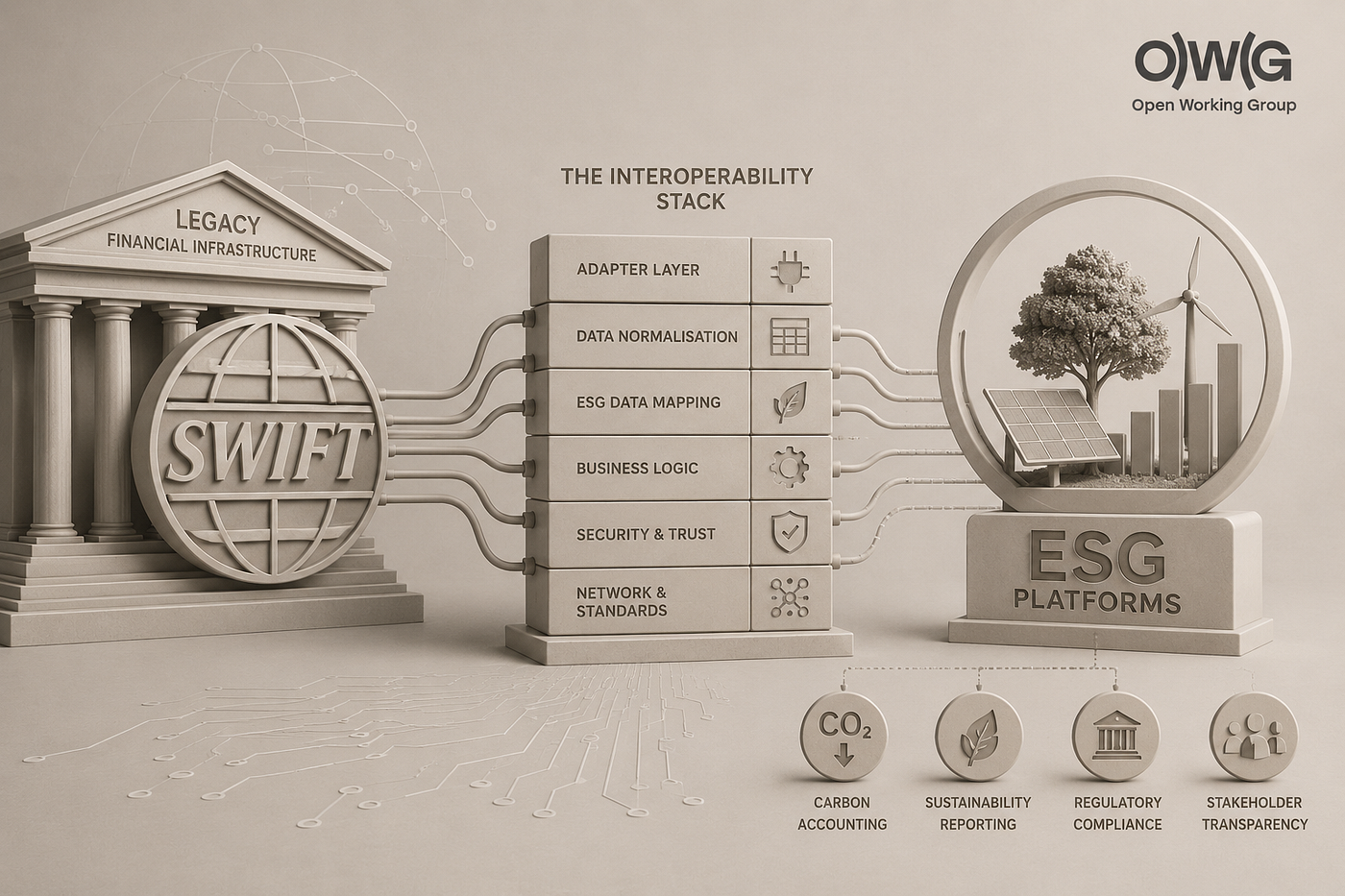
Think of the stack as a logical architecture, not a single product. It’s a set of protocols, middleware components, and governance rules that sit between the transactional world and the sustainability world. When I diagrammed it with a couple of CTOs over coffee, it kept coming out as five layers — like a modernised OSI model for green finance.
Layer 1: Data Extraction & Canonicalisation
The bottom layer pulls SWIFT messages — whether legacy MT or newer ISO 20022 formats — and converts them into a canonical event stream. This is not just parsing; it’s about entity resolution. A single trade transaction might generate a dozen messages: an MT700 letter of credit issuance, an MT400 advice of payment, and a couple of MT202s for settlement. The stack needs to stitch these together into a coherent “transaction lifecycle object” with resolved counterparties, ideally using BIC-to-LEI mapping, which remains a major data-quality challenge. Only then does it become a meaningful unit that can be assessed against ESG criteria.
Layer 2: Semantic Mapping & Ontology Alignment
Here’s where the heavy intellectual lifting happens. The stack must translate the canonical transaction into a sustainability query. This requires a shared ontology — a formal representation of concepts like "counterparty", “beneficial owner", “end-use of funds", and “sector of activity" and their relationships to ESG dimensions. Initiatives such as FIBO, extended with ESG concepts, are promising building blocks, while the EU Taxonomy provides a regulatory reference point in Europe. This layer might ask: “Given this payment chain, which legal entity is the ultimate borrower? What is its NACE code? Does the end-use description match a restricted activity under the EU Taxonomy?” It transforms a SWIFT narrative (“shipment of crude palm oil”) into a structured ESG question.
Layer 3: Orchestration & ESG Platform Queries
Once you know what to ask, the stack becomes an intelligent router. It doesn’t just call a single ESG API. It might need to pull a supplier’s deforestation score from one provider, a vessel’s IMO number from a logistics database to check its carbon efficiency, and a corporate bond’s green certification from a registry. This is a mesh of microservices, triggered by the transaction event, caching results, and handling timeouts elegantly. The key is that the stack abstracts away the individual platform APIs so that if you switch from one vendor to another next year, you reconfigure the orchestration layer, not the entire banking application.
Layer 4: Decision & Signal Injection
Now the stack produces a standardized “ESG signal” that can be injected back into the operational flow — ideally before a transaction is finalized. Imagine a compliance officer about to release a high-value payment. The stack assesses the transaction quickly and returns a simple verdict: “Green: aligned with internal policy and EU Taxonomy.” “Amber: supplier has moderate deforestation concerns — enhanced due diligence required.” “Red: counterparty on sanctions/ESG blacklist.” This isn’t just a dashboard; it’s an API call that could auto-block a payment or force a manual review within the existing payment processing system. That’s a profound shift from post-trade reporting to pre-trade steering.
Layer 5: Immutable Audit & Regulatory Reporting
Because regulators demand proof, the final layer creates a verifiable, tamper-evident record. Every mapping decision, every external data call, every generated signal is logged and cryptographically hashed. Some banks are experimenting with anchoring these audit trails to distributed ledgers so that a supervisor can independently verify that the ESG check was performed correctly on a given day without having to trust the bank’s own logs. This closes the loop: the SWIFT message that moved the money becomes permanently linked to the evidence that the money was clean.
The Hardest Layer Is Meaning
If you’re a tech optimist, this stack sounds like a straightforward integration project. It is not. The true difficulty sits in Layer 2 — the semantic mapping — and it’s a governance nightmare, not a coding problem.
Take a real-world example from the palm oil industry. A transaction message might reference a shipment of “CPO” (crude palm oil) from a mill in Indonesia. The ESG platform flags the mill as “high risk for deforestation based on satellite monitoring.” But the bank’s trade finance department knows the mill was recently certified by RSPO (Roundtable on Sustainable Palm Oil). Does the RSPO certification override the satellite alert? How recent must the certificate be? Who decides? The stack must codify these conflict-resolution rules, and they are inherently contested. Different banks, different jurisdictions, different NGOs will answer differently. If the interoperability stack doesn’t embed a transparent and auditable decision-logic framework, it will simply automate greenwashing at scale.
I spoke to a data architect at a Nordic bank who told me they had to abandon a promising semantic AI tool because the model kept hallucinating ESG classifications from ambiguous SWIFT narrative fields. “It saw ‘natural rubber’ and decided it was sustainable because ‘natural’ is a nice word,” he said. “We needed a human-in-the-loop rule book, not just a transformer model.” The stack must marry machine learning with explicit business rules that can be debated in boardrooms, not just in notebooks.
From Burden to Strategy
Despite the complexity, the banks that get this right won’t just satisfy regulators — they’ll rewire their entire business. Right now, most ESG integration is about reporting what has already happened. The interoperability stack enables something far more powerful: sustainability-informed capital allocation in near real time.
Think about supply chain finance. A corporate buyer could instruct its bank to automatically pay suppliers 2% early, but only if those suppliers’ live ESG scores from an independent platform exceed a threshold — and to route the payment via a “green corridor” that may, in some policy discussions, be associated with lower capital treatment. All of this would be executed by the stack, pulling the SWIFT payment engine levers based on a dynamic sustainability rulebook. That transforms ESG from a cost center into a liquidity and pricing tool.
Another mind-bending possibility: programmable ESG covenants. Imagine a syndicated loan agreement where the interest rate is algorithmically tied to the borrower’s real-time carbon intensity, verified by IoT meters at their factories and communicated via the stack back to the agent bank’s SWIFT-driven loan servicing system. Breach a carbon budget, and your next interest payment ticks up automatically — no human intervention, no Excel spreadsheet, no argument. This turns static green loans into responsive sustainability contracts, although legal enforceability would still depend on contract language and local law.
The Middleware Race
So who builds this stack? A land grab is underway. Fintechs like Finbourne, Solidatus, and Greenomy are pitching ESG data fabric solutions. Big cloud providers are offering data integration skeletons. SWIFT itself is not sitting still; its corporate and KYC-related initiatives, along with the ongoing ISO 20022 migration, are expanding the amount of structured data available in the financial plumbing. But I suspect the real battle will be between existing banking core providers who are layering ESG modules onto their payment hubs and a new breed of platform-agnostic middleware players who promise a “bring your own ESG” approach.
The winners will be those who understand that the stack is not a product — it’s a protocol. And protocols need community governance. We’re already seeing embryonic standards: PCAF for financed emissions, the Global LEI system for entity identification, and a range of open sustainability taxonomy efforts. What’s missing is a binding way to express: “For a trade finance transaction, the ESG signal must be computed using data sources X, Y, Z, with conflict rule R, and the result attached to the ISO 20022 message as a structured supplementary data block.” That requires an industry accord, similar to how SWIFT itself operates as a cooperative.
Katja’s Monday Morning
Let’s rewind to Frankfurt, three years forward. Katja logs in. The same two screens exist, but they’ve merged into a single workflow. A flagged payment from the Singapore trader sits in her queue. She clicks it. The system has automatically assembled the full trade lifecycle, mapped the mill’s LEI, pulled real-time deforestation alerts, checked the RSPO certificate’s validity via an API, and overlaid the bank’s internal policy. The verdict is “Amber — spatial overlap detected but certified sustainable; enhanced due diligence required.” She drills into the satellite imagery to visually inspect the forest boundary, then clicks "Accept". The payment is released with a cryptographic attestation of the entire decision trail automatically appended to the SWIFT gpi tracker.
She gets up to grab a coffee. The whole thing took four minutes.
That’s not science fiction. It’s the interoperability stack, quietly rewiring the global financial system’s sensory system so that money not only talks but also sees, measures, and bears witness to its own impact. The question is no longer whether legacy SWIFT systems can talk to ESG platforms. It’s whether we have the collective will to teach them a language worth speaking.
Short source list
- SWIFT traffic and message-volume context: SWIFT Traffic Highlights.
- SWIFT historical volume milestone context: Swift daily messaging volumes exceed 30 million mark.
- ISO 20022 / SR2026 migration context: Why Swift’s SR2026 Matters.
- ESG reporting interoperability context: ESRS–ISSB Standards — Interoperability Guidance.
- High-level ESG framework interoperability overview: What is the interoperability between ESG reporting standards?.
메타데이터
- post_id
- f953bba9df8e
- slug
- when-swift-met-esg-building-the-interoperability-stack-to-save-the-planet-and-your-balance-sheet-f953bba9df8e
- url
- https://medium.com/@tradefin101/when-swift-met-esg-building-the-interoperability-stack-to-save-the-planet-and-your-balance-sheet-f953bba9df8e
- canonical_url
- https://medium.com/@tradefin101/when-swift-met-esg-building-the-interoperability-stack-to-save-the-planet-and-your-balance-sheet-f953bba9df8e
- author_url
- https://medium.com/@tradefin101
- status
- ok
- fetched_at
- 2026-06-10 15:53:41