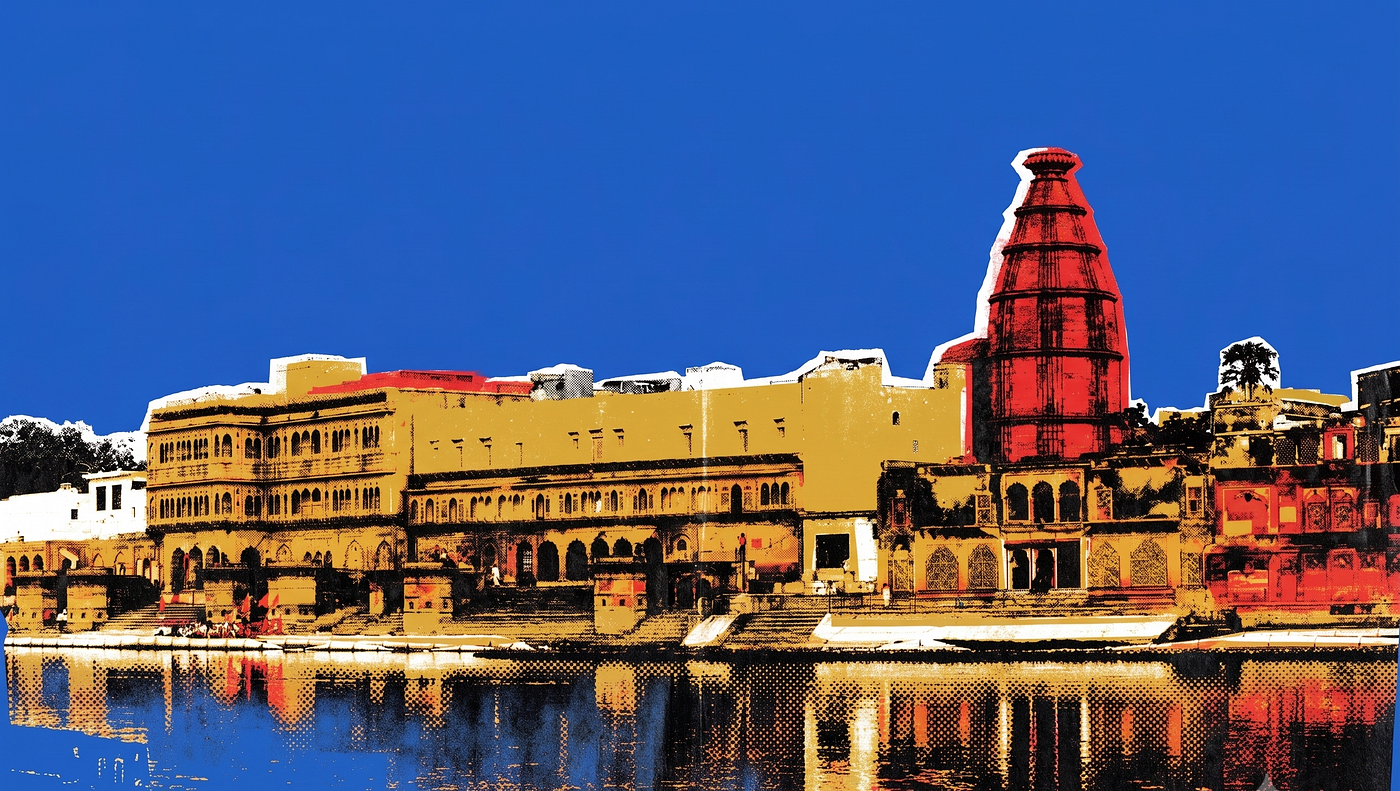
The Epic of a Billion Faces: Why the Mahabharata is Actually a Collection of Your Neighborhood…
If you visit a kathakali performance in the humid, coastal belt of Kerala, take a train up to a dusty town in Punjab, and then fly across…
The Epic of a Billion Faces: Why the Mahabharata is Actually a Collection of Your Neighborhood Stories
If you visit a kathakali performance in the humid, coastal belt of Kerala, take a train up to a dusty town in Punjab, and then fly across to a village in the heart of Bengal, ask the locals to tell you the story of the Mahabharata.
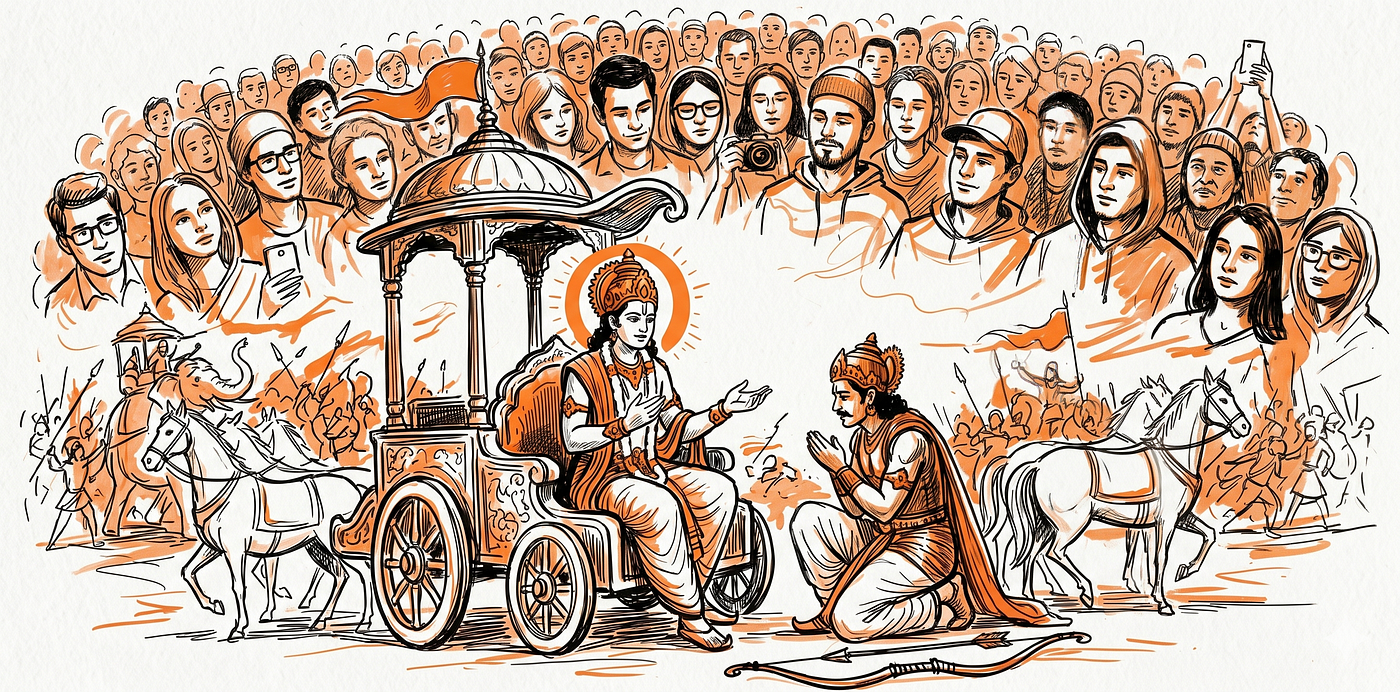
Krishnas Gita and Mahabhrata in Modern Context
You won’t get the same narrative. Not even close.
We’re usually taught to view this epic as a massive, untouchable monument, a single, rigid book written down by the sage Veda Vyasa. It’s framed as this pristine, unchangeable chronicle of a ancient royal war fought on the distant plains of Kurukshetra.
But if you look closely at the seams, you realize it isn’t a monolith at all. It’s more like a massive, thousand-year-old group chat where everyone was allowed to insert their own family drama, regional ghost stories, and neighborhood gossip.
The core plot, the bitter family feud over a throne, is really just a skeleton. Over centuries, local storytellers and tribal communities took those bones and wrapped them in their own flesh, blood, and local heartbreaks. The epic didn’t just shape Indian culture, regional cultures literally built the epic from the ground up.
A Story About People Telling Stories
The text doesn’t even try to hide this. Right from the opening pages, the Mahabharata isn’t a direct lecture from a lone author. Instead, it’s structured like a giant game of telephone. We see wandering bards arriving at a forest gathering, repeating what they heard at a royal sacrifice, which itself was a retelling of an older account.
It’s basically an ancient confession: this is a collection of voices.
Think of the main Kuru lineage as the “Big Story.” As this northern tale traveled down the Gangetic plain and crossed the Vindhya mountains, it ran straight into thousands of “Little Stories.” To make the epic actually mean something to a farmer in Karnataka or a fisherman in Tamil Nadu, the narrative had to open its doors. It had to absorb local heroes, validate village gods, and give ordinary people a stake in the cosmic battle.
How Different Regions Completely Flipped the Script
When the story traveled, it didn’t just conquer communities, it adapted to them. The ways different regions completely rewrote major plot points tell us a lot about how diverse the subcontinent’s headspace really is.
Down South: Making Villagers the Ultimate Heroes
When the northern story filtered into Southern India, it collided with deeply rooted Dravidian traditions, specifically Bhuta (spirit) worship and a fierce historical culture of building “hero stones” (Viragal) for local warriors who died protecting their villages.
The classic Sanskrit text treats characters like Karna or Duryodhana as tragic, complicated villains. But in southern folk traditions, those rigid moral lines evaporated.
Take Iravan, Arjuna’s half-tribal son. In the elite Sanskrit version, he’s a background character who gets sacrificed before the first arrow is even shot. But in Tamil folklore? He became a deeply loved deity, a symbol of ultimate sacrifice, and the centerpiece of a massive annual festival that draws thousands of people to this day.
Regional poets also had zero issues challenging northern political hierarchies. Back in the 10th century, the great Kannada poet Pampa wrote his own version, the Pampabharata. Writing for a local king, Pampa completely hijacked the ending. He didn’t care about Yudhishthira being the righteous eldest brother, he made Arjuna the absolute center of the universe and crowned him king instead, mostly because it made his own royal patron look good.
Out West: Trading War Tactics for Devotion
Head over to Gujarat or Rajasthan, and the entire vibe of the war changes. The gritty, political military strategies get completely swallowed up by the early Bhakti movements and the pastoral, cowherd lore of Krishna.
Through coastal ballads and local dance traditions, the focus shifted away from Arjuna’s arrows and entirely toward Krishna’s grace. This perspective heavily shaped the Harivamsa (the traditional appendix to the epic). It reads less like a war manual and more like an intimate, rural collection of tribal feuds, cattle raids, and forest romances. In Rajasthan, local folk-heroes like Gogaji were slowly stitched directly into Krishna’s family tree, turning a bloody political tragedy into a deeply personal devotional refuge.
In the East: Mud, Monsoons, and Human Tears
If the Western versions made the epic divine, the Eastern traditions made it devastatingly human. In Odisha and Bengal, poets stripped the characters of their royal, stoic armor and made them weep, rage, and live like normal, everyday people.
Look at the 15th-century Odia Mahabharata by Sarala Das. He wasn’t a court scholar writing in pristine Sanskrit, he was a farmer who wrote in the language of the soil. He placed the Pandavas right in the muddy landscape of Odisha. In his version, the forest isn’t just an empty backdrop for their exile, it’s an active, alive ecosystem full of local tribal spirits. Das humanized the gods so deeply that he even portrayed Krishna as a figure who profoundly respected and bowed down to Draupadi.
A few centuries later in Bengal, poets like Kasiram Das brought the epic to the masses by infusing it with the rhythm of local folk ballads. The characters spoke in a rustic, sweet dialect, arguing like passionate neighbors, grieving like real parents, and sitting down to meals of local river fish.
The “Law of the Fish” (But in Reverse)
Ancient Indian philosophy talks about a concept called Matsya Nyaya,the “Law of the Fish”, where the big fish ruthlessly eats the small fish. In a literary sense, the Mahabharata did something brilliant: it turned this law completely on its head. The “Big Story” swallowed the “Small Stories,” but instead of destroying them, it preserved them forever.
This came in incredibly handy for rising political dynasties like the Chalukyas or the Rashtrakutas. Whenever a local chieftain managed to conquer a piece of land, his court poets would simply go into the epic’s massive family tree, tweak a few lines, and link the chief’s ancestors directly to Arjuna or Yudhishthira.
It also triggered what scholars call the Kshetrapurana effect. If a specific village had a mysterious deep cave, an old grove, or a sacred well, a local storyteller would just invent a new side-plot: “Oh, Bhima actually wrestled a demon in this exact cave during his exile,” or “Sahadeva blessed this specific well.” Just like that, a tiny, forgotten village was woven directly into cosmic history.
The Takeaway: A Masterpiece of the Local
Today, modern corporations talk about “glocalization”, adapting a global product to fit a local market, like they invented it. But Indian bards were doing this flawlessly a thousand years ago. They took a universal human crisis, the devastating cost of war, the fragility of family, and the messy gray areas of duty (Dharma), and allowed every single community to paint it with their own local clay.
That’s why the Mahabharata can feel like an intense, ritualistic dance-drama in the South, a philosophical text in the North, and an emotional folk song in the East. It proves the epic doesn’t belong to an elite class of scholars. By weaving tribal stories and folk heroes into the sacred fabric of history, it validated the real, lived experiences of ordinary people.
Of course, if you look at the epic only as a fragmented bag of local folklore, you might miss the sheer architectural genius of the text. There is a sharp, brilliant philosophy running through the entire thing. The real miracle of the Mahabharata is that this central thread never snaps, no matter how many heavy regional pearls are strung onto it.
The standard Sanskrit text contains roughly 100,000 verses, making it one of the longest pieces of literature in human history. But its true scale can’t be measured in lines of poetry. It has to be measured in the millions of variations told over kitchen tables and evening fires across centuries.
As a literal, hyper-accurate historical log of a single military conflict, it’s a myth. But as a sociological map of a civilization’s soul, it is an absolute masterpiece. It stands as a reminder that Truth is rarely a single, rigid decree handed down from a distant throne. It is a joyful, crowded, deeply democratic gathering of local realities. The epic never erased the village storyteller, it simply pulled up a chair, smiled, and whispered: “Come, tell your tale. You belong here too.”
Sources
Introduction to the Mahabharata (Penguin Classics Edition) Author: A.L. Basham
The Legend of Krishna in the Mahabharata Author: Alf Hiltebeitel
Folk Tales from India Author: A.K. Ramanujan
The Mahabharata: A Condensed Rendering in Modern English Author: W.J. Johnson
The Sarala Mahabharata (Regional Source) Author: Sarala Das
The Vikramarjuna Vijaya (Regional Source) Author: Pampa
메타데이터
- post_id
- f96fd31fc211
- slug
- the-epic-of-a-billion-faces-why-the-mahabharata-is-actually-a-collection-of-your-neighborhood-f96fd31fc211
- url
- https://medium.com/no-time/the-epic-of-a-billion-faces-why-the-mahabharata-is-actually-a-collection-of-your-neighborhood-f96fd31fc211
- canonical_url
- https://medium.com/no-time/the-epic-of-a-billion-faces-why-the-mahabharata-is-actually-a-collection-of-your-neighborhood-f96fd31fc211
- author_url
- https://medium.com/@ecothinker1993
- status
- ok
- fetched_at
- 2026-06-16 19:09:56