The AI Unshackling: Is a Post-Big Tech Internet Our Only Hope?
Beyond centralized control, explore how decentralized AI can reshape our digital future and empower users.
Reclaiming Digital Sovereignty with AI
The AI Unshackling: Is a Post-Big Tech Internet Our Only Hope?
Beyond centralized control, explore how decentralized AI can reshape our digital future and empower users.
Have you ever scrolled through your feed, paused, and thought, “How did they know I was just thinking about buying a vintage record player?” Or perhaps you’ve seen the same ad follow you across every single website, a digital shadow relentlessly reminding you of that one pair of shoes you briefly clicked on. If you’re anything like me, an AI engineer constantly tinkering and pondering the future, these moments aren’t just a minor annoyance — they’re stark reminders of a fundamental imbalance in our digital lives.
We live on an internet largely owned, operated, and monetized by a handful of colossal tech companies. They provide the platforms, the services, and in return, they collect an unfathomable amount of our data. This isn’t necessarily a sinister plot; it’s the business model. But when you couple this centralized power with the exponential growth of Artificial Intelligence, a new, more pressing question emerges: Are we building an incredible future that we don’t truly own, controlled by algorithms we don’t understand, run by entities accountable to no one but their shareholders?
The Elephant in the Room: Big Tech’s Algorithmic Grip
For years, we’ve implicitly accepted the trade-off: free services for our data. Google organizes the world’s information, Facebook connects us, Amazon delivers everything. And with AI, these services become eerily good — predicting our next purchase, suggesting our next binge-watch, even finishing our sentences.
But this convenience comes at a cost. Our data, our digital footprint, becomes a commodity. AI models, trained on these vast, centralized datasets, grow ever more powerful, creating a feedback loop where the companies with the most data (Big Tech) build the best AI, which attracts more users, generating more data. It’s an incredibly efficient, yet deeply concentrating, engine of power.
This centralization creates vulnerabilities:
- Data Silos & Privacy Concerns: Your personal information is hoarded, often without granular control or transparent use.
- Algorithmic Bias: If the data going in is biased, the AI coming out will be too, perpetuating societal inequities at scale.
- Censorship & Control: Centralized platforms hold immense power over what information is seen and who can speak.
- Lack of Innovation at the Edges: Smaller players struggle to compete with the data advantage of incumbents.
So, here’s the rub: AI, a technology with the potential to democratize knowledge and unlock unprecedented human potential, is currently reinforcing the very power structures that limit our digital freedom. But what if AI itself could be the answer to this paradox?
A Glimmer of Hope: AI’s Decentralized Promise
What if we could reimagine the internet, not as a few towering data centers, but as a vast, interconnected network where AI works for us, on our terms? This isn’t a pipe dream of utopian technologists; it’s a tangible vision driven by advancements in decentralized AI.
What Does a “Post-Big Tech Internet” Even Mean?
At its core, a “post-Big Tech internet” is one where power, data, and computational resources are distributed, not concentrated. It’s an internet where individuals and communities have more agency, where innovation can flourish without permission, and where AI serves humanity directly, rather than corporate bottom lines.
This shift isn’t about eliminating large companies entirely — they play a role in infrastructure and complex systems. It’s about shifting the default from centralization to distribution, creating a digital ecosystem where Big Tech is one player among many, not the gatekeeper.
Here’s how AI can be the catalyst for this monumental shift:
Federated Learning: Keeping Your Data Close
Imagine an AI model that learns from your data without ever actually seeing your data. Sounds like magic, right? That’s the promise of Federated Learning. Instead of sending all our personal photos, messages, or health records to a central server for AI training, the AI model comes to your device. Learn More about Federated Learning
Here’s how it works:
- A central model sends a copy to your phone or computer.
- Your device trains this model using your local data.
- Only the updates (the learned patterns, not your raw data) are sent back to the central server.
- These updates are then aggregated with millions of other updates to improve the global model.
This means your private data stays private, on your device, while still contributing to a smarter, more capable AI. It’s like a massive collaborative learning exercise where no one has to show their homework to the teacher. This is a game-changer for privacy-preserving AI.
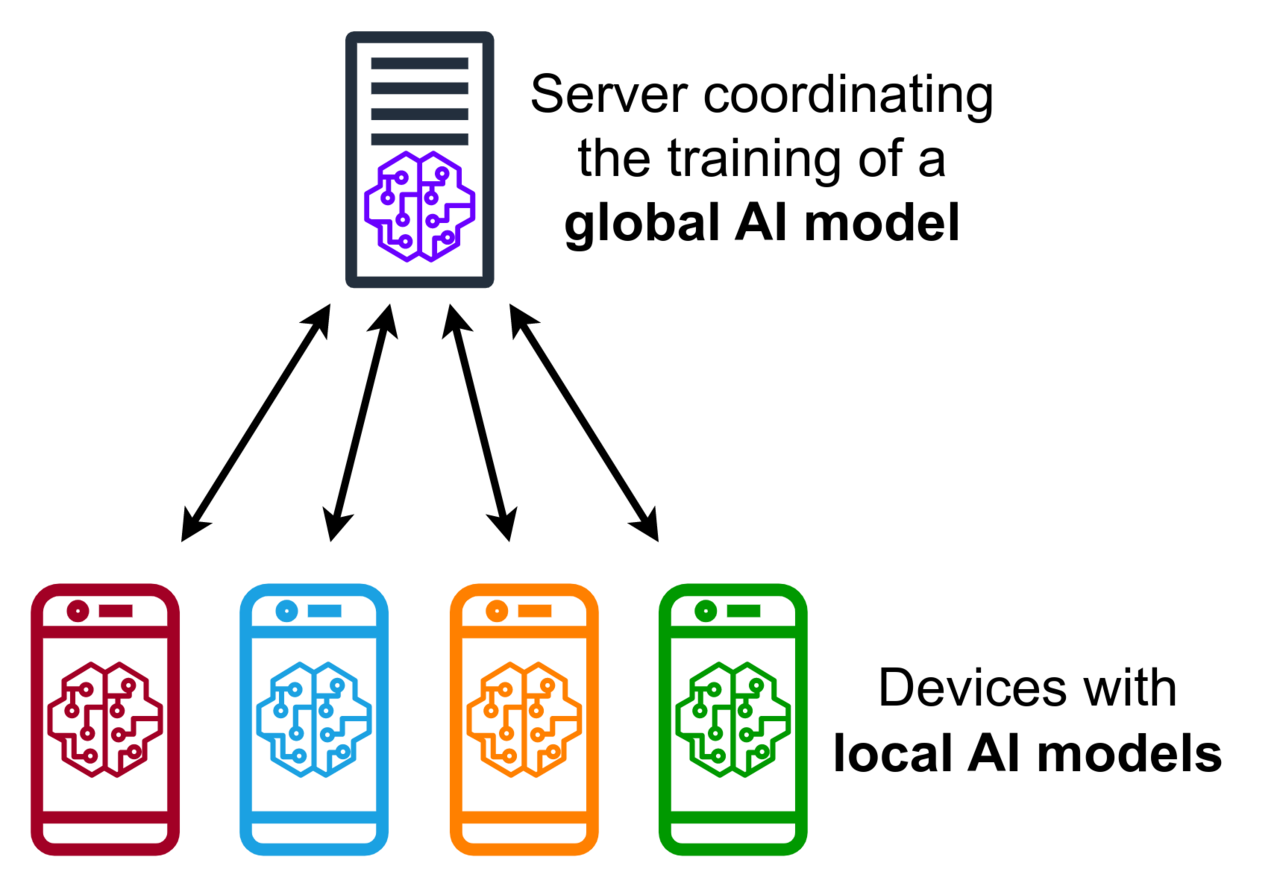
Fig. Federal Learning Diagram
Blockchain & AI: Trust Without Intermediaries
Blockchain, often synonymous with cryptocurrencies, is fundamentally a distributed ledger technology that enables transparent, immutable record-keeping without a central authority. Its potential extends far beyond digital money when paired with AI.
Consider these synergies:
- Data Provenance & Ownership: Blockchain can create verifiable records of who owns data, when it was created, and how it’s being used, ensuring fair compensation or usage rights for AI training data.
- Decentralized AI Marketplaces: Imagine a marketplace where individuals can offer their computational power or specialized datasets for AI training, compensated directly via blockchain, bypassing traditional cloud providers.
- Transparent AI Governance: The decision-making processes of AI systems could be recorded on a blockchain, creating an auditable and transparent trail for how an algorithm arrived at a conclusion, fostering trust and accountability.
Open-Source AI & Collective Intelligence
The open-source movement has always been a powerful force for decentralization in software. Now, it’s gaining unprecedented traction in AI. Projects like LLaMA 2, Stable Diffusion, and countless others are democratizing access to powerful AI models.
Why is this crucial?
- Community-Driven Innovation: When AI models and tools are open, developers worldwide can inspect, improve, and adapt them, fostering rapid innovation beyond corporate labs.
- Reduced Vendor Lock-in: No single company owns the technology, preventing monopolies and encouraging interoperability.
- Scrutiny & Safety: Open models can be scrutinized by the community for biases, vulnerabilities, or ethical concerns, leading to safer and more robust AI.
Edge AI: Processing Power in Your Pocket
Instead of sending every query to a massive cloud server, Edge AI brings AI computations closer to the data source — on your smartphone, smart speaker, or IoT device. This reduces latency, saves bandwidth, and significantly enhances privacy because data doesn’t leave your device for processing.
Think about real-time voice assistants or on-device image recognition. These operations can happen without an internet connection, further reducing reliance on centralized infrastructure.
The Vision: A User-Centric Digital Realm
Piecing these technologies together, we start to see the outline of a truly revolutionary internet.
- Enhanced Privacy & Data Sovereignty: You control your data; it’s no longer a product to be harvested.
- True Data Ownership: The value generated from your data accrues to you, not a distant corporation.
- Censorship Resistance: With decentralized platforms and AI models, it becomes far harder for any single entity to control information flow.
- Democratized AI Access: Powerful AI models and tools are accessible to everyone, fostering a Cambrian explosion of innovation.
- Reduced Bias & Increased Fairness: Open models and transparent governance structures allow for greater accountability and the proactive identification and mitigation of biases.
Imagine a world where your smart assistant truly serves you, learning your preferences on your device, without sending every whisper to a server farm. Or a social media platform where content moderation is governed by a decentralized autonomous organization (DAO) and AI, rather than a single company’s fluctuating policies.
The Road Ahead: Hurdles and Headaches
While the vision is compelling, building a post-Big Tech internet isn’t a walk in the park.
- Scalability & Performance: Decentralized networks can be slower and more complex to manage than centralized ones. How do we ensure they can handle billions of users and petabytes of data efficiently?
- Security Challenges: While blockchain offers security for data integrity, distributed systems introduce new attack vectors. How do we secure every node against sophisticated threats?
- User Experience (UX): Big Tech excels at seamless, intuitive user experiences. Decentralized alternatives often face a steeper learning curve. How do we make these powerful tools accessible to everyone, not just the technically savvy?
- Regulatory Uncertainty: Governments are still grappling with how to regulate centralized AI. Decentralized AI introduces entirely new legal and ethical frameworks that need to be developed.
- Energy Consumption: Some decentralized technologies, particularly certain blockchain consensus mechanisms, are notoriously energy-intensive. Sustainable solutions are paramount.
These aren’t minor issues, but active areas of research and development. The bright minds in the AI and blockchain communities are tackling these challenges head-on, fueled by the conviction that a better internet is not just possible, but essential.
So, Is It Our Only Hope? A Concluding Thought.
“Only hope” might be a strong phrase, but it certainly feels like our best hope for redirecting the trajectory of AI and the internet towards a more equitable, private, and innovative future. It’s about shifting from an architecture of control to one of empowerment.
The current internet, with its centralized AI powerhouses, is a marvel of engineering, but it’s also a system that inherently commodifies us. The decentralized AI movement offers a path to reclaim our digital sovereignty, to participate in an internet where our data is ours, our privacy is respected, and our collective intelligence, amplified by AI, truly serves the common good.
This isn’t just about cool tech; it’s about the kind of digital society we want to build. It’s about leveraging AI not to further entrench existing power, but to dismantle it and redistribute it back to the users.
What are your thoughts on a post-Big Tech internet powered by decentralized AI? Do you see it as a realistic future or a far-off dream? Share your insights and questions in the comments below — let’s keep this vital conversation going!
Acknowledgements This post draws inspiration from countless researchers and open-source contributors pushing the boundaries of decentralized AI and web3 technologies. Diagrams and visual concepts were conceptualized to reflect common visual representations found in open-source educational materials.
AI #DecentralizedTech #FutureOfInternet #MLOps #TechEthics #BlockchainAI #DataPrivacy #OpenSourceAI
메타데이터
- post_id
- f98a3816e8ef
- slug
- the-ai-unshackling-is-a-post-big-tech-internet-our-only-hope-f98a3816e8ef
- url
- https://medium.com/@akhileshyadav805a/the-ai-unshackling-is-a-post-big-tech-internet-our-only-hope-f98a3816e8ef
- canonical_url
- https://medium.com/@akhileshyadav805a/the-ai-unshackling-is-a-post-big-tech-internet-our-only-hope-f98a3816e8ef
- author_url
- https://medium.com/@akhileshyadav805a
- status
- ok
- fetched_at
- 2026-07-11 17:08:33