How oestrogen influences systemic lupus erythematosus across a woman’s lifespan
Systemic lupus erythematosus (SLE) is a chronic autoimmune disease that affects multiple organ systems, such as the kidneys, skin, and…
How oestrogen influences systemic lupus erythematosus across a woman’s lifespan
Systemic lupus erythematosus (SLE) is a chronic autoimmune disease that affects multiple organ systems, such as the kidneys, skin, and heart.[1] Clinical manifestations vary greatly and may include extreme fatigue, fever, joint pain, facial rash, and headaches.[2]
Interestingly, SLE is more common in women than men.[3] In childhood, SLE prevalence in girls is about double than boys, but by reproductive years, women are 8 to 15 times more likely to be diagnosed with SLE than men.[3] Clinical features of SLE also differ considerably between men and women.
The cause of lupus is not fully understood, which makes it difficult to explain why the disease affects men and women differently. One theory is that oestrogen is a key determinant of lupus activity.
How does oestrogen influence immunity and SLE?
Oestrogens are a type of female sex hormone that are predominantly produced by the ovaries in women.[4]
Oestrogen has a complex role in the immune system, but is known to:
· Stimulate B cell and innate immunity, resulting in production of antibodies.[5]
· Downregulate the autoimmune regulator gene (AIRE), which normally maintains immune tolerance and prevents immune system over-reaction.[5]
· Increase interferon type I signalling, which is a central driver of many autoimmune diseases.[6]
In people without lupus, oestrogen supports regulatory T cells, which play a key role in immune tolerance. This response is notably dysregulated in people with SLE.[7] Additionally, mice model experiments with oestrogen deprivation and supplementation has shown that oestrogen exacerbates disease activity of SLE.[8]
The combination of increased immune activity and decreased immune tolerance in response to oestrogen may contribute to overproduction of auto-antibodies and increased susceptibility to autoimmune disease.
The potential link between oestrogen and lupus activity is interesting, given that a woman’s experience with lupus will change across her lifespan.
Lupus across the lifespan:
Childhood
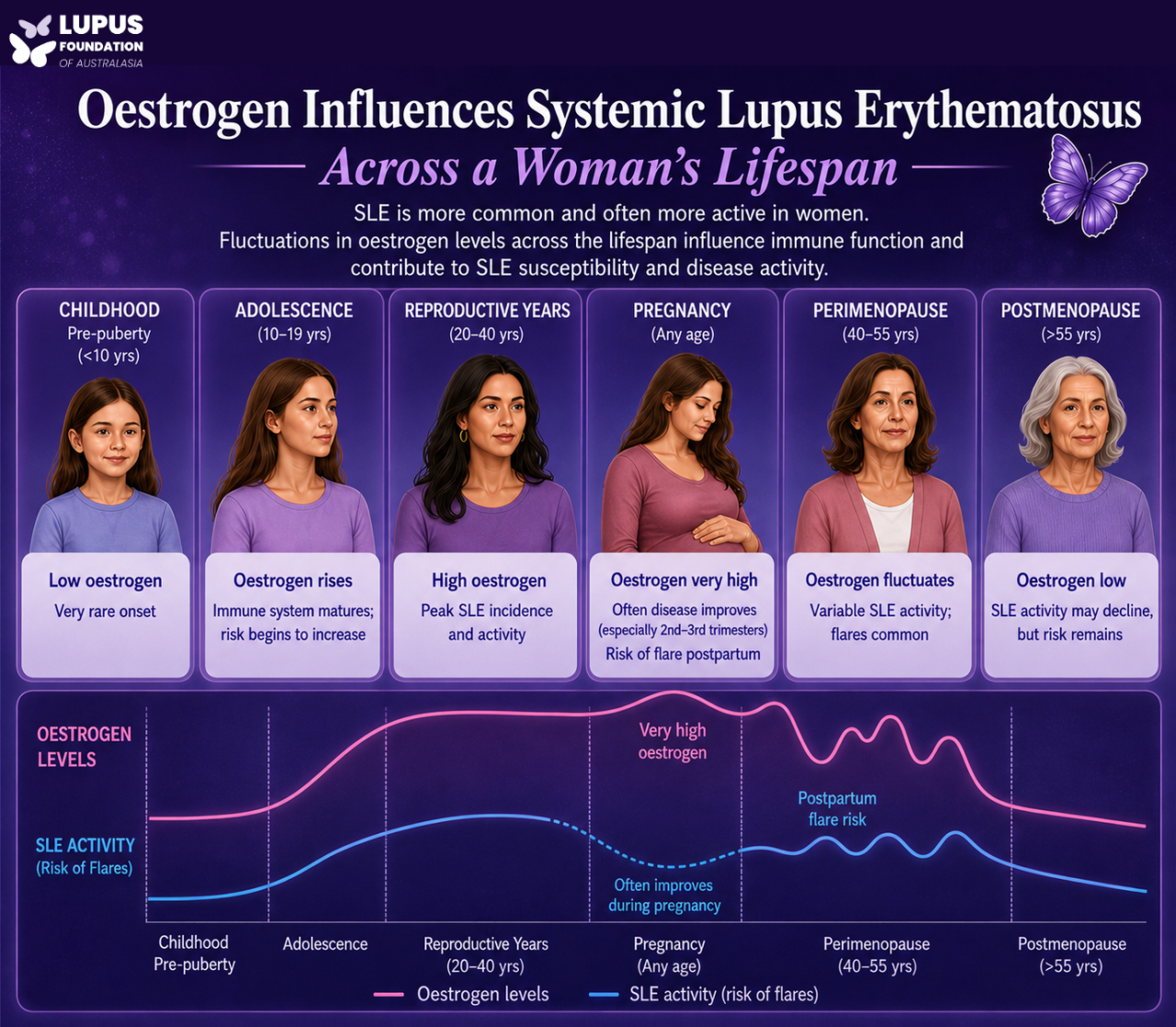
In childhood, oestrogen levels are near absent in girls, with small amounts being produced by adrenal glands and adipose tissue (fat).[9] This is the point where the difference in prevalence of lupus in females and males is lowest, at a 2:1 ratio.[3]
Puberty
Activation of the reproductive hypothalamus-pituitary-gonad axis in puberty causes oestrogen levels to rise from ‘none to maximum’.[9] Frederiksen et al. (2019) conducted the first high-precision lifespan study of oestrogen levels.[10] They showed that levels of oestrogen in girls increases progressively with age and pubertal stage, and is closely linked to menstruation.[10] Oestrogen levels then follow a cyclical trend alongside the menstrual cycle, rising in the late follicular phase and peaking at ovulation.[10]
Around a third of women with SLE report increased levels of pain and fatigue during premenstrual and menstrual phases, which aligns with the rapid rise and fall in oestrogen levels.[11,12] It is worth noting the subjectivity of self-reports and potential overlap with pre-menstrual syndrome symptoms. More comparative and objective research is required in this area.
Interestingly, early age of first period (<10 years) is correlated to early clinical manifestation of lupus.[13] Menstrual irregularity and abnormal length of menstruation (both short and long) is also linked to an increased risk of lupus development.[13]
Contraception
People with SLE may be hesitant to use oral contraception, given that the pills contain estrogen. In general, estrogen-containing contraceptives should be avoided for women with high levels of antiphospholipid antibodies, which increase the risk of blood clotting.[14] This is the case for severe SLE.
For the majority of people living with (non-severe) lupus, randomised trials have shown no difference in flare rates between oral contraceptive and placebo groups.[15] Most oral contraceptives contain low doses of oestrogen that create a hormone environment similar to early follicular menstrual states.[16,17] In fact, oral contraceptives act to suppress ovulation, thereby preventing the normal ovulatory oestrogen peak.[16,17]
Pregnancy
There is a dramatic rise in oestrogen levels, particularly estriol, during pregnancy.[10] In the first 6 weeks of pregnancy, the corpus luteum is the main producer of estrogen, with the placenta taking over after the first trimester.[10] Oestrogen levels continue to increase throughout pregnancy, reaching its peak level just before delivery.[10]
Flare risk in pregnant people with SLE may increase by up to 60%, particularly in those with active disease prior to conception.[18] These are most common in the second and third trimesters, with worsened experiences of arthritis, fatigue, photosensitivity, mouth ulcers, and anaemia.[18]
The activity of lupus in the 6 months prior to conception has been shown to influence health outcomes for both the mother and foetus.[19] If lupus is active in this period before conception, there is a 7-fold greater chance of disease flares during pregnancy.[19] The most severe complication for the mother is kidney involvement. Although rare, those with prior kidney involvement (lupus nephritis) have a 20–30% risk of renal relapse during pregnancy.[20]
Although many women with SLE can conceive, the disease increases risk of premature ovarian failure and early miscarriage.[21,22] However, if pregnancy is planned during a time of low disease activity and low antiphospholipid antibodies, successful delivery is much more likely.[21] Hence, preconception counselling with rheumatologists and obstetricians is important.
Oestrogen levels typically return to baseline with a week of delivery, yet flare risk remains elevated for 2–6 months post-partum.[18]
Menopause
Exogenous oestrogen production from the ovaries begins to decline with menopause, and the predominant form of oestrogen comes from adipose tissue.[10] As women with lupus age, their flares and overall disease activity reportedly decreases.[23]
However, prior disease damage is irreversible and accumulative. The combined effect of menopause with autoimmune disease damage from younger years places menopausal women with SLE at a higher risk of kidney, cardiovascular, and osteoporosis complications.[24] Therefore, it is important for menopausal women with SLE to have their bone health and suitability for hormone replacement therapy (HRT) assessed.
Similar to oral contraceptives, HRT involves oestrogen supplementation, which may seem alarming. A large-scale systematic review by Khafagy et al. (2015) found that there was a slight increase in flare rate associated with HRT, but these were mild in intensity and no severe flares were noted.[25] HRT may be recommended for women with SLE if there is no history of thrombosis, risk of blood clotting, or presence of antiphospholipid antibodies.[25]
Key takeaways
· Differences in disease activity across a woman’s lifespan supports the idea that oestrogen influences lupus manifestation
· Yet, there are other factors that contribute to sexual dimorphism, such as disturbances in X chromosome inactivation in women and differences in gut microbiota.[3] More research is required to elucidate the complicated effects of oestrogen on the immune system in SLE women.
· Therefore, it is important that women with lupus are supported by a multi-disciplinary health team that provide counsel on contraceptive and reproductive options
RFERENCES
-
Garchow B, Acosta YM, Kiriakidou M. 2021. HIF1-α and miR-210 differential and lineage specific expression in systemic lupus erythematosus. Molecular Immunology. 133: 128–134
-
Leuchten N, et al., 2018. Early symptoms of systemic lupus erythematosus (SLE) recalled by 339 SLE patients. Lupus. 27(9):1431–1436
-
Christou EAA, et al., 2019. Sexual dimorphism in SLE: above and beyond sex hormones. Lupus. 28(1):3–10
-
Cutolo M, Straub RH. 2020. Sex steroids and autoimmune rheumatic diseases: state of the art. Nature Reviews Immunology. 16:628–644.
-
Dragin, N, et al., 2016. Estrogen-mediated downregulation of AIRE influences sexual dimorphism in autoimmune diseases. Journal of Clinical Investigations. 126(4):1525–1537.
-
Singh RP, Hanh BH, Bischoff DS. 2021. Interferon genes are influences by 17β-estradiol in SLE. Frontiers in Immunology. 12:725325
-
Tsai YG, et al., 2023. Pathogenesis and novel therapeutics of regulatory T cell subsets and interleukin-2 therapy in systemic lupus erythematosus. Frontiers in Immunology. 14:1230264.
-
Roubinian JR, et al., 1978. Effect of castration and sex hormone treatment on survival, anti-nucleic acid antibodies, and glomerulonephritis in NZB/NZW F1 mice. Journal of Experimental Medicine. 147(6):1568–1583
-
Yu Z, et al., 2022. Level of oestrogen in females — the different impacts at different life stages. Journal of Personalised Medicine. 12(12):1995
-
Frederiksen H, et al., 2019. Sex-specific oestrogen levels and reference intervals from infancy to late adulthood determined by LC-MS/MS. The Journal of Clinical Endocrinology and Metabolism. 105(3):754–768
-
Colangelo K, et al., 2011. Self-reported flaring varies during the menstrual cycle in systemic lupus erythematosus compared with rheumatoid arthritis and fibromyalgia. Rheumatology. 50(4):703–708
-
Masto L, et al., 2023. Association of menstrual cycles and disease flare activity in women with systemic lupus erythematosus and rheumatoid arthritis. Arthritis & Rheumatology. 75:2667–2668.
-
Costenbader KH, et al., 2007. Reproductive and menopausal factors and risk of systemic lupus erythematosus in women. Arthritis Rheumatology. 56(4):1251–1262.
-
Sammaritano LR, 2014. Contraception in patients with systemic lupus erythematosus and antiphospholipid syndrome. Lupus. 12:1242–1245.
-
Petri M, et al., 2005. Combined oral contraceptives in women with systemic lupus erythematosus. New England Journal of Medicine. 353(24):2500–2558
-
Mishell Jr DR, et al., 1972. Serum estradiol in women ingesting combination oral contraceptive steroids. American Journal of Obstetrics and Gynaecology. 114(7):923–928.
-
Rodriguez LA, et al., 2023. The hormonal profile in women using combined monophasic oral contraceptive pills varies across the pill cycle: a temporal analysis of serum endogenous and exogenous hormones using liquid chromatography with tandem mass spectroscopy. American Journal of Physiology-Endocrinology and Metabolism. 327(1):121–133
-
Eudy AM, et al., 2018. Effect of pregnancy on disease flares in patients with systemic lupus erythematosus. Annals of the Rheumatic Diseases. 77(6):855–860.
-
Larosa M, et al., 2021. SLE-DAS in the first trimester of gestation predicts maternal lupus flares later in pregnancy. Frontiers in Pharmacology. 12:660123
-
Bramham K, Soh MC, Nelson-Piercy C. 2012. Pregnancy and renal outcomes in lupus nephritis: an update and guide to management. Lupus. 21(12):1271–1283.
-
Fierro JJ, et al., 2023. Preconception clinical factors related to adverse pregnancy outcomes in patients with systemic lupus erythematosus or primary Sjögren’s syndrome: a retrospective cohort study. Rheumatic & Musculoskeletal Diseases. 9(3)
-
Moyer A, Edens C. 2024. Impact of systemic lupus erythematosus on conception: insights into infertility, fertility preservation, assisted reproductive technology, and pregnancy outcomes. Seminars in Reproductive Medicine. 42(3):209–227
-
Sanchez-Guerrero J, et al., 2001. Disease activity during the premenopausal and postmenopausal periods in women with systemic lupus erythematosus. The American Journal of Medicine. 111(6):464–468
-
Bultink IEM et al., 2005. Prevalence of and risk factors for low bone mineral density and vertebral fractures in patients with systemic lupus erythematosus. Arthritis & Rheumatism. 52(7):2044–2050.
-
Khafagy AM, et al., 2015. Effect of menopause hormone therapy on disease progression in systemic lupus erythematosus: A systematic review. Maturitas. 81(2):276–281.
Author
Alannah Hibbard is a recent Biomedicine graduate from the University of Melbourne. She completed an honours year at the Peter Doherty Institute for Infection and Immunity, where she investigated how TGF beta signalling in lymph nodes affects melanoma growth. She has a strong interest in rare diseases, women’s health, and translating complex medical research into accessible information. Alannah is passionate about patient advocacy and education, and brings additional experience in healthcare administration to her perspective and writing.
Reviewer
Elizabeth Donald has over a decade of experience in communications, clinical research, and education. She undertook advanced doctoral research in oncology, contributing to peer-reviewed publications on improving treatment efficacy and exploring emerging therapies. Elizabeth has presented at international congresses, facilitated webinars and podcasts, and developed award-winning continuing education programs across oncology, immunology, and rare diseases. As a patient advocate, she works to ensure the latest research is made accessible and meaningful for people navigating chronic illness.
Reviewer
Dr. Nigel Leon Martis, an ECFMG-certified physician, is a peer reviewer for Cureus with international clinical and research experience. He holds a design patent and is dedicated to advancing healthcare innovation and improving outcomes in chronic diseases such as lupus.
Editor
Paula De Paoli is the Principal Editor and Content Lead at The Lupus Foundation of Australasia. She is a senior medical writer and communications consultant with over a decade of experience across clinical practice, university education, and national health regulation. She has held risk advisory roles at Ahpra and currently supports healthcare organisations across education and marketing projects at Medwire. She holds postgraduate qualifications in public health from the University of Sydney and Harvard University.
메타데이터
- post_id
- f9b7f0be5ab4
- slug
- how-oestrogen-influences-systemic-lupus-erythematosus-across-a-womans-lifespan-f9b7f0be5ab4
- url
- https://medium.com/@lupusfoundationaustralasia/how-oestrogen-influences-systemic-lupus-erythematosus-across-a-womans-lifespan-f9b7f0be5ab4
- canonical_url
- https://medium.com/@lupusfoundationaustralasia/how-oestrogen-influences-systemic-lupus-erythematosus-across-a-womans-lifespan-f9b7f0be5ab4
- author_url
- https://medium.com/@lupusfoundationaustralasia
- status
- ok
- fetched_at
- 2026-06-09 15:37:30