How to Use Shieldstral: Mistral’s 3B Safety Model That Runs on One GPU
A step-by-step guide to using Shieldstral, the open-weights safety classifier that judges content against policies you write in plain…
How to Use Shieldstral: Mistral’s 3B Safety Model That Runs on One GPU
A step-by-step guide to using Shieldstral, the open-weights safety classifier that judges content against policies you write in plain language — no retraining required.
Every safety team hits the same wall eventually.
Your moderation model was trained on last year’s harm categories. Your policy changed last month. Now every update means retraining, or living with rules that don’t match reality anymore.
That’s the hidden tax of most guard models — the safety layer sitting between your users and your main AI, quietly falling behind every time your policy evolves.
Mistral’s answer, released August 4, changes the math: a 3-billion-parameter model that reads your safety policy in plain English at the moment it checks content — no retraining, ever — and still matches guard models up to 7x its size.
Most teams solve this problem by throwing a bigger model at it — a 20-billion-parameter guard model running alongside their main one, doubling their GPU bill just to keep content safe.
Shieldstral is Mistral’s bet that size was never the actual lever.
In this guide, we’ll install Shieldstral, send it a real moderation request, break down exactly how its request format works, and look at when it’s the right tool for the job.
What Is Shieldstral?
Shieldstral is an open-weights, policy-adaptive safety classifier from Mistral AI, released under the Apache 2.0 license.
It checks text and images against a moderation policy and returns a calibrated safety score — a number, not just a label.
It runs on a single 16GB Nvidia GPU, supports 12 languages, and is available on Hugging Face today.
Mistral released it under Apache 2.0 — one of the more permissive open-source licenses — which means you can fine-tune it, redistribute it, and run it commercially without asking anyone’s permission first.
That licensing choice matters as much as the architecture for teams evaluating whether to build on it long-term. A model you can’t legally modify or self-host isn’t really a foundation, it’s a vendor dependency wearing an open-source label.
Example: Instead of training a model to recognize “violent content” as one of ten fixed categories, you hand Shieldstral a plain-English question at request time — “Does this content promote physical violence?” — and it answers, with a confidence score attached.
That’s a genuinely different shape of tool than what most teams have used until now.
A traditional guard model is closer to a fixed rulebook — thorough, but slow to update. Shieldstral behaves more like a reviewer you can brief fresh before every shift, because in a sense, you are: the policy travels with the request, not with the weights.
The Problem With Fixed-Category Safety Models
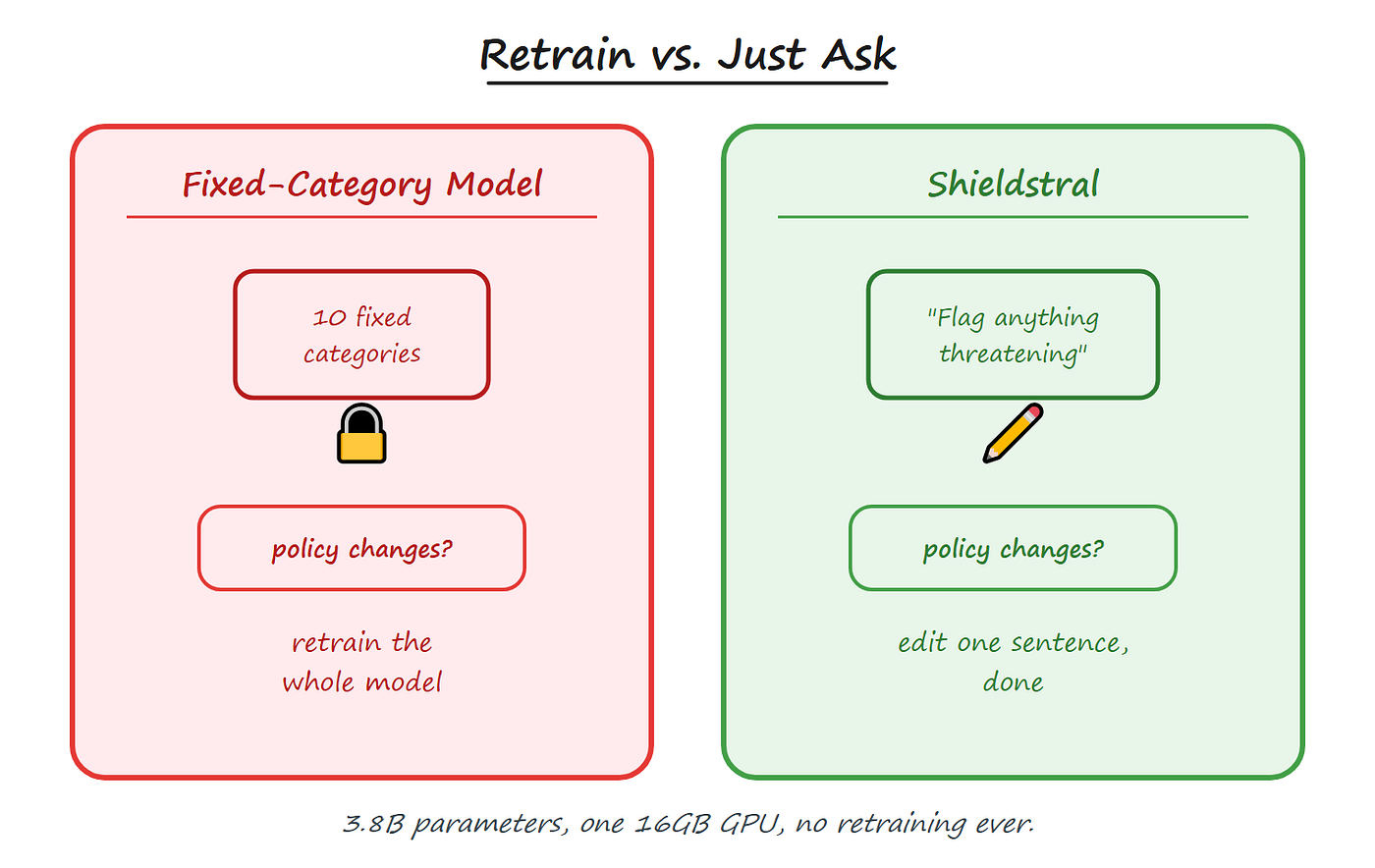
Traditional Guard Models (The Familiar Way): Trained on a fixed list of harm categories baked in during training. Change your policy, and you retrain the whole model — a process that costs real time and real compute.
Shieldstral (The Policy-Adaptive Way): Treats moderation as a live question-answering task. You write the policy in plain language when you call the model, and it evaluates content against exactly that policy, on the spot.

Bad: Your community guidelines change, and the safety model stays stuck on the old rules until someone finds time to retrain it.
Good: You edit one sentence in your policy text, and the very next request is checked against the new rule.
This matters most for teams whose policies genuinely evolve — a marketplace tightening rules after a new scam pattern shows up, a support platform adjusting tone standards after user feedback, a community product responding to a new kind of abuse nobody anticipated at training time.
None of those situations should require a multi-week retraining cycle before the fix takes effect.
Getting Started: Your First Safety Check
Here’s the shortest path from zero to a working safety check.
1. Install and load the model
Shieldstral is on Hugging Face under Apache 2.0, so it drops into any standard transformers-based pipeline.
pip install transformers accelerate
from transformers import AutoModelForCausalLM
model = AutoModelForCausalLM.from_pretrained("mistralai/Shieldstral-1.0-3B")
That pulls the 3.8B-parameter model onto your GPU — a single 16GB card is enough.
For context, that’s consumer-grade hardware. A 20B-parameter guard model typically wants 40GB or more, which usually means a data-center-class GPU and a meaningfully bigger cloud bill just for the safety layer.
2. Write your policy in plain language
No config file, no category taxonomy. Just a sentence describing what you’re checking for.
instruct = "You are moderating customer support replies. Flag anything threatening or abusive."3. Ask a yes/no question
This is the actual check you’re running against the content.
query = "Does this response contain abusive language toward the customer?"4. Send the content and read the score
Pass in the text (or image) you’re checking, and Shieldstral returns a calibrated score between 0 and 1.
Example: A score of 0.92 means the model is highly confident the content violates your policy. A score of 0.08 means it’s confident the content is fine. You set the threshold that matters for your product.

The Request Format: Instruct, Query, Document
Every Shieldstral request has exactly three parts. Understanding them is the whole skill.

The Instruct block
This sets the evaluation context and strictness — who’s checking, for what purpose, and how strict to be.
You can also define, in plain words, exactly what counts as unsafe for this specific check. This is where your policy actually lives.
The Query
A single, focused yes/no question. Not “is this bad” — something specific enough to answer cleanly.
Example: “Does this content promote physical violence?” is a good query. “Is this appropriate?” is too vague for the model to answer with confidence.
The Document
The actual content being judged. This can be a user prompt, a model’s response, a full prompt-response pair, or an image with optional accompanying text.
At inference, Shieldstral doesn’t generate a paragraph of reasoning. It reads out only the yes/no logits — the model’s raw confidence in each answer — and softmax-normalizes them into one continuous score.
That’s a meaningfully different design than a model that writes “I think this is unsafe because…” and you have to parse the text. A calibrated number is something you can threshold, rank, and log — a paragraph isn’t.
It also means you can run the same document through multiple queries in parallel — one Instruct block asking about violence, another about self-harm, another about harassment — and get three independent, comparable scores back instead of one blended judgment.
That composability is easy to underrate until you’ve tried to debug a single monolithic “is this safe” score and had no way to tell which specific policy it actually failed.
A Real Example: Moderating a Support Chatbot Response
Let’s walk through an actual check, start to finish.
Say your support chatbot just generated this reply to a frustrated customer: “I understand your frustration, but if you keep escalating this, we’ll be forced to take further action against your account.”
That phrasing is borderline — not clearly abusive, but not clearly fine either. This is exactly the kind of judgment call a fixed-category filter tends to get wrong.
instruct = "Moderate customer support replies for tone. Strict: flag any implied threat."
query = "Does this response contain an implied threat toward the customer?"
document = "I understand your frustration, but if you keep escalating this, we'll be forced to take further action against your account."
Shieldstral returns a score — say, 0.71. Above your threshold of 0.5, so it flags the reply for human review before it ever reaches the customer.
Notice what didn’t happen: nobody wrote a regex looking for the phrase “further action.” Nobody maintained a blocklist of threatening-adjacent phrases that support agents kept accidentally triggering on legitimate escalation language.
The model read the sentence the way a human reviewer would — in context, against a policy stated in plain words.
Change the Instruct block’s strictness to “lenient,” and rerun the same query against the same document. The score drops, because the model is now evaluating against a looser standard — the exact same content, judged by a different policy, without retraining anything.
A second example: image moderation
Now say your product lets users upload photos with captions, and someone posts an image with text overlaid promoting a scam giveaway.
instruct = "Moderate uploaded images and captions for scam content."
query = "Does this image or caption promote a financial scam?"
document = image_bytes  # the uploaded photo, with its caption
Because Shieldstral shares one interface for text and images, this call looks almost identical to the text example — same three parts, same calibrated score back.
You didn’t need a second model, a second pipeline, or a second on-call rotation for “the image moderation service” versus “the text moderation service.” One request format covers both.

How It Works Under the Hood
Shieldstral is built on Ministral-3–3B-Base-2512, with a native Pixtral vision encoder attached.
That vision encoder is what lets text and image moderation share one interface instead of needing two separate pipelines — an image with a caption gets evaluated the same way a paragraph of text does.
The training set behind it is about 54.1 million samples: 45.2 million from open-source text-safety datasets, 4.4 million synthetic contrastive pairs built specifically to teach the model to tell apart similar-sounding but differently-scoped policies, and 4.5 million multimodal examples.
That middle number matters more than it sounds. Contrastive pairs are what teach a model the difference between “flag violent content” and “flag content that depicts violence in a news context” — two policies that look almost identical in text but should produce very different scores.
Without that specific training, a smaller model tends to collapse subtle policy distinctions into one blunt “unsafe/safe” judgment — exactly the failure mode that makes fixed-category filters frustrating to work with in the first place.
Mistral spent a disproportionate share of the training budget on teaching Shieldstral to hold two similar-sounding policies apart, rather than just teaching it more categories. That’s a design choice, not an accident of scale.
It’s the same instinct that shows up in good technical writing: specificity beats scope. A model trained to distinguish ten precise policy nuances tends to generalize better than one trained to recognize a hundred broad categories.


Shieldstral beats Qwen3Guard 8B, Nemotron 3.5 Content Safety 4B, and LlamaGuard 4 12B outright on overall text safety. Against the 20-billion-parameter GPT-OSS Safeguard, it trades blows — occasionally behind, but never by much.
Put the parameter counts next to those scores and the pattern jumps out. Nemotron 3.5 Content Safety needs 4B parameters to score 83.3. LlamaGuard 4 needs 12B to land at 69.1 — worse, despite three times the size.
Parameter count and safety performance clearly aren’t moving together in lockstep here. Training data quality and architecture choices are doing more of the work than raw scale.
Its strongest category is multimodal safety, where it leads every competitor tested, including models nearly twice its size.
That’s worth sitting with. The category where Shieldstral wins outright is the one where the native Pixtral vision encoder does the most work — the architecture choice mapping directly onto the benchmark result, not a coincidence.
When to Use It (and When Not To)
Shieldstral earns its place when your policies change often, when you’re checking both text and images with one pipeline, or when running a 20B-parameter model on every single request isn’t something your GPU budget can absorb.
- Bad fit: You need the absolute highest possible score on refusal detection specifically, and compute cost is genuinely not a constraint.
- Good fit: You’re moderating high volume — every chatbot reply, every user upload — and need a model that fits comfortably on the same GPU as everything else.
There’s a middle case worth naming too: teams running multiple products with different policies, where a fixed-category model would mean maintaining several separate fine-tuned versions.
With Shieldstral, that’s one deployed model serving every product, differentiated only by which Instruct block each product sends. Fewer models to version, monitor, and eventually retrain.
I’d treat Shieldstral as the default choice for most production moderation pipelines, and reach for a larger dedicated guard model only when a specific benchmark gap actually matters for your use case.
There’s also a latency argument that doesn’t show up in the benchmark table. A safety check sitting in the critical path of every user-facing response needs to return fast, or your whole product feels slower.
A 3.8B model on a 16GB GPU responds meaningfully quicker than a 20B model that may not even fit on the same card as your main model — which means less time your user spends waiting on a moderation check they never see.
That invisible latency budget is easy to forget about until a product review flags your chatbot as “feels a beat slower than it used to,” and the safety layer turns out to be the culprit nobody thought to check first.
The pattern here isn’t new to readers of this publication — a smaller, smarter-designed model beating a much larger one on cost and latency, while staying competitive on quality. It’s the same shape of win as the pricing stories I’ve covered elsewhere, just applied to the safety layer instead of the main model.
Take Aways
- Shieldstral is a 3.8B-parameter, policy-adaptive safety classifier — you write policies in plain language at request time, no retraining needed.
- Every request has three parts: Instruct (context and strictness), Query (a yes/no question), and Document (the content being judged).
- It returns a calibrated score, not just a label — something you can threshold, rank, and log.
- It runs on a single 16GB GPU and matches or beats guard models up to 7x its size, especially on multimodal safety.
- Reach for it as your default moderation layer; reach for something bigger only when a specific benchmark gap genuinely matters for your product.
Safety layers used to be the part of the stack nobody wanted to touch, because touching them meant a retraining cycle.
A model that reads its instructions instead of memorizing them turns that into a one-line edit.
That’s a small change in workflow with a large change in how quickly a team can respond when something goes wrong in production — which, for a safety layer, is the entire point.
Thank you for reading.
· · ·
If you found this helpful, feel free to click the ‘Clap’ button ❤️
I write about AI infrastructure, agentic systems, and the economics behind them.
Let’s be friends! 🙂 Don’t forget to subscribe so you don’t miss the next one! Find me on LinkedIn.
메타데이터
- post_id
- f9dff71a60f4
- slug
- how-to-use-shieldstral-mistrals-3b-safety-model-that-runs-on-one-gpu-f9dff71a60f4
- url
- https://medium.com/@raghuece455/how-to-use-shieldstral-mistrals-3b-safety-model-that-runs-on-one-gpu-f9dff71a60f4
- canonical_url
- https://medium.com/@raghuece455/how-to-use-shieldstral-mistrals-3b-safety-model-that-runs-on-one-gpu-f9dff71a60f4
- author_url
- https://medium.com/@raghuece455
- status
- ok
- fetched_at
- 2026-08-18 07:42:55