What BLEU Actually Measures — And Why I Started Using It to Validate AI Output
I ran into BLEU while trying to answer a simple question:
What BLEU Actually Measures — And Why I Started Using It to Validate AI Output
I ran into BLEU while trying to answer a simple question:
How do you objectively evaluate whether an AI-generated response is “good”?
Not just readable. Not just plausible. But actually aligned with what it should produce.
That’s where BLEU comes in.
What BLEU Is
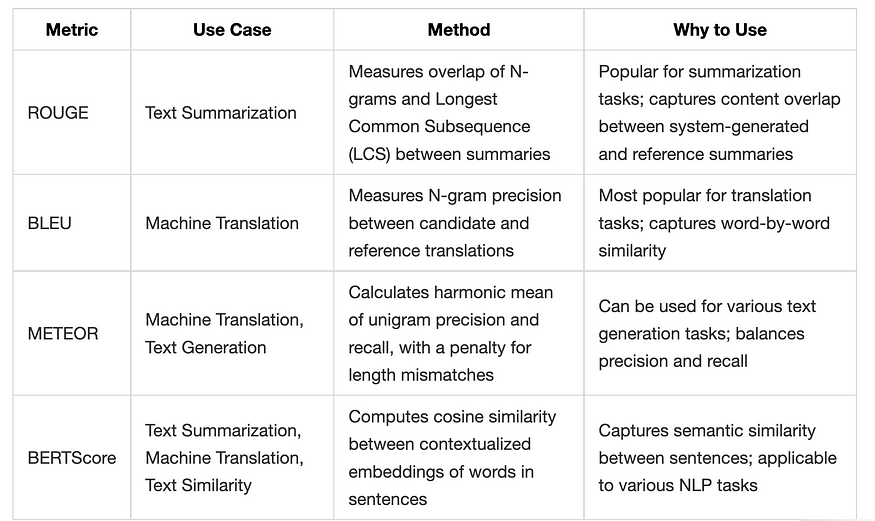
BLEU (Bilingual Evaluation Understudy) is a metric originally designed for machine translation.
At its core, it measures how similar a generated output is to a reference (ground truth) by comparing overlapping word sequences.
Not just individual words — but sequences of words (called n-grams).
The idea is simple:
If a model produces text that closely matches a trusted reference, it’s probably doing something right.
How It Works (Without Overcomplicating It)
BLEU looks at:
- 1-gram overlap (individual words)
- 2-gram overlap (word pairs)
- 3-gram and 4-gram overlap (phrases)
Then it applies a penalty if the generated output is too short.
So it’s not just about matching words — it’s about matching structure and context.
Higher BLEU score = closer match to reference Lower BLEU score = less alignment
Why This Matters More Than It Seems
Most teams evaluate AI outputs informally:
- “Does this look right?”
- “Does it sound good?”
That works for demos.
It doesn’t work at scale.
BLEU gives you a way to:
- Quantify output quality
- Compare model versions
- Track performance over time
It turns subjective evaluation into something measurable.
Where I Found It Useful
I started using BLEU in a very practical scenario:
Evaluating AI-generated summaries of security incidents.
The goal wasn’t creativity. It was accuracy and consistency.
We had:
- A set of known incident reports (ground truth)
- AI-generated summaries
- A need to measure how close those summaries were to expected outputs
Instead of relying on manual review alone, BLEU gave a baseline.
Example Use Case
Let’s say we have:
Reference (ground truth): “The vulnerability allows remote code execution through improper input validation.”
Model Output A: “This vulnerability enables remote code execution due to improper input validation.”
Model Output B: “This issue may allow attackers to exploit the system.”
BLEU would score Output A significantly higher than Output B.
Why?
Because:
- Output A preserves key phrases (“remote code execution”, “improper input validation”)
- Output B is vague and loses critical detail
That distinction matters in security contexts.
Simple Python Example
Here’s a lightweight way to apply BLEU using nltk:
from nltk.translate.bleu_score import sentence_bleureference = [["the", "vulnerability", "allows", "remote", "code", "execution", "through", "improper", "input", "validation"]]candidate = ["this", "vulnerability", "enables", "remote", "code", "execution", "due", "to", "improper", "input", "validation"]score = sentence_bleu(reference, candidate)print(f"BLEU Score: {score}")This gives you a numeric score between 0 and 1.
Closer to 1 = stronger alignment.
Where BLEU Falls Short
BLEU is useful — but it’s not complete.
It has limitations:
- It rewards similarity, not correctness
- It struggles with paraphrasing that changes wording but keeps meaning
- It depends heavily on the quality of the reference
Example:
Two sentences can mean the same thing but score lower if phrased differently.
That’s why BLEU should not be used in isolation.
Best Practices for Using BLEU
From practical use, a few things stand out:
1. Use BLEU as a baseline, not the final decision Combine it with human review or other metrics
2. Build strong reference datasets Bad ground truth = misleading scores
3. Compare trends, not just single scores Track how models improve or regress over time
4. Use it for structured outputs Works best when consistency matters (summaries, translations, reports)
5. Pair with semantic metrics when possible BLEU measures overlap — not meaning
What This Comes Down To
BLEU isn’t a perfect metric.
But it’s a practical one.
It gives you a way to move from: “I think this output is good” to: “I can measure how close this is to what I expect”
And in environments where accuracy matters — security, compliance, decision support — that shift is critical.
Because the biggest risk in AI isn’t bad output.
It’s unmeasured output that looks correct.
ArtificialIntelligence #MachineLearning #NLP #BLEU #ModelEvaluation #AIEngineering #DataScience #MLOps #GenAI #AIMetrics
메타데이터
- post_id
- f9e69a0767f9
- slug
- what-bleu-actually-measures-and-why-i-started-using-it-to-validate-ai-output-f9e69a0767f9
- url
- https://medium.com/@sevenlayersecurity/what-bleu-actually-measures-and-why-i-started-using-it-to-validate-ai-output-f9e69a0767f9
- canonical_url
- https://medium.com/@sevenlayersecurity/what-bleu-actually-measures-and-why-i-started-using-it-to-validate-ai-output-f9e69a0767f9
- author_url
- https://medium.com/@sevenlayersecurity
- status
- ok
- fetched_at
- 2026-06-23 17:05:31




