Finding the Right Primary Care Provider in Canada
I finally found a primary care provider after four years of searching, and I am incredibly grateful. It took going through multiple doctors…
Finding the Right Primary Care Provider in Canada
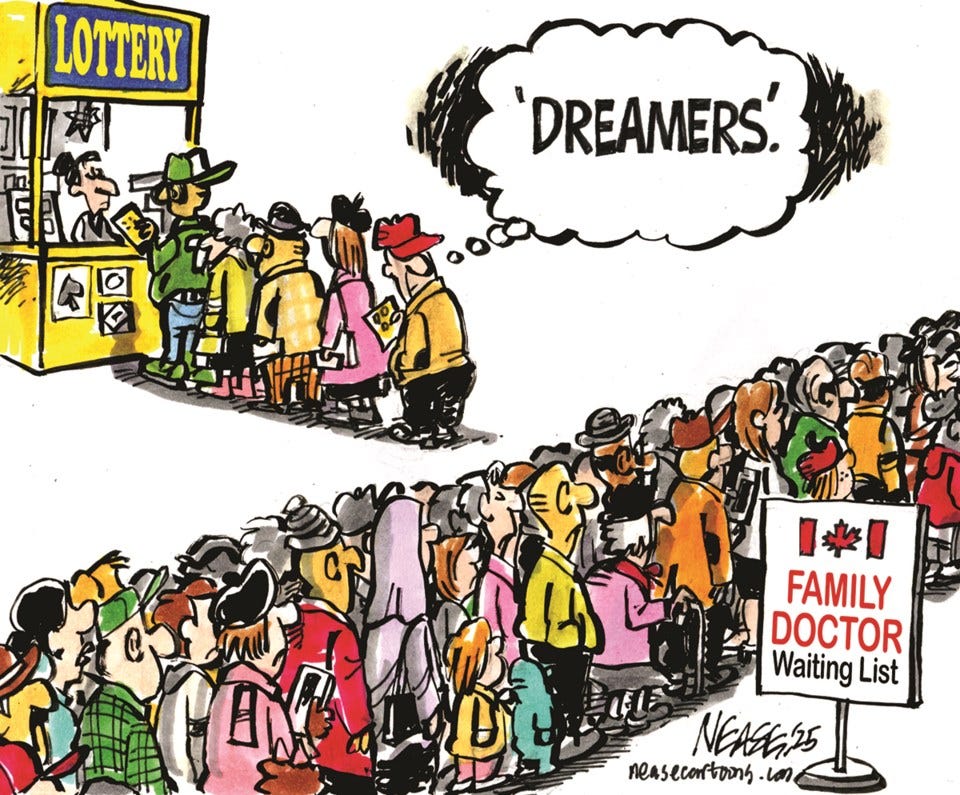
A political cartoon contrasting two lines of people. A massive, overflowing crowd and a sign that reads “Family Doctor Waiting List” . In contrast, a much shorter line stands at a “Lottery” booth, with a thought bubble overhead reading “Dreamers,” satirizing the difficulty of finding primary care in Ontario.
I finally found a primary care provider after four years of searching, and I am incredibly grateful. It took going through multiple doctors and clinics before finding someone who felt like the right fit. At the same time, I know many people across Canada , especially in rural communities , still do not have access to a primary care provider at all.
This is a reflection on my experience navigating the healthcare system and eventually finding the right nurse practitioner.
My Experience with Healthcare in Ontario
I have been in and out of the healthcare system for years, and honestly, my experiences have been mixed. One thing that became very clear to me was the noticeable difference between the care I received through private healthcare versus the public system. For example, when I was paying out of pocket for therapy, that hour was entirely mine; I received calm, sympathetic, and unrushed care.
Paying privately allowed both parties to work together directly, rather than navigating a system that is constantly looking to cut costs. Often, the first response to systemic inefficiency is to slash expenses under the guise of maximizing effectiveness. Mind you, these cost savings are rarely reinvested directly back into care. This disconnect isn’t necessarily because individual doctors do not care, but because the system itself is stretched incredibly thin — and most of that extra systemic work ultimately gets offloaded onto primary care providers and patients.
Many primary care doctors seem exhausted and overwhelmed, and I genuinely empathize with them. Physicians often manage enormous patient loads while handling administrative tasks they are not fully compensated for — such as paperwork, insurance forms, referrals, and follow-ups. In many cases, the burden of these costs and extra labor ends up being transferred directly to the patient.
For example, I have had ADHD my entire life and recently began applying for the Disability Tax Credit (DTC). My doctor charges $250 just to complete the paperwork — and I know some clinics charge upwards of $2,000 for the full assessment and forms — yet approval is still never guaranteed. When I brought it up during an appointment, the conversation felt rushed. She briefly explained the cost and pointed to the growing stack of forms already waiting on her desk. Meanwhile, trying to see a psychiatrist through the public system to assist with these complex needs can involve months of grueling waiting.
Over time, I became increasingly frustrated with the care I was receiving. I started brainstorming alternative ways to actually get the comprehensive support I needed, and that is when I began seriously looking into securing a Nurse Practitioner as my primary care provider.
Discovering Nurse Practitioners
I have met some incredible nurses throughout my life, and many of them completely changed how I viewed healthcare. They were compassionate, attentive, and genuinely present with patients. I realized I would feel comfortable having someone like that manage my primary care.
To me, family medicine is not only about diagnoses and prescriptions — it is also about patient management and relationship building. A provider needs to understand the person sitting in front of them, and a 15-minute intake appointment is rarely enough time to do that properly.
I really wanted my primary care doctor not to look like they are not being compensated effectively for their service. This was one of the main reasons i went with a NP. I appreciated that nurse practitioners are often compensated differently, meaning time spent on paperwork, insurance calls, and administrative tasks can still be considered part of their workday. That matters because those tasks are a real part of patient care.
The Structural Divide: Small Businesses vs. Salaried Care
Through this journey, I gained some valuable insight into why family doctors and nurse practitioners operate so differently. In Canada, most family physicians function as small business owners. They are personally responsible for all the overhead costs required to run a clinic — including office rent, medical supplies, and administrative staff salaries.
On paper, a gross income of $300,000 or more sounds substantial. However, once you subtract a typical 40% business expense margin, overhead eats away a massive chunk of that revenue. Because of this fee-for-service business model, many doctors are trapped in a cycle of maximizing patient turnover just to keep their clinics viable. This structure often forces a culture of “nickel-and-diming” patients for every extra request, from sick notes to insurance forms, simply to recoup uncompensated administrative time.
Of course, this varies by individual. Some doctors choose not to charge for these extras, opting instead to do hours of unpaid labor every evening — which is equally unfair to them. Frankly, I do not want my primary care managed by someone who feels unfairly compensated or utterly overworked; that systemic stress inevitably trickles down and impacts the quality of care I receive.
Nurse practitioners, on the other hand, typically operate under a completely different model. They are generally salaried employees who are paid hourly, meaning their administrative tasks, paperwork, and patient advocacy are built directly into their paid workday. They aren’t worrying about clinic rent while sitting across from a patient.
Realizing that this structural difference directly correlates to the time and presence a provider can offer is what ultimately led me to focus on securing a Nurse Practitioner as my primary care provider.
[embed]Figure 1: Breakdown of Nurse Practitioners vs. Family Physicians
The Wrong Fit
I wish I could say my first experience with a nurse practitioner was positive, but it was not.
I went into the appointment with an open mind, but it became one of the worst healthcare experiences I have had. During the intake appointment, my weight became the central focus of the visit. Each time it was brought up, I became more frustrated.
At that point in my life, I had already explained that I was experiencing significant burnout, mental health challenges, and major life stressors. Even after I explained that my weight was a symptom of my current situation, the focus of the appointment repeatedly returned to it, which left me feeling unheard and dismissed.
Eventually, I sent a formal complaint to the directors and nursing manager because the clinic was supposed to serve vulnerable populations and people with complex needs. I felt strongly that no one else should leave feeling the way I did after that appointment.
Finally Finding the Right Fit
After filing the complaint, I was matched with another nurse practitioner, and the difference was immediate.
From the first appointment, I felt listened to and understood. She had experience working with people on the spectrum, strong bedside manner, and a calm, patient-centered approach to care. Since then, everything has felt smoother, and for the first time in a long time, I genuinely feel supported by my healthcare provider.
That experience completely changed my perspective.
Final Thoughts
Nurse practitioners are not necessarily a replacement for family physicians, but they are an important part of the healthcare system and may be a better fit for some patients. My experience taught me that finding the right provider can make an enormous difference, not only medically, but emotionally as well. Finally, your biggest tool when navigating the healthcare system is your ability to self-advocate.
I realized that, like many people, I had placed too much trust in the healthcare system and assumed that, because I was dealing with healthcare professionals, I would automatically receive the best possible care. Over time, I learned that patients also need to actively participate in their care, ask questions, advocate for themselves, and make informed decisions alongside healthcare professionals.
For me, that looks like having a nurse practitioner with extensive experience working with vulnerable populations as my primary care provider. So far, the difference has been night and day.
I wish you all the best in navigating the healthcare system.
Good healthcare is not just about treatment. It is also about trust, being heard, being respected, and being cared for.

Colorful drawing of a crowd of happy people celebrating a major achievement together.
메타데이터
- post_id
- f9e9dfcdb6df
- slug
- finding-the-right-primary-care-provider-in-canada-f9e9dfcdb6df
- url
- https://medium.com/@suganyam/finding-the-right-primary-care-provider-in-canada-f9e9dfcdb6df
- canonical_url
- https://medium.com/@suganyam/finding-the-right-primary-care-provider-in-canada-f9e9dfcdb6df
- author_url
- https://medium.com/@suganyam
- status
- ok
- fetched_at
- 2026-06-09 15:37:30