What are Some Basic Concepts of Chemistry?
Chemistry is the branch of science that studies matter, its composition, structure, properties, and the changes that occur in it…
What are Some Basic Concepts of Chemistry?

A study of the transition from everyday biological materials to laboratory chemical analysis and molecular theory.
Chemistry is the branch of science that studies matter, its composition, structure, properties, and the changes that occur in it. Everything around us (air, water, food, drugs, and other materials) is made up of matter, and chemistry helps us understand how these substances behave and interact with each other. It explains how atoms combine to form molecules and how new substances are created through chemical reactions. From cooking and cleaning to medicine and technology, chemistry plays an important role in everyday life. It is closely related to other sciences such as physics, biology, and ecology. By studying chemistry, scientists develop new materials, drugs, and technologies that improve human life and help protect the environment.
Matter and Its Nature
Matter is anything that has mass and occupies space. Everything around us, including air, water, rocks, plants, and our bodies, is made of matter. Matter exists in many forms and is made up of very small particles called atoms and molecules. These particles are constantly moving and interacting with each other.
Matter can be classified in many ways. A common classification is based on its composition. Accordingly, matter is divided into elements, compounds, and mixtures. An element is a pure substance that is made up of only one type of atom, such as oxygen, hydrogen, or iron. When two or more elements combine chemically in certain proportions, a compound is formed. For example, water is a compound made up of hydrogen and oxygen. A mixture is a combination of two or more substances that are not chemically bonded together. Examples include air, salt water, and soil.
Mixtures can be further divided into homogeneous mixtures and heterogeneous mixtures. In homogeneous mixtures, the composition is completely uniform, such as sugar dissolved in water. In heterogeneous mixtures, the composition is not uniform, such as sand mixed with water.
Understanding matter and its nature is one of the most basic concepts in chemistry, as it helps scientists study how substances behave, interact with each other, and change during chemical reactions. This knowledge lays the foundation for many other topics in chemistry.
States of Matter
Matter exists in different forms, called states of matter. These states depend on how the particles in the matter are arranged and how much energy they have. The three most common states of matter are solid, liquid, and gas.
In a solid, the particles are very close together and vibrate in a fixed position. Because of this arrangement, solids have a fixed shape and volume. Examples of solids include ice, wood, and metal. Strong forces between the particles keep the structure stable.
In a liquid, the particles are still close together, but they can move past each other. Liquids have a fixed volume, but no fixed shape, so they take the shape of the container they are placed in. Water, oil, and milk are common examples of liquids.
In a gaseous substance, the particles are far apart and move freely in all directions. Gases have no fixed shape or volume, and they expand to fill the entire container. Examples include oxygen, carbon dioxide, and air.
In addition to these three general states, scientists also recognize other states, such as plasma and Bose-Einstein condensates, that arise under specific conditions of temperature and pressure.
Changes in the states of matter occur through processes such as melting, freezing, evaporation, condensation, and sublimation, which are usually caused by changes in temperature or pressure. Understanding the states of matter helps explain many natural and chemical processes around us.
Physical and Chemical Properties
Substances can be described and identified by their physical and chemical properties. These properties help scientists understand how a substance behaves and how it can change under different conditions.
Physical properties are characteristics that can be observed or measured without changing the chemical composition of the substance. These properties describe the appearance and physical form of the substance. Common physical properties include color, shape, density, melting point, boiling point, and solubility. For example, melting ice into water is a physical change, because the substance remains chemically the same. Similarly, the reddish-brown color of copper and its good electrical conductivity are also physical properties.
On the other hand, chemical properties describe how a substance reacts with other substances to form new materials. These properties can only be observed during a chemical reaction. Examples of chemical properties include flammability, reaction with acids or oxygen, corrosion, and erosion. For example, iron reacts with oxygen in the presence of moisture to form rust, which is a new substance.
Understanding the difference between physical and chemical properties is important in chemistry, as it helps scientists identify substances and predict how they will behave in different reactions. These properties are also useful in industries such as medicine, manufacturing, and ecology, where it is essential to know how substances react or change.
Physical and Chemical Changes
There are various types of changes that can occur in matter, which are mainly classified as physical changes and chemical changes. These changes describe how matter transforms under different conditions.
A physical change is a change in which the form, shape, or state of matter changes without changing its chemical composition. In this type of change, no new substance is formed. The particles remain the same, but their composition or physical state may change. Examples of physical changes include melting ice into water, freezing water into ice, cutting paper, or dissolving sugar in water. These changes are often reversible because the original substance can usually be recovered.
A chemical change occurs when one or more substances react with each other to form a new substance with different properties. During a chemical change, the chemical composition of the substance changes permanently. Common signs of a chemical change include the production of a gas, the formation of a precipitate, a change in color, the release or absorption of heat, or the emission of light. Examples include burning wood, rusting iron, cooking food, and the digestion of food in the body.
Understanding the difference between physical and chemical changes is important in chemistry, as it helps scientists explain how substances change in natural processes and industrial reactions. This knowledge is essential for studying chemical reactions and the behavior of substances.
Laws of Chemical Combination
The laws of chemical combination describe how elements combine to form compounds in chemical reactions. These laws were developed through careful experimentation and observation and are the foundation of modern chemistry.
One of the most important laws is the law of conservation of mass, which was proposed by Antoine Lavoisier. This law states that mass can neither be created nor destroyed during a chemical reaction. The total mass of the reactants is always equal to the total mass of the products.
Another important principle is the law of definite proportions, which was proposed by Joseph Proust. This law states that, regardless of the source of the compound, a chemical compound always contains the same fixed mass of the same elements. For example, water always contains a fixed mass of hydrogen and oxygen.
The law of multiple proportions, proposed by John Dalton, states that when two elements combine to form more than one compound, the mass of one element that combines with a fixed mass of the second element is in simple whole number proportions.
The second law, the law of reciprocal proportions, explains how elements combine with each other in terms of the amount by which they combine with a third element.
These laws helped scientists understand how chemical reactions occur and played an important role in the development of atomic theory and modern chemistry.
Atomic Theory
Atomic theory explains the fundamental nature of matter and states that all matter is made up of very small particles called atoms. This theory provides a scientific explanation for how substances combine and react with each other in chemistry.
The modern development of atomic theory began with the work of John Dalton in the early 19th century. Dalton proposed many important ideas about atoms. According to his theory, all matter is made up of small, indivisible particles called atoms. Atoms of the same element are identical in mass and properties, while atoms of different elements have different masses and properties. Dalton also suggested that atoms combine in simple whole-number ratios to form compounds and that in chemical reactions atoms are rearranged rather than created or destroyed.
Although Dalton’s atomic theory was very important, later discoveries showed that atoms are not indivisible. J. J. Scientists like Thomson discovered the electron, while Ernest Rutherford revealed the nuclear structure of the atom. Later, Niels Bohr proposed a model that explained how electrons orbit the nucleus.
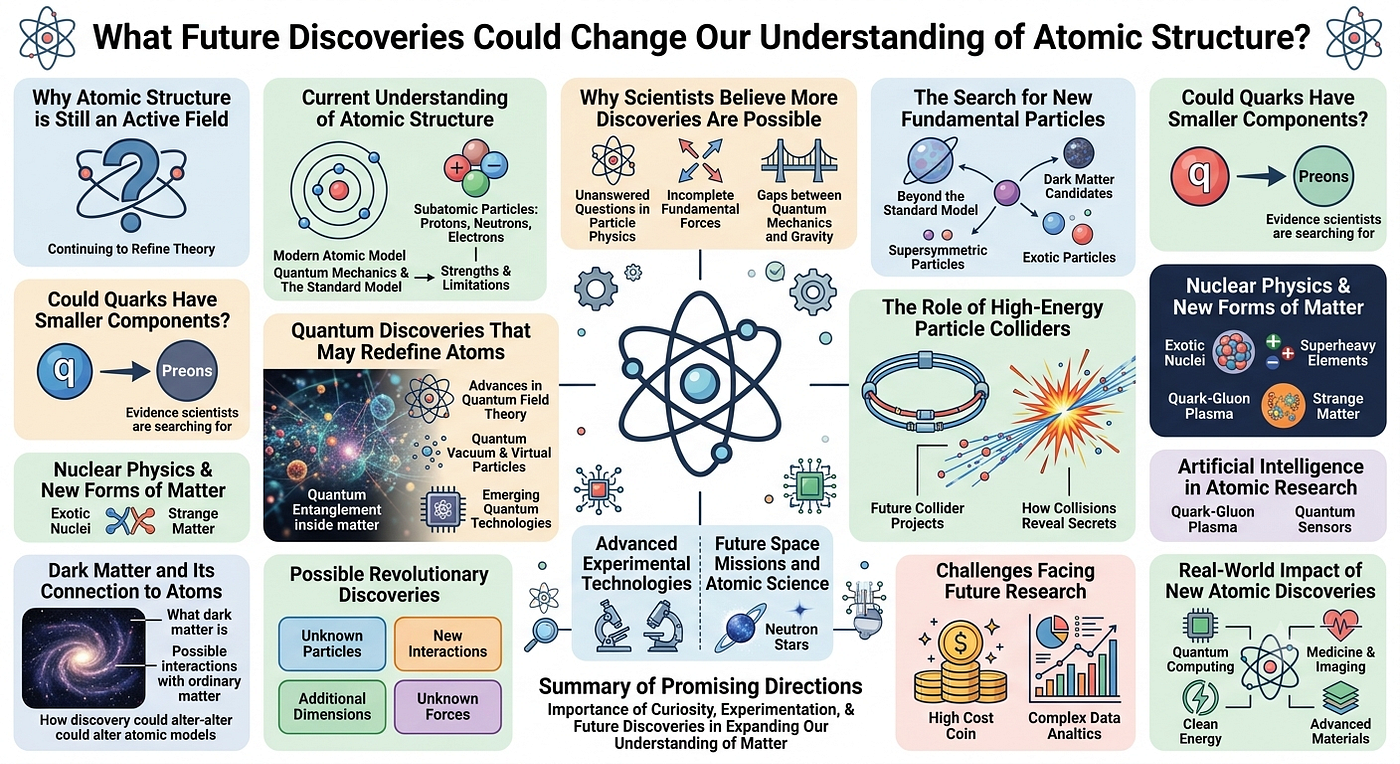
Today, atomic theory has been expanded by modern discoveries in quantum mechanics and subatomic particles. Understanding atomic theory is essential because it explains the structure of matter, the behavior of elements, and how chemical reactions occur in nature and technology.
Atoms and Molecules
Atoms and molecules are the basic building blocks of matter. Everything around us, including air, water, plants, and living things, is made up of atoms and molecules. Understanding these particles is an important part of basic chemistry.
An atom is the smallest unit of an element that retains the chemical properties of that element. Atoms are extremely small and cannot be seen with the naked eye. Each atom has a central nucleus containing protons and neutrons, and electrons orbit the nucleus. Different elements have different types of atoms. For example, a hydrogen atom is different from an oxygen atom. The idea that matter is made up of atoms was strongly supported by John Dalton’s atomic theory.
A molecule is formed when two or more atoms are joined together by chemical bonds. Molecules can contain atoms of the same element or atoms of different elements. For example, oxygen gas is made up of two oxygen atoms bonded together, while water molecules are made up of two hydrogen atoms and one oxygen atom.
Molecules are the smallest units of a compound that can exist independently and still exhibit the properties of that substance. The study of atoms and molecules helps scientists understand chemical reactions, the structure of matter, and how substances interact with each other in nature and in various chemical processes.
Mole Concept
The mole concept is one of the most important concepts in chemistry, because it helps scientists measure extremely small particles such as atoms, molecules, and ions. Because these particles are too small to measure individually, chemists use the mole as a convenient unit of measurement.
A mole is the amount of a substance that contains 6.022 × 1⁰²³ particles. This number is known as Avogadro’s number, named after Amedeo Avogadro. Depending on the substance being measured, these particles can be atoms, molecules, ions, or other microscopic entities.
The mole concept connects the microscopic world of atoms and molecules with the measurable world of mass. For example, one mole of carbon atoms has a mass of about 12 grams, while one mole of water molecules has a mass of about 18 grams. This mass is called molar mass and is expressed in grams per mole.
Chemists use the concept of the mole to calculate in chemical reactions. The concept is used to determine how much of a substance is needed or produced in a reaction; this process is called stoichiometry. Using the mole, scientists can easily convert the number, mass, and volume of particles in a substance.
Understanding the concept of the mole is essential for solving numerical problems in chemistry and for accurately studying chemical reactions.
Chemical Formula and Equations
Chemical formulas and chemical equations are important tools in chemistry, used to clearly and concisely represent substances and chemical reactions. They help scientists understand how elements combine and how reactions occur.
A chemical formula shows the types and numbers of atoms in a substance. It uses chemical symbols and numbers to represent the elements in a compound. For example, the formula H₂O represents water, which means that each molecule contains two hydrogen atoms and one oxygen atom. Similarly, CO₂ represents carbon dioxide, which contains one carbon atom and two oxygen atoms. Chemical formulas help identify substances and describe their composition.
A chemical equation uses symbols and formulas to represent a chemical reaction. It shows the substances that react, called reactants, and the substances that are formed, called products. For example, when hydrogen reacts with oxygen to form water, it can be written as a chemical equation. Chemical equations must obey the law of mass equivalence, meaning that the number of atoms of each element on both sides of the equation must be the same.
To obey this rule, equations are often balanced by changing the coefficients in front of the formulas. Balanced equations provide important information about the amounts of substances involved in a reaction.
Understanding chemical formulas and equations helps scientists describe reactions, predict products, and calculate the products in chemical processes and laboratory experiments.
Stoichiometry
Stoichiometry is a branch of chemistry that deals with the quantitative relationships between reactants and products in a chemical reaction. Scientists use it to determine how much of each substance is needed or produced during a reaction. Stoichiometry is based on a balanced chemical equation and follows the law of conservation of mass, which states that no substance can be created or destroyed in a chemical reaction.
In stoichiometry, chemists use the concept of the ‘mole’ to measure the amount of a substance. A mole is a specific number of particles, known as the ‘Avogadro number’, named after Amedeo Avogadro. This number helps convert between the mass of a substance and the number of atoms or molecules it contains.
Stoichiometric calculations allow scientists to predict the exact amounts of reactants needed and products formed in a reaction. An important concept is the ‘limiting reagent’, which is the reactant that is used up first and determines how much product can be formed. Another concept is the ‘percentage yield’, which compares the actual amount of product obtained with the theoretical amount predicted by mathematics.
Stoichiometry is widely used in chemical laboratories and industries. It helps chemists design reactions efficiently, reduce waste, and produce the right amount of substance. Understanding stoichiometry is essential to studying chemical reactions and solving many practical problems in chemistry.
Importance of Basic Concepts in Chemistry
Basic concepts in chemistry provide the foundation for understanding how substances behave and how chemical reactions occur. These concepts help explain the structure, properties, and transformations of substances in the natural world. Without a clear understanding of these basic principles, it will be difficult to study more advanced topics in chemistry.
Basic concepts such as atoms, molecules, substances, chemical reactions, and stoichiometry provide the necessary framework for learning chemistry. They help students understand how elements combine to form compounds and how substances interact with each other. These concepts also explain many everyday processes such as cooking, digestion, the corrosion of metals, and the combustion of fuels.
Understanding the basic principles of chemistry is also important in many fields of science and technology. In medicine, chemistry helps in the development of drugs and vaccines. In industry, it is used to manufacture goods such as plastics, fertilizers, fuels, and cleaning products. Chemistry also plays an important role in environmental science, where it helps scientists study pollution, climate change, and air and water quality.
By learning the basic concepts of chemistry, students develop analytical and problem-solving skills that are useful for scientific research and innovation. These concepts serve as a starting point for studying more complex areas of chemistry and understanding the chemical processes that shape our world.
Conclusion
The basic concepts of chemistry help us understand the nature of matter and how substances interact with each other. Concepts such as atoms, molecules, states of matter, chemical reactions, and stoichiometry form the foundation of chemistry. These concepts explain many everyday processes and provide the basis for the study of advanced topics in chemistry. By learning these fundamentals, students gain a clearer understanding of how the physical world works. Knowledge of basic chemistry is also essential in fields such as medicine, industry, and ecology. Overall, these fundamentals provide a starting point for exploring and applying chemistry in science, technology, and everyday life.
메타데이터
- post_id
- f9ec06c2aea2
- slug
- what-are-some-basic-concepts-of-chemistry-f9ec06c2aea2
- url
- https://medium.com/@sciencespectrum/what-are-some-basic-concepts-of-chemistry-f9ec06c2aea2
- canonical_url
- https://medium.com/@sciencespectrum/what-are-some-basic-concepts-of-chemistry-f9ec06c2aea2
- author_url
- https://medium.com/@sciencespectrum
- status
- ok
- fetched_at
- 2026-07-31 23:44:10