A Fowl Discovery: The First Archaeological Case of Crested Geese Discovered in 17th Century Germany
Skull abnormalities in 17th-century geese from an aristocratic site in Brandenburg indicate deliberate breeding for the crested trait, the…
A Fowl Discovery: The First Archaeological Case of Crested Geese Discovered in 17th Century Germany
Skull abnormalities in 17th-century geese from an aristocratic site in Brandenburg indicate deliberate breeding for the crested trait, the first published case in the archaeological record.
A grey and white crested goose, a shoveler, a Muscovy duck, goslings, ducklings and other fowl in a park by Melchior d’Hondecoeter. Credit: Wikimedia Commons
Many birds have crests, some are the result of millions of years of evolution, such as in the grey crowned crane, the Atlantic royal flycatcher, or one of my favorite birds, the Hoopoe. But they can also result from deliberate breeding, as in crested chickens, ducks, and geese. But while crested chickens, geese, and ducks may look cute, their crests often result in one or more holes in their skulls. These holes can be useful for identifying archaeological remains and determining when a crested breed first came about.
In a recent study, Dr. Maaike Groot and Dr. Marcus Wandelt examined four unusual goose skulls from a 17th-century site in Brandenburg, Germany. Such holes had never before been observed in geese’s skulls in archaeology, and the researchers considered several hypotheses to determine their cause: disease, parasites, or infection? Their research led them to a completely different explanation, but maybe not necessarily a healthier one.
Aristocratic Geese
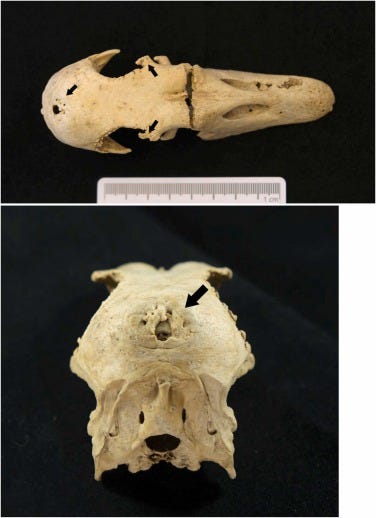
Goose 2 with holes in its skull: Credit: Top by Marcus Wandelt, bottom by Hans Whitefield in Groot and Wandelt 2026
The site from which these goose remains were obtained is called Flecken Zechlin. It is located around 100km northwest of Berlin in Brandenburg. Excavations of the site between 2021 and 2023 revealed a long history of use.
First built in the 14th century, the site was no more than a wooden building tied to the Cistercian monastery. It passed through various owners, including Heinrich II von Mecklenburg, who built a ring castle in 1306; the bishops of Havelberg from 1320, who created a three-winged residence; and the Kurfürst (Prince-elector) Johann Georg von Brandenburg, who in 1548 built a residence for himself and his wife Sabina von Ansbach.
From 1625 onwards, it served mainly as an occasional hunting retreat, only to burn during the Thirty-Year War in 1638. The building had its final construction in 1680 and was completely abandoned shortly after 1700. As you can see, this building has a long history associated with the aristocracy.
During excavations of the site, not only was the building’s long and storied history uncovered, but also 651 animal bones spanning the 14th to the 19th centuries, including birds. Birds do not survive well in archaeology because the very same hollow, light bones that enable them to fly are typically fragile. Most of these bird remains belonged to chickens and geese, but among them were also four goose skulls. If finding a few random bones is rare, finding near-complete skulls is even rarer. They were recovered from the lavatory shaft, along with various other discarded kitchen scraps.
But what made them unique were the various holes observed on their skulls. To determine whether these holes were the result of disease, infection, parasite, or something else, the researchers need to give them a closer look.
Fowl With A Crest

Goose 1 and the 15 mm large hole in its skull. Credit: Marcus Wandelt in Groot and Wandelt 2026
The researchers determined the skulls had no signs of butchery, burning, or animal gnawing on them, and the holes did not appear to have been caused by breakage. This suggested they had formed in life. Each goose had slightly different sizes, shapes, and numbers of holes, with Goose 1 having the largest hole around 5mm in size, surrounded by multiple smaller ones.
The holes resembled those often seen on crested chickens known for their distinctive tuft of feathers on the head. The crest is often associated with a condition called a cerebral hernia, in which the brain protrudes through an opening in the skull. This creates a bony bump on the forehead, alters brain structure, and produces the distinctive crest that the chickens are known for. Even Charles Darwin noticed and described these features in Polish chickens, noting that the skull bone often fails to form fully, leaving various holes and gaps of varying sizes and numbers.
Such crested chicken skulls have been recovered as far back as the Roman era, in sites such as Uley and Trier, after which they disappear only to reappear in Central and Northern Europe around 1300 CE, and become relatively common in the 16th and 18th centuries across Denmark, Austria, Hungary, and Germany.
In crested ducks, the crest sits upon a cushion of fat, which in turn is often connected through holes to the brain cavity. Though curiously, in some crested ducks the fat is missing, while in some non-crested ducks fat is present. Regardless, a study of 96 crested duck skulls found that most (78) had abnormal holes on the backs of their skulls, very similar to those of our crested geese.
Based on these findings, the researchers concluded that the four goose skulls from Flecken Zechlin likely belonged to crested geese. Considering the aristocratic history of the site from which they came, this was not too surprising, and the geese were likely bred for aesthetic purposes. But what makes them truly unique is that these crested geese are the very first to be recovered from an archaeological context ever.
The History of Crested Geese
“The Crow Exposed”, with a crested goose on the right by Melchior d’Hondecoeter. Credit: Wikimedia Commons
Finding crested fowl is significant because it provides insight into the breed’s evolution, distribution, and husbandry. For crested geese, the only historical evidence of their existence is late 17th-century paintings by Melchior d’Hondecoeter (1636–1695) (in many, the crested geese look rather flabbergasted). These paintings, alongside the archaeological evidence, show that crested geese were being kept in northern Europe in at least two regions by the 17th century.
But perhaps there are earlier instances that have simply been overlooked.
The presence of crested geese also tells you about their health, at least to some extent, and indirectly. You see, the crested trait is linked to genetic variation and a myriad of health problems. Most breeders want the healthiest and strongest to survive and keep breeding, but the crested breed is inherently less healthy and was bred purely for aesthetics, similar to Bubble Eye goldfish, and many dog breeds like Pugs.
In crested breeds, these breeding practices can lead to fat pockets within the skull, which can affect coordination and movement. In some cases, the birds even lose their sight or hearing. That said, the effect varies widely, and crest size is not a reliable indicator of health. Some birds have large skull openings but seemingly no health problems, while others have much smaller ones but obvious health issues.
In a recent study, researchers identified the first known archaeological case of crested geese, dated to the 17th century and found in an aristocratic context. The geese were likely bred for aesthetic purposes (though they may still have been eaten upon death). These crested geese are the first physical proof of their existence, with the only other evidence coming from Dutch 17th-century paintings.
I wonder how long crested geese have been around, considering the unusual gap in crested chickens between the Roman period and their later reappearance in the 1300s. I would not be surprised if crested geese have had a much longer history. Though I also feel sad that we humans like to breed animals for aesthetics, even when it is obvious that the animals are suffering. It also reminds me of a German saying: ‘Wer schön sein will, muss leiden’, meaning, ‘Those who wish to be beautiful must suffer’.
How long do you think crested geese have been around, and can you think of any older examples, paintings, sculptures, or the like depicting them?
Let me know your thoughts, and if you’d like to support the countless hours I pour into researching, writing, and bringing these hidden corners of history to life, why not Buy Me A Coffee
Reference
Groot, M., & Wandelt, M. (2026). Cranial defects in remains of 17th-century geese from Brandenburg, Germany. International Journal of Paleopathology, 54, 9–13. https://doi.org/10.1016/j.ijpp.2026.06.001
메타데이터
- post_id
- f9f07eb88a32
- slug
- a-fowl-discovery-the-first-archaeological-case-of-crested-geese-discovered-in-17th-century-germany-f9f07eb88a32
- url
- https://medium.com/the-academic/a-fowl-discovery-the-first-archaeological-case-of-crested-geese-discovered-in-17th-century-germany-f9f07eb88a32
- canonical_url
- https://medium.com/the-academic/a-fowl-discovery-the-first-archaeological-case-of-crested-geese-discovered-in-17th-century-germany-f9f07eb88a32
- author_url
- https://medium.com/@sandeeoster17
- status
- ok
- fetched_at
- 2026-06-27 07:40:21