Co-host USMNT faces an uphill battle at 2026 FIFA World Cup
The 2026 FIFA World Cup is here.
Co-host USMNT faces an uphill battle at 2026 FIFA World Cup
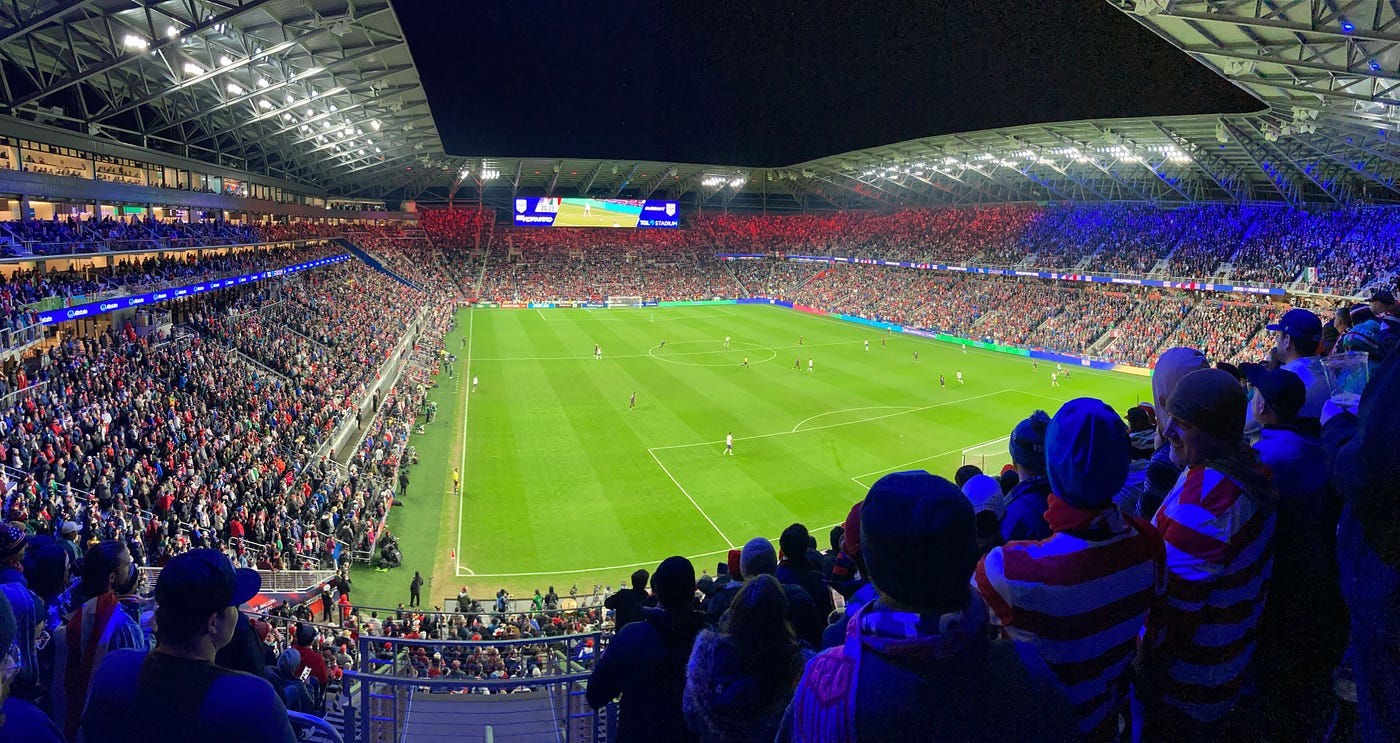
Photo courtesy of Wikimedia Commons
The 2026 FIFA World Cup is here.
Four(ish) years have passed since Lionel Messi and Argentina lifted the most prestigious trophy in world sport, simultaneously ending a 36-year drought for La Albiceleste and Messi’s long quest for glory in Argentina’s famous blue and white shirt.
Messi and Argentina return to defend their title alongside 25 countries who fell short in Qatar, four nations making their World Cup debut, six others making their first appearance of the 21st century, and a collection of others returning to chase football’s ultimate prize.
Co-hosts Canada, Mexico and the United States will all look to improve upon disappointing runs in 2022 as the FIFA World Cup arrives on home soil. Despite high hopes, Canada and Mexico were both eliminated in the group stage last time around.
A tepid Round of 16 exit four years ago contributed to the departure of longtime USMNT head coach Gregg Berhalter. Results have been mixed under Berhalter’s replacement, Mauricio Pochettino, who has won just 55 percent of his matches on the touch line for the United States. That’s the worst win percentage of any full-time USMNT coach since Steve Sampson led the Americans in the mid-1990s.
All that can be erased in the next few weeks, as Poch and the Yanks host the World Cup for the first time since 1994. Pochettino leads a 26-man squad loaded with talent plying their trade both at home and abroad.
USMNT World Cup roster
Goalkeepers Chris Brady (Chicago Fire) Matt Freese (NYCFC) Matt Turner (New England Revolution)
Defenders Max Arfsten (Columbus Crew) Sergino Dest (PSV Eindhoven) Alex Freeman (Villareal) Mark McKenzie (Toulouse) Tim Ream (Charlotte FC) Chris Richards (Crystal Palace) Antonee Robinson (Fulham) Miles Robinson (FC Cincinnati) Joe Scally (Borussia Monchengladbach) Auston Trusty (Celtic)
Midfielders Tyler Adams (Bournemouth) Sebastian Berhalter (Vancouver Whitecaps) Weston McKennie (Juventus) Cristian Roldan (Seattle Sounders)
Attackers Brendan Aaronsen (Leeds United) Christian Pulisic (AC Milan) Gio Reyna (Borussia Monchengladbach) Malik Tillman (Bayer Leverkusen) Tim Weah (Marseille) Alejandro Zendejas (Club America)
Forwards Folarin Balogun (AS Monaco) Ricardo Pepi (PSV Eindhoven) Haji Wright (Coventry City)
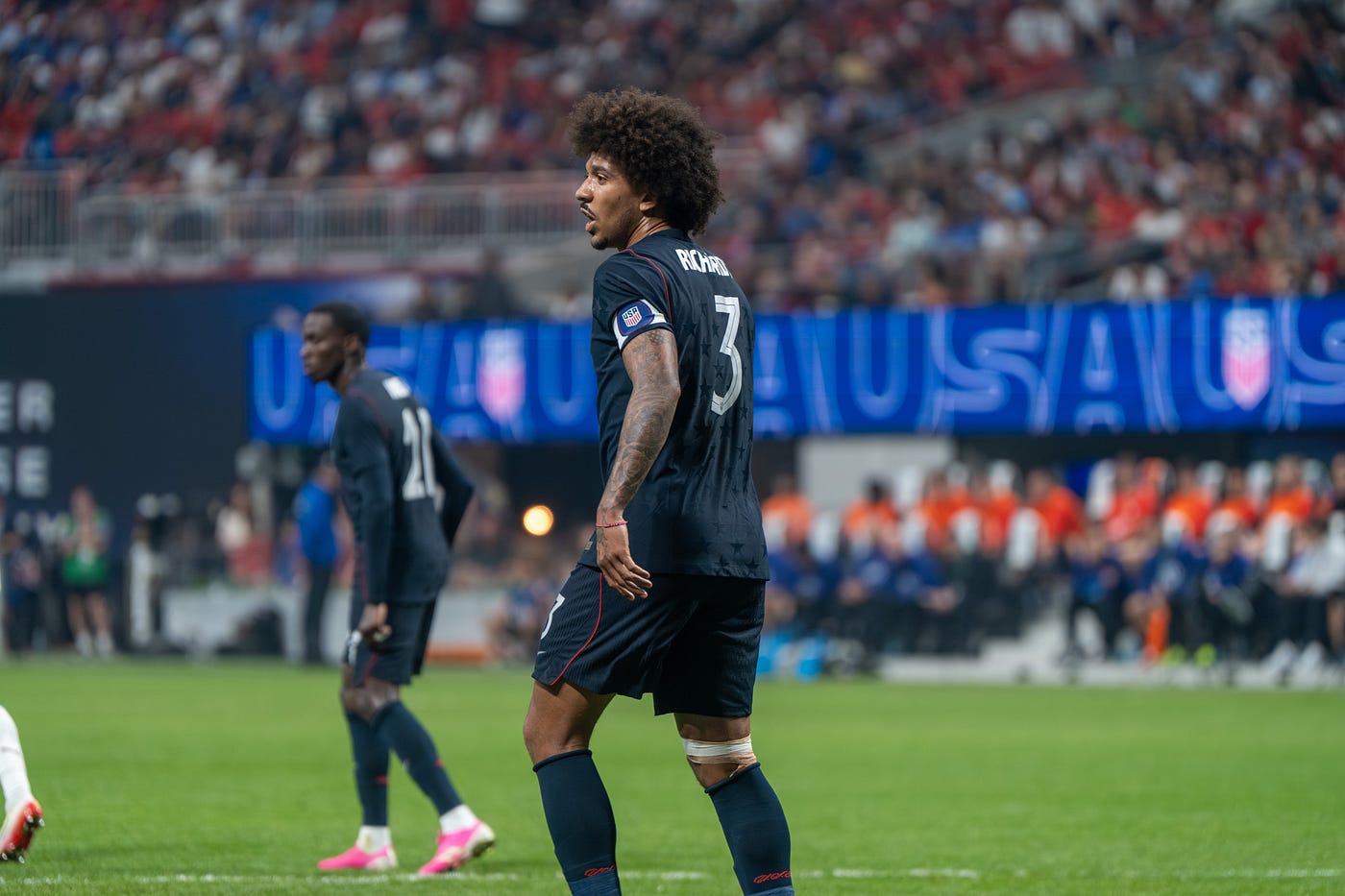
Christian Pulisic gets the attention, but it’s Chris Richards (seen above) who may be the USMNT’s most important player. Photo courtesy of Wikimedia Commons
On paper, this is the most talented roster the United States men’s national team has ever taken to the World Cup. Each of the three forwards is a capable and dangerous threat to score. Midfielders Tyler Adams and Weston McKennie are an excellent pairing with extensive European experience. Chris Richards and Antonee Robinson are Premier League-proven defenders and leaders on the American back line.
There is high end talent everywhere, and yet, the on-field product is incongruent to the level of individual quality at Mauricio Pochettino’s disposal.
The lack of a proper qualifying cycle is not necessarily an excuse for the USMNT’s lack of cohesion on the pitch, but it’s relevant.
In the 2022 World Cup cycle, the United States played 14 qualification matches on top of their normal schedule of friendlies. This time around, there were no qualification matches to be had since the United States, as a cohost with Canada and Mexico, automatically qualified for the 2026 World Cup.
That’s 1,460 minutes of game action the USMNT didn’t have in the 2026 qualifying cycle. All those hours lost could have been used figuring out the team’s best Starting XI, tweaking tactics, and building team chemistry.
Poch is part of the problem, too. He’s been consistently tinkering with his Starting XI since taking over as USMNT head coach in September 2024. There is something to be said about searching for your best lineup, but Pochettino should know his ideal Starting XI by now.
The exclusion of midfielder Tanner Tessmann (Lyon) and attacker Diego Luna (Real Salt Lake) drew headlines when Pochettino’s final World Cup roster was released on May 26 and will bring about even more questions if the midfield or attack falters this summer. Tessmann and Luna were better options than Gio Reyna and Alejandro Zendejas, who can barely get on the pitch for their club (Reyna) or their country (Zendejas) lately.
Tessmann’s absence also means Tyler Adams is the only defensive midfielder available to Pochettino. That isn’t a problem if Adams stays fit, but Adams has battled injuries throughout his career. Pochettino loses his midfield linchpin if Adams is injured or ineffective, which would likely to spell a quick demise for the USMNT’s World Cup hopes this summer.
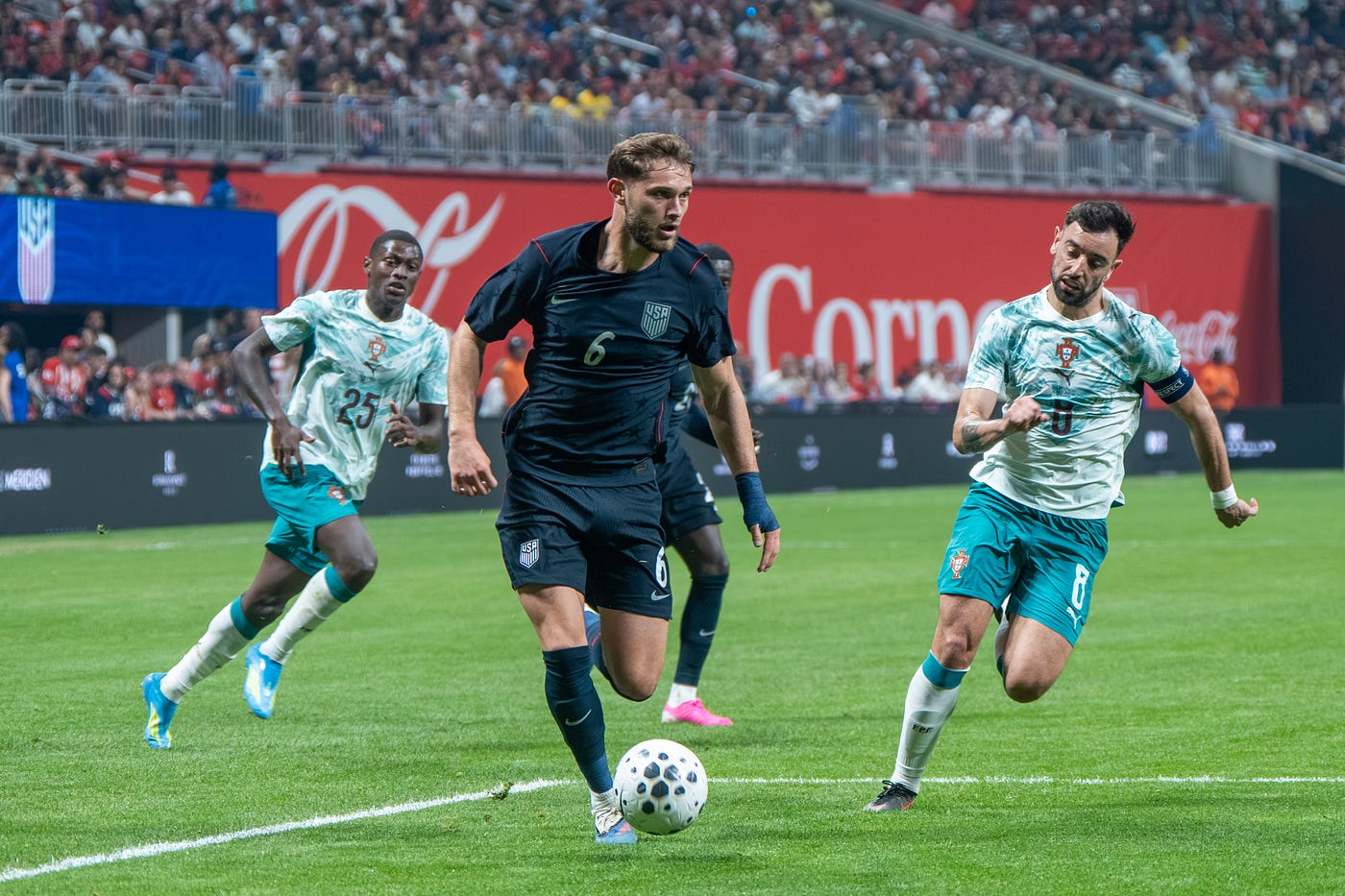
Tanner Tessmann’s exclusion from the final USMNT squad is a mistake. American fans will be hoping it doesn’t end up costing the team a spot in the knockout stage. Photo courtesy of Wikimedia Commons
Lastly, we can’t ignore the consistency issues facing Pochettino’s squad.
Although the talent up front is capable, reliable goal-scoring has been a problem for the USMNT for years. Try as he might, Christian Pulisic has never been a prolific scorer for his country, at least not on a consistent basis. The same can be said for Folarin Balogun, whose form always seems to be on a roller coaster ride.
Chris Richards has been a stalwart on the USMNT’s back line for some time now, and although he was named to the final 26-man roster, Richards’ status remains unclear after suffering an ankle injury in Crystal Palace’s 2–2 draw with Brentford on May 17. Tim Ream admirably deputized Richards in the past, and will wear the captain’s armband this summer, but Ream began showing his age during the last World Cup four years ago. It remains to be seen how Ream plans to keep up, especially if Richards is unable to play.
Antonee Robinson is healthy and effective, but he can’t play both fullback positions. Sergino Dest was supposed to be Robinson’s long-term partner in crime at fullback, but Dest can’t stay on the pitch — he’s missed 62 matches for club and country over the last two years. Joe Scally looked like he might be able to fill the void Dest left behind, but Scally’s form has faded to the point that many wondered if he’d make the final World Cup roster.
We don’t have to wait much longer for all of these questions to be answered. The United States begins its 2026 World Cup journey at SoFi Stadium (known in this tournament as “Los Angeles Stadium” due to FIFA naming regulations) on June 12, with additional group matches on June 19 and June 25.
USMNT v. Paraguay (June 12, Los Angeles Stadium)
These teams took part in a physical, hard-fought friendly back in November 2025, a match the United States won, 2–1. The good news is that the Yanks were probably the better team from top to bottom in that match, but a November friendly in Pennsylvania is a lot different than the opening game of the World Cup group stage.
Miguel Almiron (Atlanta United) is the most recognizable, and most important, player on the Paraguayan roster. Almiron and fellow midfielder Diego Gomez (Brighton) drive a Paraguayan team without a ton of potent scorers up top. Almiron and Gomez will need to get the better of their midfield counterparts, Tyler Adams and Weston McKinnie, for Paraguay to come away with a result.
USMNT v. Australia (June 19, Seattle Stadium)
Australia also battled the USMNT to a 2–1 loss last fall. The Yanks were the better team in that match as well despite Christian Pulisic leaving the pitch in the first half due to injury. Haji Wright stepped up after Pulisic departed, scoring a pair of goals en route to being named Player of the Match.
The Socceroos are one of the most experienced squads in the entire tournament and will be anxious to get their win back from the USMNT. The key to a repeat victory for the Stars and Stripes will be consistent link-up play in attack. Be it Wright, first-choice striker Folarin Balogun, or a healthy Christian Pulisic, the Americans must be consistent and level-headed through 90 minutes if they wish to knock back the Australians for the second time in a row.
USMNT v Turkiye (June 25, Los Angeles Stadium)
Results in their first two matches will be crucial, as the USMNT’s toughest group stage contest comes in the finale against Turkiye.
Frankly, the Turkish attack is going to be a problem for the United States’ already questionable defense. Arda Guler (Real Madrid), Kenan Yildiz (Juventus), and Can Uzun (Eintracht Frankfurt) all ply their trade at the top of their respective leagues and feature regularly for the Crescent Stars. That’s not to mention the other high end talent available to Turkiye head coach Vincenzo Montella, who has the likes of Hakan Calhanoglu (Inter Milan), Orkun Kokcu (Besitkas), Caglar Soyuncu (Fenerbahce), Merih Demiral (Al-Ahli), and Ozan Kabak (Hoffenheim) at his convenience.
Turkiye’s issue of late has been putting it all together. The Crescent Stars are capable of going toe-to-toe with the likes of second-ranked Spain, which they did in a 2–2 draw during UEFA qualifying. They were also pasted by the Spaniards, 6–0, two months before that draw and have a recent history of stumbling in major tournaments.

Kenan Yildiz tallied 16 goal contributions for Juventus last season. He will be a big part of Turkiye’s attack at the World Cup this summer. Photo courtesy of Wikimedia Commons
Turkiye should probably be considered the favorite to win Group D. Although the Yanks have beaten both Paraguay and Australia recently, neither will be a straightforward affair. Poch and company need to take care of business in both of those matches if they want to avoid a very difficult must-win situation in their final match of the group stage.
The last time the United States hosted the men’s World Cup, the USMNT qualified for the knockout stage but bowed out in a 1–0 defeat to eventual champion Brazil. A Round of 16 exit may be the ceiling for the Stars and Stripes this time around as well.
Ecuador, Japan, or Senegal could be waiting for the Yanks in the Round of 32 if they pull the upset and top Group D. Win that one and it could be a rematch of the wild 2014 World Cup Round of 16 matchup between the United States and Belgium.
Should the United States fail to win their group, the path forward would become much more challenging. The Round of 32 would likely see a tricky matchup with either Egypt or Iran, the latter of which could be the most complicated match in USMNT history. Win that contest, and it will likely be Uruguay or defending champion Argentina waiting for the Americans in the Round of 16.
The nail-biting would be next level if the USMNT finishes third, as qualification for the knockout stage would not be certain. Should they survive as a third-place finisher, the United States would be facing the prospect of a Round of 32 match against world powerhouses Germany, France, or Portugal.
Pick a path and you will find a problem for the USMNT. Belgium, Uruguay, Argentina, Germany, France, and Portugal are all demonstrably better than the United States, and barring a string of upsets, one of those six teams stand between the Yanks and a trip to the quarterfinals.
Advancing through Group D isn’t a given, but a talented 26-man squad and an expanded knockout round should see the United States through to the business end of the tournament. Anything more than an appearance in the Round of 16, however, seems unlikely.
메타데이터
- post_id
- f9f1100bb096
- slug
- co-host-usmnt-faces-an-uphill-battle-at-2026-fifa-world-cup-f9f1100bb096
- url
- https://whileromeburns.net/co-host-usmnt-faces-an-uphill-battle-at-2026-fifa-world-cup-f9f1100bb096
- canonical_url
- https://whileromeburns.net/co-host-usmnt-faces-an-uphill-battle-at-2026-fifa-world-cup-f9f1100bb096
- author_url
- https://medium.com/@alwaysbrewing
- status
- ok
- fetched_at
- 2026-06-13 16:00:06