Small Business Owners: You’re Losing 2 Hours a Day to WhatsApp. Here’s How to Stop
Running a business is hard enough. Your communication tools shouldn’t be making it harder.
Small Business Owners: You’re Losing 2 Hours a Day to WhatsApp. Here’s How to Stop
Running a business is hard enough. Your communication tools shouldn’t be making it harder.
Ask any small business owner to describe a typical morning and you’ll hear some version of the same thing.
Wake up. Before the coffee is even made, open WhatsApp. There’s a supplier group with 43 messages from last night. A staff group with 28 messages, including what looks like a disagreement about a shift swap. A client group with 11 messages, two of which have your name tagged. A delivery group where someone has sent a string of voice notes you haven’t listened to yet. A vendor group. A freelancer group. A group for the business association you joined six months ago.
Before you’ve made a single business decision, you’ve already spent 35 minutes reading, scrolling, and mentally triaging messages that arrived while you were asleep.
This is the small business WhatsApp problem. And unlike the WhatsApp habits of people who use it primarily for personal communication, this one has a direct cost attached to it. Your time, as a business owner, is the scarcest resource you have. Two hours of it every day going to message excavation is two hours not going to sales, customer relationships, product development, or anything else that actually moves your business forward.
Here’s what’s driving it, what it’s actually costing you, and how to fix it without disconnecting from the communication channels your business genuinely depends on.
Why Small Business Owners Are Hit Harder Than Everyone Else
WhatsApp overload affects a lot of people. But small business owners have a specific version of the problem that’s more acute than most.
The first reason is volume. A typical person has 6 to 10 WhatsApp groups mixing personal and professional communication. A small business owner often has 10 to 20 groups that are almost entirely operational — suppliers, staff, clients, logistics partners, service providers, professional networks. These groups don’t wind down on weekends. They don’t respect working hours. They generate messages around the clock because your suppliers are in different time zones, your staff have questions at 11 PM, and your clients expect accessibility.
The second reason is stakes. When a message in a personal WhatsApp group goes unread for a day, the consequence is usually minor. When a supplier message about a delayed shipment goes unread for six hours, it can cascade into a missed deadline and an angry customer. When a staff message about a no-show goes unseen until mid-morning, you’re scrambling to cover a shift with no notice. The cost of missing messages is higher for business owners than for almost any other WhatsApp user.
The third reason is the absence of alternatives. Large companies have CRMs, project management software, and dedicated communication platforms with better filtering and prioritization. Small businesses run on WhatsApp — not because it’s the ideal tool for operational communication, but because it’s free, it’s universal, and everyone from your cleaner to your biggest client is already on it. You can’t just switch platforms. You have to work with what’s there.
The Real Time Accounting
The 2-hours-per-day figure isn’t an exaggeration for most small business owners in actively managed businesses. Here’s where it accumulates:
The morning catch-up, reading everything that came in overnight: 30 to 45 minutes for anyone in more than eight active business groups. The midday check-in, re-reading threads to track ongoing conversations: 20 to 30 minutes. The late afternoon read before end of business: 20 to 25 minutes. The evening scroll, because something important might have come in: 15 to 20 minutes. The miscellaneous dip-ins throughout the day, triggered by notifications: 20 to 30 minutes cumulative.
Add it up and you’re comfortably at 105 to 150 minutes on a normal day. Some owners, in industries where WhatsApp is particularly active — hospitality, retail, construction, logistics — are over two hours on a regular basis.
What makes this number particularly uncomfortable is what it displaces. Two hours is enough time to have meaningful conversations with five customers. To review your month-end numbers properly. To develop the pitch for the account you’ve been meaning to pursue. To actually work on your business rather than just managing the communications around it.
The Three Categories of WhatsApp Time Drain
Not all of those two hours are wasted equally. It helps to break it down:
Category 1: Reading noise to find signal. The largest chunk. You have to read 150 messages to find the 12 that actually require your attention. The ratio of useful to non-useful content is brutally low in most business WhatsApp groups, but you can’t skip messages without risking missing the one that mattered. This is the most fixable category — and where AI summaries make the biggest impact.
Category 2: Re-reading for context. You saw a message this morning but didn’t action it. Now you’re going back to find it, re-read the surrounding thread, and remember what the situation was. Every time you return to a thread without resolving it, you’re paying the reading cost again. This is largely a system problem — you need a way to capture action items when you first read them rather than hoping you’ll remember where they were.
Category 3: Searching for specific information. Something was mentioned in a group last week — a price, a deadline, a commitment someone made. You need to find it. WhatsApp’s search is keyword-dependent and unreliable, so you end up scrolling back through days of messages looking for a specific exchange. This is where the Q&A feature of AI summarization tools saves a disproportionate amount of time relative to how often the situation arises.
The Fix: AI-Assisted Reading for Business Groups
The solution that addresses all three categories is switching from manual reading to AI-assisted reading for your high-volume business groups.
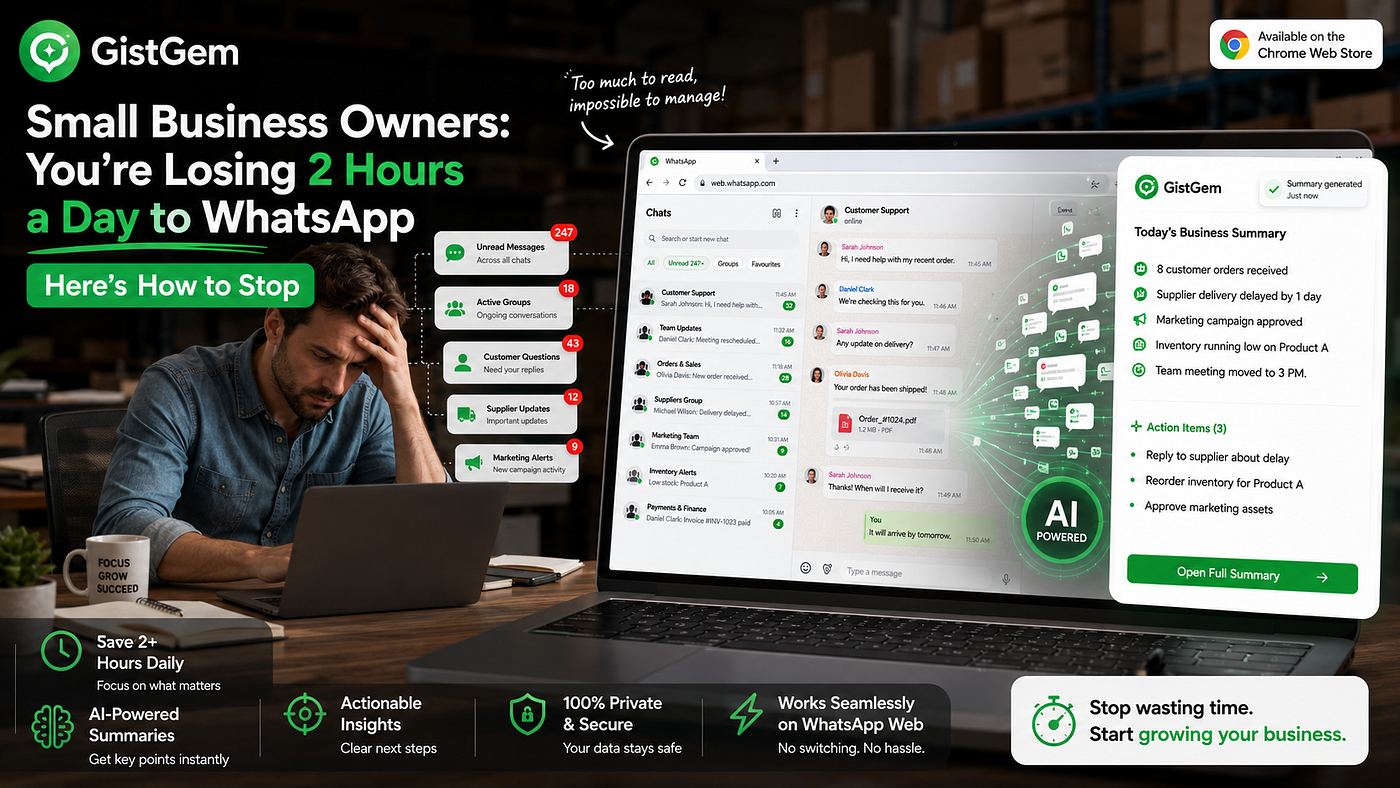
The tool that does this inside WhatsApp Web is GistGem — a free Chrome extension that generates structured AI summaries of your group chats directly in your browser. You select the groups you want to catch up on, set the time period, and it reads the threads for you — all messages, in full — and returns a clean summary of what actually happened. Decisions made. Updates shared. Action items. Anything that requires your response.
For a staff group with 80 messages from the past 24 hours, this takes 60 seconds to process and 45 seconds to read. A supplier group with 120 messages becomes a 90-second summary review. The client group where two messages tagged you gets surfaced immediately.
The time comparison for a typical business owner morning: 40 minutes of manual reading across eight groups versus 8 to 10 minutes of reading AI summaries of those same groups. That’s where the two hours becomes 20 minutes. Not by missing things — the summaries are more reliable at catching important items than manual scrolling — but by eliminating the noise reading that makes up the majority of the time.
The Q&A feature handles Category 3 directly. Instead of scrolling back to find what the supplier said about the delivery schedule last Tuesday, you type the question in plain English and get the answer from the actual message content. “What was the revised delivery date mentioned this week?” — answered in seconds, without any scrolling.
Building the Business Owner WhatsApp Routine
The efficiency gains from AI summaries only stick if you build them into a consistent daily routine. Here’s what works for most business owners:
Before 9 AM (10 minutes): Open WhatsApp Web. Run GistGem across all your business groups — staff, suppliers, clients, logistics — covering the past 16 hours. Read the summaries. Pull out the three to five things that need action before noon. Handle the urgent ones immediately; note the rest for action later. Close WhatsApp.
Midday (3–4 minutes): Run a quick summary check on your highest-priority groups — the ones where time-sensitive issues are most likely to have emerged since morning. Use Q&A if you need to check on a specific ongoing issue. Handle anything that’s genuinely urgent. Close.
End of business (5–6 minutes): Full summary review of the day. Confirm any action items that came up have been captured. Send any outstanding replies. Note anything that needs to be followed up tomorrow.
Total: 18 to 20 minutes of structured, intentional WhatsApp engagement per day. Down from two hours.
The key discipline is not opening WhatsApp outside these windows. Notifications off for groups (individual contacts can stay on if needed). The anxiety that this creates — the “what if I miss something urgent” feeling — fades quickly once you’ve established that the routine reliably catches everything that matters. Knowing how to prioritize your WhatsApp notifications properly is what makes the structured routine actually hold up under real business pressure.
The Privacy Question for Business Communication
Before using any tool that reads your business WhatsApp messages, you should ask where your data goes. Your groups contain supplier pricing, client discussions, staff information, and operational details that you wouldn’t want on a third-party server.
GistGem processes everything locally inside your Chrome browser. Nothing is transmitted externally. No message content is stored on any server, used for training, or accessible to anyone else. When you close the tab, the processed content is gone.
This is the correct architecture for a business communication tool. The information overload problem in business WhatsApp communication is real enough without introducing a data privacy risk on top of it. The local-processing model means you get the efficiency gains without the exposure.
What the Time Recovery Actually Enables
Recovering 90 to 100 minutes per day sounds significant in the abstract. It’s worth being concrete about what that time can actually do for a small business.
90 minutes is enough to have genuine strategic conversations with your team rather than just operational firefighting. To follow up with leads who went quiet. To review your financial position and make proactive decisions rather than reactive ones. To develop the systems and processes that would reduce your operational dependence on WhatsApp in the first place.
The irony for most small business owners is that the time they’re losing to WhatsApp reading would, if recovered, be most usefully spent on the activities that would eventually reduce their dependence on constant WhatsApp monitoring. Better systems, clearer communication protocols, better-trained staff — all of these take time to build, and that time is currently being consumed by the problem they would solve.
AI is changing how business communication on WhatsApp works in 2026 in ways that are directly relevant to this. The owners who adapt earliest — who build AI-assisted reading into their daily routine now — are recovering that time while their competitors are still scrolling.
Getting Started
Setup takes about 3 minutes:
- Install GistGem from the Chrome Web Store — free, no credit card required
- Open web.whatsapp.com in Chrome
- GistGem panel appears on the right — click Sign Up
- Enter name, email, phone number → verify with the 6-digit OTP sent to your email
- Click + → select your business groups → set date range → click Run
- Stay on the tab while it processes (30–90 seconds per run)
- Click Summary on any group for the AI-generated overview
- Use Q&A to find specific information from any group instantly
The free plan covers 50 summaries per month. For most business owners, the paid plan at $4.99/month — 500+ summaries — is worth it within the first week once you see the time recovery in practice.
The Bottom Line
Two hours a day to WhatsApp reading isn’t a personal discipline failure. It’s what happens when you run a real business through a tool that was designed for personal messaging — without any filtering, prioritization, or intelligent summarization built in.
The gap between what WhatsApp delivers and what a business owner actually needs from their communication channels is real. AI summarization is what fills it. Not perfectly, not forever, but right now, today, in a way that returns meaningful time to the activity that matters most: running your business.
메타데이터
- post_id
- f9f7ce1014cb
- slug
- small-business-owners-youre-losing-2-hours-a-day-to-whatsapp-here-s-how-to-stop-f9f7ce1014cb
- url
- https://medium.com/@gistgem/small-business-owners-youre-losing-2-hours-a-day-to-whatsapp-here-s-how-to-stop-f9f7ce1014cb
- canonical_url
- https://medium.com/@gistgem/small-business-owners-youre-losing-2-hours-a-day-to-whatsapp-here-s-how-to-stop-f9f7ce1014cb
- author_url
- https://medium.com/@gistgem
- status
- ok
- fetched_at
- 2026-06-09 15:37:30