The Nepal We Forgot to Measure
Nepal didn’t waste 35 years. It decided who the country actually belongs to.
The Nepal We Forgot to Measure
Nepal didn’t waste 35 years. It decided who the country actually belongs to.
If you look at your smartphone screen in Kathmandu today you will see one dominant narrative frequently. People are sharing videos and posts that tell a story: that the last few decades in Nepal were a complete waste.
Even the Prime Minister, Balen Shah said that things that were not done for thirty-five years cannot be fixed in thirty-five minutes.
Today’s young generation can watch videos of streets in Singapore or high-speed subways in Europe on their screens. They watch SpaceX launch rockets to Mars, China build massive AI data. Back in Nepal, all they see is a never-ending game of political musical chairs and biased social media pages pushing propaganda.
This constant contrast makes them deeply pessimistic, blinding them to how far their own country has actually come since 1990.
All this hopelessness in the media gets a lot of attention. When you look at the numbers, it comes with some progressive statistics. Is the crowd at Tribhuvan International Airport a sign of a failed country? Does our growing foreign loan mean we are in trouble?
Education
Historically, formal schooling was domain restricted primarily elite Brahmins males.
The shift since 1990 remains historically significant. In 1991, nearly 60 percent of Nepalese were completely illiterate; the entire country had fewer than 18,000 primary schools and a handful of higher education options. Today, that map has expanded to over 35,000 schools across the nation.
Press enter or click to view image in full size
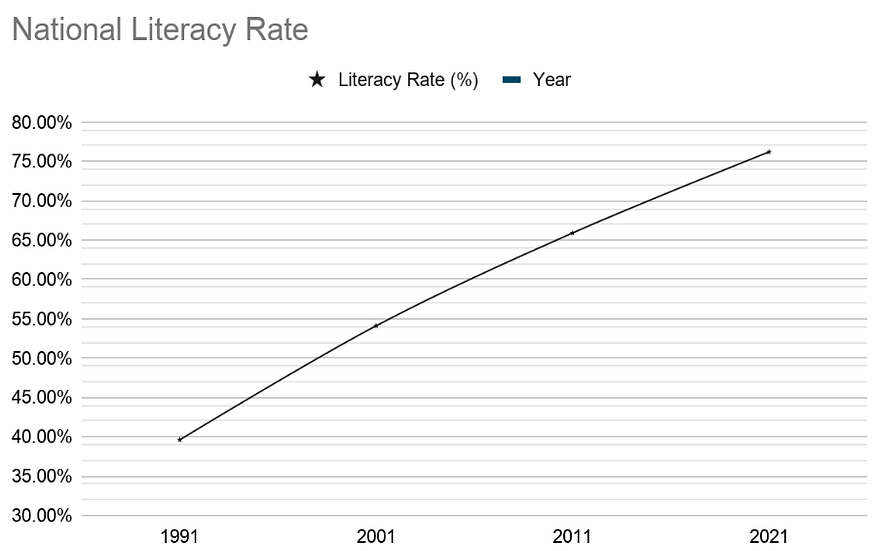
Literacy rate of country is increasing linearly from 1991 to 2021.
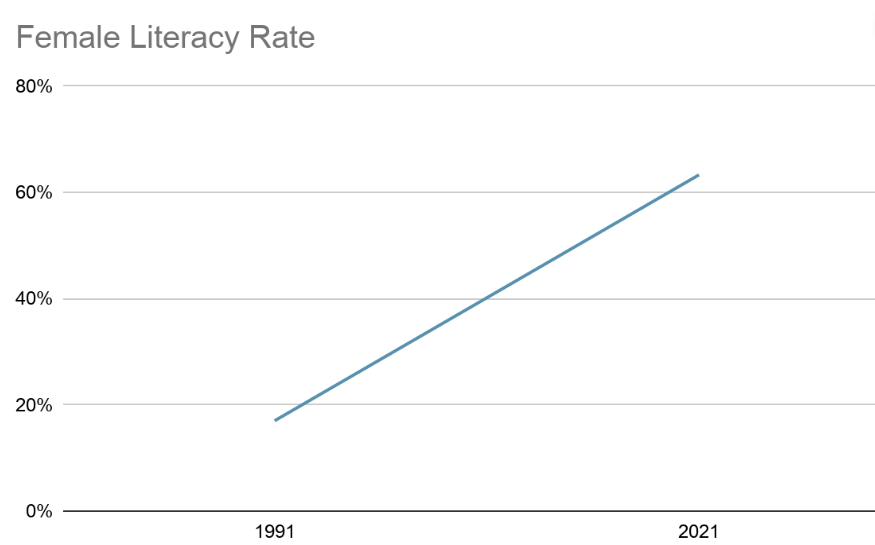
By 2021, more than three-fourths of the country could read and write, while youth literacy crossed 94 percent. The biggest change happened among women, with female literacy skyrocketing from a dismal 17 percent to over 63 percent. Numerically, this represents one of the most rapid educational expansions in modern South Asian history.
The mid-1990s push for economic liberalization resulted a huge growth in private schooling. At the exact same time, during a fragile period of political transition, mainstream political parties began viewing public classrooms and universities as fertile ground to expand their power bases.
After 2008, the government was able to break the monopoly of the universities. It created a network of universities and institutions that brought education to the provinces.
When Nepal became a republic after 2008, it broke the old system. The government established multiple universities and higher education centers far beyond Kathmandu.
The great paradox of the post-1990 state is that it successfully built impressive literacy statistics, but fundamentally failed to prepare competitive domestic human capital. The state successfully opened many schools and colleges but failed to prepare human resource with real-world skills.
Private education became a driver of a new, bitter class struggle; forever separating the children of the elite from the children of the poor.
Consequently, Tribhuvan International Airport has become the final stop of Nepalese youth and a tragic gateway that imports remittance while permanently exporting gem of the nation.
Healthcare
Nepali healthcare prior to 1990 was defined by absolute centralization. Medical infrastructure was a luxury, with a life expectancy of just 54 years and a brutal infant mortality rate of 99 deaths per 1,000 live births. The post-1990 expansion of grassroots health posts and the adoption of the Millennium Development Goals (MDGs) completely decentralized basic survival. Today, life expectancy has climbed to 72 years, and the national immunization program stands as one of the most robust frameworks in South Asia.

Life Expectancy (Years) vs Infant Mortality Rate (Among 1000 Live Births)
Total MBBS seats across the country have increased to 2,635. Instead of building more medical schools in Kathmandu, recent policies have focused on different geographical locations. Villages where people once suffered without a single paracetamol now have health institutions right in their neighborhoods. Prime examples include the Karnali Academy of Health Sciences (KAHS) in remote Jumla, Geta Medical College in Kailali, and the Purbanchal University School of Health Sciences.
However, the state failed to build public specialized infrastructure for modern chronic illness like cardiovascular disease and cancer. Because public hospitals remain by severe equipment shortages, advanced specialized treatment has been entirely commercialized.
While other countries use government money to shield their people from massive hospital bills, Nepal forces its citizens to pay a brutal 62 percent of all medical costs straight out of their own pockets.
Compared to the rest of South Asia, people of the Maldives and Sri Lanka need to pay just 19 percent and 48 percent of their medical bills. Even our massive, nuclear-armed neighbors, India and Pakistan, provide a better cushion, with their citizens paying 55 percent and 58 percent respectively. Standing at the absolute bottom of this list exposes a harsh reality.
Infrastructure
Prior to 1990, Nepal’s strategic roads were strictly limited to of 4,700 kilometers, national power generation just at 240 megawatts, and telecommunication was an elite privilege accessible to less than 1 percent of the population. The political reforms afterwards changed everything.
This shift interestingly busts out the claim that post-1990 political parties deliberately destroyed an industrial empire built by the old kings.
Legendary entities like the Janakpur Cigarette Factory, the Bansbari Shoe Factory, and the Bhrikuti Paper Mill were never sustainable businesses built on market metrics. They were actually foreign grants of the Soviet Union and China between the 1960s and 1980s during the cold war.
These companies were in loss long before the country became republic. They had outdated technologies and heavy over-politicization. They relied entirely on state revenue to survive. These artificial monopolies collapsed under the competitive goods of import.
The 2010s will be remembered as the decade of the great load-shedding recovery. Nepal systematically ended peak load-shedding that once lasted up to 18 hours a day, expanding household electrification from 14 percent to over 95 percent. The installed generation capacity which now exceeds 3,500 megawatts, the country has transitioned from a chronic power deficit to a seasonal exporter of hydroelectricity.
While, fiber broadband and mobile networks are large enough to connect more than 90 percent of the population.
While internet and energy networks thrived, physical transportation became the victim of political corruption. Strategic roads expanded past 15,000 kilometers to connect nearly all district headquarters, but this expansion completely ignored basic engineering standards. Under a corrupt syndicate system, road contracts are treated as political patronage, leading to weak contractor accountability and chronic completion delays.
Economy
In the early 1990s, arrival of multiparty democracy and economic liberalization caused a massive shift. Private banks expanded, foreign employment increased, and money transfer services such as IME and Western Union made it easier for migrant workers to send earnings home. Cash began reaching villages that had long been disconnected from formal economic activity.
According to the Nepal Living Standards Survey (NLSS) I and II, conducted between 1995 to 2004, the national poverty rate decreased from 41.8 percent to 30.9 percent, a relative decline of 26 percent that occurred despite of the heart of a brutal civil war. During this exact period, real per capita expenditure surged by 43 percent, reflecting a significant raise in household purchasing power across the provinces that kept families afloat even as local economies faced structural disruptions.
As the country transitioned from NLSS II to III between 2004 and 2011, the underlying driver of this wealth became firm. Average GDP growth stayed at a modest 4.5 percent; meanwhile, remittance inflows as a share of GDP leaped from 10 percent to a staggering 29 percent.
Concurrently, the recently released NLSS IV (2023) reveals that 20.27 percent of the population remains poor under a modernized national poverty line, now set at an annual per capita expenditure of Rs 72,908. If the government had kept the previous inflation-adjusted baseline of Rs 42,854 unchanged, Nepal’s poverty rate would have fallen to 3 percent.
The government plans to abolish absolute poverty by 2100 and limit multidimensional poverty to 3 percent.
However, Nepal was not becoming richer because it was producing more goods. It was becoming richer because millions of its citizens were earning money abroad. Instead of investing these billions into manufacturing or domestic factories, the political establishment fell into a comfortable fiscal loop of exporting its youngest labor force to the Gulf and Malaysia, importing every single commodity back home, and funding the government machinery through the resulting customs duties, remittances and excise taxes.
The true catalyst for poverty reduction was federalism. The institutionalization of local and provincial authorities, each with their own administrative directives, finally dismantled the old regime of absolute centralization. Local schools, village water systems, and municipal roads no longer required the physical signature of a bureaucrat in Kathmandu.
Socio-Politics
For nearly two and a half centuries, the Shah monarchy and the ruling elites operated as an exclusive playground for land-owning feudals and high-caste elites. The ten-year civil war launched in 1996 was a violent counter-response to generations of institutionalized casteism, regional neglect, and gender discrimination. The Maoist didn’t have a good parliamentary fortune but the constitutional architecture they forced into existence permanently reengineered the state. The true significance of this era is not a single party, but the 2015 Constitution and the institutionalization of federalism, inclusiveness state and secularity.
Before this federal devolution, power was completely centalized in Kathmandu. Women’s political representation was practically invisible, hovering at less than 5 percent across the legislative bodies of the 1990s. Today, under the constitutional framework, a mandatory 33 percent quota ensures robust female participation in the Federal Parliament, while affirmative action at the municipal level has driven the female share in local government to an unprecedented 41.2 percent. Across Nepal’s 753 local units, over 14,000 women now hold elected office, turning grassroots governance into a highly visible matrix of female leadership.
This structural reengineering is equally worthy across caste and ethnic lines through the Proportional Representation (PR) system. The 110 PR seats in Parliament are distributed to the country’s exact demographic composition: 31.2 percent for Khas-Arya, 28.7 percent for Adivasi Janajati, 15.3 percent for Madhesi, 13.8 percent for Dalit, 6.6 percent for Tharu, and 4.4 percent for Muslim.
Beyond the halls of parliament, federalism permanently altered the social grammar of historically marginalized communities. In 1991, systemic exclusion left the overall Dalit literacy rate below 20 percent, with baseline Tarai communities like the Musahar and Dom under 5 percent. Today, overall Dalit literacy has crossed 60 percent. Hence, the old monopoly on knowledge has been broken.
By creating seven provincial governments and more than 700 local governments, federalism restructured the tightly the old Khas-Arya elite. Indigenous nationalities, Dalits, Madheshis, and religious minorities hold state ownership.
When a woman from the marginalized Badi community becomes a federal minister, or when minority leaders control their own local budgets, it is no longer a fluke. It is proof that fair representation is no longer just a favor, it is a permanent constitutional right.
Conclusion
Nepal’s post-1990 trajectory is reduced to a debate of total failure versus undeniable progress. The reality is far more uncomfortable and important.
The country has achieved measurable, life-changing breakthroughs in literacy, healthcare, infrastructure, and political representation. These are not symbolic milestones; they represent a permanent structural break from the pre-1990 era.
This is why the popular narrative of “wasted decades” falls apart under its own simplicity. Nepal did not stand still; it changed rapidly. However, the political and administrative systems responsible for turning those social changes into long-term national capacity evolved far slower than society itself.
Ultimately, the real question is not whether Nepal progressed or failed. It is whether this progress has been structurally absorbed into the country’s foundation, or merely recorded on a government spreadsheet. The final outcome of that struggle is still being decided on the ground, not in the numbers.
References
메타데이터
- post_id
- fa17f5e40f89
- slug
- the-nepal-we-forgot-to-measure-fa17f5e40f89
- url
- https://medium.com/@samipgautam615/the-nepal-we-forgot-to-measure-fa17f5e40f89
- canonical_url
- https://medium.com/@samipgautam615/the-nepal-we-forgot-to-measure-fa17f5e40f89
- author_url
- https://medium.com/@samipgautam615
- status
- ok
- fetched_at
- 2026-07-21 13:14:50