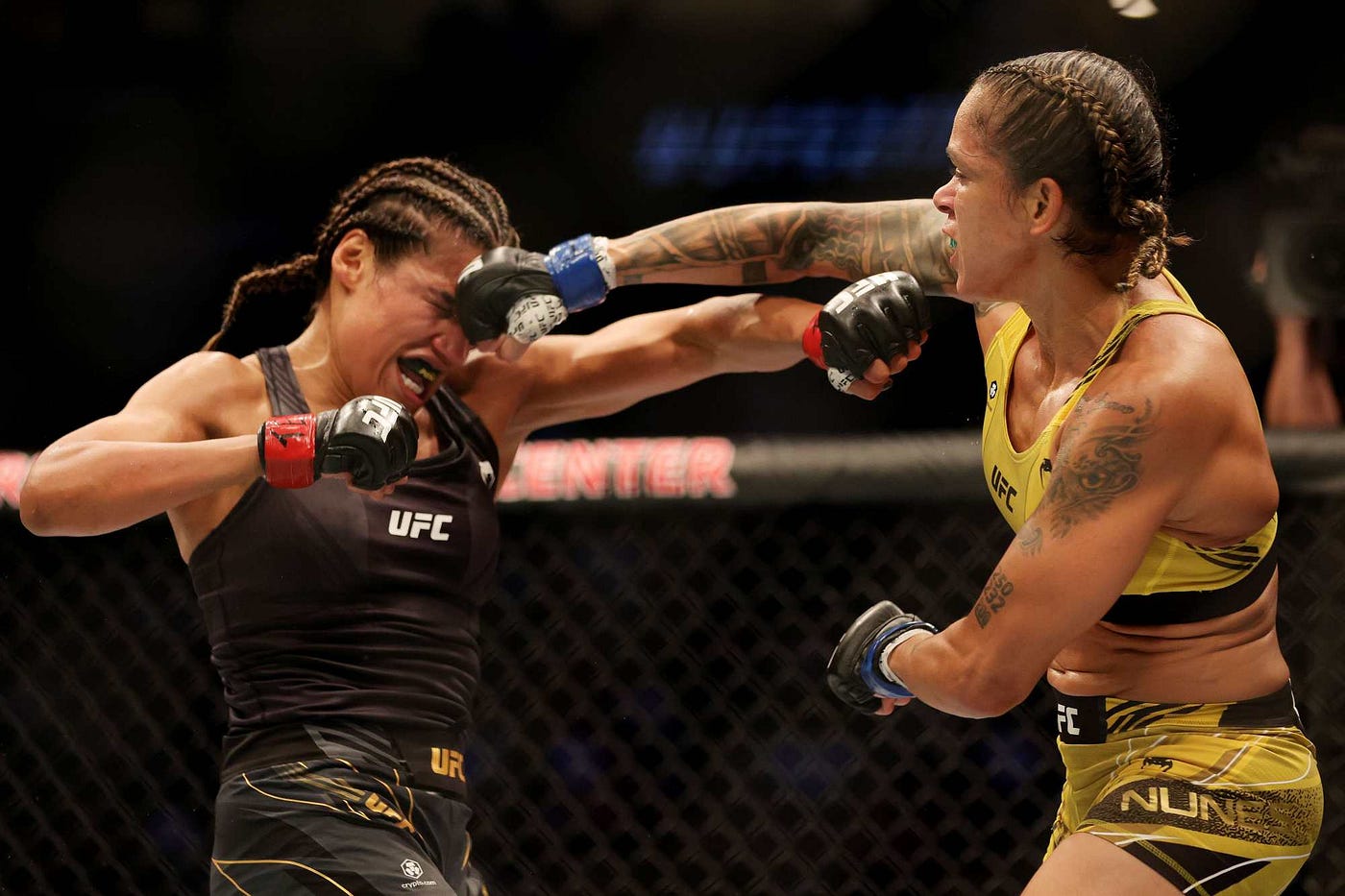
How Reaction Time Changes During a Five-Round UFC Fight
How fatigue changes perception, decision-making, and defensive timing in championship fights
How Reaction Time Changes During a Five-Round UFC Fight
How fatigue changes perception, decision-making, and defensive timing in championship fights
Reaction time in a UFC fight does not stay constant from Round 1 to Round 5. As fatigue builds, fighters may still see the same attacks, but the time it takes to process, decide, and execute a response usually gets less reliable.
A five-round fight is a stress test for the nervous system as much as for the muscles.
In Daniel Cormier vs. Alexander Gustafsson at UFC 192, both athletes maintained high output across five rounds, but the fight’s round-by-round statistics show that effort, accuracy, and defensive timing changed as the bout progressed.
Reaction Time Is More Than Reflexes
In combat sports, reaction time is often treated like a simple reflex, but that is an oversimplification.
The real process includes perception, pattern recognition, decision-making, and motor execution. Expert fighters often win by anticipating what is coming rather than only reacting after it starts.
That matters in mixed martial arts because the fastest response is not always the fastest muscle contraction; it is often the fastest read. A fighter who recognizes a shoulder twitch, stance shift, or level change early can begin responding before the strike or shot is fully launched.
Why Fatigue Slows Responses
Fatigue affects the brain and body together.
In a controlled study of MMA fighters, acute fatigue increased reaction times by about 1.5% and reduced reaction consistency by 14.7%, showing that tired fighters not only react a little slower but also react less predictably.
That matters in a fight because inconsistency is dangerous. If your response timing becomes variable, you may block late during one exchange and then overreact during the next, creating openings for counters.
In practical terms, fatigue does not simply make a fighter “slower.” It makes timing less trustworthy, and that is often the bigger problem.
UFC 192 as an Example
UFC 192 is a useful case because it was a five-round title fight, and the pace stayed high for a long time.
The official statistics show that Cormier landed 140 of 283 significant strikes, while Gustafsson landed 120 of 254. Both fighters remained active deep into the championship rounds.
The round-by-round data also show the rhythm of the fight changing over time. In Round 1, Cormier landed 14 of 22 significant strikes, but by Round 5 he landed 31 of 69. Gustafsson went from landing 5 of 21 in Round 1 to 18 of 47 in Round 5.
That does not prove changes in reaction time directly, but it does show a fight in which sustained output, cumulative fatigue, and defensive decision-making were all being tested simultaneously.
For a fight like this, reaction time likely shifts from being crisp and reactive early to becoming more anticipatory and economy-driven later. Fighters begin reading patterns earlier, conserving energy, and choosing higher-percentage responses instead of relying solely on pure speed.
What Changes Round by Round
During the opening two rounds, fighters generally have the greatest reserves of speed, visual sharpness, and movement quality. They can step, slip, and counter with less delay because the physical cost of each exchange is still relatively low.
By Rounds 3 through 5, accumulated work raises the price of every reaction. Muscles are less fresh, breathing becomes heavier, and the brain must make increasingly rapid decisions while dealing with fatigue, pain, and stress.
At that stage, reaction time becomes a blend of three factors:
- Actual sensory response
- Anticipation
- Fatigue management
The best fighters do not simply react faster. They react earlier because they recognize patterns more effectively.
What Coaches Should Take From This
If you coach fighters, the lesson is not to train only raw reflex speed.
Reaction quality under fatigue also deserves attention because the most important reactions often occur when the athlete is already tired.
A stronger training approach combines technical sparring, reactive drills, and high-intensity conditioning so that decision-making remains sharp even when breathing is compromised.
That matches what current research suggests: fatigue can worsen reaction time and make it less consistent, even when movement speed itself changes very little.
The objective, then, is not simply to “move faster.”
It is to:
- Recognize sooner
- Decide sooner
- Stay accurate when tired
Final Take
Reaction time during a five-round UFC fight generally declines in quality, even if a fighter still appears explosive.
The central issue is not merely a loss of speed but a loss of consistency, making timing progressively harder to trust.
Using UFC 192 as an example, it becomes clear why championship fights reward more than athleticism. They reward the fighter whose perception, anticipation, and defensive decision-making remain intact long after the body begins paying the fatigue bill.
메타데이터
- post_id
- fa3b73c2640b
- slug
- how-reaction-time-changes-during-a-five-round-ufc-fight-fa3b73c2640b
- url
- https://medium.com/@themohitbishani/how-reaction-time-changes-during-a-five-round-ufc-fight-fa3b73c2640b
- canonical_url
- https://medium.com/@themohitbishani/how-reaction-time-changes-during-a-five-round-ufc-fight-fa3b73c2640b
- author_url
- https://medium.com/@themohitbishani
- status
- ok
- fetched_at
- 2026-07-19 06:17:39