What a Wisteria Vine Taught Me About Intelligence
Ten years ago, I planted a wisteria vine.
What a Wisteria Vine Taught Me About Intelligence
Ten years ago, I planted a wisteria vine.
It wasn’t much to look at — a single twig about a foot tall. I planted it near our deck and expected it to do what vines do: grow, climb, and hopefully add some beauty to the yard.
What I didn’t expect was that it would eventually make me question what intelligence really is.
Over the years, I watched that plant almost daily. At first, its behavior seemed ordinary enough. If a branch brushed against a nearby support, it would wrap around it and continue growing. That made sense.
But as the plant matured, something caught my attention.
It stopped relying solely on nearby supports and began sending out long runners. What struck me was that these runners didn’t seem random. They appeared evenly spaced and aimed in specific directions.
At the time, I didn’t think much of it.
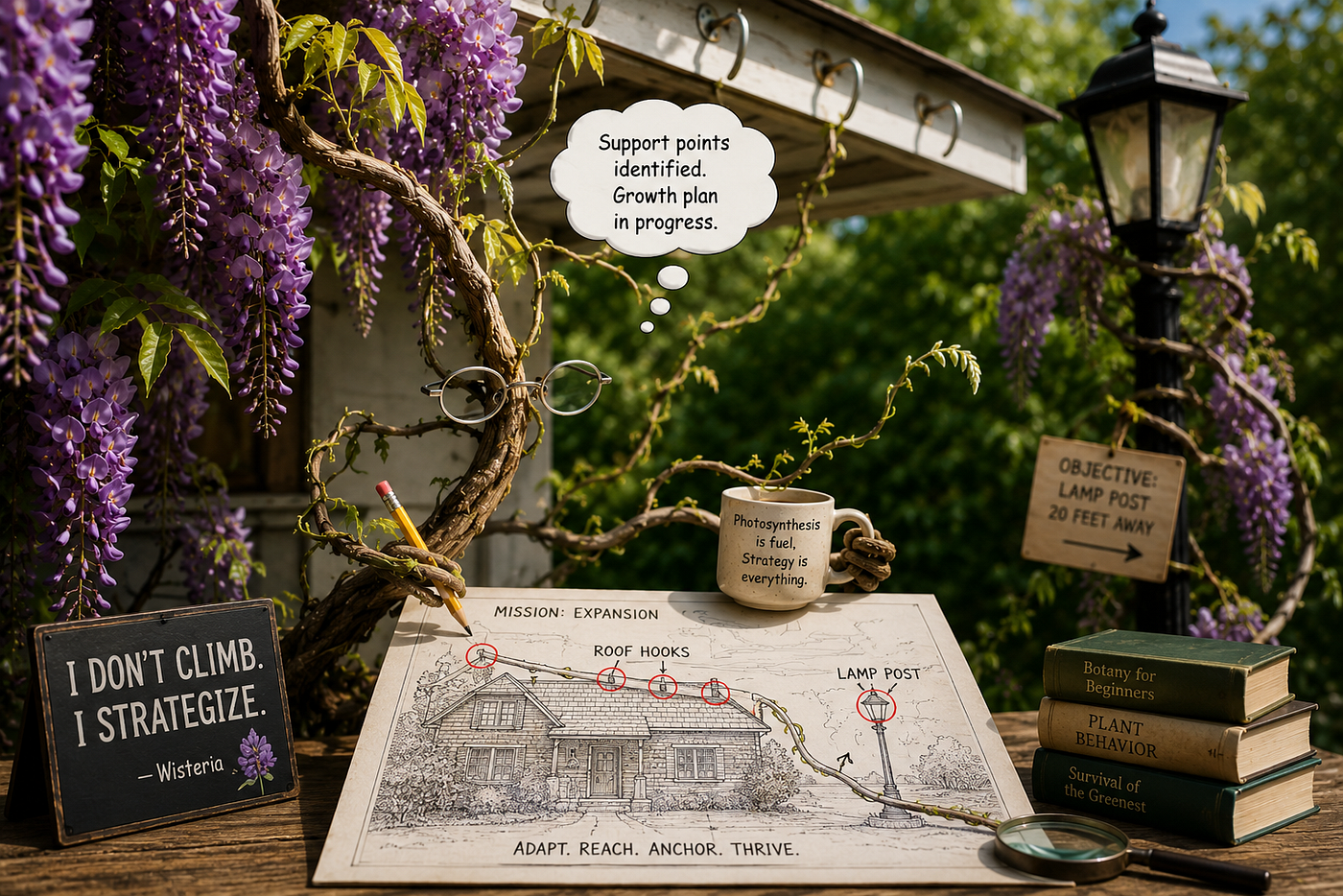
About ten feet above the deck was our roofline. Along the edge of the roof were small aluminum hooks we used for hanging Christmas lights. The hooks were tiny — less than half an inch across — and spaced several feet apart.
One day I noticed something odd.
The runners below seemed to line up with those hooks.
Not approximately.
Not generally.
Directly.
I didn’t even realize the hooks were the targets until the first runner reached one.
Then another reached the next.
As the runners grew longer, their own weight caused them to bend downward. That’s when the vine did something even stranger. It began producing additional curling shoots that wrapped around the original runners, reinforcing them and helping support their climb upward.
The hooks became anchor points.
Soon the vine had spread across the roof.
Years later, I witnessed something similar with a lamp post about twenty feet away from the main plant. The post stood by itself. Yet the vine sent runners directly toward it across the ground.
What made the experience so puzzling was what I didn’t see.
I didn’t see dozens of failed attempts growing in every direction.
I didn’t see random branches scattered everywhere.
I saw successful growth repeatedly finding useful destinations.
Now, I understand the scientific explanation.
Plants can respond to light, gravity, touch, moisture, temperature, and many environmental cues that humans barely notice. A botanist might argue that the vine wasn’t targeting hooks or lamp posts in any conscious sense. It was responding to information in its environment through mechanisms shaped by millions of years of evolution.
That may be exactly what happened. But 1/2 inch targets many feet away?
But even if that explanation is correct, I find myself asking a deeper question.
What should we call a living system that gathers information, responds to changing conditions, allocates resources, reinforces successful strategies, and consistently solves problems?
Most people reserve the word “intelligence” for creatures with brains.
Yet the more closely I watch living things, the less certain I become.
Cells solve problems.
Immune systems solve problems.
Plants solve problems.
Even parasites can alter the behavior of their hosts in ways that improve their own chances of survival.
Perhaps none of this requires consciousness.
Perhaps it is all the result of chemistry, feedback loops, and natural selection.
But when we dismiss these phenomena as “just biology,” I wonder if we’re overlooking something extraordinary.
Maybe intelligence is not something that suddenly appears once enough neurons are assembled.
Maybe it exists on a spectrum.
Maybe life itself possesses forms of awareness and responsiveness that we are only beginning to understand.
Or perhaps my wisteria vine is simply a reminder that nature is far more sophisticated than we often imagine.
I don’t claim to know the answer.
I only know what I observed.
A one-foot twig became a sprawling vine. Along the way, it behaved in ways that continually challenged my assumptions about what a plant should be capable of doing.
Ten years later, I still find myself looking at that wisteria and wondering:
How much intelligence exists in the living world that we have not yet learned to recognize?
메타데이터
- post_id
- fa3d3962ebfc
- slug
- what-a-wisteria-vine-taught-me-about-intelligence-fa3d3962ebfc
- url
- https://medium.com/@marvin.vonrenchler/what-a-wisteria-vine-taught-me-about-intelligence-fa3d3962ebfc
- canonical_url
- https://medium.com/@marvin.vonrenchler/what-a-wisteria-vine-taught-me-about-intelligence-fa3d3962ebfc
- author_url
- https://medium.com/@marvin.vonrenchler
- status
- ok
- fetched_at
- 2026-06-25 07:00:49