We’ll Miss Editorial Cartoonists When They’re Gone
I thought the Washington Post would want to publish this piece. They didn't. No nibbles from a few other places either. So before this gets…
We’ll Miss Editorial Cartoonists When They’re Gone
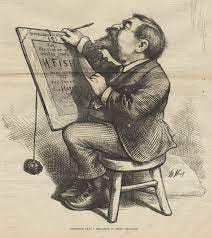
That nasty Thomas Nast
I thought the Washington Post would want to publish this piece. They didn't. No nibbles from a few other places either. So before this gets too old:
With the firing of three Pulitzer Prize-winning editorial cartoonists, the Boss Tweeds of the world are finally getting their way.
“Stop them damned pictures,” William Tweed said. “I don’t care so much what the papers say about me. My constituents don’t know how to read, but they can’t help seeing them damned pictures!”
Them damned pictures were the editorial cartoons of Thomas Nast, whose work for Harper’s Weekly contributed to the toppling of the power broker whose name has been synonymous with corruption since he dominated New York City politics during the middle decades of the 19th century.
Jack Ohman of the Sacramento Bee, Joel Pett of the Lexington Herald-Leader and Kevin Siers of the Charlotte Observer were all the grandchildren of Thomas Nast. Ohman won the Pulitzer in 2016, Pett in 2000 and Siers in 2014. All three worked for McClatchy newspapers. All were canned last month.
“We made this decision based on changing reader habits and our relentless focus on providing the communities we serve with local news and information they can’t get elsewhere,” a statement from McClatchy opinion editor Peter St. Onge said.
“Relentless” would be a good word for editorial cartoonists’ penchant for providing the communities they serve with “information they can’t get elsewhere.” Nast published more than 140 cartoons featuring Boss Tweed.
A century later, Herb Block, better known as Herblock, the Washington Post’s four-time Pulitzer winner, went after the Nixon White House as doggedly as Nast went after Boss Tweed’s Tammany Hall.
Nixon was as rattled by the power of the editorial cartoon as Tweed had been, calling Herblock “vicious.” Vice President Spiro Agnew denounced him as “a master of sick invective.”
In his memoir, Block recalls a newsroom encounter with Post publisher Katharine Graham a week after the Watergate break-in. When Graham asked him what he was working on, Block showed her a cartoon featuring footprints in the snow leading up to the White House. At that point, no one had connected the “third-rate burglary” to the president and his men.
Graham laughed, then said, “But you’re not going to print that, are you?”
He was, of course. Graham could have spiked it. She didn’t.
Compare that episode to the experience of Rob Rogers, who was fired by the Pittsburgh Post-Gazette in 2018 after management killed several of his hard-hitting Donald Trump cartoons. Rogers, who had won the Thomas Nast Award in 2000 and 2013 and the Herblock Prize in 2021, put the role of the editorial cartoonist succinctly:
“I was fired for doing my job,” he wrote in the introduction to a 2019 collection of his work, “Enemy of the People” — a reference to a Trump tweet about the news media. Rogers’ job, it should be noted, included skewering President Obama before Trump, and the one Democratic and three Republican presidents before Obama dating back to 1984, when he started his career.
As for being an enemy of the people, when I was working on the Herblock Oral History Project for the Library of Congress in 2011, Roger Wilkins, an editorial writer at the Post during the Watergate years, described Block thus: “He loved America, and he loved sticking it to people who were unkind to America.”
The same can be said of all editorial cartoonists, which is why it’s so disheartening to read that fewer than 40 of them remain in staff positions at news outlets around the country.
Editorial cartoonists are heirs to the tradition of the court jester, or fool — the one person who could tell the king what he really thought without fear of having his head chopped off. After all, you can’t take what a fool says seriously. It’s just a joke, right? It’s just a cartoon.
Therein lies the sneaky power of the editorial cartoon. Or as Shakespeare put it in “King Lear,” “Jesters do oft prove prophets.”
Newspaper publishers have always been fonder of profits than prophets, but at least they tolerated those “damn pictures.” With the firing of Ohman, Pett and Siers, it’s clear that tolerance is wearing thinner and thinner.
메타데이터
- post_id
- fa4b55aa6ed2
- slug
- well-miss-editorial-cartoonists-when-they-re-gone-fa4b55aa6ed2
- url
- https://medium.com/@rfrank1918/well-miss-editorial-cartoonists-when-they-re-gone-fa4b55aa6ed2
- canonical_url
- https://medium.com/@rfrank1918/well-miss-editorial-cartoonists-when-they-re-gone-fa4b55aa6ed2
- author_url
- https://medium.com/@rfrank1918
- status
- ok
- fetched_at
- 2026-08-09 08:04:28