From Finance to Machine Intelligence: Applications of Robust Multi-Period SOCP Optimization in…
How can we trust AI with high-stakes tasks? Our research adapts a battle-tested framework from financial risk management to build AI that…
From Finance to Machine Intelligence: Applications of Robust Multi-Period SOCP Optimization in Modern AI and ML
Abstract
Artificial intelligence and machine learning systems exhibit a well-documented fragility, often failing when deployed in environments that deviate from their training data. This paper argues that the framework of robust optimization, initially developed in finance to stabilize investment portfolios, provides a mathematically rigorous and computationally tractable solution for building trustworthy AI.
Robust optimization, particularly in the form of Second-Order Cone Programming (SOCP), was initially developed to overcome instability in classical portfolio optimization under the Markowitz mean–variance paradigm. By explicitly modeling bounded parameter uncertainty, this approach yields deterministic performance guarantees, even in the worst-case scenario. While its early adoption was in finance, the mathematical structure of robust multi-period SOCP optimization aligns closely with many modern AI and ML challenges — from adversarial robustness to federated learning and safe reinforcement learning.
We establish a unified foundation by first detailing the core theory of robust optimization, explaining how ellipsoidal uncertainty sets are used to model parameter ambiguity and how intractable worst-case optimization problems are transformed into solvable Second-Order Cone Programs (SOCPs) via conic duality.
We demonstrate how conic duality transforms min-max problems with ellipsoidal uncertainty into tractable convex programs. The approach provides deterministic guarantees against distribution shifts, adversarial perturbations, and data heterogeneity — critical for safety-critical AI applications. We unify theoretical foundations, clarify common misstatements (e.g., squared vs. linear norm penalties), and outline future research directions for integration with modern architectures.
Building on this theoretical base, we explore the direct application of this framework to critical challenges in modern AI, including adversarial training, safe reinforcement learning, and robust federated learning. By contrasting the robust SOCP approach with current methods like Projected Gradient Descent and FedAvg, we demonstrate its superiority in contexts where deterministic, worst-case performance guarantees are paramount. We further discuss practical limitations including computational scalability and conservatism, and outline pathways for mitigation.
This work unifies principles from financial mathematics and modern AI, offering a principled path toward the reliable deployment of AI in high-stakes, safety-critical domains.
1. Introduction
A foundational challenge in modern artificial intelligence is the inherent brittleness of models trained on finite, noisy data. While methods like stochastic gradient descent (SGD) have enabled remarkable progress, they optimize for average-case performance and offer no formal guarantees when faced with real-world complexities such as distributional shifts or deliberate adversarial attacks. This limitation severely curtails the deployment of AI in safety-critical domains like autonomous systems, medical diagnostics, and finance, where the cost of a single, unforeseen failure is catastrophic. This fragility mirrors challenges first solved in finance, where robust optimization emerged to counter parameter uncertainty.
This exact problem of sensitivity to input data was first identified and rigorously addressed in the field of quantitative finance. The classical Markowitz mean-variance portfolio model, while Nobel-prize-winning, was famously criticized for producing “error-maximized and investment-irrelevant portfolios” in practice. Its solutions were found to be extremely sensitive to small statistical errors in the estimated market parameters, such as expected returns and covariances.
In response, the paradigm of robust optimization was developed to be inherently immune to such data uncertainty. This approach reframes the optimization problem entirely: instead of optimizing for a single point estimate of parameters, it optimizes for the worst-case realization of those parameters within a bounded uncertainty set. The result is a solution that is provably resilient, offering a deterministic guarantee of performance across a continuum of plausible scenarios. This approach is built on two key innovations in modeling parameter uncertainty within ellipsoidal sets and using conic duality to transform these semi-infinite programs into tractable SOCPs.
Unlike stochastic methods optimizing for average performance, this paradigm delivers certifiable worst-case guarantees essential for autonomous systems and safety-critical applications.
The primary contribution of the foundational work in finance was demonstrating that these complex, seemingly intractable robust problems could be efficiently solved by reformulating them as Second-Order Cone Programs (SOCPs). This paper bridges the gap between financial mathematics and modern AI. We first provide a self-contained exposition of the theory of robust optimization and SOCP, drawing from the original financial thesis. We then demonstrate how this powerful and tractable framework can be directly applied to solve critical robustness and safety challenges in machine learning, offering a superior alternative to existing heuristic or stochastic methods like Bayesian optimization or randomized smoothing. Crucially, we establish that robust SOCP provides a unified mathematical foundation for both financial risk management and AI safety — transforming previously domain-specific techniques (e.g., Markowitz portfolios and adversarial training) into instances of conic optimization.
This is not merely a theoretical transfer of ideas; robust conic optimization is already a cornerstone of many real-world engineered systems where safety and reliability are paramount. Current applications include:
- Robotics and Autonomous Systems: In motion planning for factory robots or autonomous drones, SOCP is used to compute efficient, collision-free trajectories. It allows the system to satisfy hard physical constraints (on torque, velocity, etc.) under uncertainty in the robot’s own dynamics, guaranteeing safe operation.
- Energy Systems and Power Grids: Grid operators use SOCP to solve “optimal power flow” problems. This allows them to create power dispatch plans that are robust to uncertainty in both the supply from renewable sources (like wind and solar) and fluctuating consumer demand, thereby preventing blackouts.
- Signal Processing and Sensor Fusion: In autonomous vehicles, SOCP is used to robustly fuse noisy data from multiple sensors (GPS, cameras, IMU). By modeling sensor noise within uncertainty sets, it provides a precise and reliable estimate of the vehicle’s true location, which is critical for safety.
- Supply Chain and Logistics: Large e-commerce and logistics companies use SOCP to design their networks. By modeling uncertainty in customer demand and transportation costs, they can determine optimal warehouse locations and inventory strategies that are guaranteed to perform well even during unexpected demand surges or shipping disruptions.
Although this work focuses on AI/ML, SOCP has been successfully deployed in industries as varied as oil & gas, aerospace, finance, telecommunications, and energy systems, each requiring robust decision-making under uncertainty.
The remainder of this paper is structured as follows: Section 2 details the theoretical underpinnings of robust SOCP; Section 3 explains the conic duality reformulation; Section 4 applies the framework to AI/ML; Section 5 extends to multi-period settings; Section 6 discusses limitations; Section 7 outlines future research; Section 8 concludes.
2. Theoretical Foundations of Robust SOCP
To understand the application of robust optimization in AI, one must first grasp the mathematical machinery that makes it both powerful and practical. This section details the core concepts, from the quantification of uncertainty to the convex reformulation that ensures computational tractability.
2.1 The Fragility of Classical Optimization
Classical optimization, as exemplified by the Markowitz model, seeks to solve a problem like:

where the expected return E[r] and covariance Var[r] are assumed to be known precisely. In reality, these are merely statistical estimates (μ̃, D̃) derived from noisy, historical data (D̃ represents the statistical estimate of the asset return covariance matrix). The classical approach’s fatal flaw is that it treats these estimates as ground truth, ignoring the inherent uncertainty and often amplifying estimation errors.
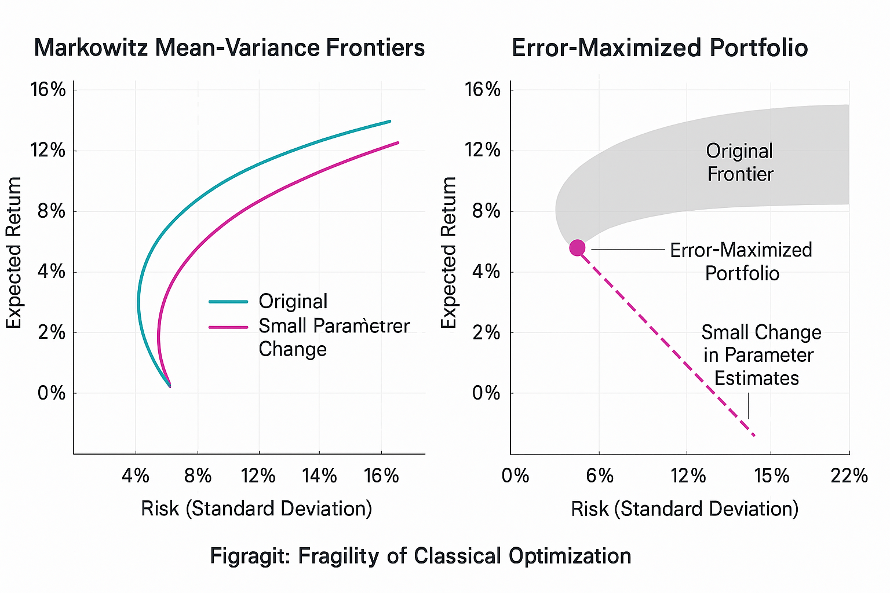
Figure 1 — Fragility of Classical Optimization Small changes in parameter estimates can cause large shifts in the Markowitz mean–variance frontier (left) and produce error-maximized portfolios with significantly worse risk–return profiles (right).
2.2 Quantifying Uncertainty: The Ellipsoidal Set
Robust optimization confronts this issue by explicitly modeling uncertainty. Instead of a single point estimate μ̃, it assumes the true parameter vector μ lies within a bounded region known as an uncertainty set. A geometrically intuitive and mathematically convenient choice for this is an ellipsoid centered at the estimate:

Here, μ̃ the estimated parameter vector, the matrix C is derived from the covariance of the estimator (encoding the shape and orientation of the uncertainty), and the scalar θ is a “robustness parameter” that dictates the size of the ellipsoid. A larger θ corresponds to greater uncertainty and forces a more conservative, robust solution.

Figure 2 — Ellipsoidal Uncertainty Set A 2D plot illustrating the ellipsoidal uncertainty set for the mean returns of two assets. The center of the ellipse represents the statistical point estimate (μ̃), while the bounded region contains all other plausible values for the true mean return vector (μ) that the robust optimization will consider.
2.3 The Worst-Case (Min-Max) Formulation
With uncertainty explicitly modeled, the optimization objective changes from a simple maximization to a min-max (or max-min) problem. The goal is to find a decision (e.g., a portfolio ϕ) that performs best under the worst-possible realization of the parameters within the uncertainty set U.
Defining the Uncertainty Sets: S_m and S_d
The robust framework contains the ambiguity of our market estimates within specific mathematical structures called uncertainty sets. Instead of a single value, we define a whole region of plausible values for each uncertain parameter.
- S_m: The Uncertainty Set for Mean Returns. This set contains all plausible values for the vector of mean asset returns, μ. It is modeled as an ellipsoid centered around our statistical best guess, μ̃. The logic is that while our estimate μ̃ is likely close to the true value, we acknowledge the possibility of estimation error in any direction, bounded by the surface of the ellipsoid.
- S_d: The Uncertainty Set for the Covariance Matrix. This set contains all plausible values for the covariance matrix, D. In the provided framework, this is often simplified to an interval for each diagonal element (the variances). This means for each asset, we define a range from a minimum plausible variance (d_i) to a maximum plausible variance (d̄_i), acknowledging our uncertainty in the asset’s volatility.
The robust analogue of the Markowitz problem is then formulated using these sets:


This objective seeks to maximize the guaranteed (worst-case) return while ensuring the guaranteed (worst-case) risk does not exceed a threshold λ.
The Geometry of Uncertainty: Understanding C and P
The ellipsoidal shape of the mean uncertainty set Sm is not arbitrary; its geometry is defined by the matrix C, which in turn determines the penalty matrix P.
- C: The “Shaping” Matrix. The matrix C defines the precise shape and orientation of the ellipsoidal uncertainty set for the mean returns. It is derived from the covariance of the estimator μ̃. Think of C as a set of instructions for shaping a sphere of uncertainty. If the uncertainty in the estimated mean return of Asset A is high and the uncertainty for Asset B is low, C will stretch the sphere into an ellipsoid that is wider along the axis for Asset A and narrower along the axis for Asset B. It also rotates the ellipsoid to account for correlations in the estimation errors.
- P: The “Penalty” Matrix. The matrix P appears in the closed-form solution of the worst-case objective function. It is mathematically derived from the shaping matrix C (for instance, if S_m = {μ | ||C(μ-μ̃)|| ≤ θ}, the formulation often uses P = C^{-T}). The term θ||Pφ||₂ acts as a crucial regularization penalty that quantifies a portfolio’s vulnerability to uncertainty. It measures how heavily the portfolio φ is invested in directions where the mean return estimates are least certain (i.e., where the uncertainty ellipsoid is widest). A large penalty value indicates that the portfolio’s performance is highly sensitive to estimation errors, making it “brittle” or non-robust.
The closed-form solution for the worst-case mean over the ellipsoidal set

is obtained via the support function of the ellipsoid:

Defining P := C^{-T}, the robust (worst-case) mean is

This shows that the penalty is linear in the Euclidean norm, not quadratic.
The robust optimization problem, therefore, becomes:

This elegant result transforms the objective function. We no longer just maximize the estimated return (μ̃^T φ), but we maximize the estimated return minus a penalty for its sensitivity to uncertainty (θ ||P φ||₂). This ensures that the chosen portfolio is not only profitable based on our estimates but is also structurally resilient to the errors within those estimates.
3. Conic Duality and the SOCP Reformulation
The key to making robust optimization practical is its reformulation as a standard, efficiently solvable convex problem. This is achieved through the mathematics of conic programming, which provides the tools to transform an intractable problem with infinite constraints into a finite and tractable one. This section lays out the fundamental theory that enables this crucial step.
The development of SOCP as a practical tool is a relatively recent achievement in the history of mathematical optimization. While the underlying theory of cones has existed for much longer, the ability to solve these problems efficiently arose from the invention of interior-point methods in the late 1980s. These revolutionary algorithms were first applied to linear programming and were later generalized by researchers like Yurii Nesterov and Arkadi Nemirovski in the early 1990s to a much broader class of problems known as conic optimization, of which SOCP is a prominent member. This breakthrough transformed SOCP from a theoretical curiosity into a powerful, practical framework, enabling its widespread adoption in fields requiring robust solutions, from control theory and signal processing to the financial engineering problems that inspired this paper.
3.1 Cones and Duality
At the heart of modern convex optimization is the concept of a cone. A set 𝒦 ⊆ ℝⁿ is a cone if for any x ∈ 𝒦 and any positive scalar λ > 0, it holds that λx ∈ 𝒦. A cone is convex if it is also closed under addition.
Associated with any cone 𝒦 is its** dual cone 𝒦***, defined as the set of vectors that form a non-negative inner product with every vector in the original cone:

This dual relationship is fundamental to optimization theory, allowing problems to be viewed from a different but equivalent perspective. The strong duality theorem states that, under mild conditions, the optimal values of a primal conic problem and its dual problem are equal, with no “duality gap”. This property is essential for reformulating complex optimization problems.
3.2 The Second-Order Cone (SOC)
A particularly important and widely used cone is the second-order cone 𝒞ₖ⊂ ℝᵏ, also known as the Lorentz or “ice cream” cone. It is defined as:

Geometrically, it represents a cone where the first component, t, is greater than or equal to the Euclidean norm of the remaining components, u. A key property of the second-order cone is that it is self-dual, meaning 𝒞ₖ*=𝒞ₖ. This simplifies many duality-based proofs and reformulations significantly.

Figure 3: The Second-Order Cone (SOC) A 3D representation of the Second-Order Cone, also known as the Lorentz cone. This geometric shape is fundamental, as the constraints of the robust optimization problem are reformulated to require that certain decision variables lie within this cone, making the problem computationally tractable.
3.3 Second-Order Cone Programming (SOCP)
A Second-Order Cone Program (SOCP) is a convex optimization problem where a linear function is minimized over the intersection of an affine space and the Cartesian product of second-order cones. The standard form of an SOCP constraint is:

Each constraint requires that an affine transformation of the decision variable x lies within a second-order cone. Despite their apparent non-linearity, SOCPs are a class of convex problems that can be solved with high efficiency using interior-point methods, much like linear programs.
3.4 From Robust Constraints to SOCP Form
The crucial connection that makes robust optimization tractable is that the infinite set of constraints imposed by an ellipsoidal uncertainty set can be collapsed into a single, finite SOCP constraint. To see how this works, consider the simple robust linear constraint discussed previously:

This single line represents an infinite number of constraints, as it must hold for every possible vector a_i inside the ellipsoid E_i. To guarantee this, the constraint must hold even for the value of a_i that makes the left-hand side, a_i^T x, as large as possible. The problem is therefore equivalent to ensuring the worst-case value does not exceed b_i:

This inner maximization problem, which finds the maximum of a linear function over an ellipsoid, has a well-known closed-form solution:

By substituting this result back, the infinite set of linear constraints is replaced by a single, equivalent SOCP constraint:

where P_i := C_i^{-T} is the inverse transpose of the shaping matrix C_i associated with constraint i (as defined in Section 2.3).
This transformation is the methodological cornerstone that renders robust optimization computationally tractable. For even more complex constraints, such as those with the piecewise-linear logic of financial options, conic duality provides a more powerful tool. It allows us to characterize the dual cone of all linear functions that are non-negative over the partitioned uncertainty set; this dual cone has a finite SOCP representation, thus converting an infinite number of constraints into a manageable, finite system.
Similarly, a quadratic constraint on portfolio variance,

can be transformed into the SOCP constraint:

These examples demonstrate the core principle: by reformulating worst-case constraints over uncertainty sets, robust problems that are seemingly intractable can be converted into efficiently solvable SOCPs. This transformation is the methodological cornerstone that renders the framework practical, even for complex problems involving non-linearities like those found in financial options.
3.5 Advantages Over Alternative Approaches
To situate the contributions of the robust SOCP framework, it is useful to contrast its properties directly with other prevalent paradigms for optimization and uncertainty quantification in machine learning. The robust SOCP framework offers distinct advantages over several of these alternatives. For instance, while standard stochastic gradient methods optimize for average-case performance and provide no worst-case guarantees, the robust approach delivers certifiable performance bounds. Compared to Bayesian inference, which can scale poorly and require strong distributional assumptions, the SOCP formulation is computationally tractable for large-scale problems using efficient interior-point methods. In the context of security, adversarial training typically relies on heuristic defenses against specific attack algorithms; in contrast, the robust framework can provide mathematical certificates of robustness against an entire class of perturbations. Finally, while related to Wasserstein Distributionally Robust Optimization (DRO), the use of ellipsoidal uncertainty sets can provide tighter, less conservative bounds when the uncertainty has a known structure, mitigating the risk of overly conservative solutions.
For clarity, the key distinctions discussed above are summarized in Table 1.

With this theoretical machinery in place, we now turn to its direct application in solving key challenges in modern AI.
4. Applications in AI/ML
The mathematical framework developed for robust financial optimization is not merely analogous to challenges in AI; it is a direct methodological solution. We now explore several key applications where robust SOCP can offer a superior alternative to current optimization techniques.
4.1 Adversarial Training for Neural Networks
Problem Context: Deep neural networks are notoriously vulnerable to adversarial examples, where tiny, often imperceptible perturbations to an input cause a dramatic misclassification. This poses a significant security risk.
Current Optimization Techniques: The standard defense is adversarial training, most commonly implemented using Projected Gradient Descent (PGD). PGD is an iterative, heuristic method. In each training step, it first finds an approximate worst-case perturbation δ by taking multiple gradient ascent steps on the loss function, then updates the model weights using this adversarial example. While effective empirically, PGD offers no formal guarantee of robustness; it is a powerful heuristic, not a proof.
Robust SOCP Approach: Robust optimization frames this problem as a min-max objective directly:

Duality yields SOCP constraints with formal guarantees against ℓ2-bounded perturbations.

Figure 4: Adversarial Perturbation within an Uncertainty Set A conceptual diagram of an adversarial attack. The original data point is surrounded by a small ℓ2-norm uncertainty ball. An attacker finds a worst-case perturbation within this ball to create an adversarial example that is visually similar but is misclassified by the model. Robust SOCP training aims to make the classifier resistant to all such perturbations within the certified ball.
Here, the uncertainty set is an ℓ₂-norm ball of radius ε around the clean input x. While the loss function L of a deep neural network is non-convex, the inner maximization problem can often be relaxed or bounded using techniques that lead to SOCP constraints. By incorporating these dual-formulated constraints into the training objective, one can train a model that comes with a mathematical certificate of robustness. For deep networks, this requires relaxations of activation functions (e.g., bounded ReLU approximations) or Lipschitz constraints to maintain SOCP tractability.
Superiority and Limitations:
- Certified Defense: When the model and loss function are convex (or suitably relaxed), the robust SOCP formulation can provide a certified bound ensuring that no perturbation within a specified ball can change the model’s prediction. For general deep neural networks, such guarantees typically hold only for convex relaxations of the network or for specially designed architectures that preserve tractability. This is a fundamentally stronger form of security. 6, 7
- Tractability for Guarantees: While finding a provably robust model seems computationally harder, the conic reformulation makes achieving this guarantee tractable, avoiding the cat-and-mouse game of developing ever-stronger heuristic attacks and defenses. While SOCP provides guarantees, scalability for large networks requires layer-wise simplification or focus on critical sub-networks. Recent GPU-accelerated conic solvers (e.g., MOSEK, ECOS) mitigate but do not eliminate this bottleneck.

Figure 5 — Robust SOCP for Adversarial Defense An ℓ₂ ball uncertainty set around an input image, showing that Robust SOCP certifies no perturbation within the ball can change the model’s prediction, providing provable adversarial robustness.
4.2 Safe Reinforcement Learning
Problem Context: In Reinforcement Learning (RL), an agent learns a policy π to maximize cumulative rewards by interacting with an environment. In safety-critical applications like autonomous driving or robotics, the agent must not only maximize rewards but also satisfy crucial safety constraints (e.g., avoid collisions), even if the environment’s dynamics are not perfectly known.
Current Optimization Techniques: Standard RL algorithms like Proximal Policy Optimization (PPO) or Deep Q-Networks (DQN) typically optimize for expected reward and do not handle constraints gracefully. Constrained RL methods often use Lagrange multipliers, but these can be unstable to train and do not provide hard guarantees under model uncertainty.
Robust SOCP Approach: Robust RL explicitly models uncertainty in the environment’s transition dynamics, P∈U. The agent’s goal is to find a policy that succeeds under the worst-plausible dynamics within this set:


When safety constraints C_j are linear in uncertain dynamics parameters (e.g., state transition coefficients), their robust counterparts admit exact SOCP reformulations. The problem can be solved to obtain a policy that is certifiably safe for the entire family of possible environment models.
Superiority and Limitations:
- Hard Safety Guarantees: For systems where constraint violation is catastrophic, optimizing for the worst case is non-negotiable. The robust SOCP formulation provides a provably safe policy, whereas standard RL methods might produce a policy that is optimal on average but has a non-zero probability of catastrophic failure.
- Uncertainty Set Design: The conservatism of solutions depends critically on U — overly large sets yield policies that may be too cautious for practical use. Adaptive θ tuning via simulation is recommended.
- Stability: The resulting policy is inherently more stable and less sensitive to errors in the system identification or simulation model, making the sim-to-real transfer more reliable.
4.3 Distributionally Robust Federated Learning
Problem Context: Federated Learning (FL) trains a global model across decentralized client devices without sharing raw data. A major challenge is data heterogeneity (non-IID data), where different clients have vastly different local data distributions, which can destabilize training.
Current Optimization Techniques: The canonical algorithm is FedAvg, which simply averages the model weights from participating clients. While simple, it can diverge or converge slowly under high heterogeneity. Methods like FedProx add a proximal term to regularize local updates, but this does not directly address the worst-case impact of divergent client distributions 9.
Robust SOCP Approach: We can frame FL as a distributional robustness problem. The goal is to find a global model w that minimizes the worst-case loss over all client distributions P_k:


Figure 6: Robust Aggregation in Federated Learning A schematic of distributionally robust federated learning. A central server aggregates updates from multiple clients, each with a different local data distribution. Instead of optimizing for the average performance, the robust SOCP approach finds a global model that is guaranteed to perform well even on the worst-case or outlier client distribution, leading to a more fair and reliable model.
If we model the uncertainty of each client’s distribution within an ellipsoidal set in the space of distributional moments, the robust constraint for each client can be reformulated as an SOC constraint. This approach finds a global model that is not just good on average across clients, but is guaranteed to have a bounded loss even on the most difficult or outlier client.
Ellipsoidal uncertainty sets here model moment perturbations (e.g., client-specific gradient means μ_k):

where Σ_k is the empirical covariance at client k, μ̃_k is its estimated mean, and θ_k controls uncertainty size.
Superiority and Limitations:
- Fairness and Outlier Robustness: By optimizing for the worst-case client, the model is prevented from ignoring minority groups or clients with unusual data, leading to a more equitable and robust global model.
- Computational Overhead: Global SOCP aggregation is costlier than FedAvg — justified only when client divergence threatens model viability (e.g., medical applications).
- Principled Aggregation: The SOCP formulation provides a more principled way to handle heterogeneity than heuristic modifications to the aggregation scheme, offering deterministic guarantees on performance across the client population.

Figure 7 — Federated Learning with Robust SOCP Multiple clients with heterogeneous data are represented by ellipsoidal uncertainty sets. A central server aggregates client models using robust SOCP, ensuring worst-case performance guarantees across all clients.
Cross-Cutting Computational Note: While SOCPs solve in polynomial time, deployment for billion-parameter models remains challenging.
Strategies include:
- applying robustness only to safety-critical subnetworks,
- warm-starting SOCPs with heuristic solutions, and
- stochastic robust approximations for training.
While these applications demonstrate the power of the robust framework, its practical deployment requires a careful consideration of its inherent trade-offs.
5. The Multi-Period Framework and Its Relevance to AI
The original financial framework was not limited to single-period decisions but was extended to a multi-period horizon, which has direct parallels to sequential decision-making problems in AI. In the multi-period model:
- Discounted Variables: Future asset holdings are “discounted” back to the present time, which linearizes the balance equations under certainty.
- Compounding Uncertainty: The uncertainty in returns compounds over time. The robust formulation protects against the worst-case realization of the entire path of future returns.
- Time-Varying Robustness: The robustness parameter can be made time-varying (θ_t), allowing an investor (or AI agent) to be more or less conservative about near-term versus long-term uncertainty.
This structure is conceptually identical to problems in planning, continual learning, and reinforcement learning, where robust multi-period SOCPs provide a tractable alternative to myopic methods or intractable dynamic programming. Specifically, the discounted constraint structure enables reformulation of robust Bellman equations as solvable SOCP hierarchies.
The robust multi-period SOCP provides a computationally tractable way to solve for an entire sequence of actions at t=1 that is guaranteed to be safe and effective over a long horizon, a powerful alternative to myopic or computationally explosive dynamic programming methods.
6. Discussion: Limitations and Practical Considerations
While the robust Second-Order Cone Programming framework offers a powerful and principled approach to building trustworthy AI, its practical application necessitates a clear understanding of its inherent trade-offs and limitations. A successful deployment depends on acknowledging the contexts where the model’s guarantees come at a cost. This section provides a critical discussion of the primary downsides of the robust SOCP methodology: its structural conservatism, challenges in model design and integration with deep learning, and computational complexity.
6.1 Conservatism and the Performance Trade-Off
The core feature of robust optimization — optimizing for the worst-case scenario — is also its primary limitation. By ensuring a solution is safe across an entire uncertainty set, the model can become excessively conservative, leading to a trade-off where peak or average-case performance is sacrificed for stability.
- Sub-optimal Performance: In benign conditions, where realized parameters are not at the boundary of the uncertainty set, a robust solution may underperform a classical model that assumed more risk. In financial applications, for example, a robust portfolio can become extremely conservative, which hinders its performance when the actual fluctuations of the data are small.
- The Robustness Parameter Trade-Off: The robustness parameter (θ) functions as a direct control for the level of conservatism. As this parameter is increased, worst-case protection improves, but the potential for higher returns or accuracy decreases, as demonstrated in numerical tests.
- Potential Mitigation: This trade-off can be managed by implementing a mixed loss,

blending robust and empirical objectives (e.g., minimizing a weighted sum of the expected loss and the worst-case loss) or by using more advanced uncertainty sets, such as those derived from PAC-Bayesian principles.

Figure 8 — Conservatism vs. Performance Trade-off Increasing the robustness parameter θ improves worst-case protection but reduces performance in benign scenarios, illustrating the trade-off between robust and classical optimization models.
6.2 Modeling and Design Challenges
The effectiveness of the entire robust framework is fundamentally dependent on the appropriate specification of the uncertainty set. The geometry and size of this set are critical modeling decisions that directly impact the solution’s quality.
- Uncertainty Set Sensitivity: The choice of the uncertainty set is a non-trivial modeling decision. If the set is defined too narrowly, the model will not be sufficiently robust to real-world perturbations. Conversely, if the set is too large, the resulting solution will be overly conservative, sacrificing too much nominal performance.
- Potential Mitigation: While ellipsoidal sets are computationally convenient, they may not always be the best fit for the true uncertainty. Alternative geometries, such as Wasserstein balls or custom polytopes, may be more appropriate depending on the application. Data-driven calibration methods can also be used to tune the size and shape of the uncertainty set to better match empirical data.
6.3 Integration with Deep Learning Architectures
Perhaps the most significant challenge is reconciling the convex SOCP framework with the non-convex optimization landscapes characteristic of deep neural networks.
- Non-Convexity: The objective functions of deep neural networks are highly non-convex. Applying a convex optimization tool like SOCP often requires using convex relaxations or approximations, which may not perfectly capture the original problem.
- Differentiability: Modern deep learning relies on end-to-end differentiability for backpropagation. Embedding an SOCP solver or its constraints directly into a neural network layer is a major research challenge, as the optimization process is generally not differentiable with respect to model parameters in a standard way.
- Potential Mitigation: This challenge can be addressed through several strategies, including the development of tightened convex relaxations (e.g., Interval Bound Propagation for ReLU networks) or the use of hybrid training schemes that combine standard SGD with SOCP-based fine-tuning for critical layers or final model verification.
6.4 Computational Complexity and Scalability
Although SOCPs are computationally tractable and can be solved to global optimality, the interior-point methods typically used exhibit higher computational complexity than the first-order methods prevalent in deep learning. Typical worst-case complexity is O(n³) per iteration with modest iteration counts.
- Solver Complexity: SOCP solvers generally have a polynomial complexity, such as O(n³), where n is the number of variables. While highly efficient for moderately sized problems, this can present a bottleneck for the extremely large-scale optimization required to train state-of-the-art neural networks with millions of parameters.
- Potential Mitigation: The scalability of SOCP for very large models can be improved with several techniques. These include hardware acceleration using dedicated GPU conic solvers, problem decomposition methods, and applying robustness constraints only to the most safety-critical subnetworks of a larger model rather than to the entire architecture.
While the preceding sections have focused on AI/ML, the same robust SOCP framework is widely applicable across safety-critical domains. Table X summarizes representative applications, the type of uncertainty encountered, and the corresponding SOC constraint forms.

Table 1 — SOCP Applications Across Industries: U = ellipsoidal uncertainty set P = Cholesky or shape matrix of the uncertainty set θ = size parameter of the uncertainty set
While this paper establishes a robust foundation for applying SOCP to modern AI, several promising avenues for future research remain critical for extending the framework’s scope and practicality. The following sections outline key directions in architectural integration, computational scaling, adaptive modeling, and the extension of the multi-period framework.
7.1 Transformer-SOCP Integration
A primary challenge lies in the direct integration of conic constraints with state-of-the-art deep learning architectures. Future work could explore embedding robustness certificates directly into the core components of models like Transformers. Conceptually, this might involve reformulating the attention mechanism to satisfy conic constraints, as illustrated by the following expression:

This presents a significant hurdle in maintaining end-to-end differentiability, which is essential for standard gradient-based training, and represents a key area for theoretical and applied research.
7.2 Quantum Acceleration
Addressing the scalability of this framework for billion-parameter models motivates research into novel computational paradigms. The potential for quantum interior-point methods to offer an exponential speedup on large-scale SOCPs is a compelling long-term direction. Such an advance could make real-time robust optimization feasible for extremely complex systems. However, practical application awaits significant progress in developing error correction techniques for noisy quantum hardware, which remains a fundamental open problem in the field.
7.3 Adaptive Scheduling
Beyond architectural and computational challenges, refining the application of robustness itself is crucial. A promising direction is the development of adaptive scheduling for the robustness parameter (θ_t), moving from a static to a dynamic model of conservatism. Such a system would adjust its robustness level in real-time by monitoring environmental statistics for distribution shifts, allowing the model to be more aggressive in benign conditions and more cautious when uncertainty increases. A possible formulation for this dynamic tuning could be:

Here, a monitor function would adapt the baseline robustness θ0 based on real-time data.
7.4 Multi-Period Extension
Finally, further exploration within the multi-period framework is warranted. While this paper leverages the existing structure, future research could focus on developing more sophisticated models of how uncertainty compounds over time as constraints are propagated through sequential time steps. Designing hybrid approaches that blend the hard guarantees of robust optimization with the adaptive recourse of stochastic programming would more closely mirror the dynamic and sequential nature of complex problems in reinforcement learning and continual learning.
8 Conclusion
The robust optimization framework, born from the necessity of managing risk in uncertain financial markets, offers a powerful and principled methodology for building trustworthy AI systems. This research has established that the well-documented fragility of modern machine learning models can be directly addressed by shifting the optimization paradigm from average-case performance to worst-case guarantees. The mathematical elegance of conic duality, which transforms complex, semi-infinite robust problems into tractable Second-Order Cone Programs, is the key that bridges theory and practice. Specifically, this work has demonstrated that the SOCP framework enables three critical capabilities:
- certifiable robustness in safety-critical applications, providing mathematical proof of resilience where other methods offer only heuristics;
- computationally feasible worst-case guarantees, transforming an intractable theoretical goal into a practical outcome; and
- explicit conservatism-accuracy trade-offs, allowing practitioners to directly tune a model’s risk posture.
However, the practical application of this powerful framework requires a clear acknowledgment of its inherent trade-offs, as discussed in this paper. The primary limitation is one of conservatism; the worst-case guarantee is achieved at the potential cost of optimal performance in benign scenarios. Furthermore, while SOCPs are efficiently solvable, their computational complexity and the significant challenge of integrating a convex framework with the non-convex architectures of deep learning present tangible hurdles for practitioners. The effectiveness of the entire approach is also critically dependent on the careful specification of the uncertainty set, a non-trivial modeling challenge that requires significant domain expertise.
Despite these challenges, the principles of robust optimization are indispensable for the future of reliable AI. The limitations identified herein also define the next frontier of research, pointing toward the need for hybrid training schemes, tighter convex relaxations for deep networks, and adaptive methods for scheduling the robustness parameter. As AI continues to permeate every facet of our society, from autonomous vehicles to medical decision-making, this framework provides a principled path forward. It ensures that we can build systems that are not just intelligent, but are also demonstrably safe, reliable, and worthy of our trust.
References
[1]E. Müller‑Stüler, Robust Optimization Framework for Multi-Period Portfolios with Options, Ph.D. dissertation, 2004.
[2] C. Szegedy, W. Zaremba, I. Sutskever, J. Bruna, D. Erhan, I. Goodfellow, and R. Fergus, “Intriguing properties of neural networks,” Proc. Int. Conf. Learn. Representations (ICLR), 2014.
[3] A. Ben-Tal and A. Nemirovski, Lectures on Modern Convex Optimization, SIAM, 2001.
[4] S. Boyd and L. Vandenberghe, Convex Optimization, Cambridge, U.K.: Cambridge Univ. Press, 2004.
[4] H. B. McMahan et al., “Communication-efficient learning of deep networks from decentralized data,” Proc. 20th Int. Conf. Artificial Intelligence and Statistics (AISTATS), pp. 1273–1282, 2017.
[6] E. Wong and J. Z. Kolter, “Provable defenses against adversarial examples via the convex outer adversarial polytope,” in Proc. 35th Int. Conf. Machine Learning (ICML), PMLR vol. 80, pp. 5286–5296, 2018.
[7] J. Cohen, E. Rosenfeld, and J. Z. Kolter, “Certified adversarial robustness via randomized smoothing,” in Proc. 36th Int. Conf. Machine Learning (ICML), PMLR vol. 97, pp. 1310–1320, 2019.
[8] A. Madry, A. Makelov, L. Schmidt, D. Tsipras, and A. Vladu, “Towards deep learning models resistant to adversarial attacks,” in Proc. Int. Conf. Learn. Representations (ICLR), 2018.
[9] T. Li et al., “Federated optimization in heterogeneous networks,” in Proc. Machine Learning and Systems (MLSys), 2020
[10] Chen et al., Unit Commitment with an Enhanced Natural Gas-Flow Model, IEEE Trans. Power Systems (SOC gas-flow relaxation).
[11] Goulart et al., Optimization over state feedback policies for robust control with constraints, Automatica, 2006 (Robust MPC via SOCP).
[12] Kocuk et al., Strong SOCP Relaxations for the Optimal Power Flow Problem; Low, Convex relaxation of optimal power flow, IEEE Trans. Control of Network Systems, 2014.
[13] Ben-Tal & Nemirovski, Lectures on Modern Convex Optimization, SIAM, 2001.
[14] Shenouda & Davidson, Convex conic formulations of robust downlink precoder design with QoS constraints, 2007; Mochaourab et al., Robust cognitive beamforming with partial CSI, 2012.
[15] Kimizuka et al., Solving Pooling Problems by LP and SOCP Relaxations and Rescheduling Methods, 2018.
[16] Chu et al., Robust optimization for intensity modulated radiation therapy; Ólafsson & Wright, Efficient schemes for robust IMRT treatment planning, 2006.
[17] Thore, A general framework for robust topology optimization under load-uncertainty, Comput. Methods Appl. Mech. Eng., 2017.
[18] Bemporad & Morari, Robust Model Predictive Control: A Survey (RMPC with SOCP in maritime guidance).
메타데이터
- post_id
- fa4b5f562efb
- slug
- from-finance-to-machine-intelligence-applications-of-robust-multi-period-socp-optimization-in-fa4b5f562efb
- url
- https://medium.com/@dr-eva/from-finance-to-machine-intelligence-applications-of-robust-multi-period-socp-optimization-in-fa4b5f562efb
- canonical_url
- https://medium.com/@dr-eva/from-finance-to-machine-intelligence-applications-of-robust-multi-period-socp-optimization-in-fa4b5f562efb
- author_url
- https://medium.com/@dr-eva
- status
- ok
- fetched_at
- 2026-07-26 04:48:36





