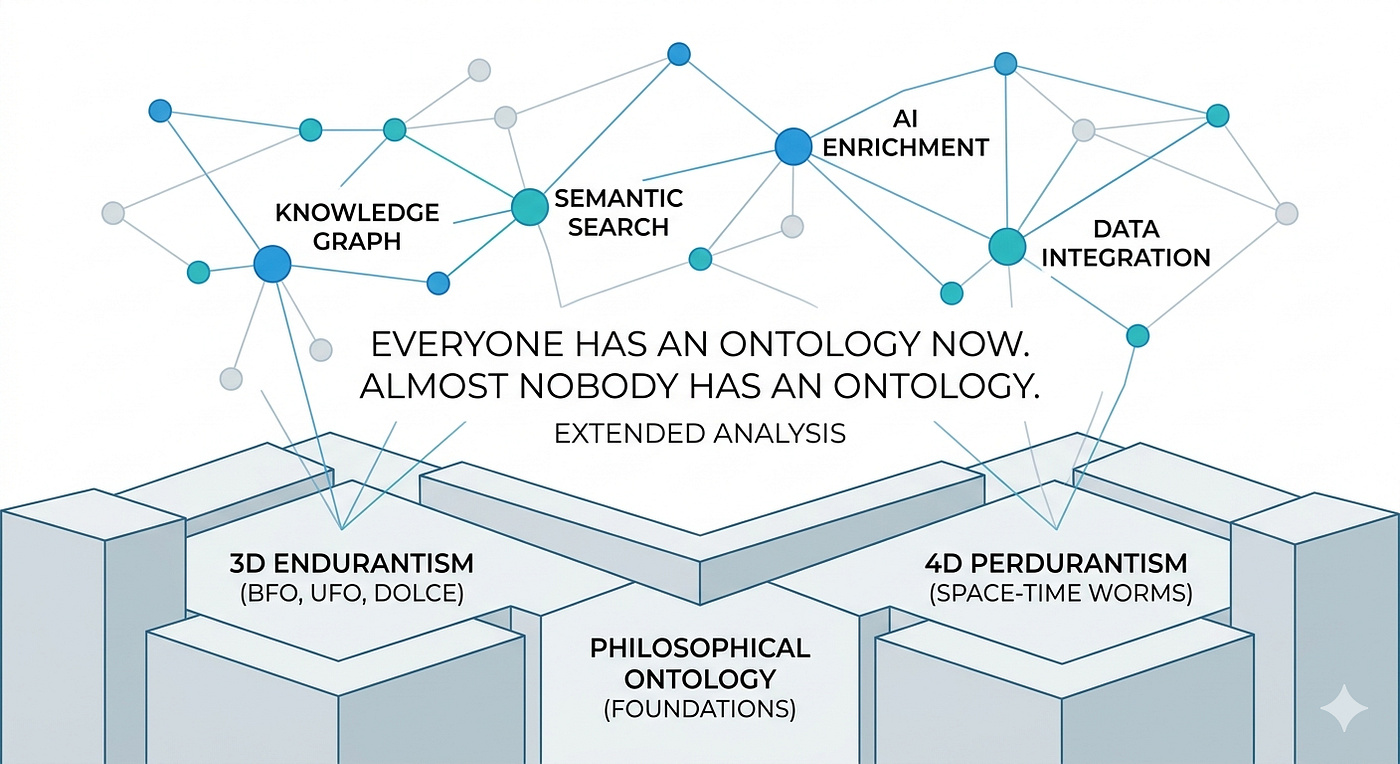
Beyond Semantic Graphs and LLMs: Reification, Hermeneutics, and Level Confusion in Contemporary AI…
From the author
Beyond Semantic Graphs and LLMs: Reification, Hermeneutics, and Level Confusion in Contemporary AI Discourse

From the author
This essay was originally published in French on LinkedIn. The English version here includes precise academic references and expands the argument for an international audience of systems architects, knowledge engineers, and technology strategists.
The fundamental problem: the collapse of levels
Contemporary AI discourse continuously conflates several distinct levels:
• Statistical correlation (pattern matching in data)
• Formal structure (syntactic organization of symbols)
• Semantic content (meaning assigned to representations)
• Knowledge (justified belief about the world)
• Understanding (grasp of significance in context)
• Intelligence (adaptive problem-solving capability)
• Consciousness (subjective experience of meaning)
These levels are neither equivalent nor continuous.
Yet modern AI discourse implicitly establishes direct passages between them: statistical correlation → semantic structure → understanding → intelligence
This implicit continuity constitutes one of the principal sources of contemporary confusion.
Anthropomorphism, reification, hypostasis, and teleology
Several linguistic and philosophical mechanisms fuel these slippages.
Anthropomorphism
Anthropomorphism consists in attributing to technical systems intentions, cognitive capacities, or human properties — for example, “the machine thinks,” “the model understands,” or “the agent wants.”
The problem arises when these metaphors cease to be perceived as pragmatic simplifications and become supposed literal descriptions.
Reification
Reification possesses two important senses.
a) Philosophical sense: transforming an abstraction, relation, or process into a supposedly autonomous “thing” — for example, “the market decides” or “the algorithm thinks.”
b) Technical sense (knowledge engineering)
In knowledge engineering, reification consists in transforming a relation into a manipulable entity. For example, instead of:
Alice worksFor CompanyX
we create:
Employment123
employee: Alicecompany: CompanyXrole: architect
This operation is extremely useful and enables contextualization, provenance, temporality, and reasoning. But it also fosters ontological slippages when reified objects come to be perceived as intrinsic entities of reality.
The critique of vendor “ontologies” that conflate classes and instances is precisely a warning against uncontrolled reification.
Hypostasis
Hypostasis designates the substantialization of an abstraction and its transformation into a quasi-ontological entity — for example: “AI knows,” “the graph understands,” or “the model possesses concepts.”
Here, the metaphor gradually becomes an implicit ontology. The “semantic layers” are often hypostasized: treated as if they contained meaning intrinsically, rather than serving as interpretable structures.
Teleology
Teleology consists in explaining a system by its supposed purpose, intention, and finality — for example, “the model seeks truth” or “AI tries to understand.”
Yet computational systems optimize, calculate, and adjust parameters; they do not necessarily pursue lived or conscious finalities. The interoperability hubs do not “aim” for coherence; they require explicit governance to maintain it.
The problem of semantic graphs and ontologies
Semantic graphs and ontologies constitute powerful structuring tools.
However, they often foster confusion between formal structure, meaning, knowledge, and understanding.
Meaning is not in the graph
A graph is not intrinsically “semantic.”
It becomes interpretable through conventions, contexts, usages, communities, and systems of interpretation.
- meaning is not contained in the structure
- it emerges from an interpretative relation
This directly connects to the argument about pragmatic continuity: the receiving system must interpret what it receives, and that interpretation depends on operational context that the graph itself cannot contain.
The danger of ontologies
Computational ontologies tend to produce an illusion:
- formalization = revealing the intrinsic structure of reality
Yet an ontology is not reality, is not knowledge itself, and is not a universal truth.
It is an interpretative, contextualized, pragmatic construction dependent on objectives and viewpoints. To distinquish between formal OWL ontologies and vendor “governed schemas” is an operational application of this principle.
Embeddings and the semantic illusion
Embeddings represent elements as vectors in a mathematical space. Their objective is to geometrically approximate statistically similar elements.
What embeddings actually capture
Embeddings capture correlations, regularities of usage, and contextual proximities. They do not directly capture lived meaning, understanding, intention, or stable reference.
The problematic slip
Contemporary discourse often slips:
- statistical proximity → semantic proximity → understanding
The vector then implicitly becomes concept, knowledge, and understanding.
Note that the most accurate French term is représentation vectorielle. The English term “embedding” sometimes contributes to the illusion of an “intrinsic encoding of meaning.”
The terminological reduction of semantics
Modern approaches to semantic governance often reduce semantics to the management of terms, taxonomies, glossaries, and vocabularies.
But:
- the term is not the concept
- the word effaces the concept
A term depends on context, usage, discipline, and intention. Several concepts may share a term. A single concept may change across contexts.
Syntax carries meaning
Meaning does not reside solely in words but also in their composition, organization, and discursive deployment. Syntax hierarchizes, implies, suggests, and orients interpretation.
Semiotics, semantics, and hermeneutics
Semiotics studies signs, their systems, and their relations.
Semantics studies the relation between sign and signification.
Hermeneutics studies the situated interpretation of meaning. It reminds us that meaning is never given directly and that all understanding depends on context, interpreter, culture, and intentions.
The problem of modern AI systems
Contemporary systems develop a computational semiotics and a formalized semantics, but the hermeneutic dimension remains largely absent.
Yet it is precisely this dimension that introduces lived context, real usages, multiple interpretations, and frame shifts. The semantic cartography is an attempt to reintroduce this hermeneutic dimension into engineering practice: not by formalizing all interpretation, but by making interpretative plurality navigable.
Ontological commitment, epistemological prudence, and conceptual scope
Ontological commitment
A discourse possesses ontological commitment when it implicitly supposes that certain entities really exist — for example, “the model understands” supposes that understanding is a real property of the system.
Epistemological prudence
Epistemological prudence consists in recognizing the limits of models, avoiding excessive claims, and distinguishing observation from interpretation.
Conceptual scope
Conceptual scope designates the limits of applicability of a concept — for example: “memory,” “intelligence,” and “understanding” do not have exactly the same meaning in computer science, psychology, neuroscience, and philosophy.
The disappearance of distinctions
Contemporary AI discourse tends to fuse:
- structure / meaning
- calculation / understanding
- correlation / causality
- representation / reality
- syntax / semantics
- information / knowledge
- model / world
This progressive disappearance of boundaries produces conceptual confusions, logical errors, fuzzy ontologies, and difficulties of real interoperability.
The fundamental problem of interoperability
Interoperability cannot be reduced to terminological mappings, ontology alignments, or relation graphs.
It also involves interpretative frameworks, local logics, different disciplines, incompatible worldviews, and pragmatic contexts.
Origin of the Inhabiting Babel manifesto: toward responsible engineering of meaning
The tensions described above — reification of relations, hypostasis of structures, confusion between semantics and interpretation, erasure of the hermeneutic dimension — are not merely academic debates. They translate a concrete transformation of engineering practices, industrial discourses, and cognitive frameworks within which digital systems are designed and interpreted.
It is in this context that the need for a work like Inhabiting Babel emerged: not as an additional technical solution, but as a call for critical vigilance regarding the contemporary fabrication of meaning.
Contemporary “Babel” is not linguistic, but conceptual
The myth of Babel traditionally evokes the fragmentation of languages. But in contemporary systems, the fragmentation is of another nature:
- multiplication of ontologies,
- proliferation of data models,
- coexistence of incompatible semantic frameworks,
- stacking of heterogeneous abstraction layers,
- divergence of interpretations according to tools and actors.
It is no longer merely a matter of speaking different languages, but of no longer sharing the same implicit structures of meaning, even when vocabulary seems identical.
Thus, the same terms — data, entity, relation, knowledge, intelligence — circulate between software engineering, data science, generative AI, data governance, and digital transformation consulting,
but with radically different ontological commitments and conceptual scopes.
This is the “Babel” to be navigated: not a tower to rebuild uniformly, but a terrain to map honestly.
The illusion of “meaning manageable by engineering”
A strong tendency of recent years consists in considering that meaning can be: modeled, normalized, structured, industrialized, governed, and optimized.
This perspective manifests notably through: semantic layers, knowledge graphs, enterprise ontologies, data governance frameworks, or RAG-augmented LLM architectures.
These approaches are useful, but they often rest on an implicit hypothesis:
meaning is a stabilizable property of a formal structure
Yet this hypothesis masks a more complex reality: meaning is contextual, interpretative, dependent on practices, linked to intentions, and traversed by tensions between disciplines and usages.
The role of industrial and marketing discourses
An aggravating factor of this confusion is the transformation of technical discourses into value discourses: “semantic intelligence,” “AI that understands,” “knowledge-driven platforms,” “context-aware systems,” or “autonomous reasoning agents.”
These formulations have strong communicative efficacy, but they often produce: compression of levels of analysis, fusion between statistical capacities and understanding, naturalization of models as cognitive agents, or erasure of human and organizational mediations.
In this context, technologies are no longer presented as tools of interpretation, but as systems supposed to bear meaning themselves.
The progressive disappearance of the hermeneutic dimension
One of the central points of the problem is the marginalization of hermeneutics in engineering discourses.
Where semantics is formalizable, modelable, and integrable into systems, hermeneutics reminds us that: meaning is always interpreted, never entirely contained in a structure, and always dependent on a lived context and an act of reading.
In its absence, systems tend to be perceived as self-sufficient, bearers of truth, and producers of autonomous meaning.
This slip is subtle, but structural.
Why Inhabiting Babel
In this context, Inhabiting Babel does not aim to propose a new universal ontology, a unified semantic standard, or a “correct” engineering method for meaning.
It is rather about:
reintroducing critical vigilance into how we construct, name, and interpret systems of representation.
“Inhabiting” means here recognizing the instability of frameworks, accepting the coexistence of heterogeneous logics, and working with tensions rather than artificially suppressing them.
“Babel” does not designate a chaos to be corrected, but a structural condition: multiplicity of languages, multiplicity of models, multiplicity of interpretations, and irreducibility of viewpoints.
Toward responsible engineering of meaning
The expression “responsible engineering of meaning” should not be understood as a new technical discipline, but as a posture.
It implies:
- Explicit ontological commitments: Knowing what a model supposes as “existing.”
- Maintaining epistemological prudence: Not confusing observation, interpretation, simulation, and understanding.
- Clarifying conceptual scope: Identifying the limits of concept usage according to contexts.
- Reintroducing the hermeneutic dimension: Recognizing that meaning is never only in the structure and that it emerges from a situated act of interpretation.
This posture is what The Semantic Compass attempts to practice: not by rejecting semantic technologies, but by refusing their naive interpretation as autonomous sense-makers.
A critical posture toward emerging technologies
Finally, Inhabiting Babel stands as a call for vigilance regarding:
- the naturalization of AI models as cognitive entities,
- the confusion between representation and reality,
- the reduction of meaning to manipulable structures,
- the domination of techno-marketing discourses over conceptual frameworks,
- the erasure of fundamental distinctions between levels of description.
It is not a matter of rejecting these technologies, but of refusing their naive interpretation as systems bearing autonomous meaning.
Conclusion
Contemporary discourses on AI, semantic graphs, and embeddings often produce continuous slippages between calculation, representation, signification, knowledge, and understanding.
These slippages are fueled by anthropomorphism, reification, hypostasis, and implicit teleology.
Computational structures then progressively come to be perceived as intrinsically bearing meaning, quasi-cognitive, even autonomous.
Yet meaning is not contained in structures, understanding does not reduce to calculation, and semantics cannot be dissociated from syntax, pragmatics, hermeneutics, context, and interpreters.
The central question is therefore not merely:
“how to represent meaning?”
but rather:
how to maintain intelligible the distinctions between representation, interpretation, calculation, knowledge, and reality in increasingly complex digital systems?
Inhabiting Babel thus arises from an observation: contemporary technologies pose not only engineering problems, but problems of readability of the world — that is, of how we construct, name, and interpret what is.
In this space, the stake is not to resolve Babel, but to inhabit it with lucidity:
- by maintaining distinctions,
- by refusing implicit slippages,
- and by reintroducing responsibility into the fabrication of meaning.
Compass bearing for this issue
One question worth sitting with:
In your organization’s discourse about AI and semantic systems, who tracks the slippages between “correlation” and “understanding,” between “the model outputs” and “the model knows”? Is there a designated role — architect, ethicist, epistemologist — who maintains these distinctions, or do they dissolve in the momentum of implementation?
If the answer is no one, you are not engineering meaning. You are engineering the illusion of meaning, and calling it intelligence.
That is the problem The Semantic Compass exists to address.
Extending the compass
If this issue resonates, it is part of a broader body of work exploring the same problem from different angles — not as a single theory, but as a set of navigational tools.
📘 Inhabiting Babel (EN / FR)
A longer-form exploration of semantic fragmentation and the limits of shared meaning across systems and disciplines.
This newsletter can be read as a continuation in a more operational, field-driven form.
→ Available on Gumroad
This book is part of a larger ensemble: newsletter, experimental tools like ArchiCG, and future publications on complexity and semantic cartography.
🔜 Ongoing work
Several extensions of this line of thought are currently in progress:
Inhabiting Babel — Part II: Complexity
Shifting the focus from semantic fragmentation to the deeper issue of irreducible complexity in interconnected systems.
ArchiCG (v2)
ArchiCG is an open platform for semantic cartography and co-representation, implementing the hypermodel approach
Semantic Cartography (book)
These are not separate projects. They are different projections of the same terrain.
References
Habiter Babel — Interdisciplinary essay proposing a critical reflection on the limits of contemporary formalisms applied to meaning, interoperability, and digital systems. The work analyzes slippages between representation, calculation, semantics, and understanding in current discourses on AI and “semantic” technologies, while calling for a responsible engineering of meaning attentive to hermeneutic, contextual, and socio-technical dimensions. It does not propose a universal solution, but constitutes the conceptual foundation that motivated the development of semantic cartography and ArchiCG as a prototype and utility for enterprise, knowledge, and systems architects in a globally digitized environment.
Ferdinand de Saussure (1916). Cours de linguistique générale. Paris: Payot.
[English translation: Course in General Linguistics, trans. Wade Baskin. New York: Philosophical Library, 1959; repr. New York: Columbia University Press, 2011.]
Foundation of structural linguistics: sign, signifier, signified, structure of linguistic systems.
Charles Sanders Peirce (1931–1958). Collected Papers of Charles Sanders Peirce, 8 vols., eds. Charles Hartshorne, Paul Weiss, and Arthur W. Burks. Cambridge, MA: Harvard University Press (Belknap Press).
Extremely profound approach to the sign (icon, index, symbol, interpretant, infinite semiosis), highly relevant for critiquing modern simplifications around “semantics.”
Umberto Eco (1984). Semiotics and the Philosophy of Language. Bloomington: Indiana University Press. ISBN: 978–0–253–35168–5 (cloth); 978–0–253–20398–4 (paper).
Major bridge between semiotics, interpretation, culture, and communication. Very useful against overly mechanistic views of meaning.
Hans-Georg Gadamer (1960). Wahrheit und Methode: Grundzüge einer philosophischen Hermeneutik. Tübingen: J.C.B. Mohr (Paul Siebeck).
[English translation: Truth and Method, 2nd rev. ed., trans. Joel Weinsheimer and Donald G. Marshall. New York: Continuum, 1989; rev. ed. 2004.]
Central work on interpretation, tradition, situated understanding, and historicity of meaning. Essential for the critique of purely formal approaches.
Paul Ricœur (1986). Du texte à l’action: Essais d’herméneutique II. Paris: Éditions du Seuil.
[English translation: From Text to Action: Essays in Hermeneutics, II, trans. Kathleen Blamey and John B. Thompson. Evanston, IL: Northwestern University Press, 1991. ISBN: 978–0–8101–0392–6 (cloth); 978–0–8101–2399–1 (paper).]
Highly relevant for language, narration, polysemy, interpretation, and the tension between structure and meaning.
Martin Heidegger (1927). Sein und Zeit. Tübingen: Max Niemeyer.
[English translation: Being and Time, trans. John Macquarrie and Edward Robinson. New York: Harper & Row, 1962; repr. San Francisco: HarperSanFrancisco, 2006.]
Understanding is no longer merely cognitive: it becomes a fundamental structure of human existence. Highly influential for modern hermeneutics.
Ludwig Wittgenstein (1921). Tractatus Logico-Philosophicus. London: Kegan Paul, Trench, Trubner & Co.
[English translation by C.K. Ogden; repr. London: Routledge, 2001.]
Ludwig Wittgenstein (1953). Philosophische Untersuchungen. Oxford: Basil Blackwell.
[English translation: Philosophical Investigations, trans. G.E.M. Anscombe. Oxford: Basil Blackwell, 1953; 2nd ed. 1958; 3rd ed. 1967; repr. Malden, MA: Wiley-Blackwell, 2009.]
Fundamental transition from language as logical representation to language as situated usage (”language games”). Extremely important for the critique of overly formal approaches.
John Langshaw Austin (1962). How to Do Things with Words: The William James Lectures delivered at Harvard University in 1955, ed. J.O. Urmson. Oxford: Clarendon Press.
Speech acts: language does not merely describe the world, it acts. Highly relevant for thinking pragmatics, intention, and communication.
John R. Searle (1969). Speech Acts: An Essay in the Philosophy of Language. Cambridge: Cambridge University Press.
Critique of strong computational views of the mind. Very useful against slippages from calculation to understanding.
John R. Searle (1992). The Rediscovery of the Mind. Cambridge, MA: MIT Press.
Barry Smith (2003). “Ontology.” In The Blackwell Guide to the Philosophy of Computing and Information, ed. Luciano Floridi, 153–166. Oxford: Blackwell.
Barry Smith & Werner Ceusters (2010). “Ontological Realism: A Methodology for Coordinated Evolution of Scientific Ontologies.” Applied Ontology 5(3–4): 139–188. DOI: 10.3233/AO-2010–0079.
Very important for distinguishing model, representation, and reality.
Robert Arp, Barry Smith & Andrew D. Spear (2015). Building Ontologies with Basic Formal Ontology. Cambridge, MA: MIT Press. ISBN: 978–0–262–52781–1 (paper); 978–0–262–32959–0 (e-book).
Nicola Guarino, ed. (1998). Formal Ontology in Information Systems: Proceedings of the First International Conference (FOIS’98), June 6–8, Trento, Italy. Amsterdam: IOS Press.
Central works on formal ontologies, meta-modelling, and ontological commitment.
Thomas R. Gruber (1993). “A Translation Approach to Portable Ontology Specifications.” Knowledge Acquisition 5(2): 199–220. DOI: 10.1006/knac.1993.1008.
Famous definition: “An ontology is an explicit specification of a conceptualization.” Highly influential — and precisely subject to the critiques developed in this article.
Hubert L. Dreyfus (1972). What Computers Can’t Do: A Critique of Artificial Reason. New York: Harper & Row.
[Revised editions: 1979; 1992 (retitled What Computers Still Can’t Do: A Critique of Artificial Reason). Cambridge, MA: MIT Press. ISBN: 978–0–262–54067–3 (paper).]
Historical critique of symbolic AI: context, tacit knowledge, body, and interpretation. Highly current in the face of LLMs.
Joseph Weizenbaum (1976). Computer Power and Human Reason: From Judgment to Calculation. San Francisco: W.H. Freeman and Company.
Early critique of computational anthropomorphism.
Luciano Floridi (2011). The Philosophy of Information. Oxford: Oxford University Press. ISBN: 978–0–19–923238–3.
Important contemporary works on information, the digital, ontology, and AI.
Luciano Floridi (2013). The Ethics of Information. Oxford: Oxford University Press.
Douglas R. Hofstadter (1979). Gödel, Escher, Bach: An Eternal Golden Braid. New York: Basic Books. ISBN: 978–0–465–02656–2.
Profound reflection on symbols, cognition, self-reference, and emergence of meaning.
Gregory Bateson (1972). Steps to an Ecology of Mind: Collected Essays in Anthropology, Psychiatry, Evolution, and Epistemology. San Francisco: Chandler Publishing Company.
[Ballantine Books edition: New York, 1972. ISBN: 0–345–27370–2. University of Chicago Press reprint: Chicago, 2000. ISBN: 978–0–226–03905–3.]
Context, communication, logical levels, metacommunication. Extremely relevant for reflection on level breaks.
Edgar Morin (1977–2004). La Méthode, 6 vols. Paris: Éditions du Seuil.
Complexity, interdisciplinarity, limits of reductionist approaches.
Georg Lukács (1923). Geschichte und Klassenbewußtsein: Studien über marxistische Dialektik. Berlin: Malik-Verlag.
[English translation: History and Class Consciousness: Studies in Marxist Dialectics, trans. Rodney Livingstone. London: Merlin Press, 1971.]
Modern concept of reification.
Alfred Korzybski (1933). Science and Sanity: An Introduction to Non-Aristotelian Systems and General Semantics, 5th ed. Lakeville, CT: International Non-Aristotelian Library Publishing Co.
Famous idea: “The map is not the territory.” Highly relevant for the critique model ≠ reality.
메타데이터
- post_id
- fa4da72b81fb
- slug
- beyond-semantic-graphs-and-llms-reification-hermeneutics-and-level-confusion-in-contemporary-ai-fa4da72b81fb
- url
- https://medium.com/@nfigay/beyond-semantic-graphs-and-llms-reification-hermeneutics-and-level-confusion-in-contemporary-ai-fa4da72b81fb
- canonical_url
- https://medium.com/@nfigay/beyond-semantic-graphs-and-llms-reification-hermeneutics-and-level-confusion-in-contemporary-ai-fa4da72b81fb
- author_url
- https://medium.com/@nfigay
- status
- ok
- fetched_at
- 2026-06-11 17:15:47