UV Air Disinfection vs Chemical Disinfection in Industrial Facilities
Air disinfection is an important part of maintaining sanitary conditions and product quality in industrial facilities. Engineers and…
UV Air Disinfection vs Chemical Disinfection in Industrial Facilities

Two common approaches are UV air disinfection and chemical treatment. Both can be effective, but they work differently and have different limitations.
Who Needs Air Disinfection Systems?
Industrial air disinfection is particularly relevant for:
- food and beverage production;
- pharmaceutical facilities;
- laboratories;
- ventilation and HVAC systems;
- production areas with elevated microbial contamination;
- facilities requiring regular sanitary control.
The appropriate method depends on room size, contamination level, operating schedule, and whether people remain inside during treatment.
How UV Air Disinfection Works
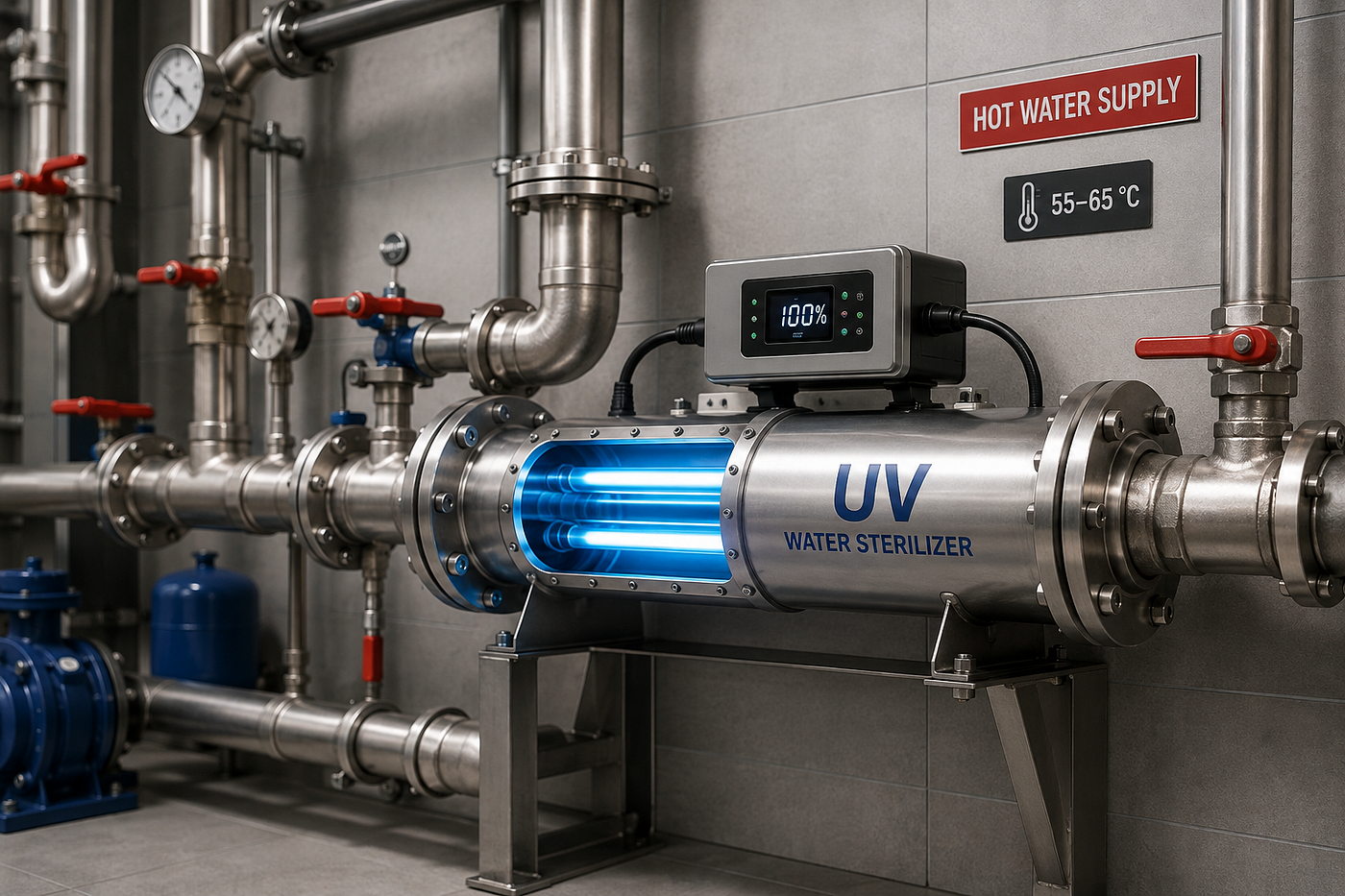
An ultraviolet bactericidal irradiator uses short-wave UV radiation, typically around 254 nm, to damage the DNA and RNA of microorganisms and reduce their ability to reproduce.
There are two main types of UV equipment.
Open UV Irradiators
Open irradiators emit ultraviolet radiation directly into the room and can treat both air and exposed surfaces.
However, they are generally operated only when people are absent because direct UV-C exposure can affect the eyes and skin.
UV Air Recirculators
A bactericidal air recirculator works differently.
A fan draws room air into a closed chamber containing UV lamps. The air passes through the irradiation zone and then returns to the room.
Because the UV sources are enclosed inside the housing, recirculators can be used in occupied areas.
Their effectiveness depends on several factors:
- airflow rate;
- UV intensity;
- exposure time;
- lamp condition;
- equipment capacity relative to room volume.
If air moves through the chamber too quickly or the lamps provide insufficient UV output, disinfection efficiency may decrease.
How Chemical Air Disinfection Works
These substances interact with microorganisms and can be used for intensive treatment of rooms, equipment, and difficult-to-reach areas.
However, chemical treatment requires careful control of concentration and exposure time.
Depending on the chemicals used, additional ventilation may also be required after treatment.
Another factor is compatibility with equipment and materials. Aggressive disinfectants can contribute to corrosion or damage certain surfaces when used incorrectly or excessively.
UV vs Chemical Disinfection
The main advantage of UV air disinfection systems is that they do not require disinfectants to be introduced into the treated air.
Recirculators can also operate continuously while personnel are present.
In many industrial facilities, the two approaches can complement each other rather than replace one another completely.
What Should Be Checked on Site?
When evaluating ultraviolet air sterilizers, pay attention to:
- location of the equipment;
- room volume;
- airflow through the recirculator;
- UV lamp intensity and condition;
- operating schedule;
- number and capacity of installed units.
Open UV irradiators should be positioned and operated so that personnel are not exposed to direct bactericidal radiation.
For recirculators, airflow should provide sufficient exposure inside the UV chamber rather than simply maximizing air velocity.
Common Mistakes
One common mistake is choosing equipment only by nominal airflow capacity without considering UV exposure time.
Another is installing too few units for the volume of the room.
For open irradiators, one of the most serious operating errors is switching the equipment on while people are present.
Which Method Should You Choose?
For areas where people remain during normal operation, a bactericidal air recirculator is usually the more convenient UV solution.
Open UV irradiators are better suited to periodic treatment when personnel can leave the room.
Chemical disinfection can be used as an additional method for intensive sanitation or for areas where UV radiation has limited access.
Conclusion
There is no single air-disinfection method suitable for every industrial facility.
UV treatment provides a reagent-free approach and can be integrated into continuous production processes, especially when closed recirculators are used.
The best solution should therefore be selected according to the room, production process, contamination level, and operating conditions.
메타데이터
- post_id
- fa5f2df3db9b
- slug
- uv-air-disinfection-vs-chemical-disinfection-in-industrial-facilities-fa5f2df3db9b
- url
- https://medium.com/@marketuvl/uv-air-disinfection-vs-chemical-disinfection-in-industrial-facilities-fa5f2df3db9b
- canonical_url
- https://medium.com/@marketuvl/uv-air-disinfection-vs-chemical-disinfection-in-industrial-facilities-fa5f2df3db9b
- author_url
- https://medium.com/@marketuvl
- status
- ok
- fetched_at
- 2026-09-04 17:51:01