Stop Saying “Tee-an”: The Hidden Pronunciation Trap in Pinyin
Most Chinese learners treat Pinyin as if it’s just English with accents. It’s not. And the biggest “scam” is the vowel combination “-ian”.
Stop Saying “Tee-an”: The Hidden Pronunciation Trap in Pinyin
Most Chinese learners treat Pinyin as if it’s just English with accents. It’s not. And the biggest “scam” is the vowel combination “-ian”.
When you see 天 (Tiān) or 电 (Diàn), your English-speaking brain wants to say: ❌ “Tee-an” (Ti + an) ❌ “Dee-an” (Di + an)
If you say it this way, native speakers will understand you, but you will always sound like a “foreigner reading a textbook.”
The Hack: In Pinyin, “-ian” is actually a hidden sound. It doesn’t sound like “an” (as in “apple”). It sounds like the English word “yen” (the Japanese currency).
Try this: ✅ Say “T-yen” ✅ Say “D-yen”
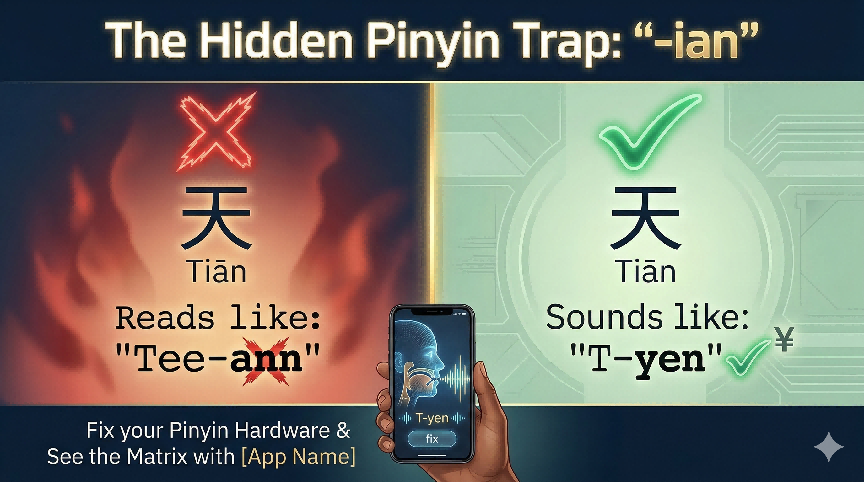
Suddenly, your accent disappears. You sound native.
Why does this happen? Because Pinyin was designed for efficiency, not for perfect phonetic representation for English speakers. There are at least 5 more “hidden traps” like this in the Pinyin system that textbooks rarely explain.
We built [YTong-Learn Chinese Culture] to fix this. We don’t just show you the letters; we show you the “Audio Anchors” (familiar English sounds) that help you hack your muscle memory in seconds.
메타데이터
- post_id
- fa85d3377222
- slug
- stop-saying-tee-an-the-hidden-pronunciation-trap-in-pinyin-fa85d3377222
- url
- https://medium.com/@YTongChinese/stop-saying-tee-an-the-hidden-pronunciation-trap-in-pinyin-fa85d3377222
- canonical_url
- https://medium.com/@YTongChinese/stop-saying-tee-an-the-hidden-pronunciation-trap-in-pinyin-fa85d3377222
- author_url
- https://medium.com/@YTongChinese
- status
- ok
- fetched_at
- 2026-07-17 02:49:50




