Dung
Part Two: Dung, from the cow, has an important role in fire sacrifices.
Dung
Part Two: Dung, from the cow, has an important role in fire sacrifices.
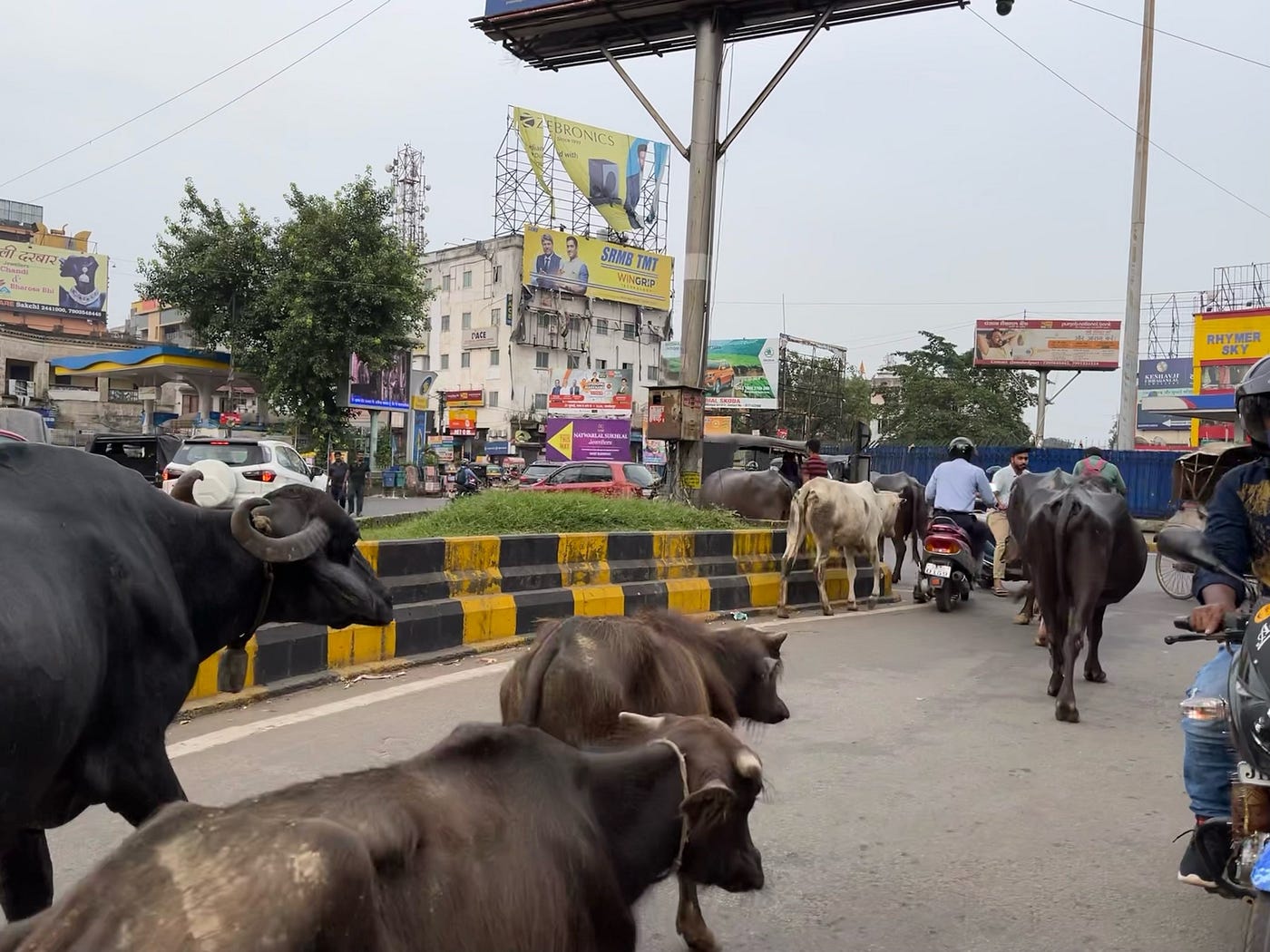
Cows on the street. Photo by Tooth Truth Roopa Vikesh , my daughter.
(This is the link for Part One)
Cowdung cakes
The dung from cows is collected in a basket; the contents of the basket are patted into cakes approximately a foot in diameter and a couple of inches thick at the centre (300mm by 50mm, approximately). The semi-dry cakes are applied with force on a brick wall where they stick by their own adhesive property.
After drying in the sun they cake up and fall off; or are taken off. They are stored in large wicker baskets and used up in the household or sold to buyers.
Travelling through the Indian countryside by rail or road as well, you can observe that all the houses’ sides and backs are stuck with drying cowdung cakes. (Recommendation — the states along the gangetic plain, particularly — Uttar Pradesh, and Bihar).
A foreigner once asked, “What are those?” and was told. He said, “I get that, but tell me, how do you get the cows to stand in line and shoot like that?”
Dried dung becomes a cheaper source of fuel in places where cows and dung are available in plenty, and money has to be paid to get charcoal, coal, coke and even firewood.
Dung is also mixed with powdered coal and a little earth, rolled into balls about two inches in diameter (50mm) and set out on the roadside to dry, to use as fuel. Until as recently as 2020, these balls were a common sight. They are now rarer, after the Government started a drive to provide all households with liquefied petroleum gas, LPG, in cylinders, and made arrangements for empty cylinders to be exchanged for full ones, for a price, of course.
LPG is so convenient. A turn of the knob, a press of the electronic lighter, and you have instant fire for cooking. All the labour involved in collecting the cowdung, processing it into fuel balls or cowdung cakes, and the attendant disgust when you are not used to it, is banished by LPG.
The use of dung in religious ritual and sacrifices
Coal is hardly ever used in religious rituals and sacrifices. Sometimes burning coals from the hearth in the household is used as a starter, when it is a daily ritual that has to be conducted speedily and put behind one.
The starter is usually a couple of camphor tablets. Lit by a match or from a nearby fire, the camphor is placed on bricks formed into a square fireplace. It is then covered with small bits of coconut shell fibre or dried cowdung which start smouldering. Rice husk and more cowdung become the base fire on which the sacrifice can be conducted. Dried twigs, dried grass, clarified butter (ghee), cooked food, cooked vegetable pieces, and such things as can be consumed by the fire, are offered, along with appropriate chants.
Fire as a messenger and benefactor
Fire is worshipped as the messenger and transporter. Agni, the fire, accepts the offerings in the form they are offered. The chants intoned signify the beneficiary of the offering. Agni carries the offering and provides it to the beneficiary in a form that can be consumed.
Fire itself can be worshipped; prayers can be recited to seek boons or benefits. Fire can confer the benefits of long life, genius, offspring and livestock, among others, when the sacrifice is conducted in the stipulated manner.
메타데이터
- post_id
- fa871b9a2544
- slug
- dung-fa871b9a2544
- url
- https://medium.com/brammarly/dung-fa871b9a2544
- canonical_url
- https://medium.com/brammarly/dung-fa871b9a2544
- author_url
- https://medium.com/@rajpadma
- status
- ok
- fetched_at
- 2026-07-22 05:32:08