The Best Linphone Alternatives for Business Use in 2026
TL;DR: Linphone is a solid free, open-source softphone that businesses tend to outgrow once they need reliable mobile push, their own…
The Best Linphone Alternatives for Business Use in 2026
TL;DR: Linphone is a solid free, open-source softphone that businesses tend to outgrow once they need reliable mobile push, their own branding, real support, or scale. The alternatives worth knowing in 2026: Tragofone (white-label, for service providers and resellers), Acrobits (mobile-first), Bria (enterprise UC), Zoiper (a step up from free), and MicroSIP (Windows desktop). Which one fits depends entirely on why you’re leaving Linphone in the first place.
I’ve recommended Linphone to people more times than I can count. It’s free, it runs on basically everything, it speaks SIP fluently, and for a developer testing a setup or someone running a home PBX, it’s genuinely hard to beat. No notes.
The problem isn’t Linphone. The problem is what happens when a business tries to run on it.
Somewhere around the point where you’ve got fifty people who need their calls to ring reliably, or a client asking why the app has someone else’s name on it, or a 2am outage with nobody to call, the free open-source thing stops being a feature and starts being the reason you’re awake at 2am. That’s usually when people start typing “Linphone alternative” into a search bar. If that’s you, here’s the honest version of what’s out there.
What is a Linphone alternative?
A Linphone alternative is any softphone that does the SIP voice and video calling Linphone does, but adds the things businesses actually end up needing: white-label branding, reliable mobile push notifications, real vendor support, or the ability to run cleanly across a few hundred users. Some alternatives are other free open-source clients. Others are commercial or white-label products built specifically for businesses and service providers.
The real difference is what the thing was built for. Linphone was built to be a free, general-purpose SIP client, and it’s good at that. The business-focused alternatives were built around reliability, branding, and support, because that’s what businesses pay for.
Why businesses outgrow Linphone
Worth being clear: outgrowing Linphone isn’t a knock on Linphone. It’s a fit problem, not a quality problem. But the reasons are pretty consistent once you’ve seen a few teams go through it.
Mobile push is the big one. On a phone, Linphone can struggle to wake up and ring when the app’s been sitting in the background for a while, because reliable push on iOS and Android takes infrastructure that a free project doesn’t always pour resources into. For a business, “sometimes the phone doesn’t ring” isn’t a quirk. It’s a lost customer.
Branding is the next one. Linphone looks like Linphone. If you’re a service provider handing an app to your customers, you don’t want your customers looking at a free open-source client with a name that isn’t yours. That’s not something you can patch in. It’s baked into what an open-source client is.
Support is the third. When Linphone breaks, your options are the community forum and your own debugging skills. Fine for a hobbyist. Not fine when your phone system is how your business makes money.
And then there’s scale. Configuring Linphone on five phones by hand is a Tuesday afternoon. Doing it across three hundred users with central management is just not the job it was built for.
The best Linphone alternatives for business use in 2026
I’ve organized these by who each one actually fits, because “best” is meaningless without knowing what you need it for.
1. Tragofone — for service providers and resellers
If your problem is “I need my own branded app and I don’t want to build one,” this is the category you’re looking at, and Tragofone is one of the cleaner options in it. It runs on iOS, Android, Windows, macOS, and the web, does SIP and WebRTC, handles auto-provisioning, and gets the mobile push piece right, which is the thing that pushes most people off Linphone in the first place. The branding goes all the way down to your own app store listing, and it integrates natively with platforms like NetSapiens. If you want the specifics, Tragofone’s white-label softphone page covers them.
Best for: Service providers, resellers, and anyone who needs the app to be theirs, not a generic client.
2. Acrobits — for mobile-first setups
Acrobits has been doing mobile softphones for a long time and has a reputation for getting battery life and call quality right, which is harder than it sounds. They offer a white-label cloud softphone too, with provisioning built for bigger deployments.
Best for: Deployments where mobile is the priority and you want a proven mobile client.
3. Bria (CounterPath) — for enterprise UC
Bria is the commercial, enterprise-leaning option. Desktop and mobile clients, team messaging, a more polished feature set than a free client, and branding options if you want them. It costs more and it shows, in mostly good ways.
Best for: Enterprises that want a polished commercial UC client.
4. Zoiper — for stepping up without committing
Zoiper sits in the middle. Free and paid tiers, lots of platforms and codecs, somewhere between a free client and a full commercial product. Useful if you’ve outgrown Linphone but aren’t ready to commit to a white-label platform.
Best for: Small businesses that want more than free without enterprise pricing.
5. MicroSIP — for Windows desktop, full stop
MicroSIP isn’t really a business-grade alternative and doesn’t pretend to be. It’s a lightweight open-source SIP dialer for Windows. But if all you actually need is a clean, reliable Windows desktop softphone, it does that one job well.
Best for: Windows-only desktop use where you want simple, not feature-rich.
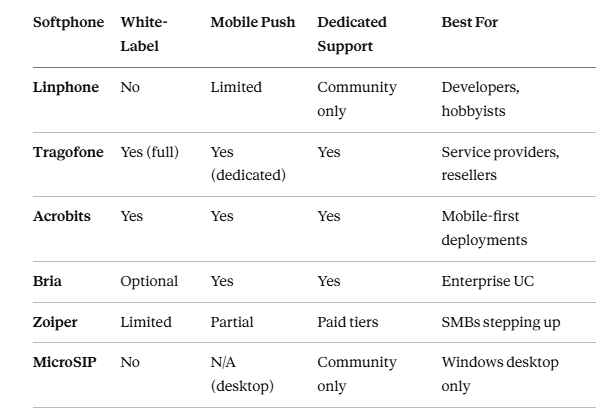
Linphone alternatives compared
How to actually choose
The trick is to work backward from whatever made you leave Linphone, because that tells you almost everything.
Need your own branded app? Then you’re in white-label territory (Tragofone, Acrobits), and the free clients are off the table entirely. You can’t bolt branding onto an open-source softphone. It’s not a setting.
Mobile reliability the issue? Run the dumbest, most effective test there is: lock a phone, walk away for an hour, then call it. Whatever rings has solved the push problem. Whatever doesn’t, hasn’t. I’ve watched this single test settle arguments that spec sheets couldn’t.
Just want a better desktop dialer? MicroSIP or Zoiper might be all you need, and there’s no reason to pay for a platform you won’t use.
Shipping to your own customers? Then it’s white-label, almost without exception. Your customers should not be looking at someone else’s brand on the app you sold them.
Switching because support was the problem? Then cross every free option off the list immediately. The whole point of leaving was to have someone to call.
Frequently asked questions
What is the best Linphone alternative for businesses? Depends on the need. Service providers and resellers wanting a branded app usually land on white-label options like Tragofone. Enterprises lean toward Bria. Mobile-heavy deployments often go with Acrobits. There isn’t one “best,” only the best fit for why you’re switching.
Is Linphone good enough for business use? For individuals, developers, and small technical setups, yes. Businesses tend to outgrow it when they need reliable mobile push, their own branding, dedicated support, or large-scale provisioning, none of which it was built to do.
Why does Linphone miss calls on mobile? Getting a backgrounded mobile app to ring reliably needs proper push infrastructure (APNs on iOS, FCM on Android). Free open-source clients don’t always build this out as thoroughly as commercial softphones do, so calls can fail to wake the app.
Are there free Linphone alternatives? Yes, MicroSIP on Windows and Zoiper’s free tier. But free alternatives mostly share Linphone’s limits around branding, support, and mobile reliability, which is why businesses often end up choosing a paid or white-label option anyway.
What is a white-label Linphone alternative? A softphone you can brand as your own, with your name, your logo, your app store listing. Tragofone and Acrobits offer this. Linphone, being a fixed open-source client, doesn’t.
The bottom line
Linphone is good software that businesses regularly outgrow, and there’s nothing wrong with that. It was built to be free and general-purpose, not branded, supported, and enterprise-scale.
So the “best” alternative is just whichever one fixes your specific reason for leaving. Service providers go white-label, usually something like Tragofone. Enterprises go Bria. Smaller teams might only need MicroSIP or Zoiper. The one move I’d actually warn against is jumping from one free client to another, because you’ll hit the exact same wall in six months and be right back here, reading another one of these lists.
Whatever you pick, test it on real networks before you commit. The demo always works. The parking lot on cellular is where you find out the truth.
메타데이터
- post_id
- fa945ef41bc3
- slug
- the-best-linphone-alternatives-for-business-use-in-2026-fa945ef41bc3
- url
- https://medium.com/@John-william09/the-best-linphone-alternatives-for-business-use-in-2026-fa945ef41bc3
- canonical_url
- https://medium.com/@John-william09/the-best-linphone-alternatives-for-business-use-in-2026-fa945ef41bc3
- author_url
- https://medium.com/@John-william09
- status
- ok
- fetched_at
- 2026-08-21 13:14:52