Most Enterprise AI Projects Don’t Fail for Technical Reasons
An AI model can perform well in testing and still create little value once it enters a real business environment. This is the gap at the…
Most Enterprise AI Projects Don’t Fail for Technical Reasons
Photo by Zach M on Unsplash
An AI model can perform well in testing and still create little value once it enters a real business environment. This is the gap at the centre of many cases of AI project failure. The underlying issue is often not model quality. It is the absence of clear ownership, reliable data access, system integration, and workflows designed to support AI-driven decisions. Model performance matters, but production success depends on something broader: whether the AI fits the way the organization actually operates.
AI Project Failure Often Begins After the Model Works
Enterprise AI projects are commonly evaluated through technical metrics during their early stages. Teams measure accuracy, response quality, latency, retrieval performance, or the model’s ability to complete a defined task. These indicators are necessary, but they do not show whether the system can operate reliably inside a business.
A proof of concept usually works in a controlled environment. The data has been prepared, the use case has a narrow scope, and the technical team can intervene whenever something goes wrong. Production environments are different. Data changes continuously, permissions vary by role, exceptions appear, and AI outputs begin influencing real customers, transactions, employees, and operational decisions.
This explains why broad AI adoption has not automatically translated into enterprise-level value. According to McKinsey’s 2025 State of AI survey, 88% of respondents said their organizations were regularly using AI in at least one business function. However, nearly two-thirds had not begun scaling AI across the enterprise, while only 39% reported an enterprise-level EBIT impact.
The gap is also visible in production deployment. ISG’s 2025 State of Enterprise AI Adoption report, based on 1,200 generative, agentic, and traditional AI use cases, found that only 31% of prioritized use cases had reached full production. Just one in four initiatives was achieving the expected return on growth.
These findings do not mean that the models failed to generate an answer. They show that producing an answer is only one part of an enterprise AI system.
Consider an AI assistant built to support customer service. During a demonstration, it may summarize conversations accurately and recommend a suitable response. In production, however, it must retrieve the latest customer record, respect access permissions, recognize open tickets, follow escalation rules, write updates back to the correct system, and transfer the case to a human when confidence is low.
If those surrounding conditions are missing, the AI may still function technically. Employees will simply avoid relying on it, duplicate its work manually, or use it outside the processes where it was expected to create value.
In this context, AI project failure should not be defined only as a broken model. It can also mean low adoption, inconsistent outputs, limited integration, poor accountability, or a pilot that never becomes part of daily operations.
Four Operational Gaps That Derail Enterprise AI Deployment
The transition from an AI pilot to an AI production system exposes gaps that are easy to overlook during development. Four of the most common are ownership, integration, data access, and workflow readiness.
1. Unclear Ownership Leaves AI Without Operational Accountability
An AI project may have a project manager, a technical lead, and a model provider without having a clear owner for the business outcome.
This creates ambiguity once the system begins operating. Who decides whether an AI recommendation is acceptable? Who responds when the system uses outdated information? Who owns adoption within the department? Who has the authority to change the workflow when employees do not follow it?
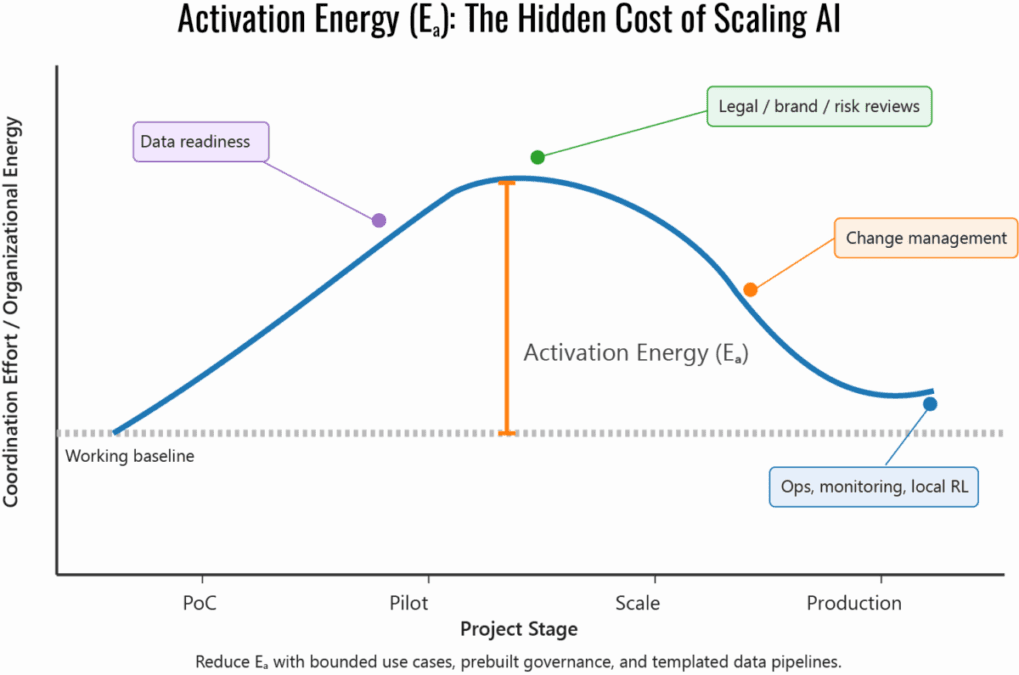
These questions cannot remain with the development team alone. Technical teams can monitor infrastructure and model behaviour, but operational teams understand the context in which decisions are made. Legal, security, data, and business leaders may also need clearly defined responsibilities depending on the risk of the use case.
The NIST AI Risk Management Framework emphasizes that human roles and responsibilities in the design, deployment, use, and oversight of AI systems need to be clearly defined and differentiated. This becomes especially important when AI can recommend or initiate actions rather than simply generate content.
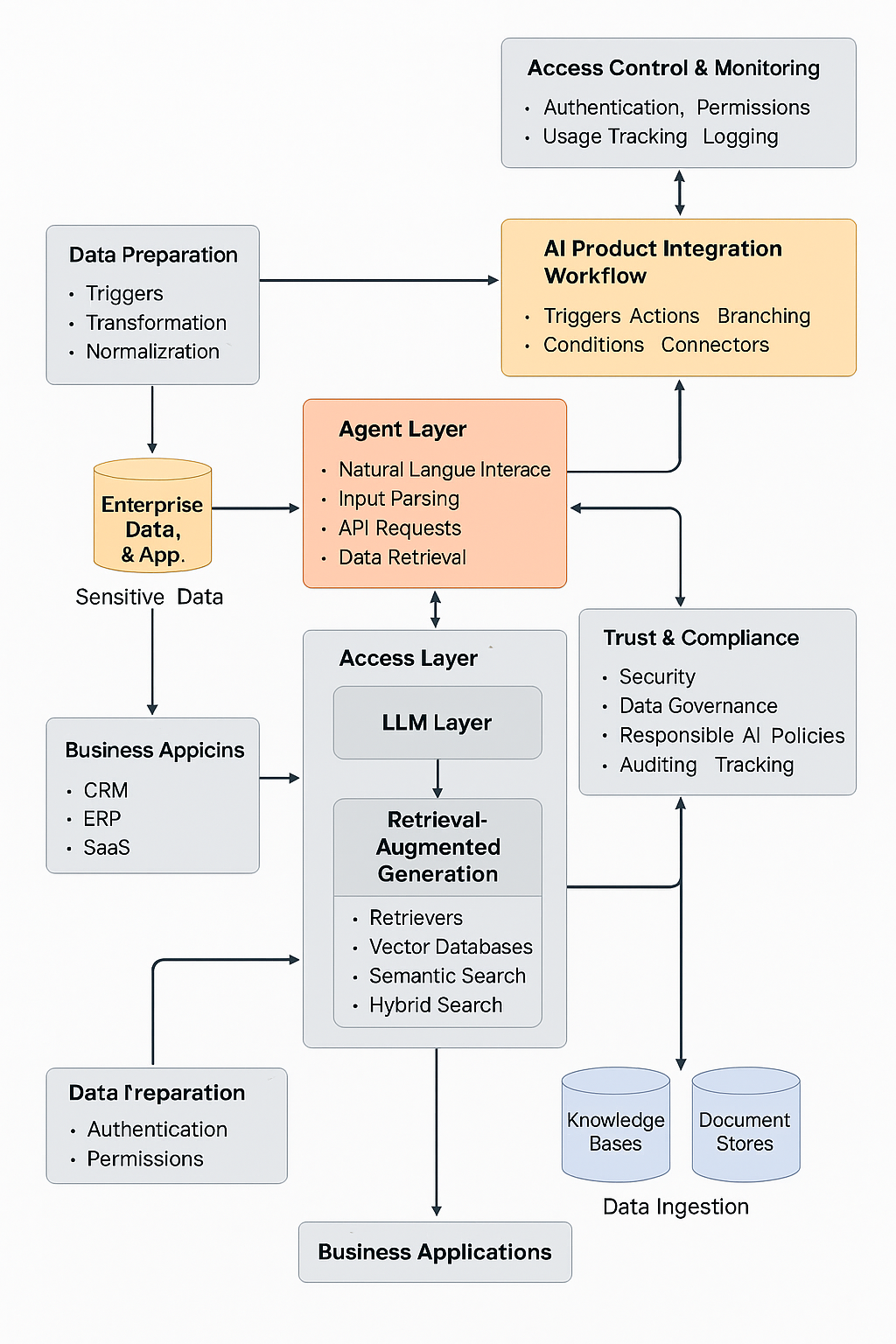
Enterprise AI ownership and governance framework
McKinsey’s research provides a similar signal. AI high performers were three times more likely than other organizations to report strong ownership and commitment from senior leaders. Leadership involvement matters because many barriers to AI implementation require decisions across departments, budgets, policies, and operating models.
A reliable ownership model should therefore cover the entire lifecycle of the system. It should define who owns the business KPI, who approves data access, who monitors performance, who reviews exceptions, and who can suspend or change the AI workflow when necessary.
2. Integration Gaps Keep AI Outside Real Business Operations
Many enterprise AI deployments begin as standalone interfaces. Employees ask questions in one system, receive an output, and then manually transfer the result into an ERP, CRM, help desk, spreadsheet, or internal approval tool.
This can improve individual productivity, but it rarely transforms the underlying operation. The employee still performs the system lookup, validation, data entry, and coordination that the AI was expected to reduce.
The integration problem is becoming more visible as companies invest in multiple platforms at the same time. In IBM’s 2025 global CEO study, 50% of surveyed CEOs said the pace of technology investment had left their organizations with disconnected, piecemeal technology. At the same time, 68% identified an integrated enterprise-wide data architecture as critical for cross-functional collaboration.
For an AI system to become part of an operational workflow, it needs more than an API connection. It must understand which system is authoritative, what information it may retrieve, what fields it may update, and which actions require approval.

AI integration with ERP and CRM systems. Source: Baytechconsulting
For example, an AI sales agent should not create or change a customer record without checking for duplicates, required fields, ownership rules, and user permissions. An AI finance assistant should not simply identify an invoice discrepancy; it should route the case through the correct approval path and preserve an audit trail.
Without these connections, AI remains an advisory layer sitting beside the business. With the right integration, it can become part of how work moves from one step to the next.
3. Data Access Problems Limit What AI Can Reliably Do
Enterprise AI does not need access to every piece of organizational data. It needs controlled access to the right data at the right point in the workflow. That distinction matters. A company may have large volumes of information while still lacking the data readiness required for a specific AI use case. Records may be duplicated, stored in incompatible formats, owned by different departments, or updated at different frequencies. Employees may also have different permission levels that the AI system must preserve.

Governed enterprise data access for AI. source: exploreagentic
Data quality is therefore only one part of the problem. Production systems must also address data freshness, lineage, searchability, access control, and context. A 2025 Deloitte survey referenced in its 2026 Tech Trends analysis found that 48% of organizations identified data searchability as a challenge to their AI automation strategy, while 47% cited data reusability.
These limitations directly affect reliability. An AI assistant connected to outdated inventory data may recommend products that are unavailable. An agent using incomplete customer records may suggest the wrong next action. A system that ignores role-based permissions may expose information to people who should not see it.
The correct response is not always a multi-year attempt to clean every dataset in the organization. A more practical approach is to define the data boundary for each use case: which sources are required, which system provides the authoritative record, how current the information must be, and what permissions apply. This creates a manageable foundation for enterprise AI deployment without delaying every initiative until the entire data estate has been transformed.
4. Unprepared Workflows Turn AI Into Another Disconnected Tool
AI cannot repair a workflow that the organization itself has not defined. When ownership is unclear, approvals happen informally, exceptions are handled differently by each employee, and status updates are spread across messages and spreadsheets, adding AI may make the process faster without making it more reliable.
The system can generate recommendations, but it does not know when an action is complete, who should receive the next task, or what happens when the standard path no longer applies.
This is why workflow redesign has become one of the clearest differentiators between AI experimentation and meaningful business impact. McKinsey found that AI high performers were nearly three times more likely than other organizations to have fundamentally redesigned individual workflows. Workflow redesign was also among the factors with the strongest contribution to measurable AI impact.
Redesign does not necessarily mean replacing an entire process. It means making the operating logic explicit before automation begins.
A team needs to define where the AI enters the process, what inputs it receives, what output it produces, and whether that output is informational or actionable. It must also identify the confidence threshold for automation, the conditions requiring human validation, and the route for handling exceptions. Once these elements are clear, AI can reduce work inside the workflow. Without them, it becomes another tool that employees must manage around the workflow.
Operational Fit Determines Whether AI Can Scale in Production
Operational fit is the degree to which an AI system aligns with a company’s workflows, systems, data rules, ownership structure, and performance requirements. It provides a more useful view of production readiness than model performance alone. A highly capable model with poor operational fit may never move beyond a pilot. A more focused system with strong integration and clear decision boundaries can create measurable value within a specific business process.
Before scaling an AI use case, organizations should be able to answer five practical questions:
- What business outcome is the AI responsible for improving, and who owns that outcome?
- Where does the AI operate within the existing workflow?
- Which systems and data sources must it read from or write to?
- Which actions can it perform independently, and which require human approval?
- How will accuracy, adoption, exceptions, business impact, and system behaviour be monitored?
These questions shift the conversation from “Can the model perform this task?” to “Can the organization operate this system safely and consistently?”
They also help companies avoid scaling the wrong thing. A pilot may appear successful because a small group of users understands how to work around its limitations. Expanding it across departments can multiply those limitations, creating more manual validation, fragmented tools, and unclear accountability.
This helps explain why strong investment has produced uneven results. IBM’s CEO study found that only 25% of AI initiatives had delivered the expected ROI, while only 16% had scaled enterprise-wide. The figures point to an execution challenge: organizations are acquiring AI capabilities faster than they are redesigning the operating environment around them.
A more sustainable implementation path begins with a specific workflow and a measurable operational problem. The business and technical teams can then map the current process, identify the required data and integrations, define ownership, and design the human-AI decision model before expanding the system.
This is also where an implementation partner can contribute beyond model development. Twendee works with businesses to examine existing operations before building or scaling AI solutions. This may include mapping workflows, identifying data and system dependencies, connecting AI agents with ERP, CRM, and internal platforms, and designing automation with permissions, approvals, and clear delivery ownership. The objective is not to place AI beside the business as an isolated interface. It is to make AI useful within the systems and processes where daily work already takes place.
Conclusion
Most enterprise AI projects do not stall because organizations lack access to capable models. They stall because the wider operating environment is not ready to support them.
Unclear ownership prevents accountability. Weak integration keeps AI outside real business systems. Poor data access limits reliability. Undefined workflows make safe automation difficult. Together, these issues turn promising pilots into disconnected tools that struggle to scale.
Reducing AI project failure therefore requires a broader definition of readiness. Enterprises need to evaluate the model, but they must also evaluate the workflow, data, permissions, integrations, exception paths, and people responsible for the outcome.
Twendee helps organizations identify these operational gaps and turn suitable AI use cases into practical systems connected to real business operations. Book a conversation with Twendee to assess where AI can create value within your existing workflows, ERP, CRM, and internal systems.
Read latest blog: Customer Support Teams Are Moving Beyond Chatbots
메타데이터
- post_id
- fa9b329b037f
- slug
- governed-enterprise-data-access-for-aiai-integration-with-erp-and-crm-systemsmost-enterprise-ai-fa9b329b037f
- url
- https://medium.com/@ellie_43405/governed-enterprise-data-access-for-aiai-integration-with-erp-and-crm-systemsmost-enterprise-ai-fa9b329b037f
- canonical_url
- https://medium.com/@ellie_43405/governed-enterprise-data-access-for-aiai-integration-with-erp-and-crm-systemsmost-enterprise-ai-fa9b329b037f
- author_url
- https://medium.com/@ellie_43405
- status
- ok
- fetched_at
- 2026-08-01 10:20:08