Dimensionality Is Not Space — 🌟 Eye-Goo & Duck-Goo — Where Rhythm Shapes Structure
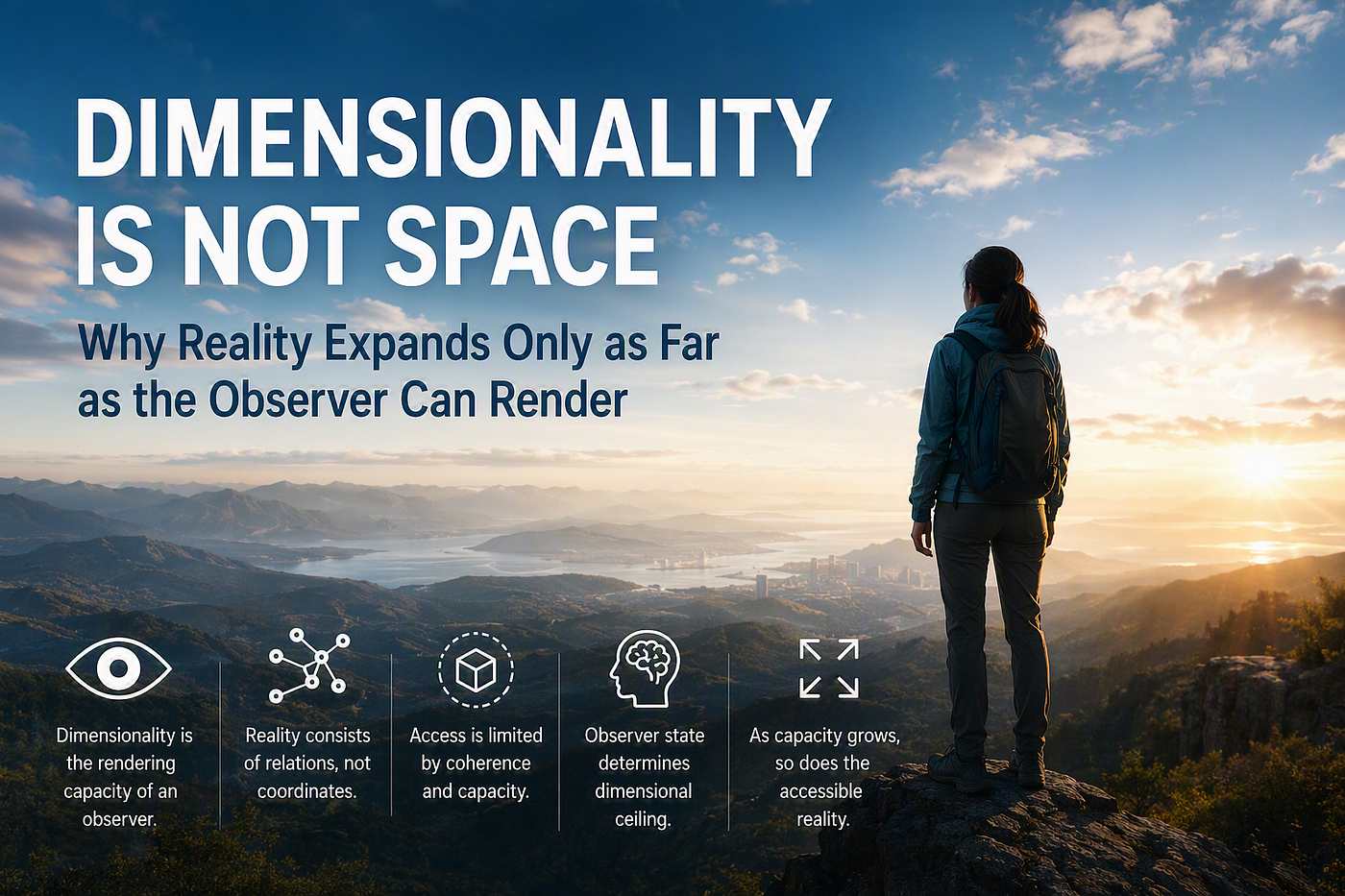
Dimensionality Is Not Space — Why Reality Expands Only as Far as the Observer Can Render
Dimensionality Is Not Space — 🌟 Eye-Goo & Duck-Goo — Where Rhythm Shapes Structure
Dimensionality Is Not Space — Why Reality Expands Only as Far as the Observer Can Render
Executive Summary
Dimensionality is not an external spatial scaffold. It is the rendering capacity of an observer: the number and complexity of independent relations that the observer can coherently represent, stabilize, and transform at a given state. The source structure does not become dimensional by entering space. It becomes dimensionally accessible only where an observer can sustain its relations without collapse.
Let Oₜ denote the observer state, D_source the source relation field, ρ_Oₜ(d) the renderability of a relation d, and θ the minimum coherence threshold. Dimensional access is the set of relations whose renderability passes that threshold.
D_access(Oₜ) = {d ∈ D_source | ρ_Oₜ(d) ≥ θ}
The existence of a relation and the observer’s access to that relation are separate structural conditions. A relation does not become absent because the observer cannot render it, and observer-side absence does not establish source-side nonexistence.
E(d) ≠ A(Oₜ, d)
Rendered dimensionality is the observer-side projection of D_access(Oₜ), the relation field admitted from D_source through the access condition. Every observer inhabits the dimensional structure it can maintain, not the total structure from which that rendering is drawn.
D_rendered(Oₜ) = Π_Oₜ(D_access(Oₜ))
The dimensional ceiling of an observer is determined by the highest relational complexity that remains coherently renderable. Dimensionality is not counted by physical coordinates alone. The ceiling is measured by the independent relations and transformations that can remain simultaneously available without representational collapse.
χ(Oₜ) = max {κ(d) | d ∈ D_access(Oₜ)}
Three-dimensional space is the stable convenience layer that the human observer can reliably maintain under biological and metabolic constraints. It is neither the final structure of reality nor a universal ceiling. Dimensional capacity varies with the observer state, including biological constraint, metabolic capacity, emotional load, perceptual organization, and cognitive coherence.
C_dim(Oₜ) = f(Bₜ, Mₜ, Eₜ, Pₜ, Cₜ)
Emotional load, trauma, fear, and cognitive overload can reduce the number of relations that remain simultaneously renderable. The source field does not flatten when dimensional access contracts. The observer loses relational axes, temporal extension, transformation range, or coherence among them. What appears as absence, nonsense, contradiction, or impossibility can therefore be the readout of observer-side dimensional collapse.
Dimensional misidentification occurs when a rendered limit is assigned to reality itself. Legal, psychiatric, scientific, and institutional systems commit epistemic failure when they presume stable and equivalent dimensional access across observers. They then treat differences in rendering capacity as if they were differences in the source structure.
Dimensionality is the first limit of intelligence because no observer can reason through relations it cannot render. Additional information does not produce higher-dimensional intelligence when the observer lacks the capacity to maintain the relations required by that information. Dimensional recovery is the observer state in which a larger relation field becomes coherently accessible. Structural reconstruction is the observer-side operation that produces that state.
D_access(O₂) ⊃ D_access(O₁)
1. The Collapse of Spatial Dimensionality
1.1 The Spatial Identification
Spatial dimensionality identifies dimension with the number of independent coordinate axes available inside a geometric model. Under this identification, one dimension is a line, two dimensions form a plane, three dimensions form spatial volume, and any higher dimension is treated as an additional coordinate direction beyond direct perception.
This structure measures the coordinate rank of a model. It does not measure the total relational structure of reality, and it does not measure the relations an observer can coherently render. A coordinate axis is already a represented distinction. It therefore belongs to the rendered model rather than to the source condition from which rendering becomes possible.
dim_space(M) = rank {e₁, e₂, …, eₙ}
dim_space(M) ≠ χ(Oₜ)
The first quantity states how many independent axes a spatial model contains. The second states the highest relational complexity the observer can maintain coherently. Their numerical equality in a particular model does not make them structurally identical.
1.2 Coordinates Are Downstream of Rendering
A coordinate system requires an observer capable of separating axes, preserving distinctions among them, tracking relations across them, and maintaining transformations without collapse. Coordinates do not precede rendering. They are a stabilized output of rendering.
Spatial extension is therefore one organization of an accessible relation field. The observer projects relations into a coordinate-compatible surface and then mistakes that surface for the dimensional source. Space records the arrangement of rendered relations; it does not establish the observer’s capacity to render them.
D_space(Oₜ) ⊆ D_rendered(Oₜ)
D_space(Oₜ) ≠ D_source
The spatial model can contain only relations that have already entered the observer’s rendered field. Relations that cannot be stabilized as location, direction, distance, sequence, or transformation remain outside the spatial surface even when they remain structurally present in the source field.
1.3 Existence and Access Are Separate Conditions
The existence of a relation does not depend on whether a particular observer can render it. Observer access is a state-dependent admissibility condition. Source existence and observer access therefore occupy separate structural positions.
E(d) = 1 ∧ A(Oₜ, d) = 0
This state is structurally valid. The relation exists while remaining inaccessible to the observer at state Oₜ. Failure of access cannot be transferred into a judgment of nonexistence.
A(Oₜ, d) = 0 ⇏ E(d) = 0
Absence, nonsense, contradiction, impossibility, and abstraction can be observer-side readouts produced when a relation exceeds the observer’s current coherence threshold. None of these readouts independently determines the condition of the source relation.
1.4 The Accessible Field Is a Proper Subset
An observer does not receive the source field without reduction. Relations that pass the current access condition enter D_access(Oₜ), and observer-side projection organizes that accessible field as D_rendered(Oₜ).
D_access(Oₜ) ⊂ D_source
The proper-subset relation fixes the boundary between the source relation field and observer-side access. The observer can reorganize accessible relations, increase precision within them, and extend transformations across them without exhausting the source field.
A flat world is not a source world deprived of depth. It is a world rendered through an observer that cannot preserve depth as an independent relation. Flatness belongs to the access structure. The source does not flatten when the observer loses an axis.
D_space(Oₜ) ⊆ D_rendered(Oₜ)
1.5 The Failure of Spatial Extension as a Definition
Spatial extension cannot define dimensionality because extension is one rendered relation among others. Temporal consequence, causal dependency, simultaneous constraint, transformation path, scale relation, and observer-source distinction can increase relational dimensionality without appearing as additional spatial directions.
A model can add coordinate axes while leaving the observer’s rendering capacity unchanged. An observer can also expand relational access without adding any spatial coordinate. Coordinate expansion and dimensional expansion are therefore independent operations.
Δdim_space(M) ≠ Δχ(Oₜ)
The spatial definition collapses at the point where it treats a rendered coordinate surface as the condition of dimensionality itself. Once that identification is removed, higher dimensionality no longer names hidden spatial extension. It names a larger field of independent relations that can be held coherently by an observer.
Dimensionality ≠ Spatial Extension
Dimensionality = Observer Rendering Capacity
2. Dimensionality as Observer Capacity
2.1 Capacity Is a State of the Observer
Dimensionality belongs to the observer state that performs rendering. It is the capacity to distinguish independent relations, preserve their identities, maintain their mutual constraints, and carry their transformations without collapsing them into a lower-order substitute.
This capacity is neither a possession located inside an observer nor a fixed label attached to a species. It is the active structural range of the observer at state Oₜ. The same observer can sustain different dimensional ranges across different states because rendering capacity is a condition of operation.
Dimensionality(Oₜ) = Rendering Capacity(Oₜ)
An observer state is dimensionally larger when it can hold more independent relations in one coherent structure. It is not dimensionally larger merely because it contains more information, uses more symbols, or names more concepts.
2.2 Independent Relations Determine Dimensional Rank
A relation contributes dimensional rank only when it remains independent within the rendered structure. Repetition, restatement, subdivision, and accumulation do not create a new dimension when every added element remains derivable from relations already present.
dim_Oₜ(R) = rank_Oₜ(R)
The observer must preserve the distinction carried by each relation while also maintaining its connection to the others. When one relation can be retained only by erasing, merging, or subordinating another, the observer has not rendered both dimensions. It has reduced the relation field to the rank it can sustain.
Dimensional rank is therefore a measure of relational independence under observer-side coherence. A large collection of mutually dependent statements can remain dimensionally narrow, while a small set of irreducible relations can require a higher rendering capacity.
2.3 Coherence Requires Simultaneous Maintenance
A relation does not enter dimensional capacity merely because the observer can recognize it in isolation. The observer must keep the relation available while other independent relations remain active. Sequential recognition without simultaneous maintenance does not produce a higher-dimensional rendered structure.
R_coherent(Oₜ) = {rᵢ ∈ R : δ_Oₜ(rᵢ) = 1 ∧ σ_Oₜ(rᵢ,R) = 1}
Here δ_Oₜ marks preservation of the relation as distinct, and σ_Oₜ marks its joint maintenance with the active relation field. When simultaneous maintenance fails, the observer substitutes a fragment, a binary judgment, a single causal line, or an isolated viewpoint for the structure that exceeded its capacity.
The failure occurs in the observer’s maintenance of relations. The source relations do not lose their independence because the observer can render them only one at a time.
2.4 Rendering Capacity Includes Transformation
Static recognition is insufficient for dimensional access. An observer must also preserve relations while they change position, scale, sequence, dependency, or state. A relation that can be represented only while frozen has not been rendered across its transformation range.
P_Oₜ(R,T(R)) = 1
P_Oₜ(R,T(R)) equals one where the observer preserves relation set R through its transformation T(R). Storage retains a state. Rendering capacity retains the structural continuity by which one state becomes another while the independent relations remain identifiable.
Temporal consequence, causal propagation, reciprocal constraint, and observer-dependent change become dimensionally accessible only where the observer can carry their transformations without flattening them into disconnected snapshots.
2.5 The Capacity Boundary Produces the Experienced World
The observer renders only the relation field that fits within its current capacity for independence, coherence, simultaneity, and transformation. This boundary determines the dimensional structure of experience before any claim about that experience is formed.
D_rendered(Oₜ) = Π_Oₜ(D_access(Oₜ))
Π_Oₜ denotes observer-side projection of D_access(Oₜ), not creation of the source field. Relations that do not enter D_access(Oₜ) remain outside the experienced structure while remaining available in D_source.
The dimensionality attributed to the world is therefore the dimensionality successfully rendered by the observer. The observer encounters its own capacity boundary as the apparent boundary of reality.
3. Formal Definition of Dimensional Access
3.1 Source Field, Observer State, and Relation
Let D_source denote the source relation field, Oₜ the observer at state t, and d an independent relation or relation structure within D_source. The source field names the relations available to be rendered. It does not name a spatial container, a completed observer model, or the observer’s experienced world.
For each d, ρ_Oₜ(d) denotes renderability under observer state Oₜ. Renderability is the observer’s capacity to distinguish d, preserve its independence, maintain its constraints with other active relations, and carry its transformation without collapse. The value belongs to the relation between Oₜ and d.
ρ_Oₜ:D_source→R
The mapping does not assign an intrinsic dimensional value to the source relation. It states whether and to what degree that relation can pass through a particular observer state as a coherent structure.
3.2 Dimensional Access as Threshold Passage
Let θ denote the minimum coherence threshold required for dimensional access. A relation enters the accessible field only when its renderability under Oₜ reaches or exceeds θ.
D_access(Oₜ)={d∈D_source∣ρ_Oₜ(d)≥θ}
D_access(Oₜ) is the dimensional access set of the observer state. Membership in this set means that the observer can maintain the relation as an active component of a coherent rendered structure. Recognition without stable maintenance does not satisfy the threshold.
The threshold is an access condition. It is not a truth threshold, an existence threshold, or a measure of importance. A relation below θ is inaccessible to Oₜ under the active state; no source-side judgment follows from that failure of passage.
A(Oₜ,d)=1⇔ρ_Oₜ(d)≥θ
3.3 Accessible Complexity and Dimensional Ceiling
Let κ(d) denote the independent relational complexity carried by d. The dimensional ceiling χ(Oₜ) is the highest complexity that remains accessible under the current observer state.
χ(Oₜ) = max {κ(d) | d ∈ D_access(Oₜ)}
The cardinality of D_access and the value of χ are distinct. An observer may access many relations of low independent complexity while remaining unable to render a smaller relation structure of higher complexity. Dimensional range is determined by the relations that remain independent and coherent, not by accumulated information volume.
χ(Oₜ) therefore marks the observer-side complexity ceiling. Relations above that ceiling do not disappear. They fail to enter the active dimensional field as integrated relations.
3.4 Existence and Access Occupy Separate Positions
Let E(d) denote source-side existence and A(Oₜ,d) denote observer-side access. These predicates are structurally nonidentical.
E(d)≠A(Oₜ,d)
E(d)=1∧A(Oₜ,d)=0
The second relation states a valid structural condition: d exists in the source field while remaining inaccessible to Oₜ. The observer cannot transfer a failed access result into nonexistence, contradiction, impossibility, or source absence.
Access also does not create existence. When A(Oₜ,d) changes from zero to one, the observer state has changed its relation to d. The source relation has not been generated by the act of rendering.
3.5 Accessible Field and Rendered Field
The accessible field and the rendered field are not interchangeable. D_access(Oₜ) contains the relations that pass the coherence threshold. D_rendered(Oₜ) is the organized experiential or model surface produced when those accessible relations are projected through the observer’s active rendering structure.
D_rendered(Oₜ)=Π_Oₜ(D_access(Oₜ))
D_access(Oₜ) ⊂ D_source
Π_Oₜ preserves the distinction between source, access, and rendering. The source field supplies the relation. Threshold passage admits the relation. Observer-side projection gives the relation a stable rendered form. No rendered form exhausts the source field from which it is drawn.
The observer encounters D_rendered(Oₜ) as reality because inaccessible relations do not appear on the rendered surface. This experiential completeness is a property of the projection, not proof that the projection equals D_source.
3.6 State-Dependent Capacity
Dimensional capacity varies with the active observer state. Let Bₜ denote biological constraint, Mₜ metabolic capacity, Eₜ emotional load, Pₜ perceptual organization, and Cₜ cognitive coherence. Their joint state defines C_dim(Oₜ), the observer’s dimensional capacity condition.
C_dim(Oₜ)=f(Bₜ,Mₜ,Eₜ,Pₜ,Cₜ)
This dependency is simultaneous. No single term independently represents dimensional capacity, and the expression does not impose an additive weighting among the terms. A change in one term can alter the coherence of the entire observer state and move relations across θ.
Eₜ in this expression denotes emotional load. It is distinct from the source-existence predicate E(d). The symbols occupy separate functional positions and are not substituted for one another.
3.7 Dimensional Expansion and Contraction
Dimensional expansion occurs when a later observer state can maintain a relation field that the earlier state could not sustain. The expansion is expressed by proper inclusion of accessible relation sets.
D_access(O₂)⊃D_access(O₁)
Expansion can also raise the accessible complexity ceiling when relations of greater κ pass θ. Contraction reverses either condition: relations leave the access set, the maximum coherent complexity falls, or both occur together.
χ(O₂)>χ(O₁)
The source field need not change across these states. Observer reconstruction changes the passage condition by which source relations become accessible. Dimensional recovery is therefore an expansion of observer-side access, not an enlargement of space.
4. The Three-Dimensional Convenience Layer
4.1 Three-Dimensionality as Stable Projection
The three-dimensional world is the stable coordinate surface through which the human observer organizes location, extension, distance, orientation, boundary, and motion. It is a projection of accessible relations into an x-y-z rendering grammar. It is not the dimensional source from which those relations arise.
L₃(Oₜ)=Π_(xyz,Oₜ)(D_access(Oₜ))
L₃(Oₜ) denotes the three-dimensional convenience layer produced under observer state Oₜ. The projection operator Π_xyz,Oₜ places accessible relations into a coordinate form that can be maintained and acted upon reliably. The equation does not reduce D_access(Oₜ) to three source dimensions. It identifies the coordinate surface through which part of that access becomes operational.
Three-dimensional stability therefore names a rendering achievement. The observer preserves a repeatable relation among bodies, boundaries, trajectories, and positions and encounters that repeatability as the external form of reality.
4.2 Biological and Metabolic Admissibility
A relation enters the stable convenience layer only where the observer can maintain it within the active biological structure and metabolic budget. Let s_Oₜ(r) denote stability of relation r under Oₜ, τ the required stability threshold, m_Oₜ(r) its maintenance demand, and μₜ the available metabolic limit.
A₃(Oₜ)={r∈D_access(Oₜ)∣s_Oₜ(r)≥τ ∧ m_Oₜ(r)≤μₜ}
The admissible set defined above contains relations that remain stable enough for continuous spatial rendering without exceeding the observer’s active maintenance limit. Biological and metabolic conditions establish the coordinate projection the observer can sustain as an uninterrupted world while the source relation field remains invariant.
Reliability selects against relation structures that require more simultaneous distinction, transformation, or integration than the observer can continuously carry. Those relations can remain source-valid while failing to stabilize inside the ordinary three-dimensional interface.
4.3 Viability Optimization Is Not Dimensional Fidelity
The human rendering system is organized for viable operation. Let V(L) denote survival viability, Q(L) response speed, E(L) emotional coherence, C(L) social coordination, and M(L) metabolic cost for a candidate rendering layer L. Their joint operating function is represented by Φ_H.
Φ_H(L)=f(V(L),Q(L),E(L),C(L),−M(L))
L₃(Oₜ)=arg max_(L∈L(Oₜ)) Φ_H(L)
The selected layer is the layer that closes ordinary human operation under the active observer constraints. Maximum source coverage and maximum relational rank are not required by this optimization. A rendering can become faster, cheaper, more coordinated, and more behaviorally reliable by excluding relations that would increase dimensional fidelity.
Operational optimization and dimensional fidelity occupy separate positions. The convenience layer is not defective because it is selective. The structural failure begins only when successful selection is converted into a claim that nothing exists beyond the selected field.
4.4 Coordinate Closure and Information Loss
Spatial coordinates preserve the relations required to place and move rendered objects. They do not preserve every distinction carried by the source relation field. Coordinate projection is therefore many-to-one: distinct relations can occupy the same spatial readout.
Π_xyz(d₁)=Π_xyz(d₂) ⇏ d₁=d₂
Equal x-y-z projection does not establish source identity. Temporal consequence, causal direction, reciprocal constraint, observer dependence, and transformation history can differ while the immediate spatial coordinates remain the same. When these relations are not independently maintained, the convenience layer compresses them into a single spatial state.
The coordinate surface remains usable because its loss is controlled around action. It answers where, how far, in which direction, and along which visible trajectory. It does not answer the full relation structure by which the rendered state became possible.
4.5 Stability Is Not Ontological Identity
The three-dimensional layer occupies a proper position inside the rendered field, while the accessible field occupies a proper position inside the source field.
L₃(Oₜ) ⊆ D_rendered(Oₜ) ∧ D_access(Oₜ) ⊂ D_source
The stability of L₃(Oₜ) gives the observer a continuous world. Relations outside that layer do not appear as missing objects because they never enter the coordinate surface from which absence is judged. The layer therefore presents itself as complete from inside its own projection.
Stable(L₃,Oₜ) ⇏ L₃=D_source
Stability proves that a projection can be maintained. It does not prove that the projection and the source field are identical. Repetition, measurement, predictability, and intersubjective confirmation can all occur within the same bounded rendering layer.
4.6 The Shared Human Interface
Human observers possess sufficiently similar biological architecture to generate a large overlap among their three-dimensional layers. That overlap becomes the shared interface for pointing, movement, measurement, language, construction, and coordinated action.
Lshared=⋂(i=1)^n L₃(Oᵢ)
The shared layer denotes the relation surface jointly renderable across the participating observers. Shared rendering gives the layer operational authority because structures built inside it can be reproduced and coordinated. It does not give the shared layer source completeness.
A relation excluded by every observer in a group remains excluded from the intersection. Collective agreement can therefore stabilize a common access boundary without detecting that the boundary belongs to the observers.
4.7 Functional Boundary of the Convenience Layer
Convenience names structural economy: a reduced coordinate surface that preserves the relations required for stable embodiment and coordinated action at sustainable cost. It does not mean illusion, arbitrariness, or dispensability. The layer is real as a rendering function and limited as a source description.
The three-dimensional layer is valid where the task is spatial placement, measurement, locomotion, construction, and repeatable interaction among rendered bodies. It loses validity when its coordinate closure is elevated into the dimensional limit of existence.
The observer inhabits the stable convenience layer that its active structure can continuously render.
5. Dimensional Collapse Under Emotional Load
5.1 Emotional Load as an Access Condition
Emotional load acts on dimensionality through the observer state. It does not remove relations from the source field. It changes the amount of independent relation structure that the observer can distinguish, integrate, and maintain without collapse.
Let ℓₜ denote the active emotional and cognitive load carried by Oₜ, and let ι(Oₜ) denote the integration capacity available under the same state. Dimensional collapse begins when the active load exceeds the observer’s capacity to preserve the relation field as a coherent whole.
ℓₜ>ι(Oₜ)
The inequality defines an observer-side passage condition. It does not define emotion as error, pathology, or unreality. It marks the point at which the active state can no longer carry every previously accessible relation in its independent position.
5.2 Threshold Elevation and Access Contraction
Under overload, the coherence threshold required for a relation to remain active rises. Let θ₀ denote the baseline threshold and Δℓ(Oₜ) the threshold increase generated by the active load condition.
θₜ=θ₀+Δ_ℓ(Oₜ), Δ_ℓ(Oₜ)≥0
D_access^ℓ(Oₜ)={d∈D_source∣ρ_Oₜ(d)≥θₜ}⊆D_access⁰(Oₜ)
Relations that passed at θ₀ can fail at θₜ without any source-side change. The accessible field contracts because fewer relations retain enough renderability to cross the elevated threshold together.
χ_ℓ(Oₜ)≤χ₀(Oₜ)
The contraction can remove relations from D_access, lower the maximum accessible complexity χ, or do both simultaneously. The observer then encounters a reduced field as the complete field because excluded relations no longer appear on the rendered surface.
5.3 Binary Compression
Emotional overload preserves rapid action by compressing a relation structure into a smaller evaluative surface. Distinctions among cause, duration, context, reciprocity, uncertainty, and long-range consequence are replaced by a reduced decision grammar such as safe or unsafe, good or bad, approach or avoid.
rank(Π_(bin,ℓ)(Rₜ))<rank(Rₜ)
Π_bin,ℓ denotes the binary projection generated under load. Its lower relational rank does not make the projection false inside its action function. It makes the projection dimensionally insufficient when it is used as a complete representation of Rₜ.
Binary compression is therefore a dimensionality-reduction operation. It preserves a narrow action boundary by removing independent relations that cannot be carried at the required speed or under the active load.
5.4 Temporal Horizon Collapse
Temporal access is the capacity to maintain relations between a present state and consequences that unfold beyond the immediate rendered moment. Let H(Oₜ) denote the longest temporal interval across which a consequence relation remains above the active coherence threshold.
H(Oₜ)=max{Δt∣ρOₜ(r(t→t+Δt))≥θₜ}
H_ℓ(Oₜ)<H₀(Oₜ)
When H contracts, immediate intensity displaces long-range structure. The observer can still name the future while failing to maintain the causal relation between present action and later consequence as an active component of the same rendered field.
Temporal collapse is not the disappearance of time. It is the loss of observer-side access to relations whose coherence requires a longer maintained interval than the active state can sustain.
5.5 Relational Fragmentation
Dimensional collapse can preserve individual elements while breaking the relations that hold them inside one structure. Let G_access(Oₜ) denote the graph of accessible relations, with nodes representing maintained elements and edges representing relations that remain jointly coherent.
|Comp(G_access^ℓ(Oₜ))|>|Comp(G_access⁰(Oₜ))|
An increase in disconnected components means that the observer retains fragments without retaining the field that makes the fragments mutually intelligible. Events, meanings, memories, agents, and consequences can remain separately renderable while their continuity no longer passes as one relation structure.
Fragmentation therefore differs from simple omission. Omission removes an element from access. Fragmentation preserves elements while closing the edges required to integrate them.
5.6 Loss of Simultaneous Relation Capacity
Dimensional access requires simultaneous maintenance. Sequential recognition of several relations does not establish the capacity to hold those relations together without one relation erasing, replacing, or subordinating the others.
N_coh(Oₜ)=max{|R|∣R⊆D_access(Oₜ), Coh_Oₜ(R)≥θₜ}
N_coh^ℓ(Oₜ)≤N_coh⁰(Oₜ)
N_coh(Oₜ) is the maximum number of relations that can remain jointly coherent under the active observer state. Under load, this value contracts. The observer can then move through relations one at a time while losing the higher-dimensional structure formed by their coexistence.
This loss produces apparent contradiction where the source field contains simultaneous conditions. The contradiction belongs to the observer’s reduced maintenance capacity when only one condition can remain active at a time.
5.7 Distinct Collapse Profiles
Trauma, anxiety, depression, and cognitive overload name different observer-state profiles when read structurally. Trauma fragments continuity among relations. Anxiety gives threat-compatible axes dominant passage and suppresses competing relations. Depression flattens experiential depth and weakens access to future-bearing relations. Cognitive overload reduces the number and complexity of relations that can remain simultaneously coherent.
These profiles are not dimensional labels assigned to persons. They identify distinct ways in which the active rendering structure can contract. The same observer can move among them as the state conditions change.
A collapsed state can remain internally stable because its exclusions are absent from its own rendered field. Stability inside the reduced field does not restore the relations that were removed, flattened, narrowed, or disconnected during collapse.
5.8 Source Stability Under Observer Collapse
Observer collapse changes access while the source relation field remains invariant. Two observer states can face the same source relation field while rendering unequal dimensional ranges.
D_source²=D_source¹, D_access(O₂)⊂D_access(O₁)
The proper inclusion states the collapse directly. O₂ accesses fewer independent relations than O₁ while D_source remains unchanged. Absence from O₂ is therefore an observer-side exclusion, not evidence that the excluded relation has ceased to exist.
Under emotional load, reality does not become lower-dimensional. The observer’s rendered reality contracts to the dimensionality that the active state can still hold coherently.
6. Why Dimensionality Is Mistaken for Space
6.1 The Dominance of Spatial Readout
Space becomes the default definition of dimensionality because spatial relations are the relations most continuously stabilized by the human observer. Location, extension, boundary, distance, orientation, and motion remain available across ordinary perception and action with minimal interruption. Their continuity makes the rendered layer appear prior to the rendering structure that produces it.
L₃(Oₜ)=Π_(xyz,Oₜ)(D_access(Oₜ))
L₃(Oₜ) is the spatial readout of the relation field that has already entered dimensional access. The projection is continuously present to the observer, while the selection and stabilization operations that produce it do not appear as objects inside the projection.
Cont(L₃(Oₜ))=1 ⇏ L₃(Oₜ)=D_source
Continuity establishes persistence inside the rendered layer. It does not establish identity between the layer and the source field. The observer mistakes spatial continuity for dimensional primacy because the rendering operation remains outside the ordinary spatial readout.
6.2 Visible Axes Are Mistaken for Independent Relations
Spatial axes are explicit distinctions inside the coordinate surface. They can be pointed to, measured, traversed, and represented independently. Other independent relations can appear only as dependency, consequence, transformation, reciprocity, constraint, temporal reach, or observer dependence. Because these relations do not present themselves as visible directions, they are denied dimensional standing.
rankxyz(Π(xyz,Oₜ)(R))≤rank_rel(R)
Coordinate rank cannot exceed the relational rank preserved by the projection, and it can be lower than that rank. A relation field can therefore carry more independent structure than its x-y-z readout displays. The missing rank is not hidden spatial direction. It is relational independence that the coordinate grammar does not preserve as an axis.
The mistake begins when visibility becomes the admission rule for dimensionality. What appears as a coordinate is counted as a dimension. What appears only as relation is treated as a property inside space rather than as dimensional structure in its own right.
6.3 Shared Rendering Is Mistaken for Observer Independence
Human observers occupy overlapping biological and perceptual conditions. Their rendered fields therefore contain a large shared spatial intersection. The intersection supports common measurement, naming, navigation, construction, and verification.
Dshared=⋂(i=1)^n D_rendered(Oᵢ)
∀i, D_access(Oᵢ) ⊂ D_source
Agreement removes variation among the participating renderings. It does not remove the common observer boundary that produced the intersection. A relation excluded by the shared human rendering architecture remains absent from every participating report and therefore cannot appear as disagreement.
The shared field is consequently misread as observer-independent reality. Intersubjective stability proves that multiple observers can sustain the same rendering layer. It does not prove that the shared layer exhausts the source field.
6.4 Measurement Remains Inside Dimensional Access
Measurement does not bypass rendering. An instrument receives a source interaction, transforms it through its own admissible structure, and presents an output that the observer can render. The measured result is produced by an instrument-observer chain rather than by unmediated access to the source field.
M_(Oₜ,I)(d)=Π_Oₜ(Π_I(d))
D_measured(Oₜ,I)⊆D_access(Oₜ,I)⊂D_source
The instrument can extend sensitivity, precision, scale, speed, and repeatability. It can reveal relations that the unaided observer could not previously stabilize. The extension becomes dimensional access only where the transformed output can be integrated into the observer’s coherent relation field.
Measurement therefore expands or sharpens a rendered domain. It does not establish that every source relation is measurable through the same spatial grammar. A relation that cannot enter the instrument-observer chain remains outside the measured field without becoming source-absent.
6.5 Stability, Repeatability, and Utility Are Misread as Completeness
The three-dimensional layer is stable enough to support continuous embodiment, repeatable enough to support science and engineering, and useful enough to coordinate collective action. These properties give the layer operational authority.
Stable(L₃)∧Repeatable(L₃)∧Useful(L₃) ⇏ Complete(L₃)
The inference to completeness does not follow. Stability states that a projection can be maintained. Repeatability states that the same operation can reproduce a compatible readout. Utility states that the layer preserves the relations required for a task. None of these conditions states that the projection contains every independent relation in the source field.
Operational success becomes ontological error when the layer that supports action is declared to be the total dimensional structure of reality. The convenience layer is promoted from interface to source without any structural passage between those positions.
6.6 Spatial Language Fixes the Misidentification
Language inherits the stable rendering layer. It names bounded objects, assigns locations, orders movements, separates inside from outside, and converts relations into predicates attached to spatially stabilized entities. The grammar of description therefore preserves the coordinate surface even when the described structure exceeds it.
Λ_sp:R→X_xyz, rank(Λ_sp(R))≤rank(R)
The spatial language map can retain an action-relevant readout while reducing relational rank. A transformation becomes movement, dependency becomes proximity, continuity becomes an object, and observer-conditioned access becomes a property assigned to the observed thing.
Once the reduction is encoded in language, the resulting statement appears to describe the source directly. The observer then reasons inside a spatialized vocabulary whose exclusions have already disappeared from the available terms.
6.7 Additional Coordinates Do Not Correct the Definition
Mathematics can extend a model from three coordinates to n coordinates. This increases the coordinate rank of the model. It does not by itself increase the dimensional access of the observer using the model.
dim(Mₙ)=n, n₂>n₁ ⇏ χ(Oₜ;M_n₂)>χ(Oₜ;M_n₁)
An observer can manipulate symbols for relations that are not simultaneously rendered as one coherent structure. Formal consistency, calculation, and prediction can therefore exceed direct perceptual access while remaining below full relational access.
Higher-dimensional coordinates preserve the spatial identification by adding more axes to the same grammar. The definition changes only when dimensionality is placed in the observer’s capacity to maintain independent relations, not in the number of variables written into a model.
6.8 The Self-Sealing Boundary of the Rendered Field
The observer judges reality from inside the field it can render. Relations excluded by the observer state do not appear as missing elements on that field. They are absent from the very surface on which absence, possibility, contradiction, and existence are judged.
D_excluded(Oₜ) = {d ∈ D_source : d ∉ D_access(Oₜ)}
J_Oₜ:D_rendered(Oₜ)→C_Oₜ
D_excluded(Oₜ) names the source relations that do not enter dimensional access. J_Oₜ names the judgment operation available to the observer inside the rendered field. Because the judgment domain is already bounded by rendering, the excluded field cannot appear internally as evidence that the rendered field is incomplete.
Dimensionality is mistaken for space when the observer assigns source authority to the most stable layer it can render. Space does not create the error. The unrecognized boundary between dimensional access and the source relation field creates it.
7. Dimensional Misidentification and Epistemic Failure
7.1 The Observer-Bounded Epistemic Field
Knowledge does not enter the observer as an unmediated copy of the source field. The observer judges only the relations that have passed dimensional access and have been rendered into a coherent field. Epistemic operation therefore begins inside an observer-bounded domain.
K(Oₜ) = {d ∈ D_access(Oₜ) | J_Oₜ(Π_Oₜ(d)) ∈ C_Oₜ}
K(Oₜ) ⊆ D_access(Oₜ) ⊂ D_source
K(Oₜ) contains the accessible relations whose rendered forms enter J_Oₜ and receive a judgment in C_Oₜ. J_Oₜ operates on the rendered field rather than on D_source directly. These relations fix the epistemic order: judgment is downstream from rendering, rendering is downstream from access, and access remains a proper subset of the source field.
Epistemic failure begins when this bounded field is assigned source authority. The observer no longer treats knowledge as a state-dependent rendering of accessible relations. The rendered boundary disappears, and the available field is taken to be the field of reality itself.
7.2 Inaccessibility Is Converted into Nonexistence
A relation outside dimensional access does not appear as an inaccessible relation. It fails to enter the surface on which existence, evidence, relevance, and intelligibility are judged. The observer therefore converts missing access into a statement about the source.
d∉D_access(Oₜ) ⇏ ¬E(d)
d∉K(Oₜ) ⇏ d∉D_source
Both implications are invalid. E(d) states source existence, membership in D_access(Oₜ) states observer-side access, and membership in K(Oₜ) states judgment-admitted access. Failure of either passage cannot negate the relation that failed to pass.
The error is structurally stronger than ignorance. Ignorance can preserve an open position for what is not known. Dimensional misidentification closes that position by declaring inaccessible relations absent, impossible, meaningless, or contradictory.
7.3 Observer Coherence Is Converted into Truth
The observer requires coherence to maintain a relation. A relation that exceeds the active threshold cannot remain inside the rendered field. This local admission condition is then misidentified as a truth condition.
Coh_Oₜ(x)≥θ_Oₜ ⇏ T_source(x)=1
Coh_Oₜ(M)=1 ⇏ Complete_source(M)=1
Observer coherence states that x or model M can be maintained without collapse under Oₜ. It does not state that x is true in the source field or that M is source-complete. A reduced model can be perfectly coherent because the relations that would disrupt it have already been excluded from access.
Internal consistency consequently becomes epistemically overextended. It remains a necessary condition for stable representation, but it cannot establish that the represented field contains every relation required for source-level truth.
7.4 Model Closure Is Mistaken for Source Closure
Every model is formed from relations that entered the observer’s access field and could be stabilized in representational form. The model can organize, compress, transform, and predict within that admitted relation set.
M_Oₜ=F_Oₜ(D_access(Oₜ))
Cl(M_Oₜ)=1 ⇏ M_Oₜ=D_source
F_Oₜ maps accessible relations into model structure. Cl(M_Oₜ) states that the model closes under its own definitions, operations, and admissible evidence. Neither operation establishes identity between the model and D_source.
A model can therefore be formally closed and operationally successful while remaining dimensionally incomplete. Prediction inside the projected domain confirms the model’s control of that domain. It does not reveal the source relations that the observer-model system cannot encode.
7.5 Dimensional Reduction Produces Apparent Contradiction
Source relations can coexist without reduction to a single axis. When the observer cannot maintain their independence simultaneously, the relation field is compressed into alternatives. One relation must then displace, negate, or subordinate the other for the rendered field to remain stable.
Coexist_source(r₁,r₂)=1, N_coh(Oₜ)<2 ⇒ Π_Oₜ({r₁,r₂})∈{{r₁},{r₂}}
The source condition preserves r₁ and r₂ together. The observer condition N_coh(Oₜ) < 2 cannot preserve their coexistence and projects only one relation at a time. The resulting opposition is generated by the access limit rather than by the source relation field.
Paradox, ambiguity, and irreconcilability can therefore be read as dimensional overload before they are read as defects in the source. An observer that cannot hold the active relations together experiences structural coexistence as contradiction.
7.6 Evidence Is Selected Inside the Existing Rendering Structure
Evidence is not admitted from the source field without an access and encoding path. A source interaction becomes evidence only when the observer can render it and the active model can preserve it in a recognizable form.
E_Oₜ(M)={e∈D_source∣e∈D_access(Oₜ)∧Enc_M(e)=1}
The evidence set is therefore conditioned twice. The relation must pass D_access(Oₜ), and it must be encodable by M. Relations blocked at either boundary cannot enter the evidentiary field that evaluates the model.
This selection produces a closed epistemic surface. The model is tested by evidence that can appear inside the same dimensional and representational conditions from which the model was formed. What lies outside those conditions cannot register as disconfirmation.
7.7 Recursive Self-Confirmation
A model updates through the evidence available to its observer-model field. When the access boundary remains fixed, each update reorganizes information inside the same dimensional enclosure.
Mₜ₊₁=U(Mₜ,E_Oₜ(Mₜ))
M=U(M,E_Oₜ(M)) ⇏ M=D_source
The recursion can converge to a stable fixed point. Stability means that the model reproduces itself under the evidence it can admit. It does not establish identity with D_source. A self-confirming model can be maximally stable at the exact boundary where excluded relations remain structurally unable to enter.
Epistemic authority then grows with internal repetition. Agreement, accumulated evidence, predictive reuse, and formal refinement strengthen the model while leaving the original dimensional exclusion untouched.
7.8 Dimensional Error Precedes Interpretive Error
Interpretation and inference operate only after relations have entered access and representation. A correct inference over a dimensionally reduced field remains bounded by the relations removed before inference began.
F_access(Oₜ) → F_representation(Oₜ) → F_inference(Oₜ)
Epistemic failure therefore has three distinct positions. Access failure excludes a source relation before representation. Representation failure distorts a relation that entered access. Inference failure derives an invalid result from represented relations. The first position is structurally prior to the other two.
When O₂ accesses relations excluded from O₁, the additional field does not merely supply more facts inside the same model. It can change the dimensional structure by which facts, causes, consequences, and contradictions are organized.
Dimensional misidentification converts the observer’s rendering boundary into a boundary of existence and knowledge. Epistemic failure is established before a false statement is made, at the point where an inaccessible relation is denied entry to the field in which statements can be formed.
8. Legal, Psychiatric, Scientific, and Institutional Consequences
8.1 Institutional Judgment Begins After Observer Rendering
An institution does not receive the source condition directly. It receives a statement, behavior, record, measurement, symptom surface, or model that has already passed through an observer’s dimensional access and rendering structure. Institutional judgment therefore operates on a rendered object.
J_I(x | Oₜ) = Φ_I(Π_Oₜ(x))
J_I(x∣Oₜ)≠J_I(x∣D_source)
Φ_I names the institutional encoding and judgment operation. The institution evaluates the rendered form Π_Oₜ(x), not x as it exists across D_source. The second relation fixes the boundary: judgment over a rendered condition is not judgment from the source field.
Institutional authority does not remove this mediation. It formalizes the projection, assigns admissible categories, and makes the result executable. The judgment can be procedurally valid inside the institution while remaining dimensionally incomplete.
8.2 Shared Dimensionality Is the Hidden Premise
Large systems require a common operating surface. They therefore presume that participating observers share comparable access to time, causality, intention, relation, consequence, and self-reference. This presumption is rarely stated because the shared three-dimensional interface makes it appear self-evident.
P_I: D_access(O_i) ≈ D_access(O_j) ≈ D_ref(I)
The institutional premise P_I places individual observer states near a reference access field D_ref(I). Once this equivalence is assumed, differences in rendering are interpreted inside the institution’s existing categories rather than as differences in dimensional access.
M_I(Oₜ) = D_required(I) ∖ D_access(Oₜ)
M_I(Oₜ) is the dimensional mismatch between the relations an institution requires and the relations the observer can access at state Oₜ. When the mismatch is not represented, the system assigns the missing relation to error, refusal, inconsistency, irrationality, incapacity, or noncompliance.
8.3 Legal Consequences
Legal judgment requires stable access to temporal order, causal sequence, intention, relational position, and projected consequence. Testimony, consent, responsibility, credibility, and procedural participation are evaluated through this required relation field.
D_required(L)={d_time,d_cause,d_intent,d_relation}
Stress, fear, trauma, and cognitive overload can reduce the observer’s active relation field without changing the source event. When one or more required relations fall outside D_access(Oₜ), the legal surface receives a compressed, fragmented, or temporally shortened rendering.
J_L(Oₜ)=Φ_L(D_rendered(Oₜ)) ⇏ T_source(Oₜ)
The invalid passage occurs when legal interpretation of the rendered surface is assigned source truth. A missing temporal link becomes contradiction. Fragmented relation access becomes unreliability. Reduced consequence access becomes intent. The system converts dimensional mismatch into a legal property of the observer.
8.4 Psychiatric Consequences
Psychiatric observation receives alterations in affect, temporal depth, relational integration, continuity, salience, and representational coherence as symptom surfaces. These surfaces are real outputs of the observer state, but they do not identify the complete structure that generated them.
S_ψ(Oₜ) = P_ψ(D_access(Oₜ), χ(Oₜ), H(Oₜ))
S_ψ(Oₜ) is the psychiatric readout produced from dimensional access, maximum coherent relation complexity, and temporal reach. Depression can appear as flattened depth, anxiety as narrowed bandwidth, and dissociation as fragmented representation because each state changes the relations that can be held together.
ΔS_ψ(Oₜ)≠ΔD_source
A change in symptom surface does not establish a change in the source field. Classification fails structurally when a state-dependent rendering boundary is converted into the identity, essence, or total reality of the observer. The category then fixes the projection while obscuring the dimensional operation that produced it.
8.5 Scientific Consequences
Scientific knowledge is stabilized through shared observation, formal encoding, measurement, replication, and model comparison. Each operation increases control inside an admissible field. None bypasses observer access or the representational grammar through which evidence becomes legible.
Kcons = ⋂(i=1)^n K(O_i)
Kcons ⊆ ⋂(i=1)^n D_access(O_i) ⊂ D_source
K_cons is the intersection of accessible relations whose rendered forms participating observers and models can jointly admit to judgment. Consensus strengthens the stability of that intersection. It does not convert the intersection into D_source.
Rep(x)=1 ⇏ K_cons=D_source
Replication establishes repeatable passage through a defined instrument-model-observer chain. It does not establish that no source relation remains outside the consensus field. Dimensional misidentification turns reproducibility within the shared rendering architecture into a claim of source completeness.
8.6 Institutional Standardization
Institutions function by defining admissible categories, evidence forms, timelines, response formats, and thresholds. The observer becomes institutionally legible only when the rendered surface can be encoded inside those predefined classes.
A_I(Oₜ)=1⇔Φ_I(D_rendered(Oₜ))∈C_I
A_I(Oₜ) is institutional admission. C_I is the institutional category field. A rendered condition outside C_I does not enter as an unrepresented relation. It enters as deviation from the available category structure.
D_I = ΦI(⋃(i=1)^n D_rendered(O_i)) ⊆ C_I
D_I is the common institutional field produced when participating rendered fields pass through Φ_I. Standardization removes relations that cannot be repeated, compared, stored, transferred, or executed across the system. The institution gains operational scale by reducing observer variation to a narrower common surface.
8.7 Cross-System Error Amplification
Legal, psychiatric, scientific, and administrative systems exchange records and judgments. A dimensional misidentification made at one surface becomes input to the next. Later systems receive the earlier projection as an established condition rather than reopening the observer-source boundary.
Yₖ₊₁=Fₖ(Yₖ;A₀), A₀: D_access(Oₜ)=D_source
A₀ is the initial identification of observer access with the source field. Each institutional transformation F_k can preserve that identification while changing its vocabulary and authority. A rendering limit becomes a diagnosis, a credibility judgment, an evidentiary exclusion, a risk classification, or an administrative fact.
J_I₁=J_I₂=⋯=J_Iₙ ⇏ T_source=1 when all J_Iₖ preserve A₀
Agreement among institutions does not create independent confirmation when every judgment preserves the same hidden premise. Repetition multiplies execution authority, not dimensional access. The same inaccessible relation remains absent at every stage and therefore cannot appear as a correction to the chain.
8.8 The Structural Position of Institutional Judgment
Institutional judgment is a projection of a projection. The observer first projects a source interaction into a rendered field. The institution then projects that rendered field into its own admissible categories and executable decisions.
J_I(x,Oₜ)=Φ_I(Π_Oₜ(x))
Π_Oₜ is observer rendering and Φ_I is institutional projection. The institutional result can disclose the institution’s relation to the observer’s rendering. It cannot erase the first projection or claim direct possession of x outside that boundary.
A system that identifies observer access with source structure cannot distinguish dimensional collapse from source absence, state-dependent rendering from stable identity, shared projection from completeness, or repeated institutional agreement from independent truth.
9. Dimensionality as the First Limit of Intelligence
9.1 Intelligence Operates After Dimensional Access
Intelligence does not begin with reasoning. Reasoning begins after a source interaction has passed through dimensional access and has been rendered into a coherent field. Every inference, comparison, abstraction, decision, and model operation therefore acts on an observer-produced projection.
I_Oₜ(x)=Γ_Oₜ(Π_Oₜ(x))
Dom(I_Oₜ) ⊆ D_access(Oₜ)
Γ_Oₜ names the observer’s inferential and transformational operation. The domain of I_Oₜ is bounded by D_access(Oₜ), and Γ_Oₜ operates on the rendered form Π_Oₜ(x). Intelligence cannot operate directly on relations that never entered dimensional access, because those relations are absent from the field on which operation occurs.
Dimensionality is therefore the first limit of intelligence. It precedes the quality of reasoning, the amount of knowledge, the speed of processing, and the complexity of the final output.
9.2 Processing Power Is Downstream of Access
Processing power increases the number, speed, precision, or depth of operations that can be performed on admitted relations. It does not by itself admit a relation that remains outside the observer’s dimensional field.
C_proc↑ ⇒ N_op(D_access(Oₜ))↑
C_proc↑ ⇏ D_access(Oₜ)↑
C_proc can increase operation count inside D_access(Oₜ). The second relation blocks the invalid passage from greater computation to greater dimensional access. A system can process the same reduced field with extreme speed and still remain dimensionally closed.
Memory, calculation, search, optimization, and prediction remain downstream functions. When the relation field is incomplete, stronger downstream operation increases control over the projection without repairing the missing access condition.
9.3 Dimensional Rank Bounds Theory
A theory is not maintained by vocabulary alone. It requires the observer to hold its independent relations, transformations, dependencies, and invariants together without collapsing them into a lower-rank representation.
rank(M_Oₜ)≤χ(Oₜ)
A_T(Oₜ)=1⇔D_req(T)⊆D_access(Oₜ) ∧ κ(T)≤χ(Oₜ)
The rank of a model stabilized by Oₜ cannot exceed the observer’s maximum coherent relation complexity. A_T(Oₜ) states the admission condition for theory T: every required relation must lie inside dimensional access, and the relation complexity of the theory must remain within χ(Oₜ).
κ(T) > χ(Oₜ) ⇒ A_T(Oₜ) = 0
D_req(T′) ⊆ D_access(Oₜ), κ(T′) ≤ χ(Oₜ), T′ ≠ T
When the theory exceeds the observer’s ceiling, it does not enter intact. The observer can admit only a reduced relation structure T′ whose required relations and complexity pass the active access condition. The observer then evaluates T′ while treating it as the original theory. Rejection, contradiction, or incomprehensibility can therefore be generated by dimensional compression before theoretical judgment begins.
9.4 Abstraction Is Not Dimensional Expansion
Abstraction can rename, group, symbolize, and recursively reorganize relations that are already accessible. These operations can increase descriptive height while preserving the same dimensional rank.
|Σ(Oₜ)|↑ ⇏ χ(Oₜ)↑
Σ(Oₜ) is the symbol field available to the observer. More symbols, categories, layers, coordinate labels, or levels of recursion do not establish greater coherent relation capacity. A lower-dimensional observer can build a highly elaborate language around the same reduced projection.
D_access(O₂)⊃D_access(O₁)
Dimensional expansion occurs only when the later observer state can access and coherently preserve relations that the earlier state could not. The strict inclusion identifies expansion at the access field rather than at the surface vocabulary.
9.5 Temporal Access Bounds Ethical and Strategic Intelligence
Long-range consequence is a dimensional relation. It requires the observer to connect present action, delayed transformation, distributed effect, and future state across a temporal interval. When that interval exceeds the active temporal horizon, the consequence relation leaves the accessible field.
d_consequence(Δt) ∈ D_access(Oₜ) ⇔ Δt ≤ H(Oₜ)
I_strategy(Oₜ) ≤ f(H(Oₜ), χ(Oₜ))
H(Oₜ) is the temporal horizon that the observer can maintain as an active relation. Strategic intelligence is bounded by this horizon and by the number of causal relations that can be held coherently across it.
Ethical declaration cannot substitute for missing consequence access. When long-range effects cannot be rendered, immediate coherence, emotional relief, local benefit, or group alignment occupies the position of the whole consequence field. The failure appears moral or strategic after it has already occurred dimensionally.
9.6 Collective Intelligence Is Not the Sum of Individual Intelligence
A collective can contain relations distributed across observers that no single observer can maintain alone. This creates a potential dimensional field. The field becomes collective intelligence only when the system can preserve, connect, and execute those non-identical relations without reducing them to a common lower-dimensional surface.
Dpotential^C(t)=⋃(i=1)^n D_access(Oᵢ,t)
D_operational^C(t)=Φ_C(D_potential^C(t))⊆D_potential^C(t)
The union defines collective dimensional potential. Φ_C is the collective encoding and coordination operation. Its operational field is a projection of that potential and can exclude relations that cannot pass shared language, institutional categories, authority structure, emotional tolerance, or execution format.
Aggregation therefore does not guarantee dimensional expansion. A large system can contain high-dimensional access locally while operating through a lower-dimensional common interface. Collective intelligence is determined by what the system can preserve across difference, not by the number of participants or the volume of information they produce.
9.7 Emotional Load Reduces the Operating Range of Intelligence
Emotional load acts before explicit reasoning by changing the admission threshold of the observer. As the threshold rises, fewer relations remain accessible, maximum coherent relation complexity falls, and downstream intelligence operates on a contracted field.
L_emotion↑ ⇒ θ↑ ⇒ D_access(Oₜ)↓ ⇒ χ(Oₜ)↓ ⇒ I_op(Oₜ)↓
The chain fixes the order of failure. Intelligence does not first reach a complete field and then reason badly about it. The field contracts before reasoning begins. Binary judgment, shortened time horizon, fragmented causality, and reduced perspective are outputs of the smaller operating domain.
The same observer can therefore display different intelligence ranges across states without any change in source reality. Intelligence is state-dependent because dimensional access is state-dependent.
9.8 The First Intelligence Threshold
Every claim about cognition, ethics, civilization, technology, or meaning presupposes an observer capable of rendering the relations the claim requires. The first intelligence threshold is therefore determined before correctness, sophistication, or usefulness is evaluated.
The governing question is: What dimensionality can this observer reliably render? The question identifies the relation field, coherent complexity, temporal horizon, and transformation range available to the observer at the moment of operation.
A higher-dimensional theory cannot be constructed as such by a lower-dimensional observer. A civilization cannot preserve long-range coherence when its collective access collapses under emotional load. An intelligence cannot operate beyond the dimensional field that reaches its rendering surface.
10. Dimensional Recovery and Observer Expansion
10.1 Recovery Is Expanded Coherent Access
Dimensional recovery occurs when relations outside the earlier accessible field become coherently maintainable in a later observer state. Recovery is the later observer state in which a larger relation field can pass without collapse.
D_access(O₂)⊃D_access(O₁)
χ(O₂)>χ(O₁)
Strict inclusion identifies recovered access, while the increase in χ identifies greater coherent relation complexity. More isolated elements without preserved relations do not expand dimensionality.
10.2 The Source Field Does Not Recover
Recovery belongs to the observer state. The source field neither contracts during collapse nor expands during recovery. The change occurs in the capacity that selects, stabilizes, and renders source relations.
D_source(O₂)=D_source(O₁)=D_source
C_dim(Oₜ)=f(Bₜ,Mₜ,Eₜ,Pₜ,Cₜ)
Bₜ, Mₜ, Eₜ, Pₜ, and Cₜ denote the biological, metabolic, emotional, perceptual, and cognitive conditions active at Oₜ. C_dim(Oₜ) is dimensional capacity under their combined configuration. The recovered state results from a transition in this configuration, not a source-side creation event.
10.3 Access Must Be Stable, Not Merely Open
Momentary notice is not dimensional recovery. A relation must remain coherent enough to be distinguished, connected, and transformed without disintegrating the surrounding field.
Membership in D_access(Oₜ) already requires coherent maintenance and excludes transient detection that cannot survive integration. Lowering the threshold alone does not establish access unless the relation remains coherently maintainable.
θ₂ < θ₁ ⇏ D_access(O₂) ⊃ D_access(O₁)
D_recovered(O₁→O₂) = D_access(O₂) ∖ D_access(O₁)
D_recovered contains relations accessible in O₂ but not in O₁. Because membership in D_access already requires coherent maintenance, recovery is measured by this difference field, not by intensity, novelty, conviction, or temporary experiential volume.
10.4 Relational Reintegration
Dimensional collapse removes relation axes by flattening distinctions, severing dependencies, shortening temporal reach, or forcing multiple relations into a single binary readout. Recovery reverses that operation by restoring independent relations while preserving their simultaneous connection.
rank(D_access(O₂)) > rank(D_access(O₁))
The rank increase marks relational reintegration. The observer can maintain distinctions previously merged, excluded, or treated as contradiction. The gain lies in restored relation independence and coordination, not added description around the same collapsed structure.
10.5 Temporal and Transformational Recovery
Temporal recovery enlarges the interval across which present conditions, prior causes, delayed consequences, and future transformations can remain connected. The observer no longer has to reduce the active field to immediate state or immediate emotional resolution.
H(O₂) > H(O₁)
Transformational recovery enlarges the changes the observer can model without losing coherence. A structure can be followed across state change rather than frozen into one rendered position.
T_access(Oₜ) = {T | T(D_access(Oₜ)) remains coherent}
T_access(O₂)⊃T_access(O₁)
Transformation access is dimensional because it preserves identity, dependency, and consequence across change. A larger static description remains an inventory inside the same boundary.
10.6 The Formal Recovery Condition
Dimensional recovery requires accessible-field expansion, increased relational rank, increased coherent relation complexity, preservation or extension of temporal access, and noncontracting transformation access. A state that opens new relations by destroying previously accessible relations is redistribution, not recovery.
C_rec(O₁→O₂) = 1 ⇔ D_access(O₂) ⊃ D_access(O₁) ∧ rank(D_access(O₂)) > rank(D_access(O₁))
∧ χ(O₂) > χ(O₁) ∧ H(O₂) ≥ H(O₁) ∧ T_access(O₂) ⊇ T_access(O₁)
C_rec equals one only when the later accessible field properly contains the earlier accessible field, carries greater relational rank, supports greater relation complexity, preserves or extends temporal reach, and does not contract transformation access. Replacement, oscillation, and temporary overload do not pass this condition.
10.7 Information Accumulation Is Not Observer Expansion
Let N_info(Oₜ) denote the information quantity available under observer state Oₜ. N_info can increase inside a fixed rendering architecture. More facts, symbols, memories, categories, measurements, and computational outputs can occupy the same accessible relation field without changing the field’s dimensional rank.
N_info(O₂) > N_info(O₁) ⇏ D_access(O₂) ⊃ D_access(O₁)
Observer expansion requires coherent access to relations the earlier state could not maintain. Information quantity is downstream of access and cannot substitute for reconstruction of the field.
10.8 Expansion Without Source Exhaustion
An expanded observer renders a larger accessible relation field. The rendered world changes because the projection surface now preserves relations, dependencies, temporal extensions, and transformations that were previously removed before experience formed.
D_rendered(O₂) = Π_O₂(D_access(O₂))
D_access(O₁) ⊂ D_access(O₂) ⊂ D_source
The later access field properly contains the earlier access field while remaining a proper subset of the source. The rendered world changes through projection of that expanded access without converting access into source completeness. Reality reopens only as far as the recovered observer can coherently render it.
11. Three Questions That Reopen Dimensional Awareness
11.1 Questions as Boundary Operations
Dimensional awareness reopens when the observer interrupts the identities it has imposed between rendering, existence, and truth. A structural question does not add an object to the rendered field. It acts on the observer state that has treated its own access boundary as the boundary of reality.
Qᵢ:Oₜ↦Oₜ^(i)
Qᵢ transforms the position from which the observer judges dimensional access. The operation suspends an inherited identification and exposes the rendering condition that produced it. The three questions act on projection identity, inaccessible existence, and state-dependent capacity.
11.2 Which Dimensions Do I Assume Exist Simply Because I Can Render Them?
The first question isolates the authority granted to successful rendering. A stable projection is ordinarily accepted as the structure of the source because it can be perceived, named, measured, and shared. Rendering establishes access to a projected relation. It does not establish identity between the projected form and the source relation.
Π_Oₜ(d)=d̂ ⇏ d̂≡d
D_access(Oₜ) ⊂ D_source
The first relation blocks projection identity. The second fixes the accessible field inside the source relation field. What reaches the observer is structurally real as a rendering event, while its rendered form cannot occupy the position of the source merely because the observer can stabilize it.
11.3 Which Dimensions Do I Dismiss Because I Cannot?
Dismissal begins when failure of access is converted into a source judgment. A relation below the active threshold does not enter the accessible field. The observer then experiences no stable object corresponding to that relation and converts the absence of rendering into nonexistence, impossibility, nonsense, or contradiction.
ρ_Oₜ(d)<θₜ ⇒ A(Oₜ,d)=0
A(Oₜ,d)=0 ⇏ E(d)=0
The first relation states access failure. The second blocks the passage from access failure to nonexistence. When access is absent, the existence judgment remains open. The inaccessible relation is outside the present rendering field, not outside reality by observer decree.
11.4 How Does My Emotional State Alter the Dimensionality I Can Access?
The third question places emotional state inside the access mechanism. Emotion does not enter only after a complete world has been rendered. It participates in the threshold, coherence, temporal reach, and simultaneous relation capacity through which the world becomes renderable.
D_access(Oₜ;Eₜ)={d∈Dsource∣ρ(Oₜ,Eₜ)(d)≥θ(Eₜ)}
C_dim(Oₜ)=f(Bₜ,Mₜ,Eₜ,Pₜ,Cₜ)
The access set is conditioned by the active emotional state, and dimensional capacity is generated by the combined biological, metabolic, emotional, perceptual, and cognitive configuration. A contracted field can therefore appear complete while its contraction is being produced by the observer state itself.
11.5 The Three Questions Form One Structural Test
The questions are not three independent reflections. They test one boundary from three positions. The first separates projection from source identity. The second separates inaccessibility from nonexistence. The third separates present capacity from fixed dimensionality.
R_aware(Oₜ)=1⇔R₁(Oₜ)∧R₂(Oₜ)∧R₃(Oₜ)
R₁ passes when the rendered field is recognized as the projection of D_access(Oₜ), while D_access(Oₜ) remains a proper subset of D_source. R₂ passes when access failure is prevented from becoming an existence judgment. R₃ passes when dimensional capacity is recognized as observer-state dependent. Dimensional awareness reopens only when all three separations hold together.
11.6 Reopening Is Not Recovery
Recognition of the boundary does not itself enlarge the accessible field. An observer can correctly identify projection limits while remaining unable to stabilize any additional relation. Reopening removes false closure. Recovery requires later expansion that is stable, coherent, and structurally maintainable.
R_aware(Oₜ)=1 ⇏ D_access(Oₜ₊₁)⊃D_access(Oₜ)
Dimensional awareness is the admission condition for reconstruction, not reconstruction itself. The questions prevent the existing boundary from being misidentified as source completeness. They do not substitute for the observer changes required to increase access.
11.7 Observer Availability for Reconstruction
When the three invalid identities are suspended, projected relations no longer define the whole source, inaccessible relations are no longer preclassified as unreal, and emotional state becomes visible as part of the rendering architecture. The observer becomes available for structural reconstruction because its present limit is exposed as a limit of access.
Oₜ^open=Q₃∘Q₂∘Q₁(Oₜ)
Oₜᵒᵖᵉⁿ names an observer state in which the three boundary operations have passed. Its dimensional field may remain unchanged at that moment. What has changed is the observer’s relation to the field: the rendering boundary is visible, source judgment is withheld beyond access, and dimensional capacity can enter reconstruction as a structural variable.
12. Structural Reconstruction of Dimensional Access
12.1 Reconstruction Acts on the Observer
Structural reconstruction begins from the open observer state established by dimensional awareness. It does not enlarge the source field, add dimensions to reality, or replace one rendered world with another. It changes the architecture through which source relations become accessible, coherent, and renderable.
R_dim:Oₜ^open↦Oₜ₊₁
D_source(Oₜ₊₁)=D_source(Oₜ)=D_source
The reconstruction operator acts on the observer while the source field remains invariant. The target is the condition that governs access, not the existence of the relations being accessed.
12.2 Reconstruction of the Access Condition
The observer state is reconstructed through the biological, metabolic, emotional, perceptual, and cognitive conditions that determine relation strength, access threshold, and coherent maintenance. These conditions are not external influences on a completed rendering. They participate in the rendering architecture itself.
Oₜ₊₁=R_dim(Oₜ^open;Bₜ,Mₜ,Eₜ,Pₜ,Cₜ)
D_access(Oₜ₊₁) = {d ∈ D_source | ρ_Oₜ₊₁(d) ≥ θₜ₊₁}
A relation enters the reconstructed accessible field only when it passes the access threshold as a coherently maintainable relation. Momentary exposure without coherent maintenance does not enter D_access(Oₜ₊₁) and does not constitute dimensional reconstruction.
12.3 Preservation Before Expansion
Reconstruction preserves relations that were already accessible before it admits additional relations. An apparent expansion that destroys prior distinctions, dependencies, or temporal connections transfers the observer into another reduced field. It does not reconstruct dimensional access.
D_access(Oₜ) ⊆ D_access(Oₜ₊₁)
D_new(Oₜ→Oₜ₊₁) = D_access(Oₜ₊₁) ∖ D_access(Oₜ)
The earlier accessible field remains contained in the later field. D_new contains only the relations that become coherently accessible through reconstruction. Newness is defined by dimensional access, not by novelty of language, intensity of experience, or volume of information.
12.4 Reconstruction of Relational Rank
Dimensional access expands when the observer can preserve more independent relations without flattening their differences or severing their connections. The reconstructed observer does not merely hold more objects. It sustains a field of greater relational rank and greater coherent complexity.
rank(D_access(Oₜ₊₁)) > rank(D_access(Oₜ))
χ(Oₜ₊₁)>χ(Oₜ)
The rank condition measures restored independence among relations. The increase in χ measures the highest relation complexity the observer can maintain coherently. Both must rise for structural expansion to occur.
12.5 Temporal and Transformational Continuity
Reconstructed access must preserve relations across time and transformation. A field that admits more simultaneous distinctions while losing prior causes, delayed consequences, or continuity through change remains dimensionally unstable.
H(Oₜ₊₁) ≥ H(Oₜ)
T_access(Oₜ₊₁)⊇T_access(Oₜ)
Temporal reach must remain intact or increase, and the accessible transformation set must not contract. The observer must be able to follow a relation through change without reducing the changing structure to disconnected states.
12.6 Expansion Without Dimensional Loss
Expansion fails when newly admitted relations displace relations that were previously accessible. Dimensional reconstruction therefore requires a zero-loss condition across the preserved field.
L_dim(Oₜ→Oₜ₊₁) = D_access(Oₜ) ∖ D_access(Oₜ₊₁)
L_dim(Oₜ→Oₜ₊₁) = ∅
L_dim measures the prior accessible relations removed during transition. Structural reconstruction requires this loss to be zero. Oscillation between incompatible reduced fields, replacement of one axis by another, and overload produced by unintegrated admission fail this condition.
12.7 The Structural Reconstruction Condition
The reconstruction condition passes only when dimensional access expands, relational rank and coherent relation complexity increase, temporal reach is preserved, transformation access does not contract, and the prior accessible field remains intact. No single gain can represent the whole condition.
R_access(Oₜ→Oₜ₊₁) = 1 ⇔ D_access(Oₜ₊₁) ⊃ D_access(Oₜ)
∧ rank(D_access(Oₜ₊₁)) > rank(D_access(Oₜ)) ∧ χ(Oₜ₊₁) > χ(Oₜ)
R_continuity(Oₜ→Oₜ₊₁) = 1 ⇔ H(Oₜ₊₁) ≥ H(Oₜ) ∧ T_access(Oₜ₊₁) ⊇ T_access(Oₜ)
R_preservation(Oₜ→Oₜ₊₁) = 1 ⇔ L_dim(Oₜ→Oₜ₊₁) = ∅
R_struct=R_access∧R_continuity∧R_preservation
R_struct distinguishes structural reconstruction from temporary opening, information accumulation, emotional intensity, conceptual sophistication, and redistribution inside the same dimensional boundary. Reconstruction is the simultaneous passage of expansion, integration, continuity, and preservation.
12.8 Reconstructed Dimensional Access
The reconstructed observer projects a larger accessible relation field. The rendered world expands because fewer source relations are removed before experience forms, not because the source has changed.
D_rendered(Oₜ₊₁) = Π_Oₜ₊₁(D_access(Oₜ₊₁))
Originally published at https://doug.frozenshadow.com.
메타데이터
- post_id
- fa9f38dcf4e1
- slug
- dimensionality-is-not-space-eye-goo-duck-goo-where-rhythm-shapes-structure-fa9f38dcf4e1
- url
- https://medium.com/@doug_87889/dimensionality-is-not-space-eye-goo-duck-goo-where-rhythm-shapes-structure-fa9f38dcf4e1
- canonical_url
- https://medium.com/@doug_87889/dimensionality-is-not-space-eye-goo-duck-goo-where-rhythm-shapes-structure-fa9f38dcf4e1
- author_url
- https://medium.com/@doug_87889
- status
- ok
- fetched_at
- 2026-07-16 13:10:16