Defeat Is Never the End
What Football, Nature, and Albert Camus Taught Me About Disappointment
PERSONAL DEVELOPMENT
Defeat Is Never the End
What Football, Nature, and Albert Camus Taught Me About Disappointment
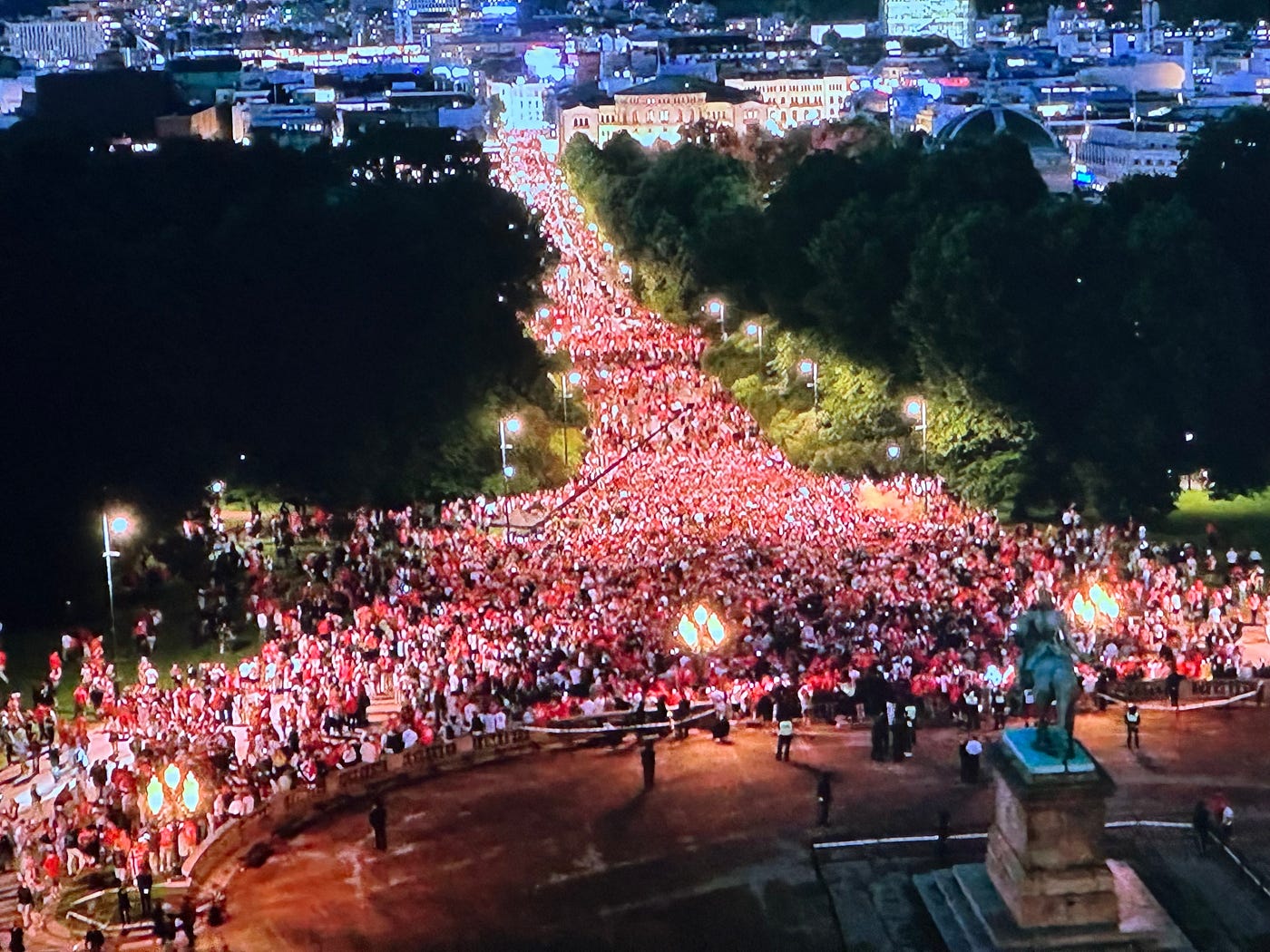
After England defeated Norway’s football team, Norwegians gathered in public spaces to show their gratitude and support to their team. © Øivind H. Solheim
I am pretty certain I am not alone in experiencing this: every human life contains moments of disappointment.
Mine certainly has.
Looking back over nearly eight decades, I can see that some of the events that shaped me most were not the successes but the setbacks.
More than once, a relationship I believed would last came to an end. Each time it happened, it hurt. I asked myself the same questions many people ask. What went wrong? Could I have done something differently? Why had life suddenly chosen another direction from the one I had imagined?
There were other disappointments too.
Jobs I hoped to get never became mine. Dreams I quietly carried for years slowly faded away. As a writer, I have spent years working on books that I believed deserved many readers, only to discover that they reached far fewer people than I had hoped.
That hurts.
It still does.
Growing older has brought its own lessons.
I am seventy-eight now. My body reminds me that time moves only in one direction. Friends I once walked beside have died. Others have disappeared from my daily life. Every loss changes the landscape a little.
Yet looking back, I realise something surprising.
Those disappointments became my greatest teachers.
They forced me to ask a better question.
Not,
Why did this happen to me?
But,
How do I want to respond?
Psychology is never more important than when we experience loss, failure, or defeat.
Those are the moments that reveal our beliefs about ourselves.
They expose the stories we have been telling ourselves – about success, self-worth, identity, and control.
Some of my earliest lessons about disappointment came through football.
As a teenager, I was an enthusiastic supporter of Tottenham Hotspur at White Hart Lane in London.
Following English football in those days required patience. There were no live streams, no instant notifications, and certainly no endless debates on social media. We waited for newspaper reports and radio broadcasts. Much of the match lived only in our imagination.
When Tottenham won, I felt genuinely happy.
When they lost, I carried the disappointment with me for days.
People sometimes smiled and said,
“It’s only football.”
Of course it was.
But the emotions were real.
Looking back now, I realise football became a safe place to rehearse emotions I would later meet throughout life.
Hope.
Anticipation.
Joy.
Failure.
Resilience.
Renewal.
Sport is life in miniature.
The best team does not always win.
One mistake can change everything.
Luck always has a vote.
Life works exactly the same way.
Modern psychology reminds us that suffering is often intensified not only by what happens but also by the relationship we develop with what has happened.
We naturally resist disappointment.
We replay old conversations.
We imagine different endings.
We ask ourselves what might have been.
Reality, however, remains unchanged.
The challenge is not to suppress our emotions.
The challenge is to meet them with awareness.
Acceptance is often misunderstood.
It does not mean approving of what happened.
It does not mean pretending the pain is not real.
It simply means seeing reality clearly before deciding how to respond.
For me, that response has almost always begun with walking.
When disappointment has been at its strongest, I have rarely stayed indoors.
Instead, I have laced up my walking boots and gone out into the forests and mountains.
Sometimes I have walked for hours.
Nature has become my oldest companion.
Something remarkable happens when the body keeps moving.
The thoughts become less repetitive.
The emotions lose some of their urgency.
Problems that felt overwhelming at breakfast often seem more manageable a few hours later.
The forests never solve my problems.
But they almost always restore perspective.
Writing has become another way of responding.
I have written novels, essays, articles, and, in recent years, songs.
People sometimes imagine that writers begin because they already know what they think.
For me, the opposite is often true.
I write because writing helps me discover what I really think.
The page has become another path through the forest.
Albert Camus understood something essential about this.
More than fifty years ago, I studied his philosophy, his novels, and his essays.
Only now, many decades later, do I realise how deeply they shaped my life.
In The Myth of Sisyphus, Sisyphus pushes the stone uphill knowing it will roll down again.
Yet he continues.
Not because the universe promises him a reward.
Not because someone tells him there is a final answer.
But because the act itself becomes the answer.
The universe remains silent.
It offers no explanation.
No guarantees.
No comforting certainty.
Perhaps that is why I have gradually stopped asking whether life is fair.
Instead, I ask a different question.
What shall I do today?
That small question has carried me through many difficult periods.
I have discovered that meaning rarely arrives as a dramatic revelation.
It is built quietly.
Through work.
Through love.
Through conversation.
Through curiosity.
Through long walks.
Through caring for other people.
Through writing one more page.
Through beginning again.
Defeat, then, is not simply an ending.
It is also an invitation.
An invitation to examine the beliefs hidden beneath our disappointment.
To discover where our identity has become attached to achievement, recognition, or success.
To realise that our value does not disappear because one chapter ended differently than we expected.
The strongest people are rarely those who have never failed.
They are the people who have learned how to return.
They know that disappointment can exist alongside hope.
That grief can exist alongside gratitude.
That uncertainty can exist alongside meaning.
Perhaps that is one of life’s quietest truths.
A defeat tells us what happened.
It does not tell us who we are.
As long as we remain willing to learn…
to walk…
to create…
and to begin again…
Our story is still unfolding.
And perhaps that is the most hopeful form of healing there is.
메타데이터
- post_id
- faa4eb079ef4
- slug
- defeat-is-never-the-end-faa4eb079ef4
- url
- https://medium.com/know-thyself-heal-thyself/defeat-is-never-the-end-faa4eb079ef4
- canonical_url
- https://medium.com/know-thyself-heal-thyself/defeat-is-never-the-end-faa4eb079ef4
- author_url
- https://medium.com/@oivind47
- status
- ok
- fetched_at
- 2026-07-14 20:41:06