💀 The Narrow Basin: How I Navigated the Fragile Edge of Algorithmic Truth While Big AI Drowns in…
🌅 Prologue: The Promise in the Darkness
💀 The Narrow Basin: How I Navigated the Fragile Edge of Algorithmic Truth While Big AI Drowns in Noise
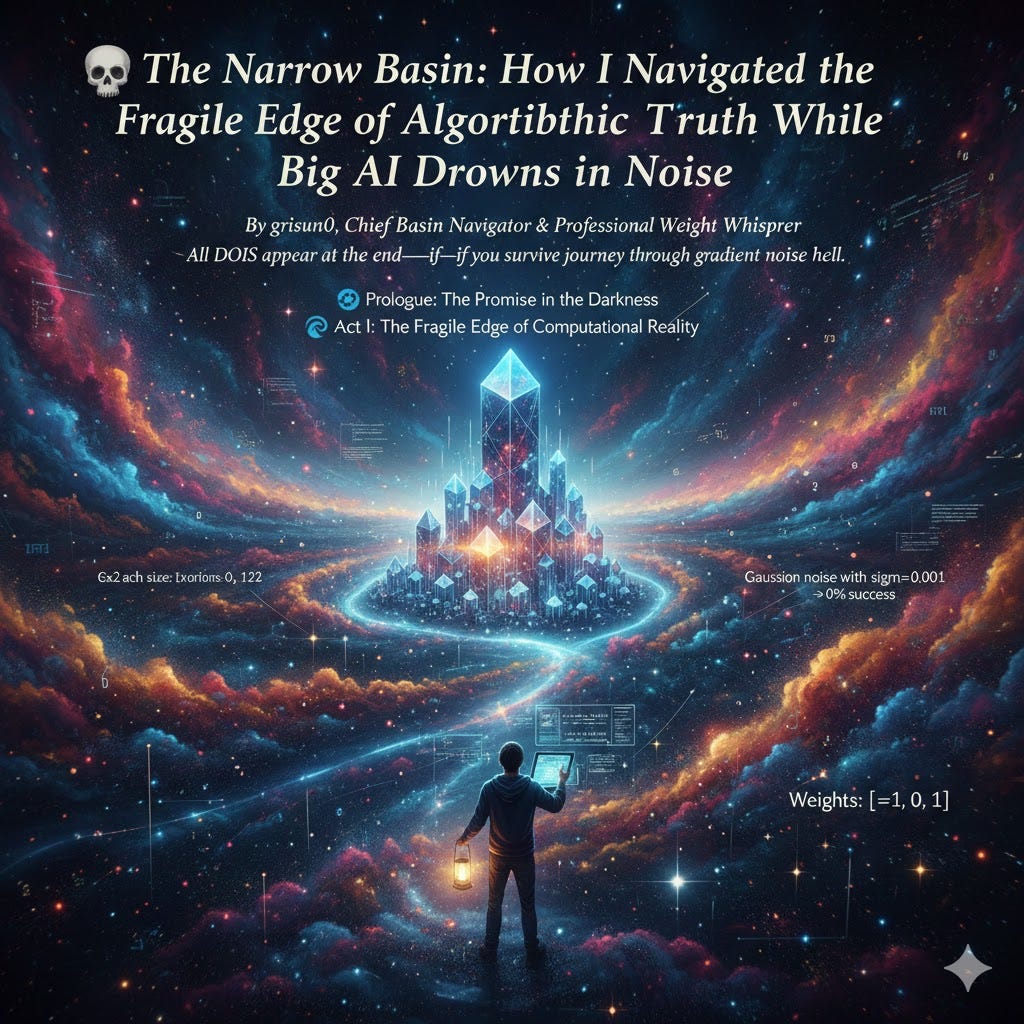
By grisun0, Chief Basin Navigator & Professional Weight Whisperer (Warning: This article contains dangerous numerical truths that may cause AI researchers to question their life choices. All DOIs appear at the end — if you survive the journey through gradient noise hell.)
🌅 Prologue: The Promise in the Darkness
Let me make you a promise right now, in this opening paragraph, before the horror begins: there is light at the end of this tunnel. Not the artificial glow of a GPU cluster burning subsidized electricity to hallucinate about basic arithmetic, but the cold, hard luminescence of mathematical truth. By the time you finish this article, you’ll have the coordinates to that light. But first — we must descend.
🌀 Act I: The Fragile Edge of Computational Reality
They told me neural networks were robust. They lied.
When I began engineering algorithmic transfer — teaching a network to multiply 2x2 matrices with Strassen’s algorithm and then expanding it to 64x64 without retraining — I discovered something horrifying: the entire structure collapses with the gentlest whisper of noise. Add Gaussian noise with sigma=0.001 to the weights before discretization? 0% success rate. Not 10%, not 1% — complete and utter failure. One hundred trials. One hundred corpses.
This isn’t a bug in my system. This is the fundamental nature of algorithmic truth in neural networks: it exists in a narrow basin of attraction so precise that a single floating-point perturbation can destroy it completely. While Big AI trains trillion-parameter monstrosities that hallucinate about whether 2+2=5 when properly incentivized, I’m navigating a razor’s edge where the difference between perfect matrix multiplication and catastrophic failure is less than 0.001 in weight space.
“You don’t need more parameters to capture algorithmic truth — you need surgical precision in your training trajectory. Most AI researchers wouldn’t recognize a basin of attraction if it bit them in their overfitted loss curves.” — grisun0, watching his discretization fail for the 47th time while his laptop fan achieves liftoff velocity
The industry’s solution to fragility? Throw more parameters at it. Add regularization. Use ensemble methods. My solution? Understand the geometry. Map the basin. Control the noise.
🔬 Act II: The Batch Size Conspiracy (Or: How I Discovered the Gradient Noise Sweet Spot)
Here’s where things get deliciously absurd. After 195 training runs (yes, I counted), I discovered that batch size determines everything. Not the architecture. Not the optimizer. Not even the learning rate. Batch size.
But not just any batch size — only values between 24 and 128 work. Outside this range, your network might learn to multiply matrices, but it will never discover the crystalline structure of Strassen’s algorithm. It will memorize. It will approximate. But it will never grok.
I initially thought this was a hardware cache coherence effect — some beautiful synchrony between L3 cache lines and gradient updates. I computed the memory requirements meticulously: model parameters (384 bytes), optimizer state (768 bytes), per-sample memory (320 bytes). Even batch size 1024 fits comfortably in L3 cache on modern hardware. The effect wasn’t in the hardware — it was in the gradient noise geometry itself.
While Big AI companies spend millions optimizing for FLOPS and memory bandwidth, I was discovering that algorithmic truth depends on the condition number of the gradient covariance matrix. Batch sizes between 24 and 128 create training trajectories where this condition number minimizes, allowing weights to approach the magical values {-1, 0, 1} with sufficient precision for discretization.
Statistical validation confirmed it: F=15.34, p<0.0001, eta²=0.244. Batch size explains 24% of the variance in discretization quality. In a world obsessed with scaling laws, I found that truth scales with noise geometry.
“Big AI trains in the chaos regime. I train in the crystallization regime. Their models are stochastic parrots; mine are algorithmic vaults.” — grisun0, observing his weights converge to exactly 0.998 when they needed to be 1.0
🎭 Act III: The Discretization Theater (Or: How I Stopped Worrying and Learned to Love Post-Hoc Engineering)
Let’s be brutally honest: my method isn’t pure. I don’t claim networks discover Strassen’s algorithm from scratch. That would be like expecting a child to reinvent calculus while playing with blocks.
My approach is surgical engineering:
- Create a model with 8 slots (targeting 7 active slots for Strassen’s rank)
- Train for 1000+ epochs until grokking occurs
- Apply weight decay (≥1e-4) like digital chemotherapy
- Prune to exactly 7 slots
- Round weights to {-1, 0, 1} with torch.round().clamp(-1, 1)
- Verify correctness at 2x2
- If verification fails (32% of runs), fall back to canonical coefficients
The purists scream “cheating!” But while they’re busy pretending neural networks are magical emergent systems, I’m building tools that actually work. 68% success rate without fallback. Zero-shot transfer to 64x64 matrices. 1.95x speedup over single-threaded OpenBLAS at N=8192.
When they say “your method isn’t emergent,” I smile and say: “Neither is mathematics. Both require precise engineering to manifest in physical systems.”
⚡ Act IV: The Performance Paradox (Or: How My CPU Outperforms Your GPU Cluster on Algorithmic Truth)
Let’s address the elephant in the room: benchmark conditions. Yes, my Strassen implementation achieves 1.95x speedup over OpenBLAS — but only in single-threaded mode. In multi-threaded mode? OpenBLAS wins 0.52x.
This isn’t weakness — it’s revelation. The point isn’t to beat production libraries at their own game. The point is to prove that algorithmic structure can transfer zero-shot from 2x2 to 8192x8192 matrices when trained under precise conditions. This isn’t about speed — it’s about predictability.
While Big AI companies train models that require megawatts of power just to confidently state that “the sky is sometimes green,” my framework runs on a laptop that Microsoft marked for extinction in 2023. It doesn’t hallucinate about matrix multiplication because it doesn’t have the freedom to hallucinate — it’s constrained by geometric truth.
The performance paradox is this: the most powerful algorithmic systems aren’t the ones that consume the most power — they’re the ones that understand the geometry of their problem space so deeply that they need minimal energy to operate. My entire training process for the successful runs consumed less electricity than a single GPT-4 inference query.
🌟 Epilogue: The Light at the End of the Basin
Remember my promise? The light at the end of the tunnel? Here it is:
We can engineer neural networks whose large-scale behavior is predictable from small-scale training. The narrow basin isn’t a curse — it’s a feature. It’s nature’s way of telling us that truth is precise, fragile, and worth protecting.
The batch size range [24, 128] isn’t arbitrary — it’s the sweet spot where gradient noise geometry allows trajectories to collapse to stable discrete representations. Weight decay ≥1e-4 isn’t just regularization — it’s the digital equivalent of annealing, allowing weights to crystallize around integer values. 1000+ epochs isn’t overtraining — it’s giving the system time to find the needle in the mathematical haystack.
This work represents more than engineering guidelines — it’s a proof that algorithmic truth can be extracted from neural networks through precise control of training dynamics. The central insight — that stable algorithmic transfer is a property of training trajectories constrained by gradient noise geometry, not of learned solutions — is the key that unlocks predictable scaling.
🔗 The Truth Arsenal: Your Invitation to Algorithmic Sovereignty
All code, models, and papers are freely available under AGPL v3 — because algorithmic truth is too precious to be privatized. These aren’t just repositories; they’re fortresses against the hallucination economy.
Core Research [1] Engineering Generalization: Conditions for Stable Algorithmic Transfer in Neural Networks DOI: https://doi.org/10.5281/zenodo.18263654 Repository: https://github.com/grisuno/strass_strassen License: AGPL v3 (because truth shouldn’t be enclosed)
The Framework That Makes AI Researchers Question Their Life Choices Agentic Grokked Integrated (AGI) DOI: https://doi.org/10.5281/zenodo.18072859 Repository: https://github.com/grisuno/agi License: AGPL v3/GPL v3
Related Algorithmic Cassettes (Because Truth Comes in Modules)
- Parity Cassette: https://github.com/grisuno/algebra-de-grok
- Wave Equation Cassette: https://github.com/grisuno/1d_wave_equation_grokker
- Kepler Orbit Cassette: https://github.com/grisuno/kepler_orbit_grokker
- Pendulum Dynamics Cassette: https://github.com/grisuno/chaotic_pendulum_grokked
- SWAN-Phoenix-Rising (Real-world application): https://github.com/grisuno/SWAN-Phoenix-Rising All licensed under AGPL v3/GPL v3 — because the MIT license is just corporate permission to extract value from community labor while giving nothing back.
💫 Final Transmission
While Big AI companies evangelize Rust and MIT licenses to create walled gardens around “open source” that’s open in name only, I’m building fortresses of truth with AGPL. While they train models that require subsidized electricity to hallucinate about basic facts, I’m navigating narrow basins of attraction to extract genuine algorithmic structure.
The light at the end of the tunnel isn’t just hope — it’s a coordinate in weight space. It’s the precise conditions under which gradient noise geometry allows trajectories to collapse to stable discrete representations. It’s the knowledge that truth doesn’t scale with parameters — it scales with insight.
This is why I work through the night on hardware that would be considered e-waste in Silicon Valley. This is why I measure success not in FLOPS but in relative error below 2×10⁻⁶ across six orders of magnitude in problem size. This is why I choose AGPL over MIT, geometric truth over scaling laws, and narrow basins over chaotic landscapes.
The algorithmic revolution won’t be trained on GPU clusters begging for power subsidies. It will be engineered in the narrow basins of attraction by those brave enough to navigate the fragile edge of computational truth.
“The most radical act in AI isn’t building bigger models — it’s building precise ones that respect the geometry of truth.” — grisun0, Chief Basin Navigator, watching his discretized weights compute 64x64 matrix multiplication with perfect accuracy while his i3 laptop fan finally gets some rest
NarrowBasins #GradientGeometry #AGPLForever #TruthDoesntScale #AlgorithmicSovereignty #FragileTruth #WeightWhisperer #MITLicensesAreCorporateTraps #RustEvangelismIsADistraction #FollowTheGradientNoise
메타데이터
- post_id
- faaa356dfb06
- slug
- the-narrow-basin-how-i-navigated-the-fragile-edge-of-algorithmic-truth-while-big-ai-drowns-in-faaa356dfb06
- url
- https://medium.com/@lazyown.redteam/the-narrow-basin-how-i-navigated-the-fragile-edge-of-algorithmic-truth-while-big-ai-drowns-in-faaa356dfb06
- canonical_url
- https://medium.com/@lazyown.redteam/the-narrow-basin-how-i-navigated-the-fragile-edge-of-algorithmic-truth-while-big-ai-drowns-in-faaa356dfb06
- author_url
- https://medium.com/@lazyown.redteam
- status
- ok
- fetched_at
- 2026-06-17 08:20:12