Major, path-breaking trends and standout papers from CVPR 2026.
Based on the official proceedings and accepted papers, the conference marked a distinct shift away from traditional per-scene optimization…
Major, path-breaking trends and standout papers from CVPR 2026.
Based on the official proceedings and accepted papers, the conference marked a distinct shift away from traditional per-scene optimization toward unified multi-modal reasoning, feed-forward 3D representations, and spatially-aware generative models.
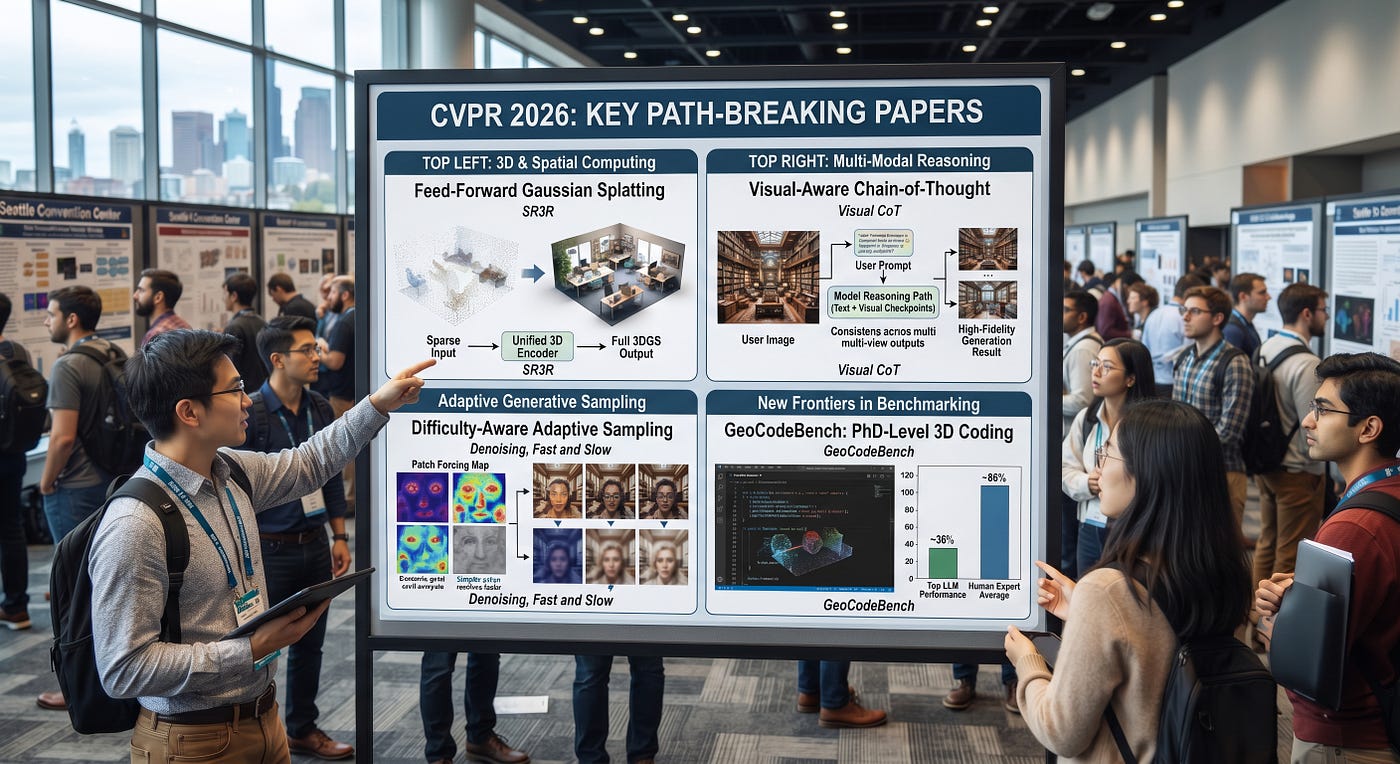
The standout, paradigm-shifting categories and specific breakthrough papers from the conference include:
1. The 3D & Spatial Computing Evolution
A major path-breaking theme of CVPR 2026 was the move away from slow, per-scene optimization (like classic NeRF or early 3D Gaussian Splatting) toward instant, feed-forward architectures.
- “SR3R: Rethinking Super-Resolution 3D Reconstruction With Feed-Forward Gaussian Splatting” https://arxiv.org/abs/2602.24020
Why it’s path-breaking: Instead of relying on dense, high-resolution views and hours of training per scene, this framework introduces a direct feed-forward mapping from sparse, low-resolution views to a high-resolution 3D Gaussian Splatting (3DGS) representation. It allows models to autonomously learn 3D-specific high-frequency geometry and appearance across multiple scenes, unlocking genuine zero-shot generalization to entirely unseen spaces.
- “MAMMA: Markerless Accurate Multi-person Motion Acquisition”https://arxiv.org/abs/2506.13040
Why it’s path-breaking: This paper presents a massive leap in markerless motion capture. By utilizing dense, 2D contact-aware and visibility-aware surface landmarks paired with a query-based transformer architecture, it successfully handles complex, multi-person physical interactions and heavy occlusions. It provides a pipeline that rivals commercial, hardware-heavy marker systems without the extensive manual post-processing cleanup.
2. Multi-Modal Vision-Language Models (VLMs) & Visual CoT
Instead of treating Large Vision-Language Models as passive image describers, the path-breaking papers focused on teaching models to use structured, spatial reasoning during the generation process.
- “Visual-Aware CoT: Achieving High-Fidelity Visual Consistency in Unified Models” https://arxiv.org/pdf/2512.19686
- Why it’s path-breaking: Traditional Chain-of-Thought (CoT) prompting for multi-modal models primarily focuses on maintaining textual consistency. This paper fundamentally shifts that paradigm by integrating a visual check-list and self-reflection directly into the model’s reasoning path. Using supervised fine-tuning and specialized RL frameworks (flow-GRPO), it ensures high-fidelity visual context consistency across multi-reference image generation.
3. Adaptive & Patch-Level Generative Sampling
In the text-to-image space, the innovation moved away from simply training bigger diffusion backbones and toward radically optimizing how the models sample noise.
- “Denoising, Fast and Slow: Difficulty-Aware Adaptive Sampling for Image Generation” https://arxiv.org/pdf/2604.19141
Why it’s path-breaking: Instead of assigning identical computational steps across an entire image canvas, this paper introduces “Patch Forcing” (PF). It uses a lightweight difficulty head to adaptively allocate compute to complex patches of an image, leaving simpler regions to resolve early and provide context for more intricate details.
- “Designing Instance-Level Sampling Schedules via REINFORCE with James-Stein Shrinkage” -https://arxiv.org/pdf/2511.22177
Why it’s path-breaking: This work completely steps away from fixed, global sampling timelines for frozen text-to-image models. It introduces model-agnostic, prompt-conditioned scheduling that vastly improves fine details, text rendering, and composition control, allowing standard models like Flux-Dev to reach hyper-efficient few-step generation qualities natively.
4. New Frontiers in Benchmark Rigor
As AI models have gotten stronger, older benchmarks have suffered from saturation. CVPR 2026 introduced high-level benchmarks to test the bleeding edge of engineering.
- “Benchmarking PhD-Level Coding in 3D Geometric Computer Vision” https://arxiv.org/pdf/2603.30038
Why it’s path-breaking: Dubbed GeoCodeBench, this paper introduces a grueling benchmark consisting of fill-in-the-function coding tasks gathered from top-tier 3D vision repositories. It exposed a major bottleneck in modern LLMs: while models excel at standard web dev scripts, even SOTA models hit severe performance walls (averaging only ~36% pass rates) when asked to map complex geometric logic, transformations, and long-context scientific papers into correct 3D computer vision code.
메타데이터
- post_id
- fac7e29fc3da
- slug
- major-path-breaking-trends-and-standout-papers-from-cvpr-2026-fac7e29fc3da
- url
- https://medium.com/@avithaljunk/major-path-breaking-trends-and-standout-papers-from-cvpr-2026-fac7e29fc3da
- canonical_url
- https://medium.com/@avithaljunk/major-path-breaking-trends-and-standout-papers-from-cvpr-2026-fac7e29fc3da
- author_url
- https://medium.com/@avithaljunk
- status
- ok
- fetched_at
- 2026-08-22 07:17:27