🧪 Why Micelle Formation Determines Whether a Cleanser Actually Works (And Why Foam Can Mislead…
Most cleansers don’t fail because of ingredients, but because the system behind them isn’t working the way people think. It shows up in…
🧪 Why Micelle Formation Determines Whether a Cleanser Actually Works (And Why Foam Can Mislead You)
Most cleansers don’t fail because of ingredients, but because the system behind them isn’t working the way people think. It shows up in everyday questions:
“This soap foams well, so why doesn’t it clean properly?” “Why does my cleanser feel effective but still leave residue?” “Why do some products work differently in different water conditions?”
At first glance, these seem like practical problems. But underneath them lies a deeper issue — a gap between what we see during washing and what is actually happening at a molecular level.
That gap is where micelles live.
The Illusion of Foam
Foam is visible. It feels active, almost reassuring. When a product produces dense, stable foam, the natural assumption is that it must be working effectively.
But foam is not cleaning.
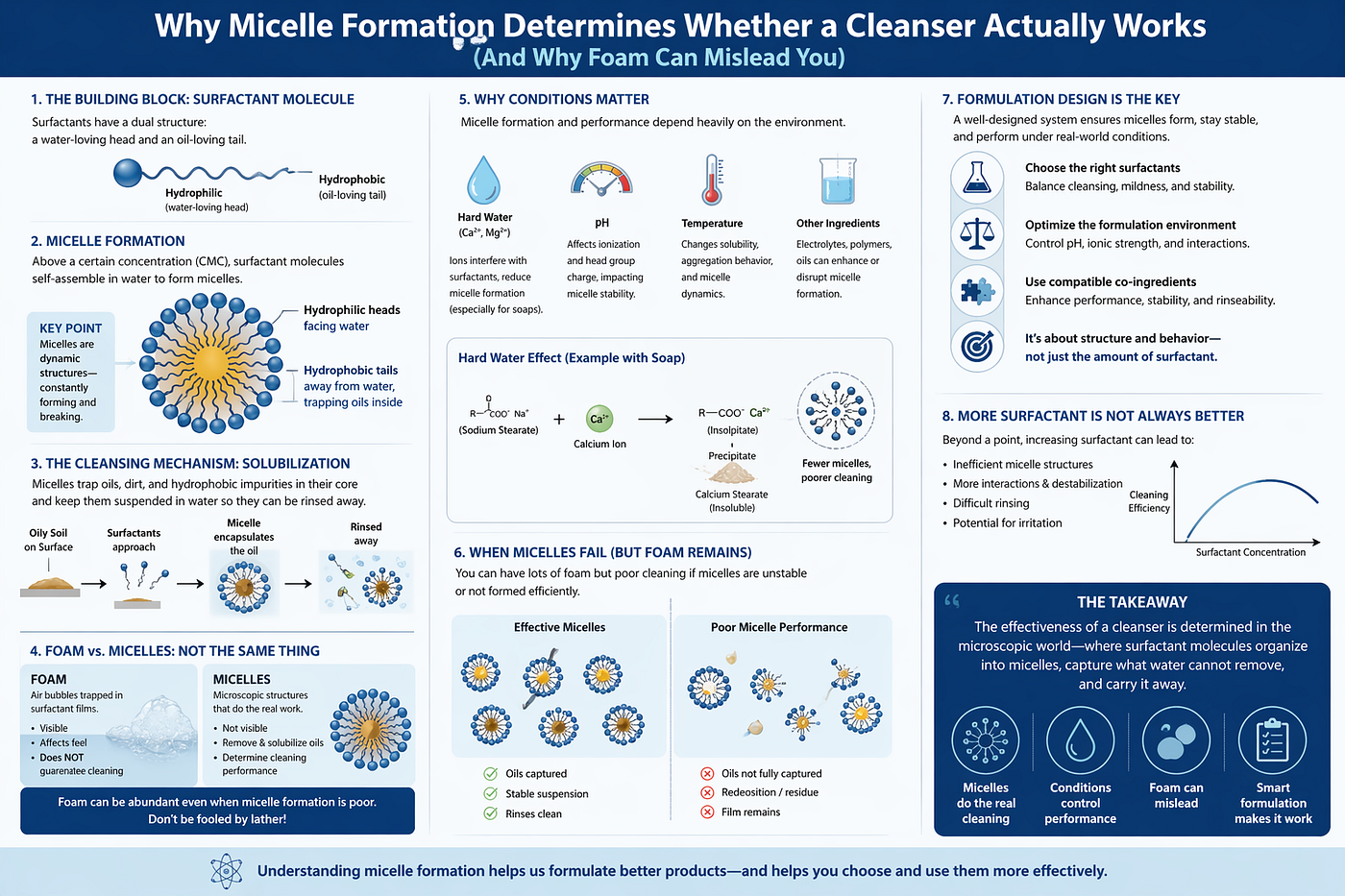
Foam is simply air trapped within a network of surfactant films. It tells you that surface tension is being reduced, but it says very little about whether oils, soils, or residues are actually being removed.
In many cases, a product can foam impressively and still perform poorly as a cleanser.
The real work happens somewhere else — in structures you cannot see.
What a Micelle Really Is
When surfactants are introduced into water above a certain concentration (the critical micelle concentration), they begin to organize themselves into structures known as micelles.
Each molecule has two distinct parts:
A hydrophilic (water-loving) head A hydrophobic (oil-loving) tail
In water, these molecules arrange so that:
the tails point inward (away from water) the heads face outward (toward water)
This creates a kind of microscopic “container” — a dynamic, constantly forming and breaking structure that can trap oily substances inside.
But it’s important to understand this clearly:
A micelle is not a static particle. It is a dynamic system that depends heavily on its environment.
Cleaning Is Not Just Removal — It’s Solubilization
Most people think cleaning means “lifting dirt away.”
In reality, effective cleansing depends on something more specific: solubilization.
Oily substances do not dissolve in water. They resist it. Simply loosening them from a surface is not enough — they need to be captured in a way that prevents redeposition.
Micelles provide that capture mechanism.
They:
surround hydrophobic materials isolate them from water keep them suspended until they are rinsed away
Without stable micelle formation, removed oils have a tendency to:
redeposit smear leave behind films
This is why some cleansers feel like they “almost work” but never quite leave a surface fully clean.
Why Conditions Matter More Than Formulas
One of the most overlooked aspects of cleansing is this:
The same formulation can behave very differently depending on external conditions.
Micelle formation is highly sensitive to:
Water hardness (calcium and magnesium ions interfere with surfactant behavior) pH (affects ionization and structure stability) Temperature (changes solubility and aggregation behavior) Presence of other ingredients (electrolytes, polymers, oils)
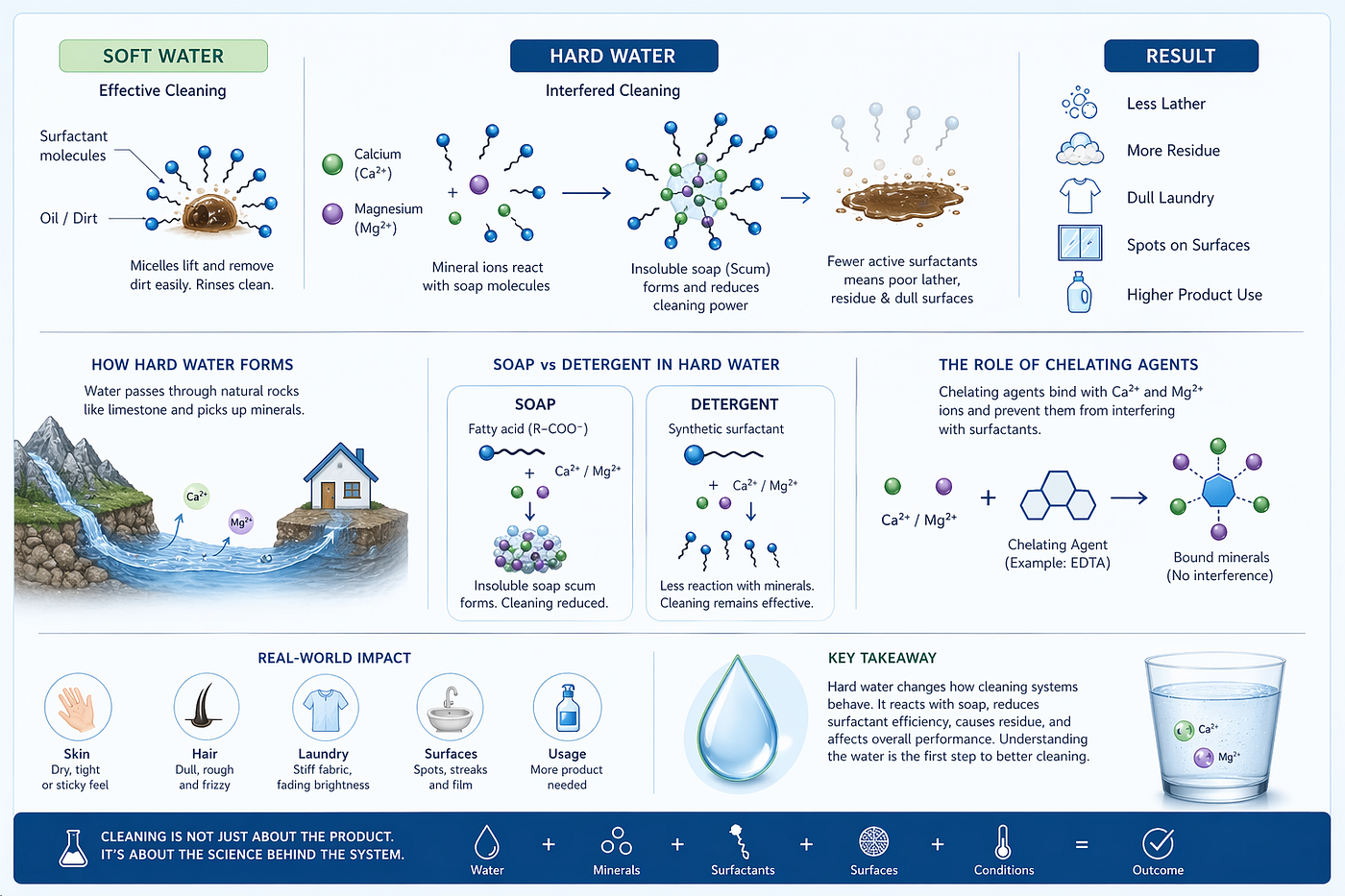
In hard water, for example, soap molecules can react with calcium ions to form insoluble salts. This reduces the availability of surfactant molecules to form micelles, even if the product still produces foam.
So the user sees foam… but the system has already been compromised.
When Micelles Fail (But Foam Remains)
This is one of the most misleading scenarios in everyday use.
You might observe:
good lather familiar texture normal application
And yet:
oils are not fully removed residue remains rinsing feels incomplete
Why?
Because foam formation and micelle formation are not tightly linked.
You can have:
foam without effective micelles micelles without noticeable foam
This disconnect is where most user confusion originates.
The Role of Formulation Design
A well-designed cleansing system is not just about choosing a surfactant. It is about building a functional environment where micelles can form, remain stable, and perform consistently.
This involves:
selecting surfactants with compatible structures controlling ionic strength managing interactions with other ingredients balancing cleansing power with stability
In complex systems like shampoos, body washes, or detergents, multiple surfactants are often used together — not just for mildness or foam, but to optimize micelle behavior under varying conditions.
Why “More Surfactant” Is Not Always the Answer
A common assumption in formulation (and even among users) is:
If cleaning is weak, just increase the surfactant level.
But this does not always improve performance.
Beyond a certain point:
micelle structures may become inefficient interactions between components may destabilize the system rinsing may become more difficult
Cleansing efficiency depends less on quantity and more on structural behavior.
The Quiet Reality of Everyday Cleansing
Most cleansing products work — but not always for the reasons we think.
And when they fail, the failure is often subtle:
not complete absence of cleaning but incomplete solubilization partial removal residual film formation
Understanding micelles changes how we interpret these outcomes.
It shifts the focus from:
what we see (foam)
to:
what actually happens (molecular organization and transport) Closing Thought
The effectiveness of a cleanser is not determined at the surface where you apply it.
It is determined in the microscopic space where surfactant molecules decide how to organize themselves — whether they will form structures capable of capturing and carrying away what water alone cannot remove.
That decision — invisible, dynamic, and condition-dependent — is what ultimately defines whether a product truly cleans.
메타데이터
- post_id
- fae66c00f790
- slug
- why-micelle-formation-determines-whether-a-cleanser-actually-works-and-why-foam-can-mislead-fae66c00f790
- url
- https://medium.com/@parvaiz13/why-micelle-formation-determines-whether-a-cleanser-actually-works-and-why-foam-can-mislead-fae66c00f790
- canonical_url
- https://medium.com/@parvaiz13/why-micelle-formation-determines-whether-a-cleanser-actually-works-and-why-foam-can-mislead-fae66c00f790
- author_url
- https://medium.com/@parvaiz13
- status
- ok
- fetched_at
- 2026-07-08 01:19:27