Beyond Infrastructure
Building the AI Operating System for the Neocloud Era
Beyond Infrastructure
Building the AI Operating System for the Neocloud Era
Part of the **Building Intelligent Enterprise Systems** series.
This article explores how I would evolve Nutanix into the AI Operating System for the emerging Neocloud ecosystem. Rather than focusing on GPU infrastructure alone, it presents a long-term product strategy for orchestrating AI infrastructure, models, data, Kubernetes, and intelligent workloads into a unified enterprise platform.
Cloud Computing Solved Infrastructure
Artificial Intelligence Creates a New Problem
Cloud computing transformed enterprise technology.
Organizations no longer needed to purchase physical servers.
Infrastructure became virtual.
Elastic.
Programmable.
Self-service.
Cloud platforms democratized compute.
Today, Artificial Intelligence is creating a similar transformation.
Organizations no longer ask,
“Where do I run my applications?”
Instead they ask,
“Where do I run my AI?”
Training.
Inference.
Agentic workflows.
Retrieval systems.
Model serving.
GPU scheduling.
Vector databases.
Kubernetes.
Data pipelines.
Each introduces a new layer of operational complexity.
Cloud infrastructure alone is no longer enough.
The AI Era Requires a New Operating Model
Today’s AI stack has become fragmented.
Different GPU providers.
Different foundation models.
Different orchestration frameworks.
Different vector databases.
Different Kubernetes clusters.
Different observability tools.
Different governance systems.
Every enterprise assembles its own collection of AI technologies.
The result is familiar.
Complexity scales faster than intelligence.
The next generation of infrastructure must coordinate the AI ecosystem — not simply provision compute.
The Rise of the Neocloud
A new category of infrastructure providers is emerging.
Neoclouds.
Unlike traditional public cloud providers, Neoclouds specialize in AI-native infrastructure.
High-performance GPUs.
AI networking.
Model hosting.
Inference acceleration.
Kubernetes.
Storage optimized for AI workloads.
Elastic AI clusters.
The opportunity extends beyond renting GPUs.
Neoclouds can become the operating environment where enterprises build, deploy, govern, and continuously optimize intelligent systems.
That requires a platform — not another infrastructure service.
A New Product Vision
If I were defining Nutanix’s long-term vision, it would be simple.
Build the AI Operating System that enables enterprises and Neocloud providers to deploy, orchestrate, govern, and continuously optimize intelligent workloads across any infrastructure.
Notice the emphasis.
Not becoming another GPU cloud.
Not competing solely on infrastructure.
The goal is becoming the coordination layer for Enterprise AI.
Beyond GPU-as-a-Service
Most discussions around AI infrastructure begin with hardware.
GPUs.
Networking.
Storage.
Compute.
These capabilities remain foundational.
But hardware alone rarely creates long-term differentiation.
The next competitive advantage lies in orchestration.
How efficiently can enterprises coordinate:
Models.
Agents.
Data.
Kubernetes.
Inference.
Governance.
Security.
Observability.
Workflows.
Infrastructure.
The future platform should manage intelligence — not simply compute.
Product Principles
Before discussing architecture, I would establish five principles.
1. Infrastructure should become invisible
Developers should focus on AI products.
The platform should manage infrastructure complexity automatically.
2. Intelligence requires orchestration
Models, data, agents, infrastructure, and workflows must operate as one coordinated system.
Disconnected AI services create operational friction.
3. Enterprise governance is non-negotiable
Security, compliance, tenancy, cost controls, identity, and auditability should be native platform capabilities — not optional integrations.
4. Open ecosystems outperform closed platforms
Enterprises will continue adopting multiple models, clouds, Kubernetes distributions, and AI frameworks.
The platform should embrace interoperability rather than enforce lock-in.
5. Continuous optimization creates long-term value
Every deployment.
Every workload.
Every inference request.
Every scheduling decision.
Every GPU allocation.
Together they improve how the platform manages enterprise AI over time.
Optimization becomes a continuously learning capability.
The Core Jobs to Be Done
If I were prioritizing the roadmap, I would focus on helping enterprises perform five essential jobs.
Deploy AI anywhere.
Provision AI workloads across hybrid, private, public, and Neocloud environments.
Optimize AI infrastructure.
Continuously allocate GPUs, storage, networking, and compute based on workload requirements.
Govern enterprise AI.
Apply security, compliance, identity, tenancy, and policy consistently across every AI workload.
Coordinate intelligent workloads.
Enable models, agents, Kubernetes services, and enterprise applications to work together through shared orchestration.
Continuously improve AI operations.
Capture operational insights that optimize performance, reliability, utilization, and cost.
Beyond Infrastructure Management
Virtualization transformed servers.
Containers transformed applications.
Kubernetes transformed orchestration.
Enterprise AI will transform infrastructure once again.
The next generation of platforms will not simply manage machines.
They will manage intelligence.
That is how I believe Nutanix can evolve from an infrastructure platform into the AI Operating System for the Neocloud era.
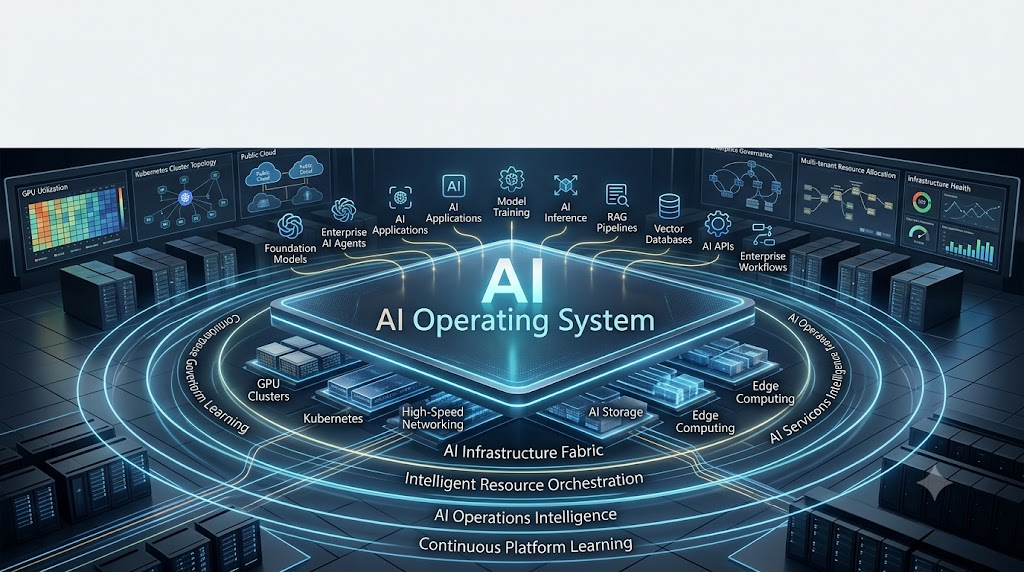
Designing the AI Operating System for the Neocloud Era
If Neoclouds become the foundation for Enterprise AI, the next question becomes obvious.
What should an AI Operating System actually look like?
I believe it should be built around six foundational platform capabilities.
Not six AI features.
Six reusable capabilities that allow enterprises and Neocloud providers to deploy, operate, govern, and continuously optimize AI at scale.
Layer 1 — AI Infrastructure Fabric
Everything begins with infrastructure abstraction.
Today’s AI environments are inherently heterogeneous.
NVIDIA and AMD GPUs.
Private clouds.
Public clouds.
Edge infrastructure.
Kubernetes clusters.
High-performance storage.
High-speed networking.
Different AI frameworks.
Different accelerator generations.
Managing this diversity manually creates operational complexity that scales faster than AI adoption.
The platform should expose a single AI Infrastructure Fabric that abstracts underlying infrastructure while intelligently orchestrating compute, storage, networking, and accelerators.
Developers request AI capacity.
The platform determines where and how workloads should execute.
Infrastructure becomes programmable rather than manually managed.
Layer 2 — Intelligent Resource Orchestration
Provisioning GPUs is no longer enough.
The platform should continuously optimize infrastructure utilization across every workload.
Imagine an orchestration engine that automatically decides:
Which GPUs are best suited for training.
Which clusters should serve inference.
When workloads should migrate.
How Kubernetes resources should scale.
How tenants share infrastructure fairly.
When idle capacity should be reclaimed.
Instead of static scheduling policies, the platform continuously adapts based on workload behavior, service-level objectives, cost, and resource availability.
Infrastructure evolves from reactive allocation to intelligent orchestration.
Layer 3 — AI Services Platform
Infrastructure should not expose hardware.
It should expose capabilities.
Developers should consume reusable AI services rather than assembling complex infrastructure every time.
These services include:
- GPU-as-a-Service
- Model-as-a-Service
- Kubernetes-as-a-Service
- Vector Database Services
- AI Inference Services
- Agent Runtime Services
- Data Pipeline Services
- Feature Store Services
Each service shares common platform capabilities for security, observability, governance, identity, and lifecycle management.
This dramatically reduces the operational burden of enterprise AI.
Layer 4 — AI Operations Intelligence
Operating AI workloads is fundamentally different from operating traditional applications.
The platform should continuously understand:
GPU utilization.
Inference latency.
Model performance.
Energy consumption.
Infrastructure health.
Capacity trends.
Model drift.
Workload failures.
Cost optimization opportunities.
Rather than presenting dashboards alone, AI Operations Intelligence continuously recommends:
Where workloads should move.
When additional capacity is required.
Which models require optimization.
Which clusters are underutilized.
Where costs can be reduced.
Operations shift from monitoring systems to managing intelligent recommendations.
Layer 5 — Enterprise Governance
Enterprise AI cannot scale without trust.
Governance must be embedded into the platform itself — not bolted on afterward.
Every workload should automatically inherit:
- Identity and access management
- Multi-tenancy isolation
- Data governance
- Policy enforcement
- Compliance controls
- Cost management
- Security monitoring
- Auditability
- Responsible AI guardrails
Developers should not have to rebuild these capabilities for every deployment.
The platform provides them by default.
This accelerates innovation while maintaining enterprise-grade security and operational confidence.
Layer 6 — Continuous Platform Learning
Perhaps the platform’s greatest long-term advantage is its ability to learn.
Every deployment generates feedback.
Every scheduling decision improves orchestration.
Every workload teaches the platform about infrastructure behavior.
Every inference request improves capacity planning.
Every optimization recommendation strengthens operational intelligence.
Over time, the platform develops institutional knowledge about how enterprise AI systems actually operate.
This creates a continuously improving operational intelligence layer that competitors cannot easily replicate.
Product Roadmap
Rather than attempting to build the entire platform at once, I would evolve it through four deliberate phases.
Phase 1 — AI Infrastructure Platform
- GPU provisioning
- Kubernetes integration
- Multi-tenancy
- Self-service deployment
- Unified infrastructure management
Outcome: Simplify enterprise AI deployment.
Phase 2 — AI Operations Platform
- Intelligent scheduling
- Capacity optimization
- Cost visibility
- Infrastructure observability
- Automated scaling
Outcome: Improve operational efficiency and resource utilization.
Phase 3 — AI Services Platform
- GPU-as-a-Service
- Model-as-a-Service
- Agent Runtime Services
- Vector Database Services
- Enterprise AI APIs
Outcome: Accelerate enterprise AI development through reusable platform capabilities.
Phase 4 — AI Operating System
- AI Infrastructure Fabric
- Intelligent orchestration
- Enterprise governance
- Continuous platform learning
- Cross-cloud AI coordination
Outcome: Transform Nutanix into the operating system that powers enterprise AI across every cloud, every model, and every intelligent workload.
Measuring Success
An AI Operating System should not be measured solely by infrastructure metrics.
Its success depends on enabling enterprises to build and operate AI more effectively.
Infrastructure Outcomes
- GPU utilization
- Cluster efficiency
- Infrastructure availability
- Elastic scaling performance
Developer Outcomes
- Time-to-deploy AI workloads
- Platform adoption
- Self-service provisioning
- Development velocity
Operational Outcomes
- Cost per inference
- Workload reliability
- Scheduling efficiency
- Mean time to recovery
Business Outcomes
- Enterprise customer adoption
- Multi-tenant efficiency
- AI workload growth
- Platform expansion revenue
Trust Outcomes
- Policy compliance
- Tenant isolation
- Security posture
- Governance adherence
- Customer confidence
These metrics reflect whether the platform delivers operational intelligence — not just infrastructure capacity.
Why This Matters
Every major infrastructure shift has abstracted away complexity.
Virtualization abstracted servers.
Containers abstracted applications.
Kubernetes abstracted orchestration.
The next abstraction is intelligence itself.
Enterprises should no longer need to understand where AI runs, how GPUs are allocated, or how infrastructure scales.
They should simply describe the intelligent systems they want to build.
The platform should handle everything else.
Final Thoughts
Cloud computing democratized infrastructure.
The Neocloud era will democratize AI.
But the organizations that lead this transition won’t be those with the largest GPU clusters.
They will be those that make AI infrastructure effortless to consume, secure to operate, and intelligent to optimize.
That requires more than compute.
It requires an operating system for enterprise intelligence.
For Nutanix, the opportunity is not merely to participate in the AI infrastructure market.
It is to become the platform that enterprises trust to orchestrate every intelligent workload — across every cloud, every model, and every stage of the AI lifecycle.
In the AI era, the winning platform won’t simply provide infrastructure.
It will continuously transform infrastructure into intelligence.
메타데이터
- post_id
- faff7ac61430
- slug
- beyond-infrastructure-faff7ac61430
- url
- https://medium.com/@karthik_prdmgr/beyond-infrastructure-faff7ac61430
- canonical_url
- https://medium.com/@karthik_prdmgr/beyond-infrastructure-faff7ac61430
- author_url
- https://medium.com/@karthik_prdmgr
- status
- ok
- fetched_at
- 2026-07-19 00:45:20




