The Big Light is Evil
5 everyday things my autistic nervous system refuses to tolerate.
The Big Light is Evil
5 everyday things my autistic nervous system refuses to tolerate.
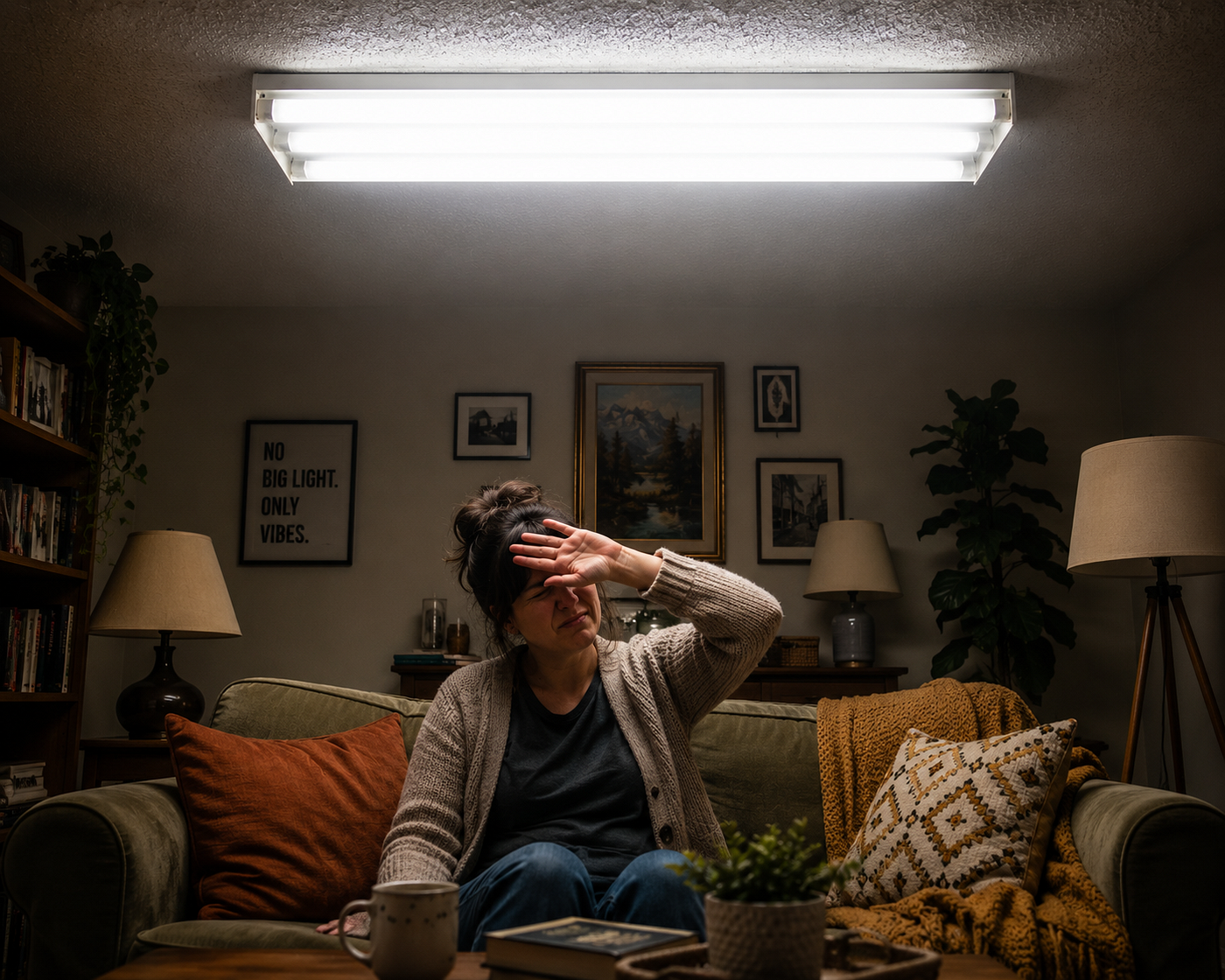
Image created by the author using ChatGPT.
“Is there any way we could turn that off?”
Since I was a little kid, I’ve said variations of that — while grimacing and pointing to the overhead light — hundreds, maybe even thousands of times. People often roll their eyes in response.
The eye-rolling taught me that I was “too sensitive.” I spent decades believing I needed to toughen up and stop being such a diva.
Then, when I was 49, I was diagnosed with autism.
Suddenly, all of those moments reorganized themselves.
I learned that sensory differences are one of the most common features of autism. Some autistic people are under-responsive to sensory input. Others, like me, are hypersensitive and prone to sensory overload.
Here are five everyday things that cause me (and a lot of other autistic people) distress that can seem disproportionate to neurotypical folks.
Photo by benjamin lehman on Unsplash
1. Overhead, fluorescent lighting is the devil.
I just cannot with fluorescent lighting, and overhead lighting is generally not something I can comfortably tolerate. It confounded my mother when I was a little kid — she’d have all the lights on in a room and I’d beg her to turn some of them, especially the dreaded overhead ones, off.
I thought it was an aesthetic preference, a quirk that I needed to get over. But after my diagnosis, I discovered that a hatred for “the big light” is a common characteristic of autistic people.
For a lot of us, the big light is only for emergencies — searching for a lost object, or if absolutely necessary, for cleaning. It makes everything ugly and stark and feels like it’s aggressively interrogating me about my very existence.
In short, the big light is evil and everything that happens beneath it is tainted by its hostility.
Photo by Nainoa Shizuru on Unsplash
2. Concerts make me wanna disappear.
This one makes me a little sad. I’ve been to loads of concerts in my life, and I’ve generally left them feeling out of sorts (at best) or completely rattled and dysregulated (more commonly).
I blamed myself.
I spent years trying to force myself to like concerts because concerts are something people like. I wanted to be the kind of person who loved live music. So I’d buy the tickets, psych myself up, and convince myself this time would be different.
It never was.
The volume, the crowd, the lights, the inability to hear or be heard — it all piled on until I felt like I couldn’t breathe.
The last concert I attended was Florence + the Machine at Red Rocks. I adore Florence, and the venue is legendary for its natural beauty. I loved the idea of being there, but the reality was another matter entirely. I made it through two songs before I fainted (literally) and had to leave.
For years I thought this meant I wasn’t trying hard enough.
Now I think my nervous system was trying to tell me something I’d spent decades ignoring. Concerts just aren’t for me.
Photo by Tricia Galvin on Unsplash
3. I can’t handle excessive heat (or cold).
My nervous system is chronically dysregulated, as evidenced by my lifelong struggle with hyperhidrosis. That means that my hands and feet have been sweaty for most of my life.
And my extreme sensitivity means I tend to overheat (think of a steaming radiator) or get too cold (think of a freezer that’s iced over). I don’t get “a little too warm,” I start to panic and get trapped inside the sensation. I don’t get “a little cold,” I feel like my body is starting to shut down.
Once I’m too hot or too cold, it becomes almost impossible to think about anything else. My body goes into emergency mode. I sweat. I shiver. I get desperate and emotional and my brain starts looking for one thing and one thing only: escape.
Photo by Laura Chouette on Unsplash
4. Most clothes are terrible.
I love clothes. I love fabric. I love costumes and all the trappings that go along with being well-dressed.
But I hate wearing most clothes. I find them constricting and maddening in their need for constant adjustment — if something’s not slipping off my shoulder, it’s riding up my rear — and their itchy seams and tags.
And shoes! Good lord, how conflicted I am on shoes. For a long, long time, I kept buying heels because of how they looked. I’d try them on in a store, hobble a few steps and lie to myself that I couldn’t walk in them because of the particular floor beneath my feet. So I’d buy the shoes and never wear them, or wear them once and ruin them with sweat and blisters that quickly bled into the shoes. And then I’d resent the shoes for costing me money then causing me pain.
It was quite a ridiculous and very vicious cycle.
Since my diagnosis, I’ve come to accept that I’m a soft clothes and flats lady, and that’s made me a happier, more comfortable human.
Photo by Matthew Holland on Unsplash
5. Escalators want to kill me.
Since I was a little kid visiting the mall with my mom, escalators have frightened me. With their toothy metal steps perpetually cycling from feasible stability to utter disappearance, they always seem to be daring me to step on them so they can drag me to my painful demise in the mysterious reverse side of the escalator.
I get chills just thinking about it.
Many autistic people also have dyspraxia, a developmental coordination disorder that affects balance and movement. I’ve always been spectacularly clumsy. I have an absurd tendency to fall down, even on ground that’s standing still. Getting on an escalator feels like high-stakes Double Dutch to me, and I think I’ll just take the stairs instead.
For me, and for a lot of autistic people, ordinary reality has a cheese-grater quality to it. It’s as though the world is constantly scraping against our nervous systems in tiny, almost invisible ways. Individually, those moments seem small. Together, they can be exhausting.
What looks like an overreaction is often just a nervous system that’s reached its limit.
So the next time someone asks to turn off the overhead light, leaves a concert early, refuses to wear a certain shirt, or insists it’s unbearably hot when everyone else seems fine, remember that you don’t live inside their body.
They might not be being dramatic.
They might just be trying to find a little relief.
Now, if you’ll excuse me, someone left the big light on.
메타데이터
- post_id
- fb0a4a444f94
- slug
- the-big-light-is-evil-fb0a4a444f94
- url
- https://medium.com/invisible-illness/the-big-light-is-evil-fb0a4a444f94
- canonical_url
- https://medium.com/invisible-illness/the-big-light-is-evil-fb0a4a444f94
- author_url
- https://medium.com/@leahwelborn
- status
- ok
- fetched_at
- 2026-07-09 03:40:04