EV Two-Wheeler Brand Preferences in India in FY25
Long story short: Explore India’s EV Two-Wheeler Brand Preferences in India in FY25, statewise & regionwise for brands like TVS, Ather…
EV Two-Wheeler Brand Preferences in India in FY25
Long story short: Explore India’s EV Two-Wheeler Brand Preferences in India in FY25, statewise & regionwise for brands like TVS, Ather, Bajaj, etc. This article examines favourite EV motorcycle and scooter brand preferences in India in FY 25.
India’s electric two-wheeler market saw strong growth in FY25 (April 2024 to March 2025), with 11,49,422 units sold, a 21% increase from FY24’s 9,48,518 units. Electric two-wheelers now account for 6.1% of all two-wheeler sales, nearly double their share in 2020. (India’s Electric Two-Wheeler Market 2025–2030, 2025) However, these figures do not show the important regional differences in consumer choices, brand strength, and product trends across South, North, West, and East India. This article examines these regional patterns using data from FADA, the Vahan Dashboard, and industry reports.
Key Takeaways
- India’s electric two-wheeler market grew by 21% in FY25, with over 1.1 million units sold. However, there are big regional differences in brand preference and buyer behaviour.
- Established brands such as TVS, Bajaj, and Hero Vida gained market share from startups by using their strong dealer networks and manufacturing presence to dominate key regions.
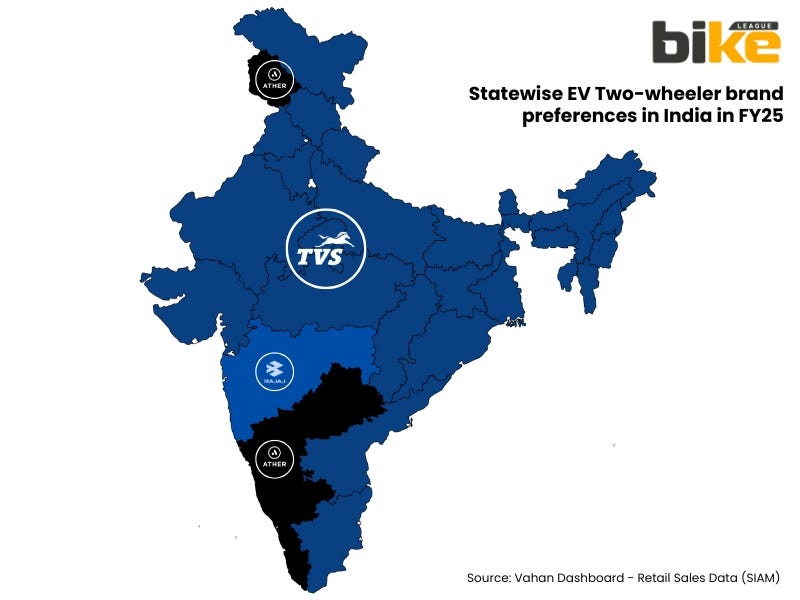
- Regional preferences depend on factors like state subsidies, local manufacturing, consumer income, and after-sales support. As a result, TVS leads in the South, Bajaj in the West, and Hero Vida is growing quickly in the North.
- Rural EV adoption is growing faster than in cities. This is due to affordable entry-level models, low running costs, and more dealer service networks reaching smaller towns.
- As the market matures, regional brand loyalties and government incentives will matter even more. Businesses and analysts need to understand and adapt to local trends, not just national ones.
National EV 2-Wheeler Market: The Consolidated Picture
Before diving into regional details, let’s look at the national picture. In FY25, three main changes shaped India’s EV two-wheeler market:
1. Rapid Consolidation Towards Legacy OEMs
Startups lost ground to established companies. Ola Electric’s market share dropped from 34.79% in FY24 to 29.93% in FY25, even though its sales grew. TVS Motor increased its share from 19.31% to 20.67%, and Bajaj Auto almost doubled its share from 11.30% to 20.08%. Together, TVS and Bajaj now hold 40.75% of all electric two-wheeler sales. Hero MotoCorp’s Vida brand was the fastest-growing, rising from 1.87% to 4.23%, a gain of 2.36 percentage points.
2. EVs as the Growth Engine of the Two-Wheeler Market
Petrol two-wheeler sales grew by 7.71% year-on-year, but electric two-wheelers grew even faster at 21%. Rural areas led this growth, with sales up 8.39% compared to 6.77% in cities. This means EVs are now reaching smaller towns and semi-rural areas, where lower costs and easy home charging are major benefits.
3. Price-Driven Market Segmentation Intensifies
Most of the growth came from entry-level and mid-range models. Bajaj Chetak sold 230,806 units, showing strong demand for affordable, sturdy scooters priced between ₹85,000 and ₹1,15,000. TVS iQube led the market with 237,576 units, helped by brand trust and reasonable prices. Ather Energy reported sales of 1,55,394 units in FY25, a 42 per cent year-on-year increase, and continued to focus on premium models priced between ₹1,20,000 and ₹1,50,000 to attract enthusiasts and professional commuters.
Regional Deep-Dive: South, North, West, and East India
1. South India: Technology-First Premium Market Leadership
Southern India, which includes Karnataka, Tamil Nadu, Telangana, Kerala, and Andhra Pradesh, has the most developed EV two-wheeler market in the country. This region accounts for about 28% to 32% of national electric two-wheeler sales. (Electric Two-Wheelers Surge in India as Market Players Adapt to Changing Industry Dynamics, 2025)
South India Brand Preference Architecture
In South India, buyers focus on technology and prefer scooters with lots of features, app support, and easy charging, rather than just low prices. TVS’s iQube is the top pick because it’s reliable and backed by a strong dealer network from its petrol vehicle business. Ather appeals to tech-savvy customers with its 450X and Rizta models. Ola still has a solid share, despite some service problems. Bajaj’s Chetak isn’t as popular in big cities but is catching on in tier-2 towns like Salem, Mysore, and Vijayawada, where people want durable scooters.
Rural areas in the South show different trends. Buyers in Rajasthan and Madhya Pradesh usually go for affordable, practical models. In rural Tamil Nadu and Karnataka, people often choose TVS and Ather because these brands have good service networks and easy access to spare parts.
2. North India: Value-Driven, Volume-Heavy Market
Northern India, which includes Uttar Pradesh, Delhi-NCR, Haryana, Punjab, Rajasthan, Uttarakhand, and Bihar, leads the country in electric two-wheeler sales, accounting for about 35% to 40% of the market. Uttar Pradesh alone contributes a large 19%. (Electric 2-wheeler sales cross the 1 million mark in 2024, 2024)
North India Brand Preference Architecture
In North India, buyers focus on value and high sales volumes. They pay close attention to the total cost of ownership, affordable monthly payments, and low running costs. Ola Electric maintained a strong market share by offering easy financing and zero-down payment options, even amid some service issues. Hero Vida increased its share from 1.87% to 4.23% nationally by selling VX2 models priced under ₹1 lakh with family-friendly features. TVS sold many mid-range iQube LR models priced between ₹1,10,000 and ₹1,25,000.
Delhi-NCR is unique in North India. Government incentives and concerns about pollution encourage people to buy premium, connected scooters. Ather and TVS’s app-enabled models, which offer real-time charging updates and navigation, are popular in Gurgaon, Noida, and central Delhi. In smaller towns, buyers usually choose more affordable Ola and Vida models.
According to Autocar India, Bajaj Auto had its highest monthly retail sales for the Chetak electric scooter in March 2025. This points to growing popularity among buyers, including fleet and delivery companies in cities like Lucknow and Kanpur. Fleet buyers are becoming more important, along with regular commuters.
To read full version of this blog please visit the following link https://www.bikeleague.in/motorcycle-articles/motorcycle-featured-articles/ev-two-wheeler-brand-preferences-in-india-in-fy25/ and do not forget to subscribe to get email notifications for our stories
메타데이터
- post_id
- fb0c22c3e650
- slug
- ev-two-wheeler-brand-preferences-in-india-in-fy25-fb0c22c3e650
- url
- https://medium.com/@bikeleagueindia/ev-two-wheeler-brand-preferences-in-india-in-fy25-fb0c22c3e650
- canonical_url
- https://medium.com/@bikeleagueindia/ev-two-wheeler-brand-preferences-in-india-in-fy25-fb0c22c3e650
- author_url
- https://medium.com/@bikeleagueindia
- status
- ok
- fetched_at
- 2026-07-12 00:17:29


