What Clean Architecture Actually Solves
How to protect your core business logic when frameworks, databases, and payment providers keep changing
What Clean Architecture Actually Solves
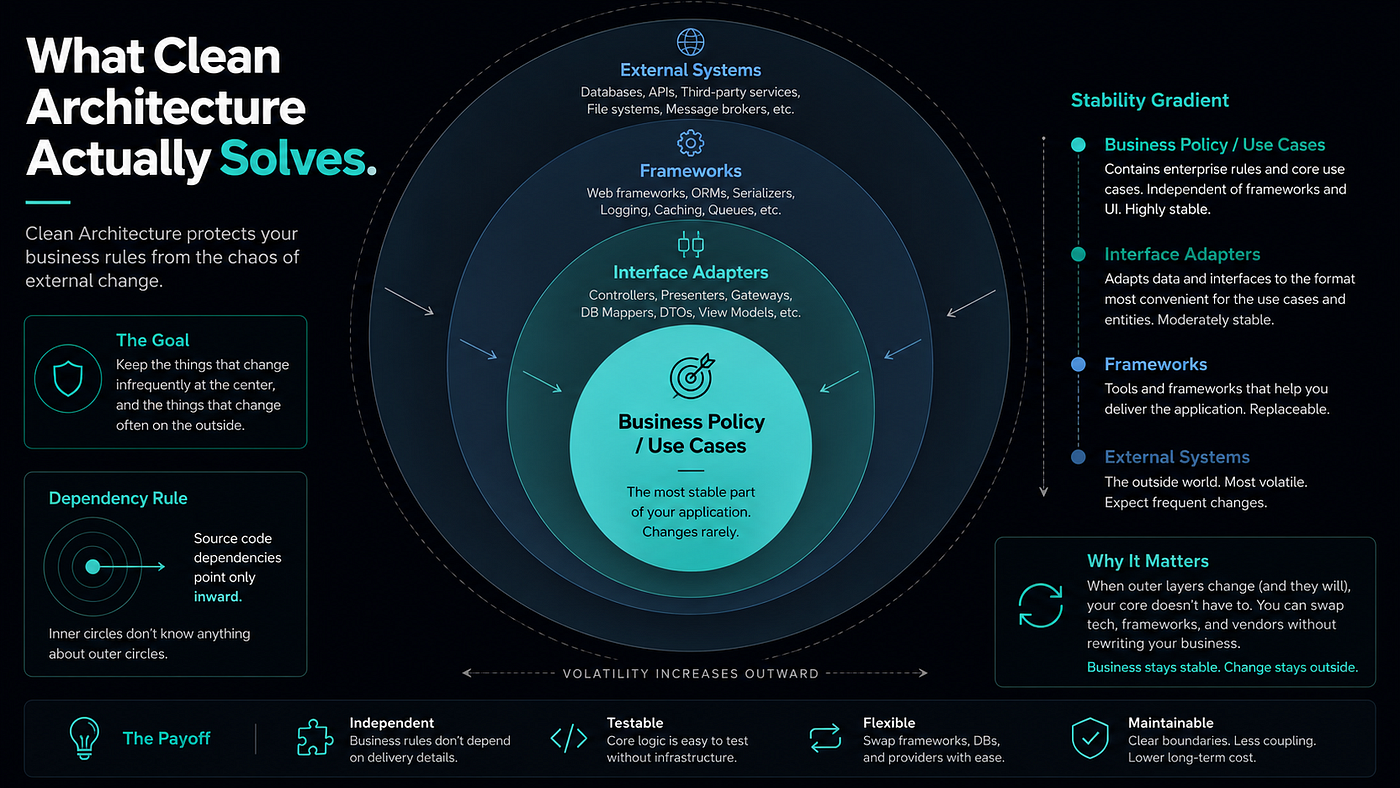
Clean Architecture keeps business policy at the center, while frameworks and integrations remain replaceable details.
How to protect your core business logic when frameworks, databases, and payment providers keep changing
In **Article 1, we looked at why layered architecture starts breaking under integration pressure. In [Article 2](https://medium.com/@nickkkcuevas/what-hexagonal-architecture-actually-solves-f25a0a39b966)**, we used Hexagonal Architecture to protect the domain from external volatility. Both are strong moves.
But as systems kept growing, another pressure appears: even when integrations are pushed outward, policy decisions, orchestration rules, and framework concerns still get mixed across modules. Teams start debating not only where code lives, but what is policy vs what is mechanism. That ambiguity creates expensive drift.
In this context, business policy includes both enterprise entities (core business rules) and application use cases (workflow orchestration).
This is exactly where Clean Architecture becomes useful.
Not because it adds more diagrams. Not because it is academically pure. Clean Architecture is an attempt to keep business policy as the least changeable part of the system, while everything else remains replaceable.
If Hexagonal asks, “How do we protect the domain from external volatility?”, Clean adds: “How do we enforce that protection consistently across policy layers and use cases over time?”
The Good Phase
Most teams do not start with Clean Architecture, and that is often the right call.
Early on, you want:
- fast delivery
- fewer concepts to hold in your head
- easy onboarding
- minimal ceremony
Layered architecture gives that. Hexagonal Architecture on the other hand adds better integration boundaries when volatility rises. They address different architectural pressures:
Layered Architecture optimizes delivery simplicity, while Hexagonal Architecture optimizes dependency isolation.
Clean Architecture becomes attractive when the core business logic is no longer “small logic in services,” but a growing set of policy decisions with real business consequences: risk checks, money movement rules, compliance constraints, compensation logic, and cross-provider consistency.
At that point, teams need stronger discipline around dependency direction and policy ownership, not just cleaner folder organization.
Where Policy Starts Leaking
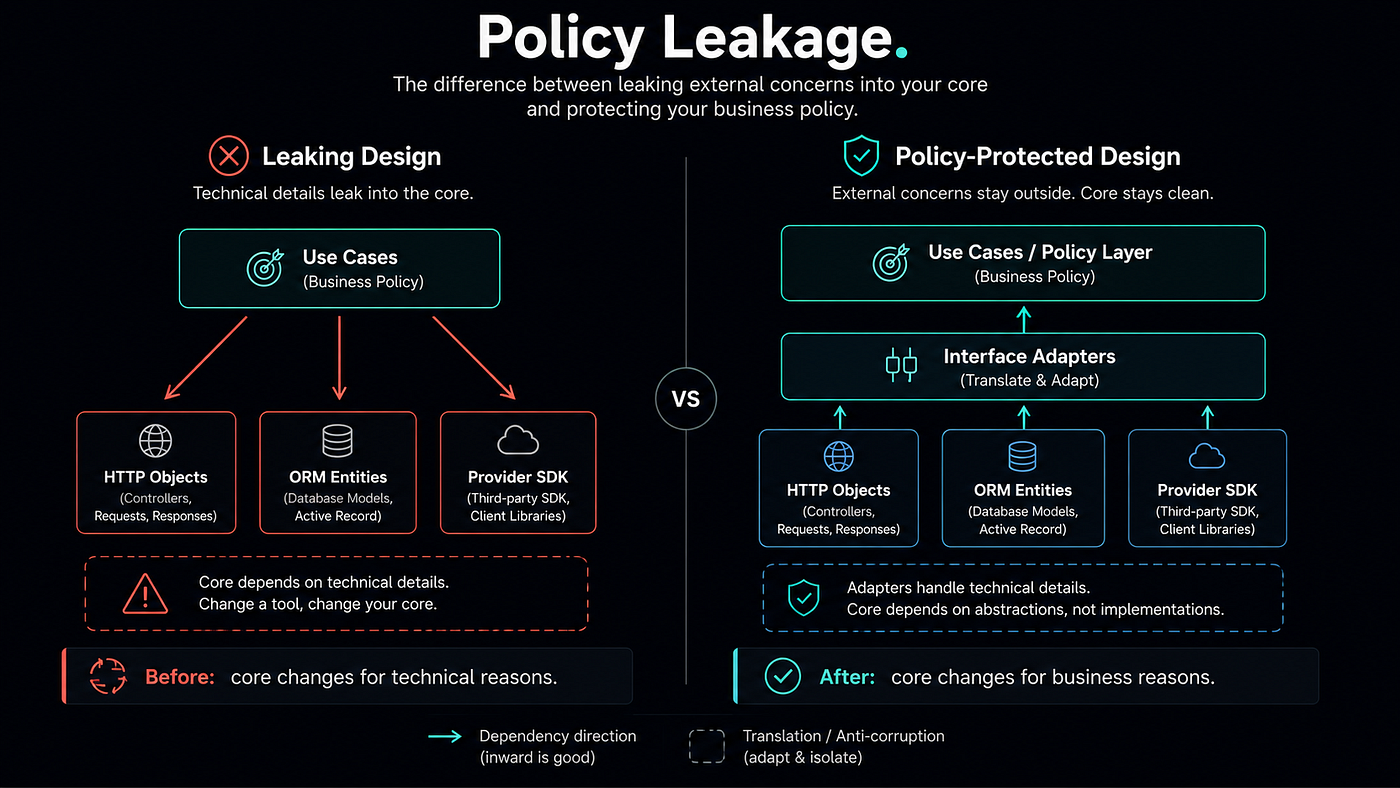
Policy leakage starts when business rules depend on framework objects, provider SDKs, or persistence details.
The key problem Clean Architecture targets is policy leakage.
You may still have “good” boundaries around adapters and providers, but if use-case decisions are entangled with framework objects, persistence assumptions, or transport-level concerns, the system remains fragile.
Common signals:
- Application rules require HTTP objects or ORM entities directly
- Use cases change when framework conventions change
- Business behavior depends on data access mechanics
- Tests require too much infrastructure to validate policy logic
- Teams cannot clearly explain what is “enterprise rule” vs “application rule”
This is where Clean Architecture’s dependency rule matters:
source code dependencies should point inward, toward higher-level policy.
In practice, that means:
- Entities and core rules should not depend on frameworks
- Use cases orchestrate policy, not transports or SDK details
- Interface adapters translate in/out of external formats
- Frameworks and databases are details at the outer edge
So what does Clean actually solve?
It solves the long-term cost of policy drift by giving teams a consistent way to separate:
- what the business decides (policy)
- from how the system executes (mechanism)
That separation improves change safety. A database migration, framework upgrade, or provider swap should not force rewrites in business policy.
A Real Growth Story: Payments
Reusing the same payment domain makes this concrete.
At first, “charge payment” looks straightforward. Then growth adds complexity:
- multiple providers (Stripe, MercadoPago, QR)
- retries and idempotency
- asynchronous reconciliation
- fraud/risk checks
- region-specific business constraints
Without strong policy boundaries, those rules scatter across services, handlers, and integration code. With Clean Architecture, use cases become the explicit home of application policy, while integrations stay behind interfaces.
from abc import ABC, abstractmethod

class PaymentGateway(ABC):
    @abstractmethod
    def charge(self, amount_cents: int, reference: str) -> str:
        raise NotImplementedError

class ChargePaymentUseCase:
    def __init__(self, gateway: PaymentGateway):
        self.gateway = gateway

    def execute(self, amount_cents: int, reference: str) -> str:
        if amount_cents <= 0:
            raise ValueError("amount must be positive")  # policy rule
        return self.gateway.charge(amount_cents, reference)  # mechanism via boundary
This is small, but the point is structural:
- policy rule (
amount must be positive) stays in use-case logic - payment mechanism stays behind an interface
- adapters can vary without rewriting core decision flow
As complexity grows, this pattern scales by making policy boundaries explicit, testable, and reviewable.
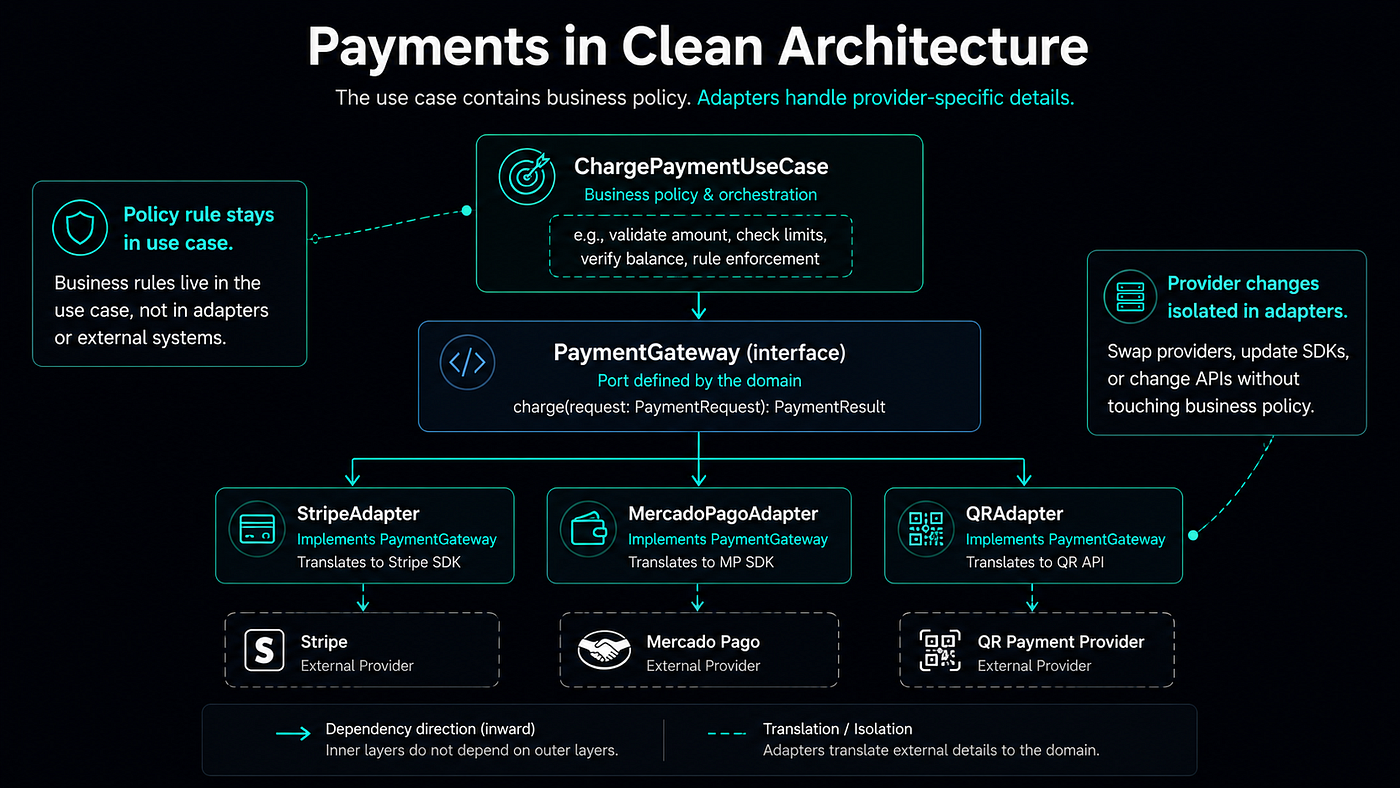
In Clean Architecture, payment policy stays in the use case; provider-specific logic stays behind a gateway interface.
What This Means in Practice
Clean Architecture does not magically reduce complexity. It organizes complexity around policy.
Tradeoff view:
- Strength: high change resilience for complex, long-lived domains
- Cost: upfront discipline, more boundaries, more architectural literacy required
For simple systems, this can be overkill. For policy-heavy systems, it can prevent years of expensive coupling.
A useful heuristic:
If business decisions frequently change for technical reasons (framework updates, provider changes, schema details), your architecture is likely missing policy boundaries Clean Architecture is designed to enforce.
So this is not “use Clean everywhere.” It is “use Clean when policy integrity is becoming your primary scalability problem.”
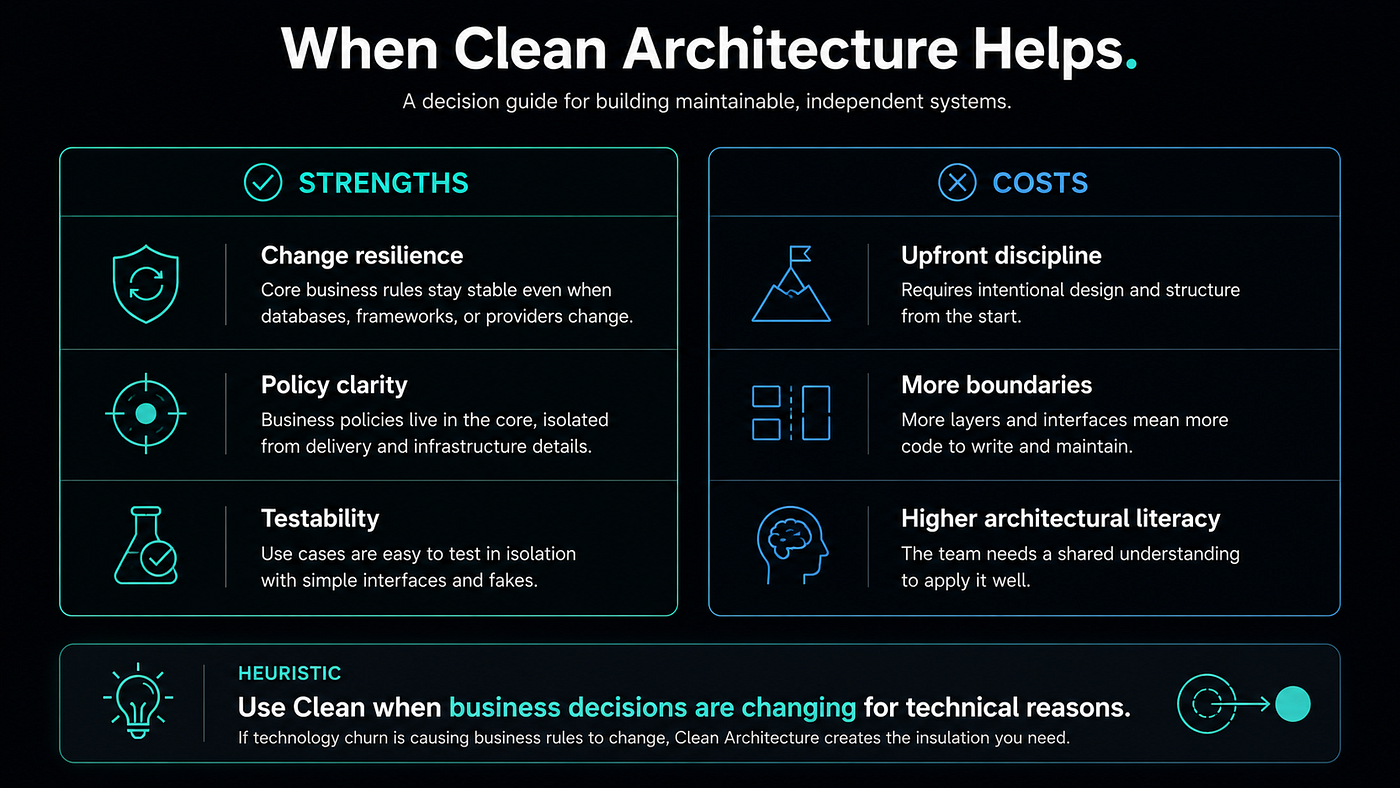
Clean Architecture does not remove complexity — it organizes complexity around policy integrity.
Bridge to the Next Step
At this point, the sequence is clearer:
- Layered Architecture gives early speed.
- Hexagonal Architecture protects the core from integration volatility.
- Clean Architecture adds stricter policy discipline across the whole dependency model.
Next article: Clean vs Hexagonal: Same Goal, Different Discipline.
That comparison is where we answer the practical team question: not “which is better,” but “which boundary discipline fits our current complexity and delivery pressure.”
References and Further Reading
- Robert C. Martin, The Clean Architecture: https://blog.cleancoder.com/uncle-bob/2012/08/13/the-clean-architecture.html
- Alistair Cockburn, Hexagonal Architecture (Ports and Adapters): https://alistair.cockburn.us/hexagonal-architecture/
- Martin Fowler, Presentation Domain Data Layering: https://martinfowler.com/bliki/PresentationDomainDataLayering.html
- Martin Fowler, Layering Principles: https://martinfowler.com/bliki/LayeringPrinciples.html
- Robert C. Martin, Clean Architecture: A Craftsman’s Guide to Software Structure and Design (book)
메타데이터
- post_id
- fb0ee5baec0d
- slug
- what-clean-architecture-actually-solves-fb0ee5baec0d
- url
- https://medium.com/@nickkkcuevas/what-clean-architecture-actually-solves-fb0ee5baec0d
- canonical_url
- https://medium.com/@nickkkcuevas/what-clean-architecture-actually-solves-fb0ee5baec0d
- author_url
- https://medium.com/@nickkkcuevas
- status
- ok
- fetched_at
- 2026-06-09 15:37:30




