Best AI Agentic Models in early 2026
AI that can think, plan, and act like an ‘agent’ to complete tasks on its own, rather than just answering questions.
Best AI Agentic Models in early 2026
AI that can think, plan, and act like an ‘agent’ to complete tasks on its own, rather than just answering questions.

◯ Anthropic Claude
◯ OpenAI Models
◯ Qwen
◯ Amazon Nova
◯ NVIDIA Nemotron
I didn’t begin my journey into AI with a clear map. It started more like curiosity, one question leading to another. What if machines could not just respond, but act? Not just answer, but decide? That’s when I stumbled into the world of agentic AI models — systems that don’t just generate outputs, but take steps, make plans, and execute tasks.
At first, the idea felt abstract. But as I explored further, I realized that these models are quietly shaping the future of how we work, create, and think.
🧩Anthropic Claude

My journey truly began with Claude, developed by Anthropic. What stood out immediately was how thoughtful it felt. Unlike traditional AI models that rush to answer, Claude often pauses, reasons, and then responds in a structured way.
One interesting thing about Claude is its strong focus on AI safety and alignment. It’s designed to behave responsibly, almost like it has a built-in ethical compass. When used as an agent, Claude can break down tasks, evaluate options, and proceed step by step, making it feel less like a tool and more like a collaborator.
🧩OpenAI Models

Then came my experience with models from OpenAI. This was where things became more dynamic. These models are not just reactive — they can be agentic, meaning they can plan, execute, and iterate.
What fascinated me most was how they could:
- Write code
- Analyze data
- Use tools
Even simulate decision-making processes
The idea that an AI could take a goal like ‘build a report’ and figure out the steps on its own felt like stepping into the future. These models are widely used because of their flexibility and ecosystem, making them a backbone for many AI-driven workflows today.
🧩Qwen
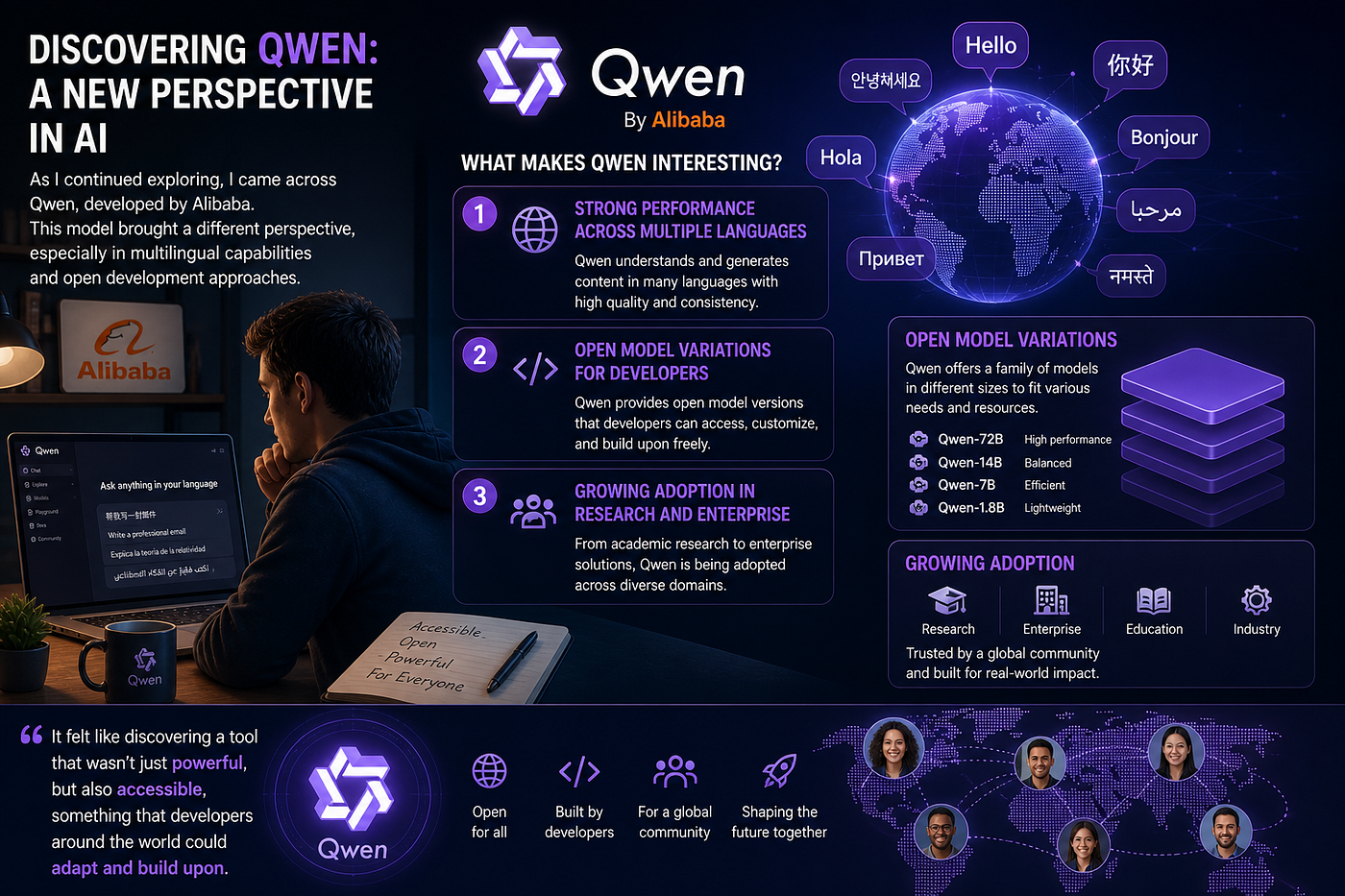
As I continued exploring, I came across Qwen, developed by Alibaba. This model brought a different perspective, especially in multilingual capabilities and open development approaches.
What makes Qwen interesting is:
- Strong performance across multiple languages
- Open model variations for developers
- Growing adoption in research and enterprise
It felt like discovering a tool that wasn’t just powerful, but also accessible, something that developers around the world could adapt and build upon.
🧩Amazon Nova

The next stop in my journey was Amazon Nova, part of the ecosystem from Amazon. Here, the focus shifted from just intelligence to scale and integration.
Amazon’s approach to agentic AI is deeply tied to:
- Cloud infrastructure
- Automation pipelines
- Enterprise-level workflows
What stood out was how these models are designed to work seamlessly with existing systems. It’s not just about intelligence; it’s about making that intelligence practical and deployable in real-world environments.
🧩NVIDIA Nemotron
Then came something unexpected: NVIDIA Nemotron from NVIDIA.
At first, I was confused. Is this even an AI model?
The answer is both yes and no.
Nemotron is not just a single model. It represents a family of models and frameworks designed to enable advanced AI capabilities, especially in reasoning and multimodal understanding. It acts more like a foundation layer that powers intelligent systems.
What makes Nemotron special?
- Strong focus on multimodal AI (text, image, audio, video)
- Designed for agentic reasoning workflows
- Built to run efficiently on high-performance GPUs
So even though it may not always be labeled as a traditional “AI model,” it plays a critical role in enabling agentic systems. It’s like the engine behind the scenes, making everything run smoothly.
Looking back, what started as a simple question turned into a deeper exploration of how machines are evolving. Agentic AI models are not just tools; they are partners in problem-solving.
And this journey is far from over.
As these systems continue to improve, the line between user and creator will blur. You won’t just use AI, you’ll collaborate with it.
Maybe that’s the real story here. Not just about AI models… but about how we are learning to think, create, and build alongside them.
메타데이터
- post_id
- fb1b0396ca40
- slug
- ai-agentic-models-fb1b0396ca40
- url
- https://medium.com/@phototech/ai-agentic-models-fb1b0396ca40
- canonical_url
- https://medium.com/@phototech/ai-agentic-models-fb1b0396ca40
- author_url
- https://medium.com/@phototech
- status
- ok
- fetched_at
- 2026-06-09 15:37:30




