FEEL RIGHT vs. ACTUALLY RIGHT.
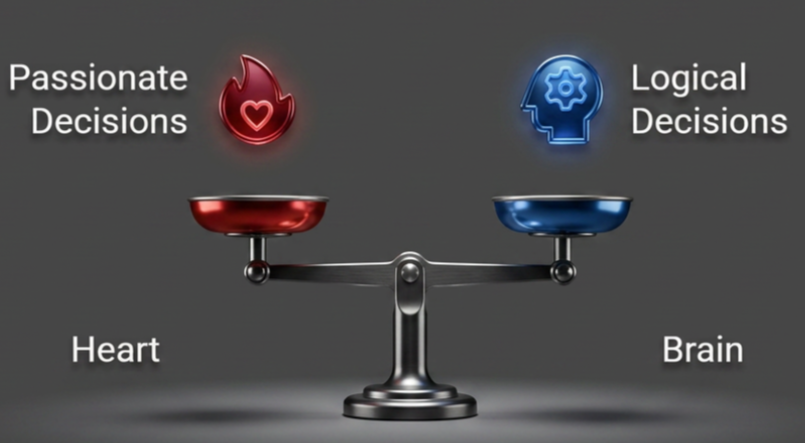
What feels good is not always right, and what is right does not always feel good.
FEEL RIGHT vs. ACTUALLY RIGHT.
What feels good is not always right, and what is right does not always feel good.
All of us do one thing or another in life and most of the time they are based on what we feel, if we’re happy — we tend to talk nicely to strangers and if we’re upset or in a bad mood then we talk rudely to even our close ones. It is merely our emotions that decide our course of action, and not the person standing in front of us.
It is rare that we stop and reflect, what just happened and what was actually supposed to happen? That is the essential difference between what we think is right and what is actually right. Often, we do things that we shouldn’t be doing because somewhere it has hurt someone, disrespected someone or has made someone look down upon themselves. We do such actions simply because we convince ourselves it’s justified just because we’re angry or feel superior and thus believe we have the right to make others feel miserable.
Think about it, no matter how many lemons life throws at us, we still have expectations of how we want our lives to unfold, but that rarely is, yet that doesn’t stop us from demanding things from God, we believe we deserve all that we ask for.
Yet, when it comes to doing the right to others we misjudge, we refuse and we fail to do it. How can we ask for good things for ourselves but refuse to extend the same to others? Whereas in the same scenario when somebody else does something they weren’t supposed to or say they crossed their boundaries, we cling to a sense of entitlement and keep blaming the other person that they wronged us, this is known as the self-serving bias, where everything we do is justified, but when others do the same, we judge them harshly and call it mean, inappropriate, or inconsiderate. It is merely a defense mechanism of the ego: shielding our self‑image by excusing our own faults while magnifying those of others.
Coming back to the point, we’re so caught up in our busy lifestyle and entitlement mindset that we fail to see how insensitive our behaviour is towards someone who simply cannot stand against us, can’t fight us because we’re superior to them or just because we hold more power? Our ego blinds us and makes us lose our humanity. It is our everyday actions like not doing some work our parents gave us, so they end up doing it themselves, not treating servants, helpers etc properly even though we’ve been taught otherwise all our lives. It is truly shocking how we do these things and easily brush it off, simply because we have other things we consider more important to deal with or think about, we convince ourselves that it is okay to compromise on our ethics and values. And the worst part? Even the person in front of us tolerates this, perhaps they love us in the case of parents or maybe they feel inferior to us, as in the second case.
We think it is okay to respect someone who might fire us from the job, and it is okay to disrespect someone because they are of no use to us, or to put it bluntly, they have no influence over our lives.
I don’t understand since when did it become a trend in the world to see treat real helpers and supporters as secondary, while giving importance to those who badmouth us behind our backs. EVERYONE DESERVES RESPECT, CARE AND EQUALITY REGARDLESS OF WHETHER WE BENEFIT FROM THEM OR NOT.
As humans, it is our highest responsibility that we treat our fellow humans as equal, if not more than ourselves and our emotions should not override our duties, as I mentioned *in my previous article, that emotions, in general, are not a stable metric for make decisions. Most importantly, “मानवधर्मः परमं भक्तिः” — “For humans, dharma is the highest devotion.” According to the Bhagavad Gita, the essence is that living according to dharma — truth, justice, and responsibility — is considered the supreme form of devotion, even greater than ritual or prayer.*
So, I hope that next time we interact with someone, it runs through our minds that who we are in front of them and what our values have taught us how to behave; because in the end, “Character is doing what’s right when it doesn’t feel right.”
Regards, Ishita.
메타데이터
- post_id
- fb263cba355f
- slug
- feel-right-vs-actually-right-fb263cba355f
- url
- https://medium.com/@eshitaudani42/feel-right-vs-actually-right-fb263cba355f
- canonical_url
- https://medium.com/@eshitaudani42/feel-right-vs-actually-right-fb263cba355f
- author_url
- https://medium.com/@eshitaudani42
- status
- ok
- fetched_at
- 2026-06-11 05:11:55