Beyond the Red Notice: The Strategic Power (and Vulnerability) of Interpol Diffusions
Following the arrest of Bangladesh’s former IGP Benazir Ahmed, a critical question arises: Can international law enforcement track you down…
Beyond the Red Notice: The Strategic Power (and Vulnerability) of Interpol Diffusions
Following the arrest of Bangladesh’s former IGP Benazir Ahmed, a critical question arises: Can international law enforcement track you down without a Red Notice?
The recent arrest of Bangladesh’s former Inspector General of Police (IGP), Benazir Ahmed, by Dubai authorities has thrust international police cooperation back into the global legal spotlight. While local news reports quickened to highlight the critical role played by INTERPOL, they also underscored a massive, persistent misconception within global white-collar defense: the belief that a fugitive is legally safe until a formal Red Notice is published.
Following the arrest, statements from the Bangladesh Ministry of Home Affairs claimed that Ahmed was apprehended under a “red alert.” Yet, an inspection of Interpol’s public channels reveals an immediate contradiction: Ahmed’s name was never listed on an active, publicly broadcasted Red Notice.
How does an international arrest of this scale materialize when no formal Red Notice exists?
The answer lies in a much faster, less visible, yet operationally lethal mechanism that frequently does the heavy lifting in cross-border enforcement: The Interpol Diffusion.
For international defense practitioners, white-collar crime lawyers, and human rights advocates, understanding the mechanics of a diffusion isn’t just an academic exercise — it is a matter of immediate client protection. Here is a breakdown of how this mechanism works under global administrative law, why it completely bypasses traditional treaty frameworks, and how to defend against its systematic abuse.
1. The Red Notice vs. The Diffusion: A Structural Shift
While a Red Notice requires centralized vetting and formal publication by the Interpol General Secretariat before it is distributed globally, a Diffusion operates with immediate, decentralized speed. Governed primarily under Articles 74 and 95 of the INTERPOL Rules on the Processing of Data (RPD), it fundamentally changes how member states exchange data:
- Direct Transmission: A country’s National Central Bureau (NCB) — such as NCB Dhaka — can draft a wanted-person alert and broadcast it directly to specific target countries (like the UAE) via Interpol’s secure I-24/7 communication system. It bypasses the centralized queue entirely.
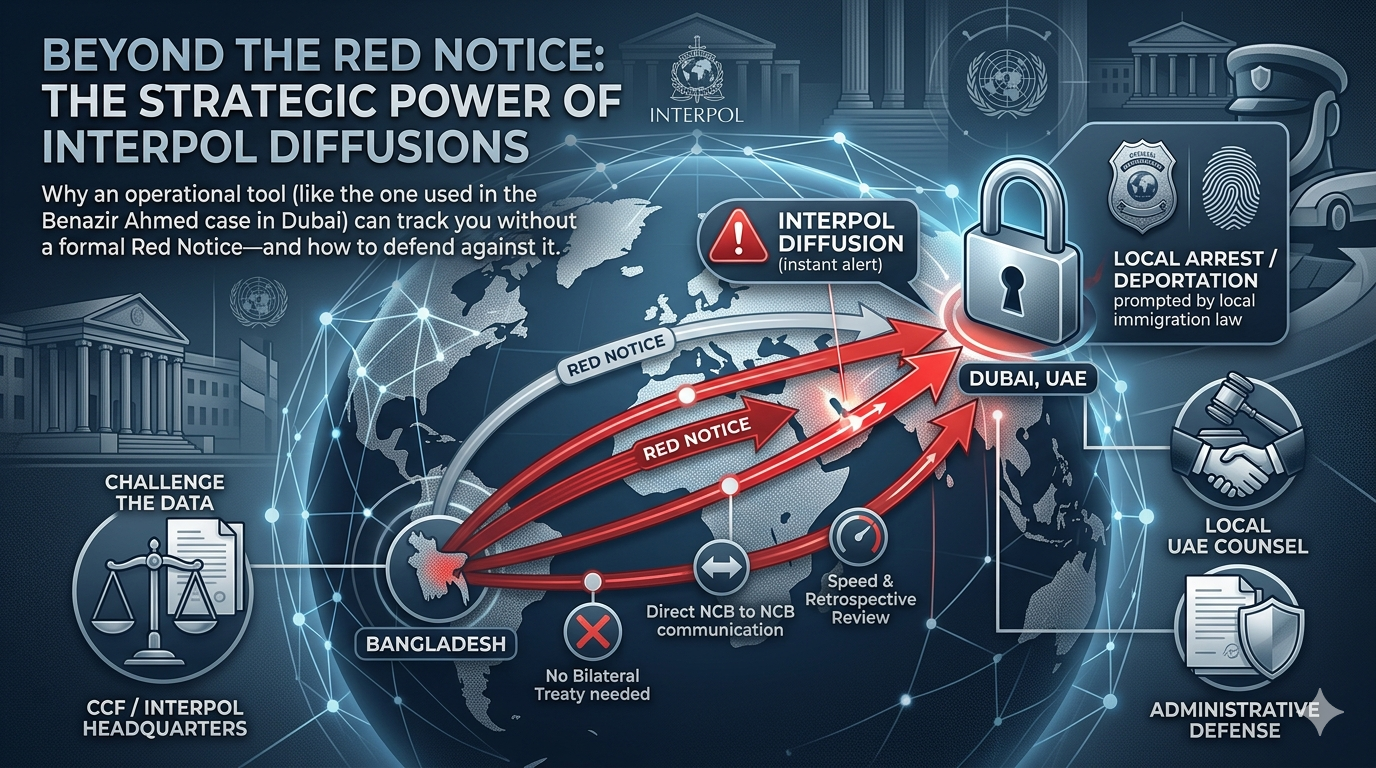
- Zero Vetting Prior to Launch: A diffusion hits the data terminal of the foreign police force immediately. Review by Interpol’s specialized Notices and Diffusions Task Force (NDTF) occurs retrospectively. This creates a high-risk operational window where authoritarian regimes can exploit the system, using fabricated ordinary-law charges (like financial fraud or corruption) to target political opponents before Interpol headquarters can intervene.
2. Can It Work Without a Bilateral Extradition Treaty?
This is the single most common question clients and legal scholars ask when analyzing cross-border detentions. The answer is a definitive yes.
Because Interpol itself possesses no executive policing powers, a diffusion carries no independent legal authority to force a sovereign state to arrest or detain an individual. It is, at its core, a multilateral intelligence-sharing conduit. Therefore, its success depends entirely on the domestic statutory framework of the host nation where the individual is located:
- The Domestic Loophole: Even if two nations lack a bilateral extradition treaty, a host country (such as the UAE) is entirely within its sovereign rights to act on a diffusion’s intelligence using its own domestic criminal code.
- Immigration Enforcement over Extradition: Launching a complex judicial extradition process without a treaty can be legally cumbersome and take years. Instead, host nations frequently pivot to domestic immigration laws. Upon receiving a foreign alert via a diffusion, authorities can unilaterally declare the individual an “undesirable alien,” revoke their visa, and execute a rapid administrative deportation or expulsion.
3. The Modern Enforcement Landscape: The Dubai Factor
Defending against these tools has become even more complex due to shifting regulatory environments in major financial and logistical hubs. For instance, the UAE’s recent policy pivots — employing more targeted government agencies and specialized officials to monitor, investigate, and clamp down on offshore allegations of corruption and money laundering — have added significant fuel to existing enforcement challenges.
When a country increases its domestic scrutiny over foreign capital and political figures, an incoming Interpol diffusion acts as an immediate trigger for state security and immigration bureaus to act, regardless of whether a formal treaty exists.
The Strategic Roadmap for Defense Counsel
If a client faces a politically charged ordinary-law criminal alert being funneled through Interpol channels, a passive or reactive strategy is fatal. Defense counsel must immediately pivot to an aggressive, dual-track response:
Track A: The Centralized Shield (Interpol Headquarters)
- File for Urgent Provisional Measures: Do not simply petition the Commission for the Control of INTERPOL’s Files (CCF) for standard data deletion, as the full adjudication process takes months. Explicitly request interim relief under Article 36 of the Statute of the CCF to temporarily block or suspend the diffusion’s visibility across the global network while the case is being reviewed.
- Demonstrate the Political Nexus: To trigger the Article 3 prohibition of the Interpol Constitution (which strictly forbids interventions of a political, military, religious, or racial character), build an evidentiary framework establishing a clear link between the client’s public profile and the sudden orchestration of criminal charges.
Track B: The Localized Anchor (The Host Jurisdiction)
- Preemptive Public Prosecution Briefs: Engage local counsel in the host country (e.g., Dubai) immediately to run localized status checks through the Public Prosecution office or police registries. File protective administrative briefs directly with the host’s Ministry of Interior.
- The Non-Refoulement Argument: Present the formal CCF dispute to local immigration authorities. Argue that an administrative deportation bypassing judicial extradition violates international non-refoulement standards due to a substantiated risk of human rights violations or arbitrary detention upon return to the home country.
Final Thoughts
International law enforcement is moving faster than formal diplomacy. As states increasingly utilize direct police-to-police networks and domestic immigration workarounds to bypass judicial checks, defense strategies must match that velocity. A robust cross-border defense requires acting at the General Secretariat in Lyon and on the ground in the host country simultaneously.
References
- Bromund, T. R. (2022). Interpol needs improved financial transparency to restore its integrity and block autocratic manipulation. The Heritage Foundation Special Report, (258), 1–16.
- Bromund, T. R. (2025). How the abuse of Interpol contributes to transnational repression. New Lines Institute for Strategy and Policy.
- Mehta, C. D. (2023). How to challenge an INTERPOL Red Notice. Grossman Young & Hammond Law Journal, 6(2), 205–222.
- Safjański, T. (2017). Crucial problems in the functioning of Interpol on the threshold of the 21st century. Internal Security, 9(2), 85–98.
- U.S. Immigration and Customs Enforcement. (2023). INTERPOL Red Notices and Wanted Person Diffusions (ICE Directive №15006.1). U.S. Department of Homeland Security.
메타데이터
- post_id
- fb2f833d6ccc
- slug
- beyond-the-red-notice-the-strategic-power-and-vulnerability-of-interpol-diffusions-fb2f833d6ccc
- url
- https://medium.com/@tkbaul/beyond-the-red-notice-the-strategic-power-and-vulnerability-of-interpol-diffusions-fb2f833d6ccc
- canonical_url
- https://medium.com/@tkbaul/beyond-the-red-notice-the-strategic-power-and-vulnerability-of-interpol-diffusions-fb2f833d6ccc
- author_url
- https://medium.com/@tkbaul
- status
- ok
- fetched_at
- 2026-07-11 10:44:35


