I Didn’t Expect a Free Quiz App to Change My English
What a classroom quiz game revealed about how we actually learn
I Didn’t Expect a Free Quiz App to Change My English
What a classroom quiz game revealed about how we actually learn
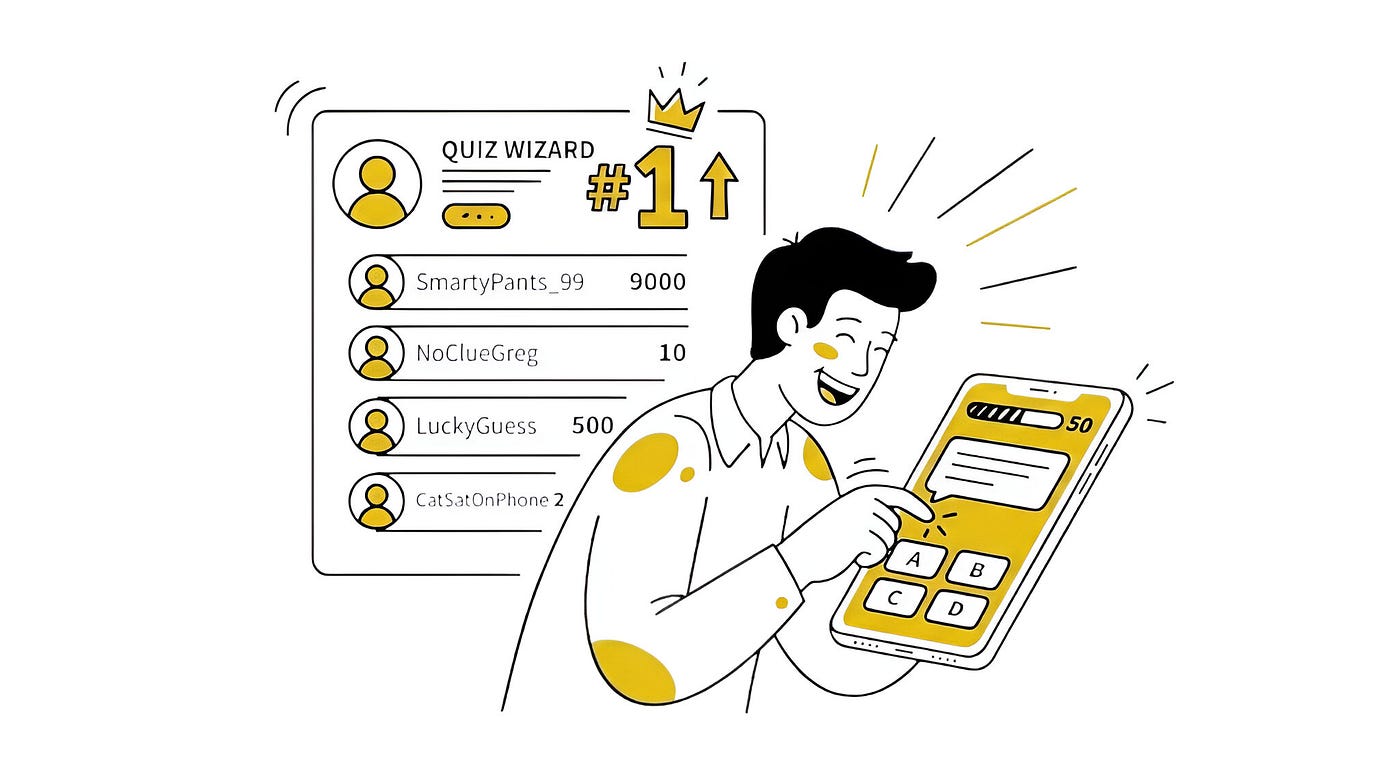
Image generated by the author with Gemini
Not so long ago, learning a language meant sitting at a desk pretending you enjoyed filling in blanks.
Fun was… not the main objective.
And yet, here we are — adults voluntarily yelling at a screen because we want to beat our classmate by 0.3 seconds on a question about the past tense.
Language learning has changed.
Whether you’re studying English, French, Arabic, Spanish, or any other language, the tools available today look nothing like those used by previous generations.
Lessons have moved beyond grammar tables and vocabulary lists into something far more dynamic, far more social.
And one of the biggest changes? Learning started to feel like a game.
And we’re not talking about the old-school games that teachers used to pull out when the electricity went out — you know, the ones where you’d go around the circle naming cities, or try to keep a word chain alive without repeating anything.
Those were fine.
But what’s available now is a completely different level.
Because once you see it in action, there’s really no going back to plain worksheets.
I’ll be honest — I had been teaching Polish for many years before, but I didn’t know about one of the apps until I took an English course.
Learning Stopped Feeling Like Work
I discovered this shift personally when I joined an English language course as an adult.
I came in expecting something fairly traditional — coursebook, audio tracks, speaking exercises.
What I didn’t expect was that some of the most effective moments in that course would happen through a colorful app on my phone, in the middle of a group of 6 people, all staring at a screen and half-shouting at their own answers.
Unexpected.
The app was **Kahoot**.
If you haven’t encountered it yet, here’s the basic idea: a host launches a quiz, everyone joins via a shared code on any device — phone, tablet, laptop — and questions appear on the main screen while answer options appear on your personal screen.
You choose your answer against a countdown timer, and points go to whoever is both correct and fast.
A leaderboard updates after every question.
The whole thing takes minutes to set up and seconds to understand.
And then something strange happens.
People who were quiet and careful during regular speaking practice suddenly become competitive and vocal (because competition and games always awaken hidden emotions within us).
Someone gets a grammar question wrong and immediately wants to know why.
Someone else gets three in a row right and starts coaching their neighbor.
The atmosphere shifts from classroom to something closer to a game night — except every single question is teaching you something. In a way, it even reminded me of playing Mafia — where everyone starts very united, but as the game unfolds, previously unknown personality traits begin to surface, haha.
That’s the trick.
Our teacher used Kahoot consistently throughout the course, usually as a recap at the end of class or a warm-up at the beginning.
Vocabulary from the lesson, idioms we’d covered, grammar structures we’d been drilling — all of it reappeared in game format, and all of it stuck better for having gone through that filter.
I can still recall words I encountered twice in a Kahoot session more clearly than things I wrote in my notebook repeatedly.
Add a countdown timer and a leaderboard, and suddenly your brain decides this matters.
Especially when your colleague is in first place.
What It Actually Covers — and Who It’s For
Alright, enough colorful theory — I want to show you some visuals.
Here’s where things get interesting for teachers who are reading this with a degree of healthy skepticism.
Kahoot is not a single-subject tool, and it is not limited to English.
The platform has a public gallery of pre-made quizzes that is, to put it plainly, enormous — and it covers far more ground than most people initially expect.
Are you learning French? Ready-made quizzes are waiting for you right now. One of them — “French Greetings,” created by a verified teacher — has already been played over 7,400 times and passed through nearly 48,000 participants.
It covers hello, goodbye, formal and informal address, all built around images and short visual prompts that make the content memorable and fun rather than mechanical.
Look.

Screenshot of a Kahoot! French greetings course page from a computer, taken by the author.
Nice, right?
How about Arabic — a language many learners find especially intimidating because of its script and sound system? There’s a full course on the platform called “Arabic Language for Non-Native Speakers,” structured across multiple kahoots and 79 questions total.
The questions work on spelling, vocabulary, and sentence recognition — the exact foundations that tend to feel overwhelming when approached through traditional study alone.

Screenshot of an Arabic language Kahoot! course page from a computer, taken by the author.
The gallery contains quizzes in Polish, Spanish, Italian, German, Japanese, and dozens of other languages at various levels and covering various topics — everyday vocabulary, grammar structures, cultural knowledge, and pronunciation patterns.
Whatever language you’re working on, someone has almost certainly already built something useful and made it publicly available for free.

Screenshot of the Kahoot! homepage showing Polish language learning kahoots from a computer, taken by the author.
Scroll, and you’ll find it.
So…
What if the student in your life isn’t struggling with French greetings but with quadratic equations?
The math section of the Kahoot gallery is genuinely staggering. Geometry, algebra, fractions, rational numbers, functions, word problems — over 10,000 quizzes covering mathematics from kindergarten level all the way through advanced high school content.
And yes — there are Disney and Marvel themed quizzes in there. Which, if you have a 9-year-old at home, you already understand the power of.
There are math courses built around Disney Pixar Cars, Spider-Man, and the Avengers. Your child can practice multiplication with Marvel superheroes. Division of fractions, wrapped in a universe they already love.
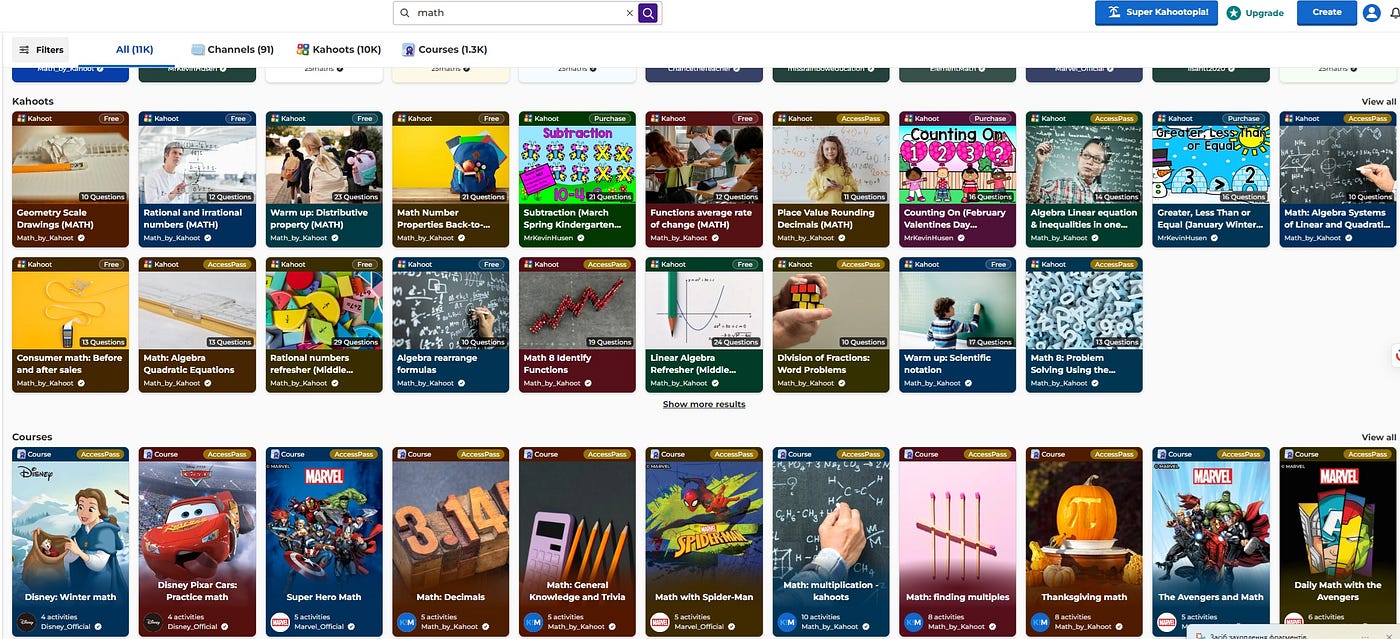
Screenshot of the Kahoot! homepage showing math learning kahoots from a computer, taken by the author.
When a child is motivated by the wrapper, they absorb the content inside it far more readily. Teachers have known this for decades — Kahoot just makes it ridiculously easy to do, with characters and worlds that children are already emotionally invested in.
And since we’re talking about the gallery, BBC Learning has its own official channel inside Kahoot, and the visual design of their quizzes alone is worth mentioning.
Take a look at what an actual question looks like mid-game: a beautifully illustrated map of India fills the screen, the Taj Mahal appears in the background as part of the interface art, and four answer options wait at the bottom — Cairo, Agra, Beijing, Rome.
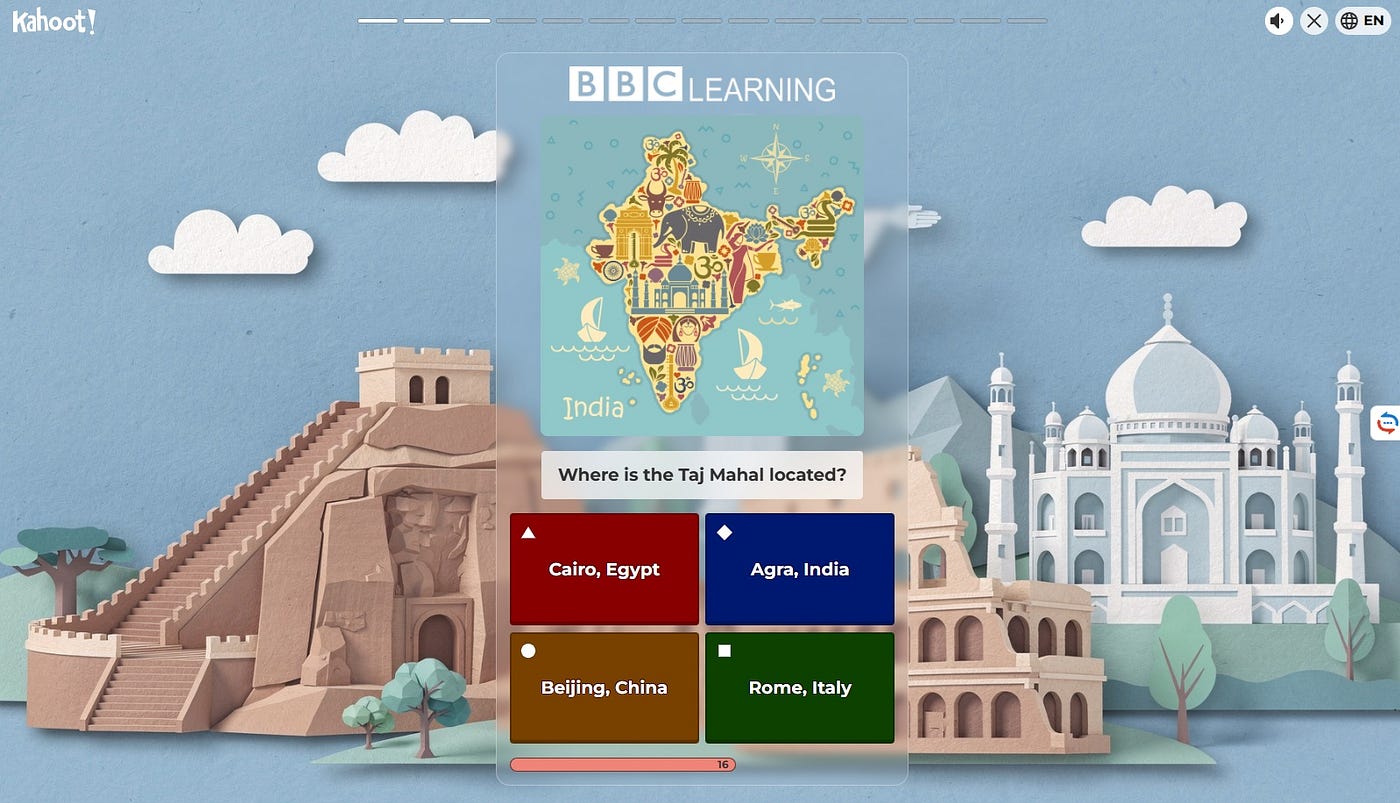
Screenshot of a BBC Learning Kahoot! quiz question about the Taj Mahal, taken by the author.
That’s what a good quiz looks like.
Never Used Kahoot Before? Start Here
I promise, it’s less dramatic than it sounds.
If you’ve made it this far and you’re thinking “this sounds interesting, but I have no idea where to begin” — that’s a completely reasonable place to be.
Here’s how to actually get started, from someone who walked in knowing nothing.
Honest.
Go to kahoot.com and create a free account. The free version is substantial — you don’t need to pay anything to explore the gallery, join games, or run sessions with up to 40 participants.
That’s more than enough for a classroom, a study group, or a family game night around the kitchen table.
Now the practical part.
- Search by topic Type what you’re studying — “French greetings,” “algebra grade 8,” “English idioms B2”. The more specific, the better the results.
- Check the play count A quiz played 5,000+ times by tens of thousands of participants has been tested by real teachers with real students. That’s a good sign!
- Start with something short Ten to twelve questions for your first session.
- Teachers: use “Host Live” Share the PIN, watch the room join, and let the leaderboard do the motivating for you.
- Solo learners: use “Play Solo” or “Learn” mode No timer pressure, no competition — just you and the content at your own pace.
- Studying with a friend remotely? Share the PIN over any messaging app. They join from wherever they are, the game runs exactly the same way.
- Got it wrong? Good Don’t skip the moment after a wrong answer. Because that’s where the actual learning happens — go back, understand why, and you’ll remember it far longer than anything you got right on the first try.
Why I’m Even Telling You This
I am a teacher. And a private tutor — specializing in Polish, which means I spend a significant part of my life thinking about one question: how do I make this actually stick?
How do I take a grammar rule, a vocabulary set, a concept that feels abstract and distant — and make it actually reach the person sitting across from me?
That question never gets old.
I shared this because Kahoot genuinely changed something in how I work with groups. Not as a replacement for methodology, but as a tool that does something I couldn’t always do on my own: it makes the room feel safe enough to be wrong, and excited enough to try again.
It matters.
But here’s the thing — it’s not only about groups. Kahoot works just as well when it’s just you, a cup of tea, and fifteen minutes between lessons.
I use it that way myself. In my free time, I’ll find a general knowledge quiz and go through it over lunch.
That’s a perfectly valid way to use it, too.
For independent learners especially, this kind of low-pressure solo exploration is underrated.
You’re just playing — and somewhere inside that, you’re absorbing useful phrases, expanding your general knowledge, and staying curious about the world in a way that eventually feeds back into everything else you do.
Quietly. Effectively.
I also shared this because I know how many teachers are still on the other side of this — curious about interactive tools, slightly skeptical, not sure where to start or whether it’s worth the effort.
And what I can tell you from real classroom experience is that the first time you run a Kahoot session with a group that’s never played before, something shifts in the room. People laugh. People are suddenly fighting for first place on the leaderboard.
So this article is my way of passing it on — from one educator to anyone who teaches, tutors, or simply cares about how people learn.
Try it once with a real group (if you are a teacher).
Or try it alone (if you are a student), over lunch, just for yourself.
Either way — watch what happens.
You’ll know.
If you found this article useful, support my work with a coffee 💛
메타데이터
- post_id
- fb2f8577cfc8
- slug
- i-didnt-expect-a-free-quiz-app-to-change-my-english-fb2f8577cfc8
- url
- https://medium.com/the-language-times/i-didnt-expect-a-free-quiz-app-to-change-my-english-fb2f8577cfc8
- canonical_url
- https://medium.com/the-language-times/i-didnt-expect-a-free-quiz-app-to-change-my-english-fb2f8577cfc8
- author_url
- https://medium.com/@polskizleo
- status
- ok
- fetched_at
- 2026-07-11 18:55:18