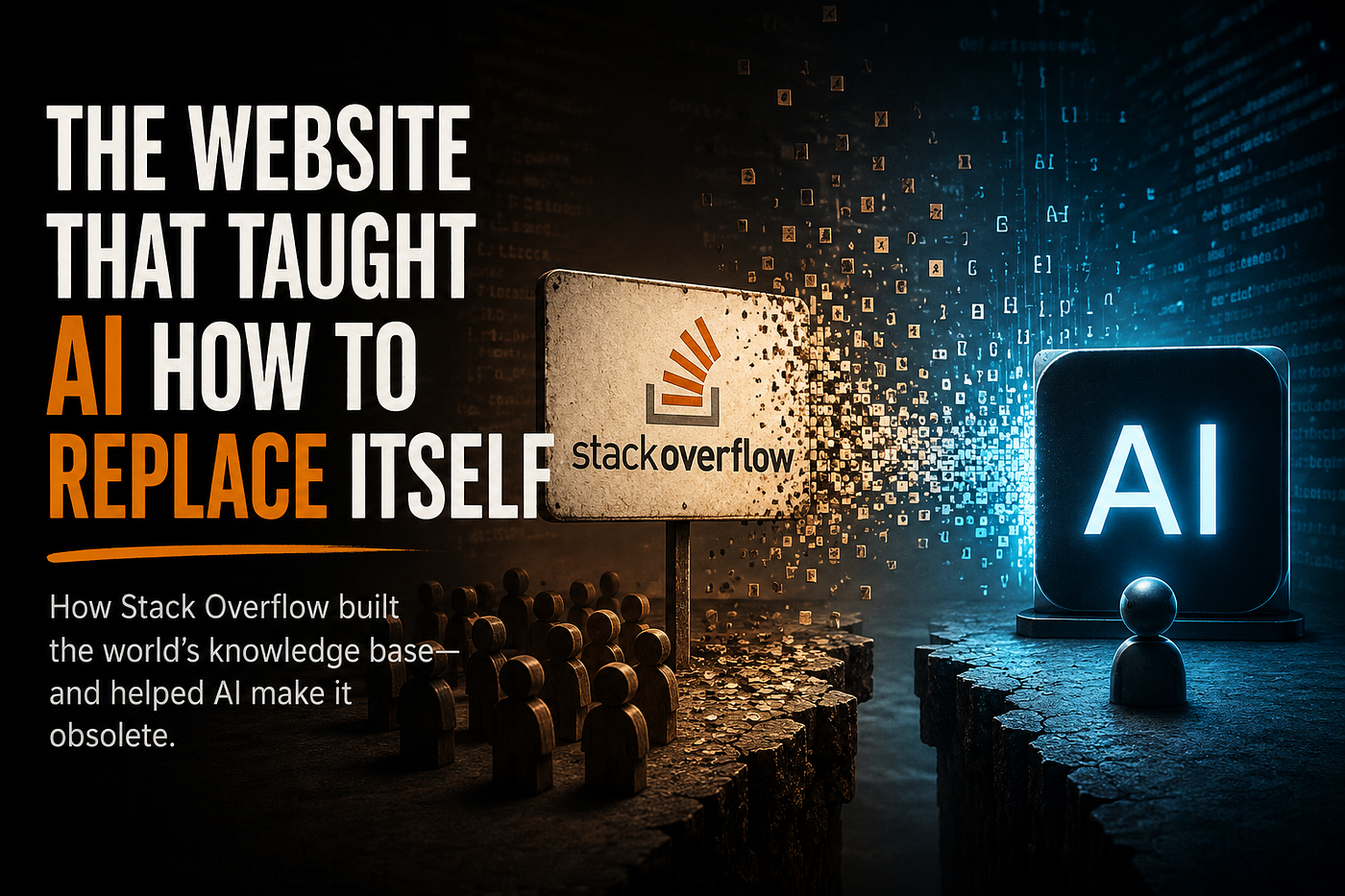
Stack Overflow The Website That Taught AI How to Replace Itself
For 15 years, programmers helped build the internet’s largest knowledge base. Then AI learned from it — and stopped sending users back.
Stack Overflow The Website That Taught AI How to Replace Itself
For 15 years, programmers helped build the internet’s largest knowledge base. Then AI learned from it — and stopped sending users back.
Every programmer knew the ritual. Hit an error you didn’t recognize. Copy the exact text. Paste it into Google. Click the blue link that said Stack Overflow. Scroll past the question to the second or third answer down. Find the fix. Close the tab. Repeat tomorrow.
Then, sometime around 2023, millions of programmers quietly stopped doing that.
In 2014, Stack Overflow received more than 200,000 new questions in a single month. By late 2025, that number had fallen below 50,000 — back to roughly where it stood in 2008, the month the site launched. Seventeen years of growth, erased in about three years. Nobody deleted the site. Nobody shut it down. The questions just stopped coming, because the people who used to ask them found somewhere faster to go.
That somewhere was trained, in large part, on the very answers Stack Overflow’s users had spent a decade and a half writing for free.
The Golden Age
That ritual wasn’t a quirk of any one developer’s habits. It was close to universal. If you wrote code between roughly 2010 and 2022, you didn’t learn it from a manual — you absorbed it the way you absorb any shared culture, by watching everyone around you do the same thing. Nine times out of ten, the first blue link after a search was a Stack Overflow thread, and the fix was waiting a few scrolls down.
Forgot the syntax for a SQL join? Stack Overflow.
Python throwing an error you’d never seen before? Stack Overflow.
CSS doing something that defied the laws of physics? Stack Overflow.
This wasn’t a tool people merely used. It was infrastructure people depended on, the way a city depends on its water table — invisible until you imagine it gone. By the time Prosus acquired the company for $1.8 billion in 2021, Stack Overflow had helped developers an estimated 50 billion times, and was pulling in around 100 million monthly visitors across 190 countries.
What made it work was a deal nobody negotiated out loud. Millions of programmers answered questions from total strangers, for nothing. No payment, no byline that mattered beyond a number next to their name. A 2013 study found that most users asked exactly one question and answered exactly one question — meaning the site’s depth came not from a small priesthood of experts, but from an enormous, shifting crowd of people who each gave a little.
Why did they bother? Ask any longtime contributor and the answer rarely mentions money. It mentions something closer to civic duty: the sense that they were building a shared, permanent record — the place future programmers, including their future selves, would go to find the answer that had taken them three hours to figure out the hard way. Jeff Atwood and Joel Spolsky, the two engineers who built the site in 2008, designed it explicitly as a public alternative to closed, paywalled expert forums. The entire premise was that knowledge should outlive the moment it was written down.
It worked, spectacularly. By 2014, the platform was fielding over 200,000 new questions a month, and the back catalog had become something close to a public utility for an entire profession.
The Success That Created the Problem
Here is where the story turns, and it turns on the very qualities that made Stack Overflow great.
Think about what 15 years of contributions actually produced. Not just answers — structured answers. Each question tagged by language and framework. Each answer voted on by thousands of working programmers, so the best explanation consistently rose to the top and the wrong ones sank. Each thread, in effect, peer-reviewed by the exact population qualified to judge it. Licensed, from day one, under Creative Commons terms that explicitly permitted reuse.
Now describe that same dataset in a different vocabulary — the vocabulary of someone building a language model in 2019 or 2020.
Public. Structured. Human-verified for quality. Massive in scale. Pre-licensed for reuse.
That is not a description of a help forum. That is a description of ideal AI training material — arguably the single highest-quality corpus of technical question-and-answer pairs that has ever existed in machine-readable form, anywhere on the internet.
Nobody contributing an answer to a Python threading bug in 2016 thought of themselves as a data labeler. They thought they were helping another human being get unstuck at 2 a.m. And they were. But every one of those answers was also, simultaneously, a training example — a clean input-output pair showing a model what a correct, well-explained solution looks like, written and validated by the people most qualified on Earth to validate it.
This is the part of the story that doesn’t resolve into villains. Nobody at Stack Overflow set out to build a free labor pipeline for future AI labs. Nobody answering a question about Django migrations in 2015 had any reason to think about transformer architectures, which didn’t exist yet in their modern form. The mismatch wasn’t a betrayal. It was a category error nobody could have caught in advance: a community built a library, and assumed the only readers would be people.

Which raises a question most people answer wrong on instinct. Most people hear “Stack Overflow’s traffic collapsed” and assume it means the site failed. But its founders set out to do exactly one thing: make programming knowledge so accessible that no developer would ever have to solve the same solved problem twice. By that standard, Stack Overflow didn’t fail. It succeeded completely — so completely that the knowledge stopped needing a destination at all. That’s the part that’s tragic and fascinating at the same time: this isn’t a story about a platform that got the job done badly. It’s a story about a platform that got the job done so well it engineered its own redundancy.
The Student Surpasses the Teacher
The old workflow had four steps, and every developer alive had them memorized.
- STEP 1: Search Google for the error message
- STEP 2: Open the top Stack Overflow result
- STEP 3: Read four or five competing answers
- STEP 4: Compare them, adapt the best one to your code
The new workflow has two.
- STEP 1: Ask ChatGPT
- STEP 2: Get an answer, already adapted to your exact code

This isn’t a minor efficiency gain. It’s a structural collapse of the in-between. The library didn’t get faster. The library got skipped — because the model had already read the library, digested it, and could now hand you a synthesized answer without you ever needing to visit the source, compare alternatives, or sit through someone’s seven-year-old comment thread about a deprecated API.
The user no longer goes to the archive. The archive’s contents come to the user, repackaged, instantly, on demand.
The data shows exactly when this happened, and it is not subtle. ChatGPT launched in November 2022. Within five months, Stack Overflow’s traffic was down 14% year over year. By March 2024, monthly questions had fallen to 58,800, down from 87,000 the same month a year earlier — a 32.5% drop in twelve months. By December 2024, the year-over-year decline had reached roughly 60%. By April 2025, the platform’s own Data Explorer showed total posts down 64% from April 2024, and more than 90% from the 2020 peak. Daily active users fell 47% over a similar window.

In May 2024, Stack Overflow made the moment official. The company signed a deal granting OpenAI structured access to its public dataset through a new product called OverflowAPI — paid access for AI companies to train and fine-tune models on the platform’s archive. A similar arrangement followed with Google. In return, AI tools would surface attributed links back to Stack Overflow content. The company now earns an estimated $20 million or more annually from these licensing deals, even as the free, human side of the platform keeps shrinking.
You spend years contributing knowledge for free. A company licenses that knowledge to train the AI that replaces the platform. The AI takes over the workflow. And the people who wrote the answers get a thank-you link nobody clicks.
The reaction from longtime contributors was not gratitude. In June 2023, Stack Overflow’s volunteer moderators — the unpaid people responsible for keeping years of content clean and trustworthy — went on strike after the company restricted their ability to remove AI-generated answers from the site. Roughly 70% of Stack Overflow’s moderators joined the action. Some users, in protest, tried to delete or edit their own old answers, only to find the company had moved to block exactly that. The contributors who built the asset were, in effect, no longer allowed to take it back.

Stack Overflow’s leadership didn’t entirely disappear into denial. They’ve pointed, fairly, to a second and older problem: a moderation culture that had grown openly hostile to beginners long before ChatGPT existed, full of questions closed as duplicates and answers buried under snark. AI didn’t just out-compete Stack Overflow on speed. It out-competed it on tone — a chatbot never tells you to read the documentation in a tone that makes you feel stupid for asking. Both things are true at once. The platform had a wound before AI arrived, and AI is the thing that’s currently bleeding it out.
The Bigger Warning
Here’s the uncomfortable question Stack Overflow’s chart should raise in literally any creative or knowledge profession: what other industries are unknowingly training their own replacements right now?
Stack Overflow isn’t important because it’s unique. It’s important because it’s first.
The pattern that played out in programming isn’t specific to programming. It’s a structure: humans create knowledge, a platform organizes it, an AI absorbs the organized version, and the user stops needing to visit the source. That structure shows up anywhere people have spent years voluntarily turning their expertise into something public, searchable, and well-labeled.
Artists: Posted portfolios so clients could find their style — now training data for models that imitate it on demand.
Writers: Published essays to build an audience, on the same open web that taught language models how to write.
Support communities: Volunteers troubleshooting products in forums — the long tail of know-how that’s nearly impossible to generate any other way, and ideal to absorb.
None of these communities were naive, exactly. They made a reasonable bet under conditions that no longer hold: that the only entities reading their work closely enough to learn from it were other humans, who’d need to come back, personally, again. That guarantee quietly expired sometime around 2022, and almost nobody got a notice.
Stack Overflow just happens to be the clearest version of this story we have, because it’s the one with a public data explorer letting anyone watch the decline happen in real time, month by month, in a chart anyone can rebuild themselves.
The story of Stack Overflow isn’t really about coding.
It’s about what happens when a community spends years creating knowledge that can be copied instantly, by something that never gets tired and never needs to ask twice.
For more than a decade, millions of programmers donated answers to help strangers they’d never meet solve problems they’d likely face themselves. They did it for free, at scale, with genuine care for the quality of what they left behind. They succeeded beyond anything the platform’s own founders predicted in 2008 — succeeded so completely that the resulting archive became the cleanest, most usable training set a coding-fluent AI could ask for.
Stack Overflow didn’t die of neglect, and it didn’t lose to a smarter competitor in any conventional sense. It lost because the answers it spent fifteen years perfecting became available everywhere else, instantly, without it.
The library didn’t get faster. The library got skipped.
Sources: Stack Exchange Data Explorer; The Pragmatic Engineer (Jan 2025); Eric Holscher (Jan 2025); Slashdot / StackExchange figures (Jan 2025); ppc.land reporting on Sam Rose’s Jan 2026 data visualization; Stack Overflow company press materials; Wikipedia (Stack Overflow, Stack Exchange, Jeff Atwood, Joel Spolsky); Prosus FY25 financial disclosures. Figures on question volume, traffic, and moderator strike numbers reflect the most recent publicly available data as of this writing and are sourced from multiple independent reports for cross-verification.
메타데이터
- post_id
- fb35e2282c5a
- slug
- stack-overflow-the-website-that-taught-ai-how-to-replace-itself-fb35e2282c5a
- url
- https://ai.gopubby.com/stack-overflow-the-website-that-taught-ai-how-to-replace-itself-fb35e2282c5a
- canonical_url
- https://ai.gopubby.com/stack-overflow-the-website-that-taught-ai-how-to-replace-itself-fb35e2282c5a
- author_url
- https://medium.com/@zaid.writes
- status
- ok
- fetched_at
- 2026-06-22 17:31:34