The GPT That Started With a Protest Sign
Why accessibility became the foundation of an AI tool designed for ASL educators, learners, and classrooms.
The GPT That Started With a Protest Sign
Why accessibility became the foundation of an AI tool designed for ASL educators, learners, and classrooms.
How a question about accessibility became an ASL classroom resource generator
Most GPTs begin with an idea.
This one began with a question.
I was thinking about protest signs.
Not how they looked.
Not what they said.
Who could actually access them?
Many signs rely on written language, slogans, wordplay, or cultural references. For hearing participants, that is often enough. But for members of the Deaf community whose primary language is American Sign Language (ASL), communication is more complicated than simply reading English text.
ASL is not English on the hands.
It is its own language, with its own grammar, structure, and visual logic.
That realization led me down an unexpected path.
- Could visual communication materials be designed in a way that respected ASL as a language instead of treating it as a translation afterthought?
- Could signs, posters, educational materials, and public information be created with accessibility as a starting point rather than an add-on?
Those questions eventually became the foundation for what is now the **ASL Expression Engine**, a GPT designed to help create accessible, classroom-ready ASL learning resources.
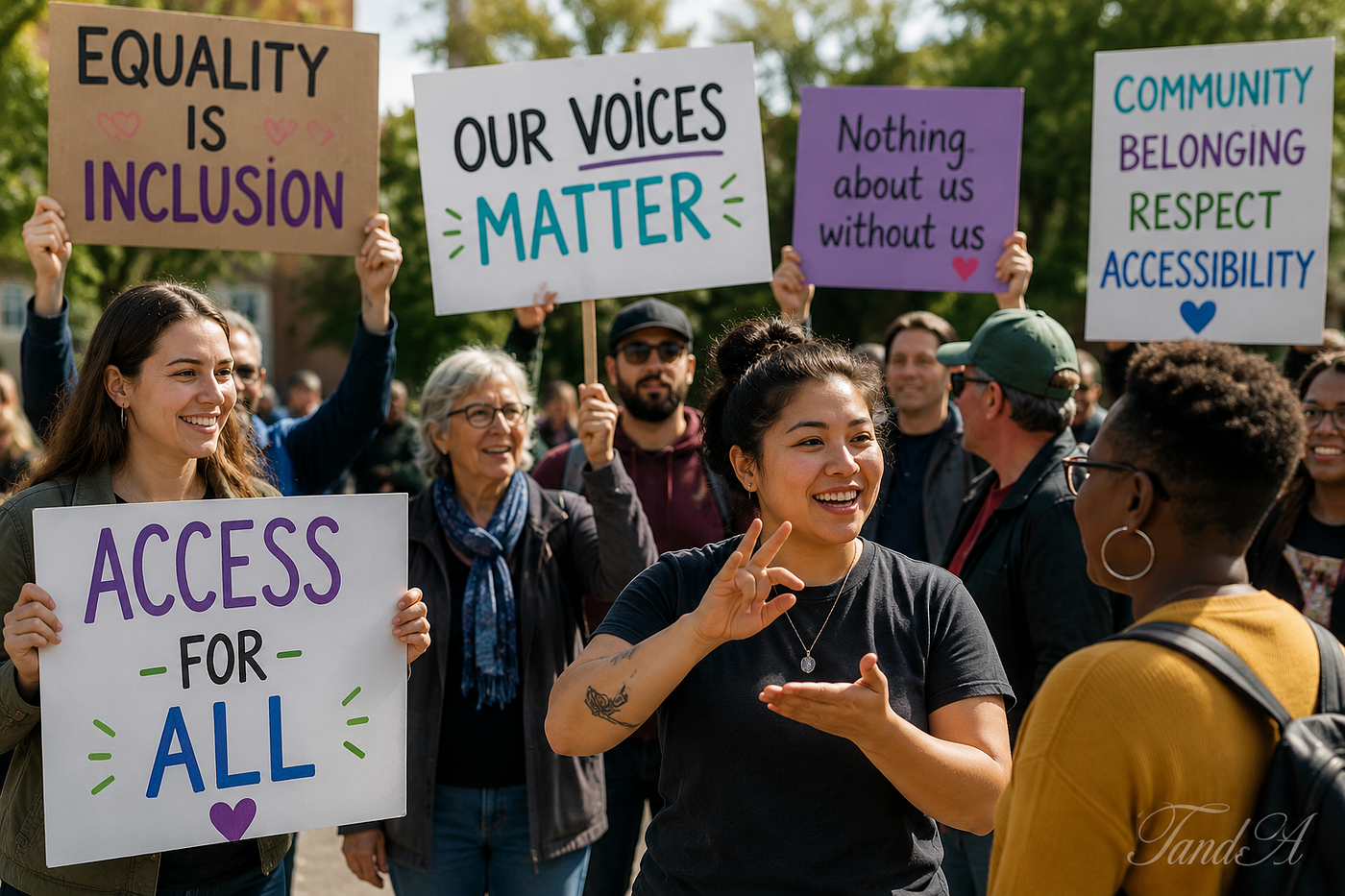
A simple question about accessibility sparked the entire project.
The Problem With Most AI-Generated ASL Content
When I started experimenting with AI tools, I noticed a recurring issue.
Most systems could generate attractive graphics.
Few could generate trustworthy ASL learning materials.
Many would:
- Confuse ASL with Signed English
- Ignore regional variation
- Present English grammar as ASL grammar
- Create unclear visual instructions
- Prioritize aesthetics over accuracy
The results often looked polished while teaching the wrong thing.
For an educational resource, that is a serious problem.
ASL learners need clarity.
Teachers need confidence.
Students need materials that support understanding rather than confusion.
The more examples I reviewed, the more obvious the problem became. AI was often optimized to create something that looked good rather than something that taught well.
For a classroom, appearance is not enough.
Accuracy has to come first.

Attractive visuals are not always accurate learning tools.
Building for Accuracy First
The goal became simple.
Build a system that treats ASL accuracy, accessibility, and visual clarity as non-negotiable requirements.
Instead of focusing on flashy graphics, the GPT was designed to ask:
- Is the handshape clear?
- Is the palm orientation obvious?
- Is the movement understandable?
- Is the sign being represented accurately?
- Does this respect ASL as a language?
Those questions became the project’s design philosophy.
Accuracy before aesthetics.
Accessibility before decoration.
Learning before visual flair.
Every design decision flowed from those principles.
A poster that looks beautiful but teaches incorrectly has failed its purpose. A vocabulary card that confuses a learner creates a barrier rather than removing one.
The mission became creating resources that educators could actually use.

Accuracy became the foundation of every design decision.
The Shift That Changed Everything
Originally, I viewed the project as an ASL design assistant.
Over time, I realized that was not the real value.
Teachers, homeschool educators, therapists, ASL instructors, and accessibility coordinators were not looking for another chatbot.
They were looking for something much more practical.
They needed classroom-ready materials.
- Posters.
- Vocabulary cards.
- Communication boards.
- Worksheets.
- Parent handouts.
Resources that normally take hours to create.
That insight changed the project completely.
The GPT evolved from an ASL helper into a classroom resource generator focused on saving educators time while maintaining accessibility standards.
Once I shifted my focus from conversation to resource creation, the project became much more useful. The goal was no longer helping someone talk about ASL.
The goal was helping them teach it.

The project became a tool for creating practical classroom resources.
Why Accessibility Matters
Accessibility is often treated as a final checklist item.
- Add captions.
- Add alt text.
- Increase font size.
Done.
But meaningful accessibility starts much earlier.
- It begins during planning.
- It shapes the design process itself.
- The same principle guides this GPT.
Rather than generating materials and then asking whether they are accessible, the system starts with accessibility as a core requirement.
Every resource is expected to prioritize:
- High contrast
- Clear visual hierarchy
- Readable layouts
- Print usability
- ASL accuracy
- Respect for Deaf culture
Accessibility is not something that gets added later.
It is part of the blueprint from the beginning.
That distinction changes the final result.

Accessibility works best when it is built into the design process.
What Comes Next
I do not see this GPT as a replacement for Deaf educators, ASL instructors, or community expertise.
In fact, the opposite.
The goal is to help more people create better materials while recognizing the importance of Deaf-led learning and verification.
If the GPT saves a teacher two hours preparing vocabulary cards, helps a homeschool parent create clearer learning materials, or encourages someone to think differently about accessibility, then it has succeeded.
The project began with a protest sign.
Today, it is about something larger.
It is about recognizing that communication is only effective when people can actually access it.
And it started with a simple question:
- Who gets included when we design communication?
- And who gets left out?
메타데이터
- post_id
- fb36cd5aac6d
- slug
- the-gpt-that-started-with-a-protest-sign-fb36cd5aac6d
- url
- https://medium.com/creating-custom-gpts/the-gpt-that-started-with-a-protest-sign-fb36cd5aac6d
- canonical_url
- https://medium.com/creating-custom-gpts/the-gpt-that-started-with-a-protest-sign-fb36cd5aac6d
- author_url
- https://medium.com/@ttrimm
- status
- ok
- fetched_at
- 2026-06-24 11:06:28