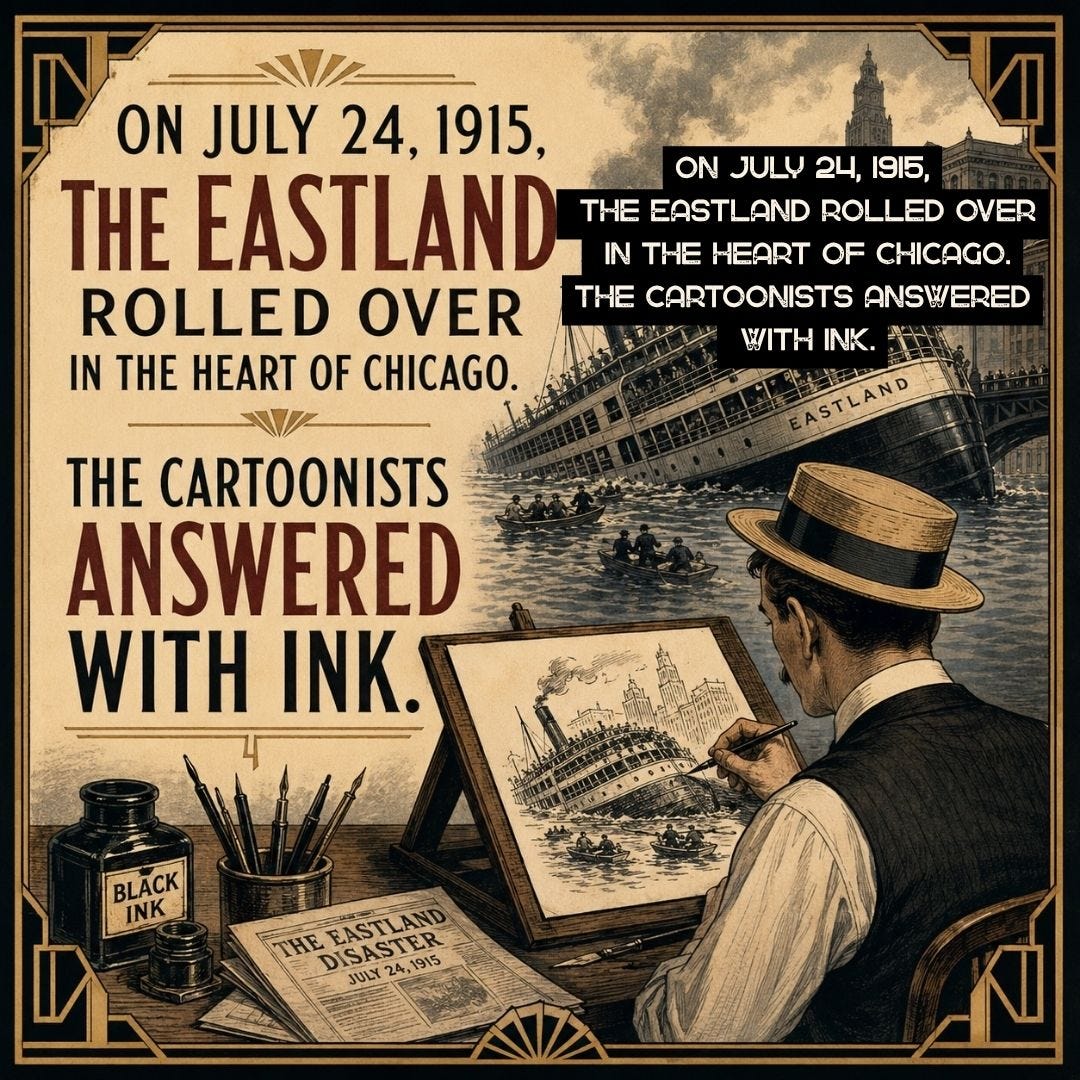
Rand McNally to the Chicago River: Agnes Lee’s Eastland Story
Promo Video for Rand McNally to the Chicago River: Agnes Lee’s Eastland Story
Rand McNally to the Chicago River: Agnes Lee’s Eastland Story
Collage for Flower in the River Podcast, Rand McNally to the Chicago River: Agnes Lee’s Eastland Story
Promo Video for Rand McNally to the Chicago River: Agnes Lee’s Eastland Story
Podcast Link: Rand McNally to the Chicago River: Agnes Lee’s Eastland Story
Beyond the Easy Summary: 5 Surprising Truths About the Eastland Disaster’s Literary Legacy
The 1915 Eastland disaster, in which more than 800 people died in the Chicago River, remains one of the major American maritime disasters. For decades, its history was researched, documented, and kept alive by historians, archivists, family members, and careful researchers. But in recent years, that record has too often been reduced to a simplified version of history — one that strips away intellectual and artistic provenance in favor of something easier to package.
To understand the Eastland more fully, we have to look beyond the capsized hull and follow the remarkable paper trail left by the writers who placed this tragedy within Chicago’s modern literary landscape.
1. History Didn’t Forget-People Dropped the Ball
There is a persistent, almost romantic notion that the victims of the Eastland were “forgotten by history.” But the archival record is not empty. It is filled with the voices of those who witnessed, recorded, and responded to the disaster.
The problem is not absence. It is simplification with consequences. After more than three years of diligent research, I no longer see this as a one-time mistake. I see a pattern: a complicated tragedy gets reduced to repeatable talking points. Those talking points are repeated until they sound like fact. And once that happens, the work of recovery becomes harder for everyone.
In that process, specific names, visceral reactions, literary responses, and contradictory evidence get pushed aside to make room for a simpler, more digestible version of the story. A repeated but unsubstantiated death toll is allowed to masquerade as fact.
By resisting the easy summary, we recover a history that was never actually lost. It was simply too detailed, too layered, and too inconvenient for those looking for a quick version.
2. The Map-Making Heiress and the Prison Newspaper
Among the most compelling figures in the Eastland’s literary circle was Agnes Lee, born Martha Agnes Rand. As the daughter of William H. Rand, co-founder of the map-publishing giant Rand McNally and Company, Lee came from a world of privilege, education, and literary discipline. Educated in Switzerland and a fluent translator of French, she was far more than a society poet.
Her literary stature was recognized in 1926, when she won the Guarantors’ Prize from Poetry magazine, placing her in the company of poets such as Robert Frost and Edna St. Vincent Millay.
One of the most revealing details in Lee’s publishing history is her 1889 contribution to The Prison Mirror, a publication from Stillwater Prison in Minnesota. Founded by inmates, The Prison Mirror is the oldest continuously operating prisoner newspaper in the United States. Its motto was: “It is never too late to mend.”
Her published legacy includes:
- The Legend of a Thought (1889), published under the name Martha Agnes Rand
- The Border of the Lake (1910)
- The Sharing (1914)
- Faces and Open Doors (1922)
- New Lyrics and Old Ones (1931)
- The Round Rabbit, a collection of children’s verse
3. The “Open Door” Policy That Helped Preserve the Record
The preservation of the Eastland’s poetic response owes a great deal to Harriet Monroe and the magazine she founded three years earlier, Poetry: A Magazine of Verse.
Monroe was already an established poet and journalist by the time she launched the magazine. She built on years of her own work and on a deep familiarity with the literary world, including the “friends of the spirit” she had known since childhood, surrounded by her father’s extensive personal library.
Poetry became Chicago’s platform for modern verse, open to a wide range of styles and voices rather than any single school. By 1915 — the same year the magazine published T. S. Eliot’s “The Love Song of J. Alfred Prufrock” — Poetry had become one of the principal organs for modern verse in the English-speaking world.
When the Eastland sank that July, the platform was already in place. It was ready to receive and circulate the grief of the writers who responded to the disaster.
Monroe’s “Open Door” editorial manifesto was sustained by an unusual funding model: she secured five-year pledges from 100 Chicago civic leaders. That financial independence helped the magazine become a home for a genuine literary community. When poets such as Carl Sandburg and Agnes Lee responded to the Eastland disaster, they did not grieve in isolation. Their words entered a literary network that could carry them beyond Chicago.
The magazine helped ensure that their witness was not left in a private drawer. It was published, preserved, and shared.
As Monroe famously wrote:
“To have great poets, there must be great audiences, too.”
4. A Landmark Legal Victory for a 2,600-Word Poem
Long before Harriet Monroe founded Poetry: A Magazine of Verse, she fought a foundational battle for the rights of writers.
In 1892, Monroe was commissioned to write the “Columbian Ode” for the World’s Columbian Exposition in Chicago. In an early instance of literary appropriation, the New York World obtained a draft of her manuscript and published it without authorization.
Monroe sued and won a $5,000 verdict in a precedent-setting copyright lawsuit. T he case affirmed that the work of a poet was not public property to be taken and republished by the press. It was a professional work deserving of legal protection.
That fierce advocacy for the financial and legal rights of writers remained a central part of Monroe’s work at Poetry. She did not simply create a magazine. She helped create a space where poets could be published, paid, protected, and taken seriously.
5. Two Poems, Two Magazines, One Disaster
Agnes Lee’s response to the Eastland disaster was not a single poem. It was at least two poems, published in two different magazines, each one taking a different route into the same terrible event.
The first, “Eastland Waters,” appeared in Poetry in February 1916. It is structured as a dialogue among three people caught in the water as the ship goes down: Niels, Mary, and Anna. Their voices overlap in fear, reassurance, confession, and dread as the scene turns fatal.
Lee gives the disaster a human, conversational immediacy. The poem is not simply a description of the wreck. It is closer to a transcript of the people trapped inside it.
The second poem, “The Divers,” appeared later that year in The Bookman. Where “Eastland Waters” is a scene, “The Divers” is an incantation. It is a two-part address spoken by the divers themselves: first the “divers of bodies” searching the charnel river, then the “divers of souls” searching for meaning in what they found.
Lee uses the recurring image of “human fish” moving through the sluggish water to expose what she calls “greed’s rule.” The poem closes with a blistering account of the disaster’s true cost: “the pitiless price of the frantic lesson.”
She writes:
“We saw young girls
Pinned to the mire of the murky, the charnel river,
Like fair fresh flowers on the filthy breast of a hag.”
Together, the two poems show a poet returning to the same tragedy from two different angles within the same year: once as witness to the people drowning, and once as witness to the divers who went down after them.
Conclusion: The Living History in the Paper Trail
The history of the Eastland disaster was never lost. It was researched, documented, and kept alive for decades by historians, archivists, family members, and careful researchers. What changed was not the record. What changed was the way parts of that record were reduced into something easier to brand, repeat, and sell.
The easy summary may satisfy the desire for a quick narrative, but the deeper story remains where it has always been: in the archives, in the newspapers, in the poems, in the records, and in the people who kept looking.
Agnes Lee understood that recovery was not clean work. In “The Divers,” she wrote of those who came up again and again “with a slimy truth.” The question now is whether we are willing to do the same: to enter the difficult waters of the archive, follow the evidence where it leads, and bring those truths back to the surface.
Links:
Promo Video for Rand McNally to the Chicago River: Agnes Lee’s Eastland Story
Podcast Link: Rand McNally to the Chicago River: Agnes Lee’s Eastland Story
Resources:
- Lee, Agnes. “Eastland Waters.” Poetry: A Magazine of Verse (February 1916)
- Lee, Agnes. “The Divers.” The Bookman 42 (September 1915–February 1916)
- The Editors, “Harriet Monroe & the Open Door,” Poetry Foundation, n.d., accessed June 24, 2026.
- Rand, Martha Agnes, and Agnes Lee. “The Knife and the Leaf.” The Prison Mirror [Stillwater, MN], vol. 3, no. 5, 12 Sept. 1889, p. 1.
Originally published at https://www.flowerintheriver.com on June 25, 2026.
메타데이터
- post_id
- fb3ff2ba2b7c
- slug
- rand-mcnally-to-the-chicago-river-agnes-lees-eastland-story-fb3ff2ba2b7c
- url
- https://medium.com/@zett_51423/rand-mcnally-to-the-chicago-river-agnes-lees-eastland-story-fb3ff2ba2b7c
- canonical_url
- https://medium.com/@zett_51423/rand-mcnally-to-the-chicago-river-agnes-lees-eastland-story-fb3ff2ba2b7c
- author_url
- https://medium.com/@zett_51423
- status
- ok
- fetched_at
- 2026-07-23 05:18:06