The Subject Matter of Interpretation
From author and text to subject matter: how hermeneutics, critique, and deconstruction reshape our understanding of meaning.
I think interpretation will always be focused on the subject matter. In the end, the focus is not the author, not the text itself, and not even the interpreter. If we think of the three components—author, text, and reader—the true focus becomes the subject matter, the theme, or the topic under discussion.
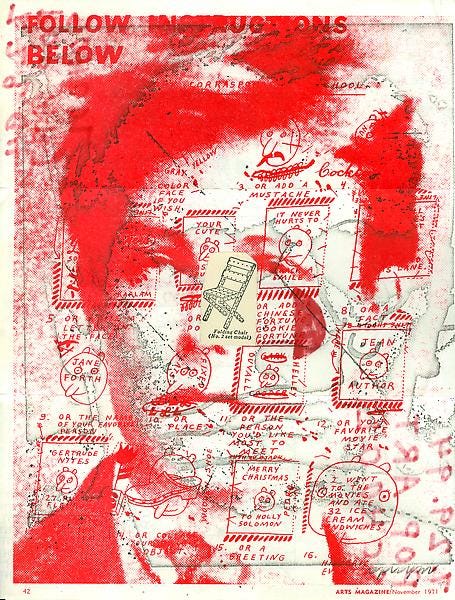
Collage artwork by the American Pop Art artist and pioneer of 'mail art’, Ray Johnson (1927–1995).
For example, when you read a book, the most important thing is not merely the author or the words on the page. What matters is the reality or issue that the text is talking about. The same applies to films. The essential question is not simply what happens in the film but what the film is actually about. What is the reality being disclosed?
Interpretation should provide new insight. Through interpretation, the interpreter exercises creative imagination to uncover possibilities that are contained within a theme. We begin to see dimensions that were not previously visible.
Take a film such as Inception. The subject matter is not merely the sequence of scenes or the technical details of the plot. The deeper issue concerns dreams and reality. Interpretation explores the new possibilities the film opens up for understanding the relationship between dreams and reality. What matters is not simply describing scenes but uncovering possibilities of meaning.
This is why hermeneutics is often controversial. People can arrive at many different interpretations. Yet interpretation should never become mere fantasy. The best interpretation is not necessarily the one that repeats the author's intention, nor is it simply whatever the reader wants. The best interpretation is the one that most faithfully discloses the possibilities contained within the text.
Interpretation therefore requires imagination, but imagination must remain correlated with the text. It cannot become arbitrary invention. The text is a complex reality that transcends both author and reader, yet interpretation must continually maintain a meaningful relationship with it.
Interpretation must also be critical. It must be critical of our own illusions and self-deceptions. We must be careful not to project our own assumptions onto a text and then use the text as a justification for ourselves.
For example, someone may claim that a sacred text commands hostility toward everyone who disagrees with them. Hermeneutics asks whether this meaning truly emerges from the text or whether it is merely the interpreter's own prejudice being imposed upon it.
Critical interpretation therefore becomes ideological critique. It examines the ways texts can be used to justify power structures, social arrangements, or personal interests. Interpretation can become a tool for exposing hidden assumptions and hidden forms of domination.
This is especially visible in feminist interpretations of religious texts. Passages traditionally used to justify patriarchal authority can be reread in ways that challenge those very structures. The same text that once supported domination can become a resource for criticizing domination.
There is therefore a subversive dimension within interpretation. Interpretation can reveal possibilities within a text that undermine accepted assumptions.
This insight is developed further in deconstruction, especially by philosophers such as Jacques Derrida. Derrida argues that every statement contains within itself the possibility of undermining its own claims. Every text harbors tensions, contradictions, and assumptions that may destabilize its apparent meaning.
When someone claims, for example, that democracy is unquestionably the political system most suited to human nature, deconstruction asks: What concept of "human nature" is being assumed here? What remains unstated? Could a different understanding of human nature lead to different conclusions?
The task is not necessarily to replace one truth with another but to uncover hidden assumptions and expose internal contradictions. This is why deconstruction often appears unsettling. It questions what seems obvious and reveals instability where certainty was presumed.
One method of deconstructive interpretation is intertextuality. A text is interpreted through its relationship with other texts. The more texts we read, the more possibilities emerge for interpreting any particular text.
In this sense, interpretation always creates something new. When someone writes a review of a book, the review is not merely a reflection of the original book. It becomes a new text in its own right. It is inspired by the original, but it contributes meanings that were not present before.
Indeed, when an author reads reviews of their own work, they may discover possibilities and interpretations they had never considered. Interpretation thus enriches the meaning of texts rather than simply reproducing them.
This process is unavoidable because human understanding always operates through previous experiences and prior knowledge. Whenever we encounter something new, we understand it through frameworks that already exist within us.
As a result, there is no completely pure interpretation. Every interpretation is influenced by historical, cultural, and intellectual contexts. Yet this does not mean all interpretations are equally valid. Interpretations can still be evaluated comparatively. Some interpretations disclose richer possibilities, maintain stronger textual correlations, and provide deeper insight than others.
I contrast modern and postmodern attitudes toward meaning. Modern thought often assumes that truth lies beneath the surface and that interpretation must dig deeper to uncover hidden meanings. Surface appearances are treated as insufficient.
Some postmodern thinkers challenge this obsession with depth. They argue that surfaces themselves can be meaningful and worthy of appreciation. Not everything requires a hidden essence behind it. Meaning can emerge through play, appearance, and presentation rather than solely through depth and foundations.
I conclude by suggesting that contemporary thought increasingly recognizes the complexity of this relationship between depth and surface. Neither can be completely separated from the other, and both remain important for understanding culture, texts, and human experience.
메타데이터
- post_id
- fb473ebbf309
- slug
- the-subject-matter-of-interpretation-fb473ebbf309
- url
- https://medium.com/@shrimpmindparadox/the-subject-matter-of-interpretation-fb473ebbf309
- canonical_url
- https://medium.com/@shrimpmindparadox/the-subject-matter-of-interpretation-fb473ebbf309
- author_url
- https://medium.com/@shrimpmindparadox
- status
- ok
- fetched_at
- 2026-06-09 15:37:30