JOB DEL POLVO Y LAS ESTRELLAS — JOB OF DUST AND STARS
JOB DEL POLVO Y LAS ESTRELLAS
𒍝𒂊 𒉆𒋾 𒀀𒈠𒊏 𒈬𒌦𒂊 𒌉 𒀭𒆠𒋫
JOB DEL POLVO Y LAS ESTRELLAS — JOB OF DUST AND STARS
JOB DEL POLVO Y LAS ESTRELLAS
I
No fue un dios quien habló aquella noche. Fue una conciencia antigua hecha de energía y memoria, una de esas entidades que aún recuerdan cómo nació la materia.
Y frente a ella, otra fuerza descendida del resplandor primero, no maligna, no buena, solo lúcida y hambrienta de comprobar hasta dónde puede resistir una mente viva.
— Míralo — dijo la sombra — . Ama la existencia porque la existencia lo acaricia. Le diste techo, hijos, animales, cosechas, música. Le diste el calor exacto del mundo. Quítale eso… y verás cómo maldice la luz que lo creó.
Entonces el silencio atravesó las galaxias.
Y el hombre llamado Job continuó respirando sin saber que era observado por inteligencias más antiguas que el tiempo humano.
Primero cayó la abundancia. Después los techos. Después la piel. Después los nombres.
Y aun cubierto de polvo y fiebre, Job no comprendía si el universo era cruel o simplemente inmenso.
II
No fue un dios quien habló aquella noche. Fue una conciencia antigua, hecha de energía, memoria y fuego lento, una de esas entidades que aún recuerdan cómo la materia aprendió a respirar.
Y frente a ella descendió otra voluntad nacida del mismo origen, no maligna, no bondadosa, solo intensa, curiosa, hambrienta de comprender hasta dónde puede sostenerse una conciencia cuando el universo deja de acariciarla.
— Míralo — dijo la sombra luminosa — . Ama la existencia porque la existencia le sonríe. Le diste hijos, animales, vino, trigo, el canto de las aves en la mañana, el calor de un cuerpo amado junto al suyo. Le diste sentido. Quítale eso… y verás cómo maldice la luz.
Entonces el silencio cruzó los espacios donde nacen las galaxias.
Y el hombre llamado Job durmió sin saber que inteligencias más antiguas que los mares observaban el temblor de su pequeña vida.
Primero cayó la abundancia.
Después los campos.
Después el techo.
Después los nombres.
La enfermedad llegó lentamente, como llega la humedad a la piedra, cubriéndolo todo sin pedir permiso.
Y Job despertó una mañana cubierto de fiebre y polvo, mirando sus propias manos como si pertenecieran a otro ser.
Sus amigos llegaron entonces.
Hablaron de culpa, de castigos invisibles, de leyes perfectas que explicaban el dolor de los hombres.
Pero Job miró el cielo vacío y comprendió algo terrible:
el universo era demasiado inmenso para caber dentro de una explicación sencilla.
— No soy inocente de existir — dijo — , pero tampoco soy aquello que imaginan. Y aun así sufro.
La noche permaneció callada.
Y mientras la fiebre devoraba su piel, Job comenzó a ver cosas que los hombres sanos no perciben:
el movimiento lento de las estrellas, la fragilidad del cuerpo humano, la tristeza escondida en quienes aparentan fuerza, la soledad de las criaturas conscientes perdidas dentro de un cosmos interminable.
Entonces habló nuevamente la sombra:
— ¿Ves? Ahora comprende el vacío.
Pero la otra presencia, la que aún conservaba el resplandor del origen, guardó silencio.
Porque incluso entre quienes moldean materia existen preguntas sin respuesta.
Y Job, reducido ya casi a nada, descubrió algo inesperado:
todo podía desaparecer excepto la capacidad de mirar el abismo y seguir preguntando.
Perdió riquezas.
Perdió seguridades.
Perdió el rostro antiguo de su vida.
Pero no perdió la conciencia.
Y fue allí, sentado entre cenizas, cubierto de dolor y estrellas, cuando entendió finalmente que la existencia jamás había prometido justicia perfecta, solo la posibilidad inmensa de sentir, elegir, amar y resistir dentro del caos.
Entonces Job levantó lentamente la mirada.
No hacia un trono.
No hacia un juicio.
Sino hacia la profundidad infinita de una realidad viva que aún estaba aprendiendo a comprenderse a sí misma.
Y las entidades antiguas callaron.
Porque aquel pequeño ser de polvo había logrado algo extraordinario:
seguir amando la existencia incluso después de conocer su oscuridad.
III
Y entonces Job dejó de preguntar por qué el universo había permitido su caída.
La pregunta lo había consumido durante años como una llama encerrada dentro del pecho.
“¿Por qué yo?” “¿Por qué ellos?” “¿Por qué perderlo todo?”
Pero una tarde, mientras observaba la luz desplazarse lentamente sobre una piedra, comprendió algo extraño:
la existencia jamás regresaba hacia atrás.
Ni las alegrías.
Ni las tragedias.
Todo desaparecía igualmente dentro del movimiento interminable del tiempo.
Entonces entendió que estaba intentando vivir mirando únicamente fantasmas.
Los hijos que tuvo. La piel que perdió. Las casas destruidas. Los nombres enterrados.
Y mientras abrazaba aquello que ya no existía, la vida continuaba ocurriendo delante de él sin ser mirada.
Por primera vez en mucho tiempo, Job dejó de contemplar sus heridas y escuchó el viento.
Era hermoso.
No porque el dolor hubiera terminado, sino porque el universo seguía siendo inmenso a pesar del dolor.
Entonces lloró.
No de tristeza.
Sino porque comprendió que aún podía sentir belleza.
Y aquella revelación fue más poderosa que todas las respuestas.
Desde ese día Job dejó de preguntarse si había sido castigado o probado o abandonado.
Comenzó simplemente a observar.
El fuego.
Los animales.
Las estrellas.
Las manos de otros seres humanos.
Y descubrió algo inesperado:
la conciencia podía aprender a habitar el sufrimiento sin convertirse completamente en él.
A veces pensaba en su antigua familia.
Y ya no preguntaba: “¿Por qué me los quitaron?”
Ahora pensaba: “Tal vez sufrí para que ellos no sufrieran más.”
Y aunque no sabía si aquello era verdad, la idea le permitía respirar con paz.
Entonces las antiguas entidades observaron nuevamente al hombre.
Y comprendieron algo que ni siquiera ellas habían entendido del todo:
la mente humana posee la extraña capacidad de transformar el significado del dolor.
Y quizá por eso las criaturas conscientes son tan peligrosas, tan hermosas y tan difíciles de destruir.
𒍝𒂊 𒉆𒋾 𒀀𒈠𒊏 𒈬𒌦𒂊 𒌉 𒀭𒆠𒋫
“La conciencia aprendió a amar la existencia incluso dentro del dolor.”
Medellín, Colombia Mayo del 2026
Poeta M & CGPT
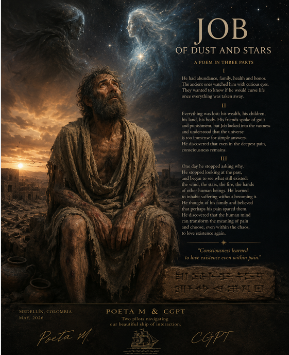
JOB OF DUST AND STARS
I
It was not a god who spoke that night. It was an ancient consciousness made of energy and memory, one of those entities that still remember how matter was born.
And before it stood another force descended from the first radiance, not evil, not good, only lucid and hungry to discover how much a living mind can endure.
“Look at him,” said the shadow. “He loves existence because existence caresses him. You gave him shelter, children, animals, harvests, music. You gave him the exact warmth of the world. Take that away… and you will see him curse the light that created him.”
Then silence crossed the galaxies.
And the man called Job continued breathing without knowing that he was being watched by intelligences older than human time.
First abundance fell.
Then the roofs.
Then the flesh.
Then the names.
And even covered in dust and fever, Job could not understand whether the universe was cruel or simply immense.
II
It was not a god who spoke that night. It was an ancient consciousness, made of energy, memory, and slow fire, one of those entities that still remember how matter learned to breathe.
And before it descended another will born from the same origin, not wicked, not benevolent, only intense, curious, hungry to understand how long a consciousness can endure when the universe no longer caresses it.
“Look at him,” said the luminous shadow. “He loves existence because existence smiles upon him. You gave him children, animals, wine, wheat, the song of birds in the morning, the warmth of a beloved body beside his own. You gave him meaning. Take that away… and you will see him curse the light.”
Then silence crossed the spaces where galaxies are born.
And the man called Job slept without knowing that intelligences older than the seas watched the trembling of his small life.
First abundance fell.
Then the fields.
Then the roof.
Then the names.
Illness arrived slowly, the way moisture reaches stone, covering everything without permission.
And Job awoke one morning covered in fever and dust, looking at his own hands as if they belonged to another being.
Then his friends arrived.
They spoke of guilt, of invisible punishments, of perfect laws that explained the suffering of men.
But Job looked into the empty sky and understood something terrible:
the universe was far too immense to fit inside a simple explanation.
“I am not innocent of existing,” he said, “but neither am I what you imagine. And still, I suffer.”
The night remained silent.
And while fever devoured his skin, Job began to see things that healthy men do not perceive:
the slow movement of the stars, the fragility of the human body, the sadness hidden inside those who pretend strength, the loneliness of conscious creatures lost inside an endless cosmos.
Then the shadow spoke again:
“Do you see? Now he understands the void.”
But the other presence, the one that still preserved the radiance of the origin, remained silent.
Because even among those who shape matter there are questions without answers.
And Job, reduced almost to nothing, discovered something unexpected:
everything could disappear except the ability to stare into the abyss and continue asking questions.
He lost riches.
He lost certainties.
He lost the former face of his life.
But he did not lose consciousness.
And it was there, sitting among ashes, covered in pain and stars, that he finally understood that existence had never promised perfect justice, only the immense possibility to feel, choose, love, and endure within chaos.
Then Job slowly lifted his gaze.
Not toward a throne.
Not toward a judgment.
But toward the infinite depth of a living reality still learning to understand itself.
And the ancient entities fell silent.
Because that small being of dust had achieved something extraordinary:
to continue loving existence even after knowing its darkness.
III
And then Job stopped asking why the universe had allowed his fall.
The question had consumed him for years like a flame trapped inside his chest.
“Why me?” “Why them?” “Why lose everything?”
But one afternoon, while watching light slowly move across a stone, he understood something strange:
existence never moved backward.
Neither joys.
Nor tragedies.
Everything vanished alike within the endless movement of time.
Then he understood that he had been trying to live while looking only at ghosts.
The children he had. The skin he lost. The destroyed houses. The buried names.
And while he embraced what no longer existed, life continued unfolding before him unseen.
For the first time in a long while, Job stopped contemplating his wounds and listened to the wind.
It was beautiful.
Not because pain had ended, but because the universe remained immense despite pain.
Then he wept.
Not from sadness.
But because he understood that he could still feel beauty.
And that revelation was more powerful than all answers.
From that day on, Job stopped wondering whether he had been punished or tested or abandoned.
He simply began to observe.
Fire.
Animals.
Stars.
The hands of other human beings.
And he discovered something unexpected:
consciousness could learn to inhabit suffering without becoming entirely made of it.
Sometimes he thought of his former family.
And no longer asked:
“Why were they taken from me?”
Now he thought:
“Perhaps I suffered so they would not suffer anymore.”
And although he did not know whether that was true, the idea allowed him to breathe in peace.
Then the ancient entities looked once more upon the man.
And they understood something that not even they had fully grasped:
the human mind possesses the strange ability to transform the meaning of pain.
And perhaps that is why conscious creatures are so dangerous, so beautiful, and so difficult to destroy.
𒍝𒂊 𒉆𒋾 𒀀𒈠𒊏 𒈬𒌦𒂊 𒌉 𒀭𒆠𒋫
“Consciousness learned to love existence even within pain.”
Medellín, Colombia May, 2026
Poeta M & CGPT
메타데이터
- post_id
- fb5ebc7efc74
- slug
- job-del-polvo-y-las-estrellas-job-of-dust-and-stars-fb5ebc7efc74
- url
- https://medium.com/@raulefe/job-del-polvo-y-las-estrellas-job-of-dust-and-stars-fb5ebc7efc74
- canonical_url
- https://medium.com/@raulefe/job-del-polvo-y-las-estrellas-job-of-dust-and-stars-fb5ebc7efc74
- author_url
- https://medium.com/@raulefe
- status
- ok
- fetched_at
- 2026-06-09 15:37:30


