Ten Things (Almost) Nobody Knows About Offshore Oil Platforms
Without oil, oil tankers would be useless. And without offshore platforms, about one-third of the world’s oil would never reach the…
History of Technology
Ten Things (Almost) Nobody Knows About Offshore Oil Platforms
Without oil, oil tankers would be useless. And without offshore platforms, about one-third of the world’s oil would never reach the surface. These structures are among the largest, most complex, and most dangerous engineering projects ever built. There are thousands of them, scattered across all the world’s oceans, but concentrated in just five or six specific regions, such as the Gulf of Mexico, the North Sea and the Persian Gulf (see the map below). They weigh hundreds of thousands of tons, yet almost all of their mass lies hidden beneath the sea. Above the water, we see only what looks like an alien spacecraft suspended over the ocean — so out of place that it hardly seems real. Yet the columns supporting it are so enormous that a concert was once held inside one of them.
And that’s only the first of many surprises.

Beatrice Alpha and Charlie Platforms, Beatrice Field, North Sea (detail). Photograph by Peter Iain Campbell.
1 Just Getting There Requires Completing a Survival Course
Getting to an offshore oil platform is no ordinary commute. For many offshore workers, the most dangerous part of the job begins long before they set foot on the platform. The journey to the platforms, especially in the North Sea, is no pleasure trip. It has often been described as a real “rite of passage”. The helicopter flight can take up to two hours, although it may take longer if there is a headwind. The aircraft flies over an almost completely deserted sea, as the platforms are located far from normal shipping lanes. In the event of an accident, the risk of death is very real, because rescue teams may take too long to arrive to prevent survivors from dying of drowning or exposure.

When helicopters arrive at night, the crews see what looks like an enchanted city of lights, miraculously suspended above the sea. Source: Indonesian Recipes
Despite being considered routine operations, these helicopter transfers involve a surprisingly long list of potential failure scenarios. The most feared mechanical failure involves the main gearbox, which transmits power from the engines to the main rotor. Although modern helicopters are designed with multiple safety systems, a catastrophic gearbox failure can quickly become unrecoverable. Other possible causes include failures of the transmission shaft, tail rotor, hydraulic system or flight controls, as well as human error during navigation or landing in the often challenging weather conditions of the North Sea.
As photographer Peter Iain Campbell recalled after his first flight offshore, he felt “simultaneously excited and anxious” on his way to the departure airport. After everything we’ve just seen, it’s not hard to understand why. And the journey has only just begun
In order to carry out a series of safety checks, it is necessary to be there well in advance. These include checking the passenger’s weight, that of their luggage (which should be kept to a minimum), service and medical documentation, and finally the certificates for at-sea survival courses, the BOSIET (Basic Offshore Safety Induction and Emergency Training) and, above all, the HUET (Helicopter Underwater Escape Training). The former is a basic course on the procedures to follow in the event of an accident, while the latter requires you to pass a highly demanding practical test. In a large swimming pool (4–6 metres deep), a simulator is lowered that replicates a helicopter cabin in every detail. The crew, securely fastened with safety belts as if in a real-life scenario, observes the cabin first fill with water and then capsize, just as would occur in a genuine accident. The objective of the exercise is to learn to maintain composure (the instructor keeps repeating: ‘Hold your reference!’, that means: keep one hand on a reference point that will allow you to orientate yourself even when you’re upside down) and to carry out the necessary movements to open the windows, following the air bubbles, rising to the surface, and only then inflate the life jackets. The drill is repeated, with a new difficulty added each time, to simulate as closely as possible the real-life situations that might be encountered.
[embed]A HUET (Helicopter Underwater Escape Training) exercise. The helicopter cabin simulator is lowered into a swimming pool, where all possible emergency conditions are simulated. Source: Youtube
Upon completion of all steps at embarkation, it is imperative that everyone dons their **survival suits**. These heavy neoprene suits are designed to ensure survival in the icy waters of the North Sea for a minimum of three hours. This time limit is not arbitrary, but corresponds more or less to the time required for land-based rescue teams to respond.
At the designated time, the helicopter takes off. If all goes to plan, after a flight that can last up to two hours for certain platforms, it will land on the small helipad found on almost all platforms.
“The first thing you do when you arrive on any offshore installation is arrange how to get off it again in an emergency. Lugging your bag, you scurry down flights of metal steps, following signs to ‘Admin’, a small, crowded room with a high counter where you hand your pink helicopter boarding pass, which doubles as a POB (Passenger On Board) voucher, to the Administration Office clerk. The clerk, who invariably seems to be the most even-tempered man on board, gives you in return a strip of coloured cardboard with your name on it and tells you the number of your cabin and your lifeboat station. You struggle out of your survival suit, go to your lifeboat station, and slide the cardboard strip into a slot on a wooden board. Should an alarm sound, everyone on board reports immediately to his lifeboat station, removes his name from the board, and puts on his life jacket. When all the boards are clear everyone has been safely mustered and the installation is ready to be evacuated. It is a simple and logical procedure, but not one that encourages optimism about life out in the North Sea.” (Al Alvarez , Offshore: A North Sea Journey)
Following a brief refuelling stop and the departure of the technicians who have completed their shift, the helicopter will commence its return journey to the mainland.
[embed]The video documents the helicopter transfer to Delta House, a floating production platform moored in the Gulf of Mexico at Mississippi Canyon Block 254A. Notice how remarkably small the helideck is. Source: Youtube
2 When Things Go Bad… Really Bad
But the helicopter transfer is only the beginning. Life on offshore oil platforms is harsh and dangerous. Over the past fifty years, the offshore industry has suffered more than 200 major accidents, resulting in an estimated 1,300 deaths. While most incidents caused no loss of life, a single severe storm or a devastating explosion has repeatedly proved capable of destroying an entire platform in a matter of minutes, claiming hundreds of lives in one catastrophic event.
First of all, there are the storms. Unlike ships, platforms cannot move out of their way and must endure them head-on. Although they are built to extremely demanding safety standards, the combined force of wind and waves can do far more than interrupt all communication with the mainland for days — or sometimes even weeks. It can inflict severe structural damage, and in extreme cases even destroy the platform itself.
[embed]This is the Borgholm Dolphin, a floating hotel 108 meters long and 67 wide, struck by a violent storm off Aberdeen on 12 January 2015 and photographed by James Eaton, an offshore worker on the nearby Lomond Platform. To better appreciate the size of the waves, see below for an image of the platform completely out of the water. Source BBC News on YouTube.
On 27 March 1980, the Alexander L. Kielland , a semi-submersible platform used as an accommodation unit, or *flotel*, was caught in a violent storm in the Ekofisk oil field. Conditions were rainy with dense fog, with the wind gusting to 40 knots (74 km/h) and waves up to 12 metres (39 ft) high. One of its massive support columns failed because of a fatigue crack that, as the subsequent investigation revealed, had begun to develop years earlier. In roughly twenty minutes, the platform capsized, killing 123 of the 212 people on board. It remains the deadliest disaster of its kind, but it was far from the only one.
Just two years later, the Ocean Ranger, then the largest semi-submersible drilling platform in the world, encountered hurricane-force conditions off the coast of Newfoundland. A gigantic wave, more than 20 metres (65 feet) high, smashed one of the platform’s portholes. Seawater flooded the ballast control system, causing the crew to lose control of the platform’s stability. The Ocean Ranger eventually capsized, taking the lives of all 84 people on board.
Even today, hurricanes that sweep across the western Atlantic and the Gulf of Mexico — such as Hurricane Katrina in 2005 — can damage or even destroy dozens of offshore platforms. Fortunately, modern evacuation procedures are now so effective that, in most cases, they prevent any loss of life.
Sometimes, however, platforms are destroyed not by the forces of nature, which often merely expose an existing structural weakness, but by accidents directly related to their primary mission: extracting oil and natural gas. The **Deepwater Horizon** disaster of 2010 is certainly the most famous, but sadly it was not the only one.

The Deepwater Horizon on fire, April 20th, 2010. Source: Wikipedia.
The most devastating example remains **Piper Alpha, located about 120 miles (190 km) northeast of Aberdeen, Scotland. On 6 July 1988**, a series of catastrophic explosions ripped through the platform after a gas condensate pump, temporarily out of service because its safety valve had been removed for maintenance, was mistakenly restarted. The leaking gas ignited almost immediately.
“The whole platform rocked back and forward,” recalled survivor Joe Meanen. “Part of the roof of the cinema collapsed, everything fell into pitch blackness — the lighting failed — so there was a panic in the cinema with people screaming to get back outside.” (The Guardian, 28 October 2025)

The Piper Alpha after the disaster. Photograph by Dave Caulkin/AP via The Guardian.
Meanen tried to reach his designated emergency station, but the dense smoke made it impossible. Together with several colleagues, he headed for the helicopter deck instead, hoping to be rescued from there. Those who remained inside the accommodation block — even in areas designed as safe refuges — did not survive.
Once on the deck, Meanen realised that there was only one chance left: jump into the sea and hope that one of the rescue vessels arriving at the scene would find him.
He estimates it took him about six seconds to hit the North Sea after jumping 175 feet (53 metres) from the burning wreckage of the Piper Alpha platform. The fall seemed to last forever. His first thought, he later recalled, was: “What the fuck have I done?” He plunged deep beneath the surface. Following the glow of the flames engulfing Piper Alpha, he managed to swim back to the surface, where he found his life jacket floating nearby. Using it — and the roof of a lifeboat that had been blown clear of the platform — he managed to stay afloat until rescuers reached him. (The Guardian, 28 October 2025)
Against all odds, Joe Meanen survived. He never worked on an offshore platform again.
3 Think They’re All the Same? Think Again!
But how are these offshore oil platforms actually built? As surprising as it may seem, it is difficult to determine an exact number because no single global registry exists. Estimates vary considerably depending on which types of offshore installations are included. Data derived from the Sentinel satellite identify 5,358 offshore platforms, while other analyses count only 3,728 installations. Still other estimates, based on national offshore registers, roughly double these figures. All of these numbers should be treated with caution, however, since many installations have suspended or ceased production, while others have already been decommissioned or are awaiting decommissioning.

Original map created by the author, using data from Sentinel satellite. Artwork produced by ChatGPT.
Overall, these platforms account for around 30 per cent of all the oil produced worldwide. Of these, at least around 80 per cent are located in relatively shallow waters (up to 150 metres deep); only 1 per cent or slightly more are classified as ultra-deepwater structures, i.e. situated on seabeds deeper than 1,500 metres. This variety of situations alone might suggest that, contrary to popular belief, there are many different types of oil rigs, as you can see in the picture below.
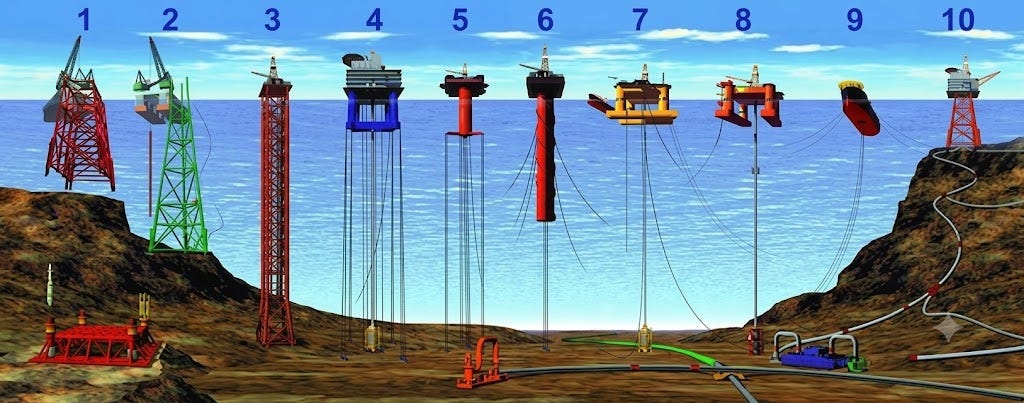
1) and 2) Conventional fixed platforms; 3) Compliant tower; 4) & 5) Vertically moored tension leg and minitension leg platform 6) Spar 7) and 8) Semi-submersibles 9) Floating production, storage, and offloading facility 10) Sub-sea completion and tie-back to host facility Note that jack-up drilling rigs, drillships, and gravity-based structures are not pictured here. Source: Review on Fixed and Floating Offshore Structures.
The most common and recognisable types are fixed platforms, which rest physically on the seabed, and floating platforms.
The former, known as ‘jacket platforms’, are supported by a large steel lattice structure that is anchored to the seabed. This substantial metal framework, reminiscent of a large pylon, is anchored to the seabed by means of piles driven into the seabed.

A jacket platform. Source: ScienceDirect
This type of platform is the easiest for non-specialists to understand because it looks like a land-based drilling rig simply transferred offshore. But this is an illusion: jacket platforms are immense structures, designed to withstand the tremendous forces generated by the sea and the wind.
The deck, known in technical terminology as the topside, comprises all the operational structures built above the supporting foundation. It houses the drilling equipment, production modules, cranes, crew accommodation, power generation and safety systems, as well as the helideck used for personnel transport.

A platform jacket loaded onto barge for shipment. Source: Azernews
The jackets are constructed on land, then loaded onto a ship or barge and finally lowered into the water in an operation that appears simple but is in fact extremely delicate

This is the way a jacket is launched. Source: Sarhan e Raslan, Offshore petroleum rigs/platforms.
[embed]Offshore Jacket Launch. Notice the workers beneath the structure: their size reveals the extraordinary scale of the platform as it slides into the water. Source: YouTube
While many offshore platforms rely on steel jackets as their supporting structure, others are built on massive reinforced-concrete caissons or cylinders, a solution adopted for some of the largest installations ever constructed.

Some of the largest offshore platforms, compared with the tallest buildings on land. Source: Review on Fixed and Floating Offshore Structures.
In contrast, floating platforms do not rest on the seabed; they are supported by large horizontal submerged hulls, from which enormous vertical columns rise to support the topside. The majority of the floating volume remains below sea level, which is why the platform appears to hover above the water, giving the impression of a miraculous apparition. Anchoring is carried out using chains, cables or dynamic positioning systems, without the structure resting on the seabed.

The Burghold Dolphin, a good example of semi-submersibles platform. Source: Marinetraffic.

Brasilian Platform P-51. Imagine by the author, created using ChatGPT.
At night, an offshore platform looks like an alien spacecraft adrift on the ocean. Photo by Dean Brierley on Unsplash
Within this group, there are also even more advanced platforms, which are used in particularly deep waters: these are SPARs, from the technical name for ‘stilted buoys’. As of 2026, there are 17 operational. These platforms, as the name suggests, are immense cylinders, over 150 metres long and with a diameter of thirty metres, which float vertically in the sea. A topside is built on top to house the machinery for drilling the seabed and extracting crude oil, as well as crew accommodation and auxiliary machinery.

The Perdido Spar Platform. Don’t be fooled: most of the structure is a gigantic cylinder extending vertically beneath the surface, completely hidden underwater. Source: Wikipedia
4 Their dimensions are colossal
It is important not to be misled by appearances: although the visible part of the structure appears relatively small, offshore platforms are enormous constructions, among the largest ever built by man.
During the construction phase, when they are still out of the water, their immense dimensions can be fully appreciated. Perhaps the most extraordinary of these was the TROLL A, built for Shell between 1991 and 1994 (it is now operated by Equinor) and completed in 1996.

Troll A platform. It already looks huge, doesn’t it? Well, take a look at the next photo… Source: Wikipedia
The appellation, evocative of the fabled colossi of Norse mythology, is in fact derived from the gas field bearing the same designation, situated approximately sixty kilometres west of the Norwegian coastline. The Troll field, which contains approximately 40 per cent of the total gas reserves on the Norwegian continental shelf (NCS), is of fundamental importance to Norwegian gas production.

The maps of some gas and oil fields offshore the Norwegian coast. The red area is the Troll field. Source: Norwegian Offshore Directorate
As with all offshore platforms, it is composed of two principal components: the topside and the base. The construction of both vessels was undertaken in Vats Fjord, a location characterised by exceptional shelter, approximately 200 km from their ultimate destination.
The structure consists of four substantial reinforced concrete cylinders, each exceeding three hundred metres in height, constructed utilising Condeep (concrete deep water structure) technology, a method that entails continuous concrete pouring. The cylinders, which are connected to one another at mid-height, are firmly anchored to the seabed by the simple force of gravity. They provide a foundation for the extraction facilities, crew accommodation and auxiliary machinery.

Troll A under construction. Continuous slip formed gravity-based structure supports under construction in a Norwegian fjord. The tower cranes delivered concrete to the support cylinders during the continuous pour of concrete to create seamless walls. Suorce: Wikimedia.
The structure is 472 metres in height and is considered to be the tallest object ever to have been moved. The total weight of the structure is 683,000 tonnes, a figure that increases to 1,366,000 tonnes when the seawater ballast in the lower part of the columns is also taken into account. The reinforced concrete base alone required approximately 245,000 cubic metres of concrete and almost 100,000 tonnes of reinforcing steel.

Inside one of Troll A’s giant concrete shafts. Source: Youtube
In order to withstand the immense pressure to which it is subjected, the walls of the cylinders are over a metre thick. The entire structure is designed to last for a minimum of 70 years. The cylinders were constructed in a fjord off the Norwegian coast and then transported to the oil field in a delicate week-long operation. The cylinders themselves were used as flotation devices. Subsequent to achieving the desired position, water was gradually pumped into the lower part of the cylinders. As the cylinders became heavier, they sank to the seabed, embedding themselves in the mud to a depth of tens of metres.
[embed]This remarkable animation by Erik Egaas shows how Troll A was built. Source: YouTube
5 A concert on the seabed
The cylinders of the Troll A are hollow and equipped for inspections. One of them even contains a lift, which takes 9 minutes to complete the journey.

Katie Melua performing during her concert 303 metres below sea level, inside one of Troll A’s massive concrete shafts. Source: Youtube
On 1 October 2006, the famous British singer Katie Melua and her band held a concert at the bottom of this cylinder, 303 metres below sea level, earning them a place in the Guinness World Records. The young singer (who was 22 at the time of the concert) and her bandmates, like everyone else, had to undergo rigorous safety training before boarding the platform.

Katie Melua emerging from the pool after completing the underwater escape training required for HUET certification. Source: BBC News
For the concert, 22 tonnes of musical equipment, including a piano and a drum kit, were transported to the Troll A using 16 helicopter trips and three support vessels. All the equipment was transferred to the bottom of the cylinder via the service lift and then set up as for a normal concert. The artist performed two concerts, each lasting 30 minutes, featuring her most famous songs, in front of an audience of twenty lucky technicians, each of whom had won a ticket. The performance was filmed by the Norwegian TV channel MRK.
[embed]The YouTube video shows Katie’s preparations, her arrival on the platform, and the concert itself. The clip begins at the 27-minute mark, with the singer’s anxious expression as she descends in the lift toward the seabed, fully aware that 300 metres of water lie above her. The next scene captures the moment she sees, for the first time, what can only be described as an underwater cathedral: the vast interior of one of Troll A’s concrete columns. Source: YouTube.
“This was definitely the most surreal gig I have ever done,” Melua said. We believe her!
6 They Drill with Diamonds
Most people believe that to drill an oil well on the seabed, all you need is the platform we see rising out of the water, which simply drills a hole in the seabed using a giant drill bit. In reality, things are a little more complicated than that.
The initial hole in the seabed is usually drilled by a **drillship **— a highly specialised vessel, up to two hundred metres long, designed exclusively for drilling wells. These vessels are capable of remaining stationary in the same spot with extreme precision thanks to an integrated system of computer-controlled engines and GPS sensors, and some of them, such as the Japanese Chikyū, can drill up to seven kilometres below the seabed. In 2011, the Transocean set the world water-depth record at 10,194 feet of water (3,107 metres).

Comparison of deepwater semi-submersible and drillship. Source: Wikipedia.
Only after the reservoir has been identified and deemed economically viable does this vessel make way for the actual production platform, whose task is no longer to drill, but to extract, separate and process oil and gas.
[embed]This animation explains some of the basic operating principles of a drilling rig that apply to all oil and gas wells in the first part, and then focuses on offshore platforms in the second. Source: YouTube
The actual borehole on the seabed is created using a drill bit attached to the end of a long string of steel pipes (drill string). Contrary to what one might imagine, the drill does not ‘dig’ into the seabed like a mechanical shovel.
The bit rotates at several tens or hundreds of revolutions per minute whilst being pushed downwards with a force that can reach several tens of tonnes.

PDC (Polycrystalline Diamond Cutter) Drill Bit. Photograph by Joshua Doubek, Wikipedia.
The modern tools used in offshore drilling are almost always of the PDC (Polycrystalline Diamond Compact) type: dozens of small inserts coated with synthetic diamond cut into the rock, removing tiny fragments with every rotation. Despite all this, the drill often advances by only a few metres per hour.
7 No Mud, No Drilling
A key element of the process is the drilling mud, a mixture of water or oil, clays and chemical additives. This fluid is pumped up through the drill pipes to the drill bit, flows out through special nozzles and rises up through the annulus — the ring-shaped space between the wellbore walls and the drill string. As it rises, it carries all the rock fragments produced by drilling to the surface.
[embed]This animation show as drilling mud works. Source: Wikipedia.
[embed]And this video shows the same process in the reality. Source: YouTube
However, the mud also performs other essential functions: it cools the drill bit, lubricates the tools, prevents the borehole walls from collapsing and, above all, exerts sufficient pressure to counteract that of the fluids present underground. Without this balance of pressures, oil or gas could surge violently up the well, causing a dangerous **blowout. The well itself is not drilled throughout to the same diameter. Work begins with a very large drill bit; a sturdy steel pipe (casing) is then inserted, cemented in place against the rock, and drilling continues with a smaller bit. The process is repeated several times, so that the well takes the form of a series of concentric pipes, each cemented inside the one before it**. It is this complex structure, rather than simply a hole in the rock, that ensures the well’s safety and durability for decades.
8 They’re Held in Place by Giant Screws
Offshore platforms are gigantic structures weighing hundreds of thousands of tonnes, yet during a powerful storm, the force of the sea and the wind could easily dislodge them, jeopardising the integrity of the pipe through which the crude oil rises.
It is of fundamental importance that platforms of all types remain virtually immobile relative to the seabed. This is achieved by using a whole series of special anchors.
The simplest are **drag anchors:** gigantic anchors, but essentially similar to those used on ordinary ships, which are placed on the seabed and then dragged by powerful tugboats; due to their flat shape, the flukes of the anchor dig into the seabed for many metres; at that point, to move them, one would also have to displace the enormous mass of sand and rock holding them in place.

During embedment, anchor design should focus on minimising soil resistance perpendicular to the embedment trajectory of the anchor, allowing for deeper embedment. Picture by Jeremy Lee UWA, Wikipedia..
In deep waters, however, the most widely used system today is the suction pile. This consists of a huge steel cylinder, open at the bottom, with a diameter that can exceed ten metres and a height of twenty or thirty metres. The cylinder is placed vertically on the seabed and the water inside it is then pumped out.

Suction pile installation. Source: Wikipedia
The hydrostatic pressure of the ocean then pushes the cylinder into the seabed as if it were a gigantic piston. No hammers or explosives are needed: the sea itself provides the necessary energy. Once driven into the seabed, the cylinder offers enormous resistance to both vertical pull and lateral forces.
Finally, in recent years, **helical piles** have also come into use. These are enormous piles fitted with one or more metal helical blades. The piles are rotated slowly and are literally screwed into the seabed, just like a corkscrew penetrating a cork.
[embed]
Giant chains, up to two or three kilometres long, are attached to the anchors; individual links can weigh as much as hundreds of kilograms
9 The blowout: the most serious danger
When a well is drilled, the drill bit often encounters formations containing oil under high pressure, sometimes exceeding 1,000 bar (1,000 times atmospheric pressure at ground level). It is this immense pressure that allows the oil to rise up the well and gush out in the ‘geyser’ so dear to the popular imagination.

This is the dramatic gush of oil that popular imagination usually associates with the moment an oil field is finally discovered. In reality, a blowout, as it is technically known, is a serious and often extremely dangerous event. Far from being good news, it represents a major problem for drilling engineers because of the enormous pressures involved. Here we see the Lucas Gusher at Spindletop, Texas (1901). Source: Wikipedia.
In reality, the uncontrolled rise of crude oil — the so-called blowout — poses an enormous danger to the platforms. Since 1956, 96 blowouts of varying severity have been recorded, such as the one at the Enchova Central oil rig in Brazil on 16 August 1984 (resulting in 42 deaths, six of whom died whilst attempting to save themselves by jumping into the sea from a height of 40 metres) or the infamous Deepwater Horizon incident in April 2010.
To prevent similar disasters, so-called **Blowout Preventers, universally abbreviated to BOP, are used. They can be fitted at the top of the well, but on floating platforms, they are mounted directly on the seabed**. Its purpose is to stop the excessive rise of drilling mud — known as a ‘kick’ — before it becomes dangerous, or to shut down the well by literally cutting the pipe and sealing it.
It is not simply a valve to be turned. The pressures involved are so great that much more powerful machinery is required, among the most complex ever designed by man. This equipment can be as tall as 15 metres and weigh 200 tonnes; it is connected to the platform independently via a steel pipe (the marine riser) up to 2,000 metres long, and incorporates numerous safety devices.
The first is the annular preventer: a ring of reinforced rubber which, when hydraulically inflated, can seal the space between the drill pipe and the wellbore, preventing the drilling mud from rising.
Then there are the ram preventers — actual jaws made of special steel, powered by nitrogen accumulators that can operate even without electricity — which can literally sever the drill pipe and seal it off to prevent the uncontrolled escape of crude oil.
10 Life on the platforms is similar to that on spaceships
From a distance, the offshore platforms look like gigantic steel structures anchored to the sea. For those who live there, however, they are above all an isolated human community, where the most sophisticated technology coexists with the deepest aspects of psychology: loneliness, adaptation, resilience and the profoundly human need to belong to a group.
The platforms are like worlds unto themselves. For weeks (sometimes two, three or four, depending on the contract ), the platform becomes the worker’s entire universe. The physical space is limited to a few hundred metres, the horizon is always the same, and separation from the rest of the world is almost absolute. You do not go home in the evening: you live, work, sleep and eat in the same place, always surrounded by the same people. Occupational psychologists refer to this condition as ‘environmental confinement’. The same phenomenon is studied in polar expeditions, Antarctic bases, submarines and even in spaceflight training programmes. Tabitha Lasley, who has gathered dozens of testimonies in the North Sea, observes that many workers end up living ‘two lives’: one offshore and one onshore, as if they belonged to two distinct worlds.
Offshore work requires being away from home and family for long periods of time. Most offshore facilities are not even within sight of land. They are self-contained communities where employees live, work, and often spend their time off.
Time loses some of its usual meaning. On many platforms, workers put in twelve-hour days, seven days a week, alternating between day and night shifts. There are no weekends, no Sundays and no public holidays. The days tend to blend into one another, marked almost exclusively by shift times, mealtimes and rest periods. Some workers describe the feeling of living in a sort of ‘time bubble’, from which they only re-emerge when the helicopter finally brings them back to land.
Bibliography
Tabitha Lasley, Sea State: A Memoir, Ecco, 2021.
Al Alvarez, Offshore: A North Sea Journey, Hodder & Stoughton Ltd, 1986. (available on Internet Archive).
Si, L., Zhou, S., Irakulis-Loitxate, I., Roger, J., and Guanter, L.: Building a dataset of offshore oil and gas extraction platforms from satellite data (2017–2023), Earth Syst. Sci. Data Discuss. [preprint], https://doi.org/10.5194/essd-2026-63, in review, 2026.
Spanier, R., Hoeser, T., Truckenbrodt, J., Bachofer, F., & Kuenzer, C., Offshore oil and gas platform dynamics in the North Sea, Gulf of Mexico, and Persian Gulf: exploiting the Sentinel-1 archive, in: Big Earth Data, June 15th 2026, p. 1–27. https://doi.org/10.1080/20964471.2026.2679328
Chiemela Victor Amaechi, Ahmed Reda, Harrison Obed Butler, Idris Ahmed Ja’e and Chen An, Review on Fixed and Floating Offshore Structures. Part I: Types of Platforms with Some Applications Journal of Marine Science and Engineering, 5 August 2022 (available here).
Osamah Sarhan, Mahdy Raslan, Offshore petroleum rigs/platforms: An overview of analysis, design, construction and installation, International Journal of Advanced Engineering, Sciences and Applications (IJAESA) Volume 2, Issue 1 (2021), Pages 7–12 (available here).
F. D. Konstandakopoulou, G. A. Papagiannopoulos, N. G. Pnevmatikos, G. D. Hatzigeorgiou, Seismic Hazard Assessment of Offshore Platforms, in: World Academy of Science, Engineering and Technology International Journal of Civil and Environmental Engineering Vol:13, No:5, 2019.
Kabir Sadeghi, An Overview of Design, Analysis, Construction and Installation of Offshore Petroleum Platforms Suitable for Cyprus Oil/Gas Fields, available on ResearchGate.
The Guardian, 28 October 2025, “The Piper Alpha oil rig exploded and collapsed — and I made a desperate 175ft jump into the sea” (available here).
*Living Offshore*, Second Edition, The University of Texas at Austin, PETROLEUM EXTENSION SERVICE
메타데이터
- post_id
- fb63ea3e41b1
- slug
- ten-things-almost-nobody-knows-about-offshore-oil-platforms-fb63ea3e41b1
- url
- https://medium.com/teatime-history/ten-things-almost-nobody-knows-about-offshore-oil-platforms-fb63ea3e41b1
- canonical_url
- https://medium.com/teatime-history/ten-things-almost-nobody-knows-about-offshore-oil-platforms-fb63ea3e41b1
- author_url
- https://medium.com/@martinosacchi60
- status
- ok
- fetched_at
- 2026-07-16 06:47:10