Every Thing about VUCA, BANI and RAAT
VUCA BANI RAAT
Every Thing about VUCA, BANI and RAAT
Introduction to VUCA
In an increasingly dynamic and interconnected world, organizations are confronted with challenges that demand new ways of thinking and operating.
The acronym VUCA — Volatility, Uncertainty, Complexity, and Ambiguity — encapsulates the multifaceted nature of contemporary environments. Originally coined in military contexts to describe unpredictable battlefield conditions, VUCA now serves as a framework for understanding the complexities faced by businesses and leaders today.
By recognizing and addressing these elements, organizations can develop more resilient strategies, enhance decision-making processes, and foster a culture of adaptability in the face of rapid change. Understanding VUCA is essential for navigating the complexities of the modern landscape and achieving sustainable success.

VUCA
1. Volatility
Volatility refers to the speed and magnitude of change within an environment. It indicates the unpredictable nature of events, which can have significant impacts on organizations. High volatility requires agile responses and adaptable strategies. Organizations must remain vigilant and prepared for sudden shifts.
2. Uncertainty
Uncertainty denotes the lack of predictability regarding future events and outcomes. In uncertain environments, decision-making becomes challenging due to insufficient information. This necessitates the development of flexible plans and contingency measures. Organizations must foster a culture of exploration and learning to navigate uncertainty effectively.
3. Complexity
Complexity encompasses the numerous interconnected factors that influence situations. It highlights the intricate relationships and dependencies that can complicate decision-making processes. Understanding complexity requires analytical skills and a holistic perspective. Organizations need to embrace systems thinking to manage and simplify complex challenges.
4. Ambiguity
Ambiguity refers to the vagueness and unclear nature of situations where multiple interpretations are possible. This can lead to confusion and indecision among stakeholders. Clarity is essential, as ambiguity complicates strategic planning and execution. Organizations must strive to establish clear communication and shared understanding to mitigate ambiguity.
How to Face with…
The key to addressing a VUCA environment is to adopt strategic management practices that help organizations navigate the dynamics of volatility, uncertainty, complexity, and ambiguity.
Some of the main solutions include:
- Fostering a Learning Organization: Organizations need to become “learning organizations” that are committed to continuous learning and adaptation. This involves encouraging co-creative and collaborative organizational learning, using systems thinking and design thinking approaches to be more reflexive.
- Embracing Agility: Agility is crucial to respond quickly to changes in a VUCA environment. Organizations need to combine long-term vision with short-term, focused, fast, and flexible decision-making. Agile leadership that can “pull several levers at the same time” is important.
- Thinking Outside the Box: Rather than relying solely on past experience, organizations need to be open to exploring the unknown, mapping new and changing surroundings, and being willing to be surprised. Creative problem-solving and contextual understanding are key.
- Developing Mitigation Strategies: For each element of VUCA, specific mitigation strategies can be employed:
- Volatility: Accept change, build in slack and flexibility.
- Uncertainty: Seek new perspectives, monitor key metrics, perform scenario planning.
- Complexity: Communicate clearly, encourage collaboration, identify areas needing more insight.
- Ambiguity: Perform tests to bring clarity, be prepared to change as more information emerges.
5. Applying OODA Loop: The OODA (Observe, Orient, Decide, Act) loop can be a useful framework for good decision-making in a VUCA environment.
The solution in a VUCA world requires organizations to become more agile, adaptive, and open to learning and exploration. By employing strategic management practices tailored to the unique challenges of volatility, uncertainty, complexity, and ambiguity, organizations can navigate the VUCA landscape more effectively.
References: [1][2][3] and also see : https://www.vuca-world.org/
These is some Examples…
Lets check the samples who successfully navigated a VUCA environment:
- Frontier Airlines: During the COVID-19 pandemic, Frontier Airlines focused on five key areas to tackle volatility — implementing zero-hour schedules to keep employees employed, communicating honestly with employees through frequent video updates from the CEO, and adopting a flexible and agile operating model. This allowed them to navigate the turbulent times .
- Best Buy: The electronics retailer reacted quickly to the pandemic by introducing contactless curbside pickup and experimenting with a hybrid e-commerce business model that uses smaller stores as online order fulfillment hubs. This allowed them to adapt to the uncertainty and complexity of the situation .
- Shopify: The e-commerce platform recognized that many of its small business clients were seeing increased local orders within 15 miles of their stores. Shopify responded by providing services to help these businesses with marketing, local pickups, and delivery optimization — turning the uncertainty into an advantage .
- Coca-Cola: Faced with growing complexity from its expansive product lines, Coca-Cola took decisive action to “ruthlessly prioritize” its core brands and eliminate over 475 products that made up only 2% of revenues. This streamlining allowed them to focus on higher-growth, stronger brands .
- Microsoft: Under CEO Satya Nadella’s leadership, Microsoft has navigated the VUCA environment by bringing clarity in uncertain times, remaining flexible and ready to adapt, and keeping a relentless focus on the customer. This has allowed Microsoft to thrive amidst volatility and complexity .
What is BANI?
BANI is a new framework that builds upon the VUCA (Volatile, Uncertain, Complex, Ambiguous) model to describe the current state of the world. Here’s a breakdown of the BANI framework:
- Brittle: The world has become more fragile and prone to sudden, unpredictable shocks that can have cascading, global effects. Systems that were once considered stable are now vulnerable to disruption.
- Anxious: Constant access to unsettling information and the unpredictable nature of events can lead to heightened feelings of anxiety, fear, and powerlessness among people and organizations.
- Non-linear: The relationships between cause and effect have become increasingly unclear and disproportionate. Minor issues can now have unfathomable and complex consequences that are difficult to anticipate.
- Incomprehensible: The scale and interconnectedness of global challenges have made the world increasingly difficult to fully understand. Events and occurrences are often illogical, unpredictable, and defy simple explanations.
Compared to the VUCA framework, BANI emphasizes the more chaotic, unpredictable, and anxiety-provoking nature of the current global environment. It highlights the need for leaders and organizations to develop new skills and strategies to navigate this new reality, such as increased resilience, adaptability, and the ability to thrive in the face of uncertainty.
And the solution is …
There is some key ways to turn VUCA (Volatility, Uncertainty, Complexity, and Ambiguity) into a company advantage, based on the search results from the vuca-world.org website:
Develop VUCA Thinking and Leadership :
- Foster a mindset of vision, understanding, clarity, and agility among leaders and employees.
- Encourage strategic thinking, anticipation of changes, and creative problem-solving.
- Empower people to handle uncertainty and adapt quickly to new situations.
Crystallize Your Future and Purpose :
- Clearly define your company’s vision, purpose, and strategic direction.
- Use this as a compass to navigate the VUCA environment and identify opportunities.
- Align your organization and people around this shared purpose.
Promote Transparency, Empowerment, and Collaboration :
- Ensure transparency around information, intentions, and the impact of your actions.
- Empower employees with the freedom, enablement, and ownership to take charge.
- Foster collaboration through knowledge sharing, flexible contribution, and continuous learning.
Build an Agile and Adaptive Culture :
- Shift away from traditional “command and control” management approaches.
- Develop a culture that embraces change, encourages experimentation, and learns from failures.
- Promote a mindset of flexibility, responsiveness, and continuous improvement.
Give Managers Permission to Discharge :
- Encourage managers to let go of outdated leadership behaviors and socialization.
- Foster a positive view of human nature and trust in employees to take responsibility.
- Invite employees to “lead their bosses” and contribute to the company’s success.
So companies can turn the challenges of VUCA into competitive advantages by cultivating a more agile, adaptive, and empowered organization that is better equipped to navigate uncertainty and complexity.
From VUCA to BANI
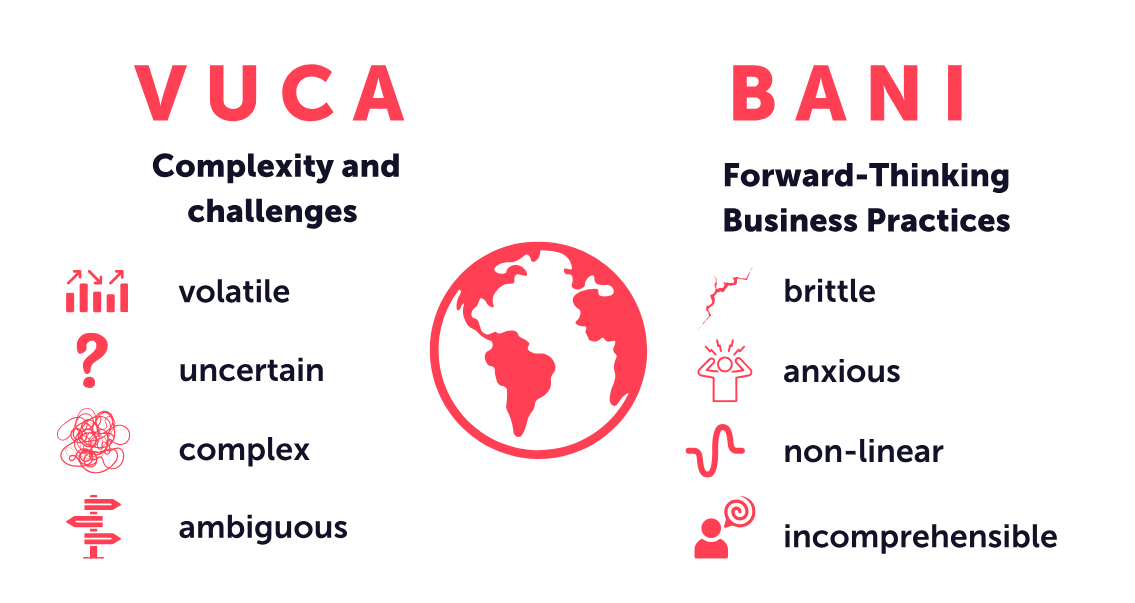
VUCA to BANI
To transition from a VUCA (Volatile, Uncertain, Complex, Ambiguous) world to a BANI (Brittle, Anxious, Non-linear, Incomprehensible) world, here are some key steps organizations can take:
Embrace Resilience and Adaptability:
- Develop the ability to quickly adapt to changing conditions and bounce back from disruptions.
- Encourage flexibility and agility within your teams to respond to the unpredictable nature of the BANI world.
Empower and Support Your Employees:
- Promote autonomy, responsibility, and self-efficacy among your team members to enhance their ability to adapt.
- Implement strategies to address employee anxiety, such as encouraging stress recovery, fostering empathy, and developing emotional intelligence.
- Provide the necessary resources and flexibility to accommodate diverse needs and promote work-life integration.
Enhance Situational Awareness and Planning:
- Closely monitor the external environment and be attentive to contextual changes.
- Develop data-driven planning processes that allow for continuous tracking and adaptation.
- Establish contingency plans to address potential disruptions and non-linear events.
Foster Collaboration and Transparency:
- Promote open communication and trust among team members to better understand the complex and incomprehensible nature of the BANI world.
- Encourage collaboration and knowledge-sharing to collectively navigate the challenges.
Invest in Employee Well-being and Development:
- Prioritize the physical and mental health of your employees to build resilience.
- Provide training and development opportunities to enhance their ability to anticipate, plan, react, and adapt to the ever-changing environment.
So organizations can better navigate the transition from a VUCA to a BANI world, becoming more resilient, adaptable, and prepared to seize new opportunities in the face of increased instability and unpredictability.
Can we survive with RAAT ?

RAAT can help resolve the challenges of the BANI (Brittle, Anxious, Non-linear, Incomprehensible) world:
Resilience: The BANI world is characterized by brittleness and fragility, where systems can suddenly collapse in unexpected ways. To address this, RAAT emphasizes the importance of building resilience — the ability to withstand shocks, adapt, and bounce back from adversity. This requires organizations and individuals to develop robust systems, diversify risks, and cultivate a culture of adaptability.
Attentiveness: The BANI world is marked by anxiety and uncertainty, where the future is difficult to predict. RAAT advocates for heightened attentiveness — the ability to closely monitor signals, trends, and emerging issues. This allows for early detection of potential problems and the agility to respond proactively before crises escalate.
Adaptation: The non-linear and incomprehensible nature of the BANI world demands constant adaptation. RAAT encourages organizations and individuals to continuously learn, experiment, and adjust their strategies and approaches. This nimble, iterative mindset is crucial for navigating the unpredictable challenges that arise.
Transparency: In a BANI world, where complexity and ambiguity reign, RAAT emphasizes the importance of transparency. By fostering open communication, sharing information, and promoting accountability, organizations and individuals can build trust, reduce anxiety, and enhance their collective understanding of the challenges they face.
By embracing the RAAT framework, individuals and organizations can develop the necessary capabilities to thrive in the BANI world. Resilience, attentiveness, adaptation, and transparency work together to help navigate the fragility, uncertainty, non-linearity, and incomprehensibility that characterize our modern era.
메타데이터
- post_id
- fb6858a73b0e
- slug
- every-thing-about-vuca-bani-and-raat-fb6858a73b0e
- url
- https://medium.com/@amirmj/every-thing-about-vuca-bani-and-raat-fb6858a73b0e
- canonical_url
- https://medium.com/@amirmj/every-thing-about-vuca-bani-and-raat-fb6858a73b0e
- author_url
- https://medium.com/@amirmj
- status
- ok
- fetched_at
- 2026-07-22 16:23:41